What is the Europe E-Commerce Logistics Market Size and Growth Rate?
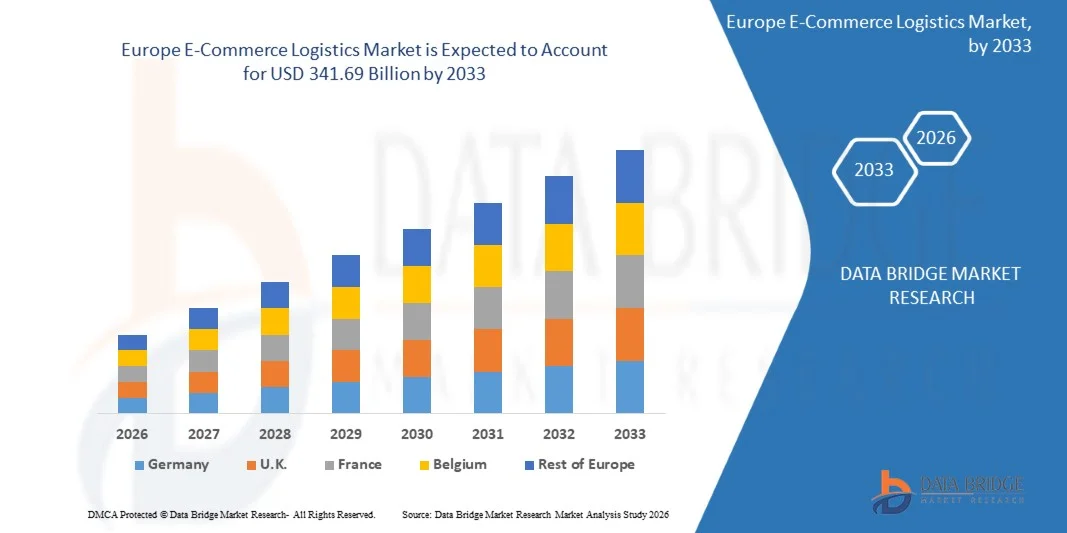
- As per Data Bridge Market Research analysis, the Europe e-commerce logistics market is valued at USD 100.70 billion in 2025 and is projected to reach USD 341.69 billion by 2033, growing at a CAGR of 16.50% from 2026 to 2033.
- The market registers strong growth driven by rapid growth in online shopping adoption, increasing urbanization, and rising consumer expectations for fast and transparent delivery services across the region.
- Expansion of cross-border e-commerce within the EU, growth of same-day and next-day delivery models, and rising investment in automation and digital logistics platforms fuel sustained market growth. Sustainability regulations, electric last-mile fleets, and expansion of reverse logistics networks reshape logistics operations across Europe, positioning automation-focused providers for long-term competitive advantage.
Market Size & Forecast
- Global Market Value (2025): USD 100.70 Billion
- Expected Market Value (2033): USD 341.69 Billion
- Forecast CAGR (2026–2033): 16.50%
- Leading Country in 2025: Germany
- Fastest Growing Country: Germany
What are the Major Takeaways of the Europe E-Commerce Logistics Market?
- Germany dominates the Europe e-commerce logistics market with the largest revenue share of 22.84% in 2025, driven by the country's central logistics infrastructure position, high e-commerce penetration, and strong presence of leading logistics providers, including DHL, DB Schenker, and Rhenus.
- Germany also registers the highest country-level CAGR of 17.30% from 2026 to 2033, driven by continued automation investment and expanding cross-border fulfillment capacity serving neighboring EU markets.
- The transportation segment leads the service type category, generating the largest and fastest-growing revenue segment within the region's e-commerce logistics value chain, with a CAGR of 17.10% from 2026 to 2033.
- The fashion & apparel segment dominates the end-use industry category, driven by high parcel volumes and frequent returns processing across European fashion retailers, with a 24.71% share in 2025.
- The road segment leads the mode of operation category, reflecting its continued position as the dominant transportation mode across the region's dense road network, with a 61.43% share in 2025.
- The next-day delivery segment dominates the delivery type category, reflecting established consumer expectations across major European e-commerce markets, with a 42.18% share in 2025.
- The semi-automated segment leads the automation level category, while fully automated fulfillment centers register the fastest growth, driven by processing speeds up to three times faster than manual methods, with semi-automated systems accounting for CAGR of 19.12% from 2026 to 2033.
Report Scope and Europe E-Commerce Logistics Market Segmentation
|
Attributes |
Europe E-Commerce Logistics Key Market Insights |
|
Segments Covered |
|
|
Countries Covered |
Western Europe
Southern Europe
Northern Europe
Eastern Europe
|
|
Key Market Players |
|
|
Market Opportunities |
|
|
Value Added Data Infosets |
In addition to the market insights such as market value, growth rate, market segments, geographical coverage, market players, and market scenario, the market report curated by the Data Bridge Market Research team includes in-depth expert analysis, import/export analysis, pricing analysis, production consumption analysis, and pestle analysis. |
What is the Key Trend in the Europe E-Commerce Logistics Market?
- Leading logistics providers continue to invest heavily in warehouse automation and robotics to expand contract logistics capacity across the region.
- In July 2025, DHL Supply Chain announced a USD 775.5 million investment to expand its infrastructure and accelerate automation rollout across customer operations in the U.K. and Ireland, building on €1 billion already invested in automation over the preceding three years and including the first UK deployment of Boston Dynamics' Stretch robots.
- Contract logistics providers continue to expand their fulfillment networks through strategic partnerships with major European retailers.
- In June 2023, GXO Logistics signed a partnership agreement with Zalando for a new, automated fulfillment center in Montereau-sur-le-Jard near Paris, France, alongside announcing a multiyear expansion program in Germany the same month.
- Leading providers continue to pursue acquisitions that expand geographic reach and e-commerce fulfillment capabilities across the region.
- In March 2024, GXO Logistics extended a takeover offer for Wincanton PLC, a leading U.K. logistics company, following its October 2023 acquisition of PFSweb, Inc., a tech-enabled e-commerce order fulfillment platform, to expand its presence across North America and Europe.
- As leading providers continue to invest in automation, expand strategic retailer partnerships, and pursue acquisitions that strengthen fulfillment capacity, the Europe e-commerce logistics market sustains strong growth across both mature Western European markets and rapidly digitizing Eastern European economies.
What are the Key Drivers of the Europe E-Commerce Logistics Market?
- Rapid growth in online shopping adoption and rising consumer expectations for fast, transparent delivery continue to drive sustained investment in e-commerce logistics infrastructure across Europe.
- In July 2025, DHL Supply Chain's USD 775.5 million U.K. and Ireland automation investment illustrates the scale of capital deployment underway across the region to meet growing e-commerce and life sciences sector demand.
- Expansion of cross-border e-commerce within the EU continues to drive demand for integrated, multi-country logistics and fulfilment networks.
- The June 2023 GXO-Zalando partnership for an automated fulfilment center near Paris, alongside GXO's simultaneous German expansion program, illustrates the region's continued investment in cross-border e-commerce fulfilment capacity.
- Growing investment in automation and digital logistics platforms continues to improve order fulfillment capacity and processing speed across the industry.
- Automated warehouse systems demonstrate processing speeds up to three times faster than manual methods, directly influencing order fulfillment capacity and driving continued automation investment across major logistics providers.
With online shopping adoption continuing to expand and leading providers continuing to invest in automation and cross-border fulfillment capacity, the Europe e-commerce logistics market remains a high-growth category within the broader European logistics and supply chain landscape.
Which Factors are Challenging the Growth of the Europe E-Commerce Logistics Market?
- High cost of operation and competitive pricing pressure constrain profitability across the fragmented European logistics provider landscape.
- In February 2026, Geopost reported that its 2025 operating profit was impacted by intense competitive pressure, persistent pricing constraints, and sustained cost inflation, highlighting the continued margin pressure across the European parcel and logistics sector.
- Transportation infrastructure, including airways, railways, and multi-modal systems, requires substantial modernization investment to support better regional connectivity and capacity expansion.
- Rising volumes create catalysts for operational restructuring during periods of slower demand growth, prompting logistics providers to re-evaluate warehouse network strategies and automation investment priorities.
- Sustainability regulations under the EU Green Deal require logistics providers to transition toward electric last-mile fleets and lower-emission freight modes, adding compliance and capital investment requirements across the industry.
- In March 2026, the Council of the European Union adopted targeted flexibility for heavy-duty vehicle manufacturers while retaining long-term CO₂ reduction targets, with the Council noting that the slow deployment of public charging infrastructure along motorways remains a structural challenge for the transition toward zero-emission mobility.
- The combination of high operational costs, competitive pricing pressure, transportation infrastructure modernization requirements, and EU sustainability compliance obligations continues to create headwinds for the Europe e-commerce logistics market, even as sustained e-commerce growth supports long-term category expansion.
How is the Europe E-Commerce Logistics Market Segmented?
The Europe e-commerce logistics market is segmented on the basis of service type, mode of operation, delivery type, end-use industry, business model, automation level, and enterprise size.
- By Service Type
On the basis of service type, the Europe e-commerce logistics market is segmented into transportation, warehousing & fulfillment, last-mile delivery, reverse logistics, and value-added services. The transportation segment dominates the market, generating the largest revenue share of 38.26% in 2025, reflecting its position as the most lucrative and largest revenue-generating service type across the region's e-commerce logistics value chain.
The transportation segment also registers the fastest CAGR of 17.10% from 2026 to 2033, driven by expanding cross-border e-commerce within the EU and rising parcel volumes across the region's road, rail, air, and sea freight networks.
- By Mode of Operation
On the basis of mode of operation, the Europe e-commerce logistics market is segmented into road, rail, air, and sea. The road segment dominates the market with the largest share of 61.43% in 2025, reflecting its continued position as the dominant transportation mode for e-commerce activities across the region's dense and well-connected road network.
The rail segment registers the fastest CAGR of 18.24% from 2026 to 2033, driven by EU sustainability mandates favoring lower-emission freight modes and continued modernization of cross-border rail freight infrastructure.
- By Delivery Type
On the basis of delivery type, the Europe e-commerce logistics market is segmented into same-day delivery, next-day delivery, and standard delivery. The next-day delivery segment dominates the market with the largest share of 42.18% in 2025, reflecting established consumer expectations for rapid fulfillment across major European e-commerce markets.
The same-day delivery segment registers the fastest CAGR of 18.63% from 2026 to 2033, driven by rising urban e-commerce penetration and expanding dark store and micro-fulfillment center networks across major metropolitan areas.
- By End-Use Industry
On the basis of end-use industry, the Europe e-commerce logistics market is segmented into fashion & apparel, electronics, home & furniture, food & grocery, health & beauty, and others. The fashion & apparel segment dominates the market with the largest share of 24.71% in 2025, driven by high parcel volumes, frequent returns processing, and strong omnichannel retail integration across European fashion brands.
The food & grocery segment registers the fastest CAGR of 18.11% from 2026 to 2033, driven by rapid expansion of quick-commerce grocery delivery platforms across major European cities.
- By Business Model
On the basis of business model, the Europe e-commerce logistics market is segmented into B2C, B2B, and C2C. The B2C segment dominates the market with the largest share of 68.42% in 2025, reflecting the fundamental structure of online retail logistics across the region's e-commerce ecosystem.
The C2C segment registers the fastest CAGR of 18.47% from 2026 to 2033, driven by expanding peer-to-peer resale and second-hand marketplace platforms across Europe.
- By Automation Level
On the basis of automation level, the Europe e-commerce logistics market is segmented into manual, semi-automated, and fully automated. The semi-automated segment dominates the market with the largest share of 47.36% in 2025, reflecting the current state of most fulfillment centers, where automated systems handle a portion of processing alongside manual labor.
The fully automated segment registers the fastest CAGR of 19.12% from 2026 to 2033, driven by automated systems demonstrating processing speeds up to three times faster than manual methods, directly influencing order fulfillment capacity investment decisions.
- By Enterprise Size
On the basis of enterprise size, the Europe e-commerce logistics market is segmented into large enterprises and small & medium enterprises (SMEs). The large enterprises segment dominates the market with the largest share of 64.85% in 2025, reflecting the scale of logistics spend outsourced by major European and global retailers to third-party and fourth-party logistics providers.
The small & medium enterprises (SMEs) segment registers the fastest CAGRof 18.02% from 2026 to 2033, driven by growing SME access to shared fulfillment infrastructure and outsourced logistics platforms.
Which Country Holds the Largest Share of the Europe E-Commerce Logistics Market?
- Germany dominates the Europe e-commerce logistics market and accounts for the largest revenue share of 22.84% in 2025, driven by the country's central logistics infrastructure position, extensive fulfillment center network, and strong presence of leading providers, including DHL, DB Schenker, and Rhenus.
- The country benefits from its strategic geographic position at the crossroads of major European trade routes, extensive rail and road freight infrastructure, and continued warehouse automation investment. Continued expansion of cross-border fulfillment capacity reinforces Germany's leadership position in the regional market.
Germany E-Commerce Logistics Market Insight
The Germany e-commerce logistics market remains anchored by the country's central position within European trade networks and its extensive fulfillment center infrastructure. In June 2023, GXO Logistics announced a multiyear expansion program in Germany, supporting the expansion of its logistics operations and fulfillment capabilities in the country. Alongside continued warehouse automation investment by TGW Logistics Group, these developments reinforce Germany's position as a major e-commerce logistics hub in Europe, supported by its extensive road and rail infrastructure, high concentration of logistics facilities, and role as a gateway to neighboring European markets.
U.K. E-Commerce Logistics Market Insight
The U.K. e-commerce logistics market benefits from significant automation investment, highlighted by DHL Supply Chain's July 2025 announcement of a £550 million investment to expand infrastructure and accelerate automation rollout across U.K. and Ireland operations. In July 2025, DHL Supply Chain announced the investment to strengthen its warehousing and logistics infrastructure and deploy additional automation technologies across its U.K. and Ireland network. In addition, in March 2024, GXO Logistics announced its recommended cash offer for Wincanton PLC, strengthening its position in the U.K. logistics market and expanding its exposure to retail and e-commerce supply chains. These developments reflect continued investment in fulfillment capacity, automation, and logistics network consolidation across the U.K.
France E-Commerce Logistics Market Insight
The France e-commerce logistics market continues to grow steadily, supported by increasing investment in automated fulfillment infrastructure and the country's large consumer market. In June 2023, GXO Logistics announced a partnership with Zalando to operate a new automated fulfillment center in Montereau-sur-le-Jard near Paris. The facility supports Zalando's European fulfillment network and demonstrates continued investment in automated e-commerce processing capacity in France. The country's strategic location within Western Europe, established road and rail connectivity, and proximity to major consumer markets further support demand for fulfillment and distribution services.
Netherlands E-Commerce Logistics Market Insight
The Netherlands e-commerce logistics market benefits from the country's position as a major European logistics gateway, supported by strong port, road, rail, and distribution infrastructure serving cross-border e-commerce flows across the broader EU market. In June 2025, the Port of Rotterdam Authority reported continued investment in logistics infrastructure and digitalization to strengthen the port's position within European supply chains. Rotterdam's extensive connectivity with European inland markets, combined with the country's concentration of distribution centers and access to major consumer markets, supports the Netherlands' role as an important fulfillment and distribution location for e-commerce logistics providers.
Poland E-Commerce Logistics Market Insight
The Poland e-commerce logistics market registers strong growth, driven by expanding fulfillment center investment across the country, including large-scale omnichannel distribution hubs serving both domestic and cross-border European e-commerce demand. In September 2024, Amazon announced the opening of its new fulfillment center in Łódź, Poland, adding significant logistics and fulfillment capacity to support customer demand in Poland and across European markets. The country's strategic location between Western and Eastern Europe, comparatively extensive logistics real-estate pipeline, and improving road infrastructure continue to support investment in fulfillment centers and regional distribution hubs. Poland's growing role as a cross-border fulfillment location also strengthens its importance within the broader European e-commerce logistics network.
Which are the Top Companies in the Europe E-Commerce Logistics Market?
The Europe e-commerce logistics industry is primarily led by well-established logistics and supply chain companies, including:
- Deutsche Post DHL Group (Germany)
- Kuehne+Nagel International AG (Switzerland)
- DSV A/S (Denmark)
- GXO Logistics, Inc. (U.S.)
- CEVA Logistics SA (France)
- Geodis SA (France)
- DB Schenker (Germany)
- Rhenus SE & Co. KG (Germany)
- Hermes Germany GmbH (EVRi) (Germany)
- InPost S.A. (Poland)
- GLS (General Logistics Systems) (Germany)
- FedEx Corporation (U.S.)
- United Parcel Service, Inc. (U.S.)
- Amazon Logistics (Amazon.com, Inc.) (U.S.)
- bpost SA/NV (Belgium)
- PostNL N.V. (Netherlands)
- Royal Mail plc (U.K.)
- DPDgroup (La Poste) (France)
- Wincanton plc (GXO Logistics) (U.K.)
- TGW Logistics Group GmbH (Austria)
What are the Latest Developments in the Europe E-Commerce Logistics Market?
- In July 2025, DHL Supply Chain announced a USD 775.5 million investment to expand infrastructure and accelerate automation rollout across UK and Ireland operations, including the first UK deployment of Boston Dynamics' Stretch robots.
- In March 2025, GXO Logistics partnered with Exotec to automate Guess's European fulfillment operation, combining Skypod robots with 60,000 storage locations across a distribution center serving Guess stores across Europe, the Middle East, Africa, and Asia.
- In March 2024, GXO Logistics extended a takeover offer for Wincanton PLC, a leading U.K. logistics company, expanding its contract logistics footprint in the region.
- In October 2023, GXO Logistics acquired PFSweb, Inc., a tech-enabled e-commerce order fulfillment platform, expanding its presence across North America and Europe.
- In June 2023, GXO Logistics signed a partnership agreement with Zalando for a new automated fulfillment center in Montereau-sur-le-Jard near Paris, France, alongside announcing a multiyear expansion program in Germany.

- Interactive Data Analysis Dashboard
- Company Analysis Dashboard for high growth potential opportunities
- Research Analyst Access for customization & queries
- Competitor Analysis with Interactive dashboard
- Latest News, Updates & Trend analysis
- Harness the Power of Benchmark Analysis for Comprehensive Competitor Tracking
Data collection and base year analysis are done using data collection modules with large sample sizes. The stage includes obtaining market information or related data through various sources and strategies. It includes examining and planning all the data acquired from the past in advance. It likewise envelops the examination of information inconsistencies seen across different information sources. The market data is analysed and estimated using market statistical and coherent models. Also, market share analysis and key trend analysis are the major success factors in the market report. To know more, please request an analyst call or drop down your inquiry.
The key research methodology used by DBMR research team is data triangulation which involves data mining, analysis of the impact of data variables on the market and primary (industry expert) validation. Data models include Vendor Positioning Grid, Market Time Line Analysis, Market Overview and Guide, Company Positioning Grid, Patent Analysis, Pricing Analysis, Company Market Share Analysis, Standards of Measurement, Global versus Regional and Vendor Share Analysis. To know more about the research methodology, drop in an inquiry to speak to our industry experts.
Data Bridge Market Research is a leader in advanced formative research. We take pride in servicing our existing and new customers with data and analysis that match and suits their goal. The report can be customized to include price trend analysis of target brands understanding the market for additional countries (ask for the list of countries), clinical trial results data, literature review, refurbished market and product base analysis. Market analysis of target competitors can be analyzed from technology-based analysis to market portfolio strategies. We can add as many competitors that you require data about in the format and data style you are looking for. Our team of analysts can also provide you data in crude raw excel files pivot tables (Fact book) or can assist you in creating presentations from the data sets available in the report.