


Global Smart Nitric Oxide (NOx) Sensors Market, By Type (Aluminum, Plastic), Application (Powertrain, Body Electronics, Vehicle Security System, Safety and Control, Telematics, Others), Sales Channel (OEM, Aftermarket), Country (U.S., Canada, Mexico, Brazil, Argentina, Rest of South America, Germany, France, Italy, U.K., Belgium, Spain, Russia, Turkey, Netherlands, Switzerland, Rest of Europe, Japan, China, India, South Korea, Australia, Singapore, Malaysia, Thailand, Indonesia, Philippines, Rest of Asia-Pacific, U.A.E, Saudi Arabia, Egypt, South Africa, Israel, Rest of Middle East and Africa)- Industry Trends and Forecast to 2029
Market Analysis and Insights of Smart Nitric Oxide (NOx) Sensors Market
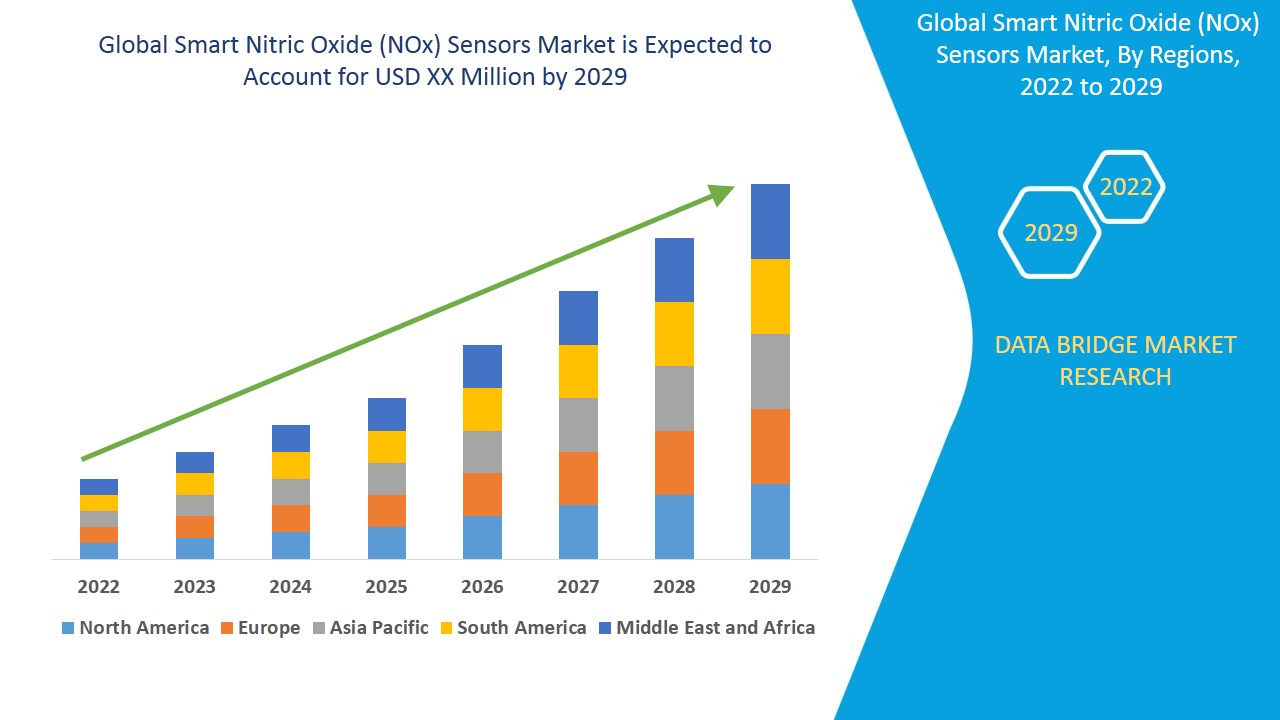
Smart nitric oxide (NOx) sensors market is expected to gain market growth in the forecast period of 2022 to 2029. Data Bridge Market Research analyses the smart nitric oxide (NOx) sensors market to exhibit a CAGR of 19.3% for the forecast period of 2022 to 2029.
Nitric Oxide (NOx) is basically a high temperature system which is utilized to detect nitrogen oxides in the combustion environment. They generally possess the ability to calculate the density of nitrogen oxide in exhaust gas. They are widely used in application such as safety and control, telematics, vehicle security system and other.
The increasing demand for smart nitrogen oxide (NOx) sensors in safety and control will emerge as the major factor driving market growth. Furthermore, the government is also taking many initiatives to decrease the emission and pollution coupled with the rising demand for smart Nitrogen Oxide (NOx) sensors has increased specifically in the applications like safety and controls, powertrain and alternative fuel vehicles will further aggravate the market value. The increasing environmental concern among population is expected to boost the overall growth of the market. However, high manufacturing and raw material cost are projected to act as a restraint for the market.
In addition to this, growing research and development and rising adoption of these types of sensors in automotive industry are estimated to create new opportunities for growing the market within the forecast period. The slowdown in production due to COVID-19 is expected to result as a challenge for the market.
This smart nitric oxide (NOx) sensors market report provides details of new recent developments, trade regulations, import export analysis, production analysis, value chain optimization, market share, impact of domestic and localized market players, analyses opportunities in terms of emerging revenue pockets, changes in market regulations, strategic market growth analysis, market size, category market growths, application niches and dominance, product approvals, product launches, geographical expansions, technological innovations in the market. To gain more info on smart nitric oxide (NOx) sensors market contact Data Bridge Market Research for an Analyst Brief, our team will help you take an informed market decision to achieve market growth.
Global Smart Nitric Oxide (NOx) Sensors Market Scope and Market Size
The smart nitric oxide (NOx) sensors market is segmented on the basis of type, application and sales channel. The growth amongst the different segments helps you in attaining the knowledge related to the different growth factors expected to be prevalent throughout the market and formulate different strategies to help identify core application areas and the difference in your target market.
- On the basis type, the smart NOx sensors market is segmented into aluminium and plastics.
- Smart NOx sensors market on the basis of application is divided into powertrain, vehicle security system, safety and control, telematics, body electronics and other.
- Smart NOx sensors market is also segment on the basis of sales channel. The sales channel is segmented into OEM and aftermarket.
Smart Nitric Oxide (NOx) Sensors Market Country Level Analysis
The smart nitric oxide (NOx) sensors market is analyzed and market size, volume information is provided by type, application and sales channel as referenced above.
The countries covered in the smart nitric oxide (NOx) sensors market report are U.S., Canada and Mexico in North America, Germany, France, U.K., Netherlands, Switzerland, Belgium, Russia, Italy, Spain, Turkey, Rest of Europe in Europe, China, Japan, India, South Korea, Singapore, Malaysia, Australia, Thailand, Indonesia, Philippines, Rest of Asia-Pacific (APAC) in the Asia-Pacific (APAC), Saudi Arabia, U.A.E, Israel, Egypt, South Africa, Rest of Middle East and Africa (MEA) as a part of Middle East and Africa (MEA), Brazil, Argentina and Rest of South America as part of South America.
North America region dominates the smart nitric oxide (NOx) sensors market due to growing industrialization and supportive governmental policies in the region. Asia-Pacific region is projected to undergo substantial during the forecast period owing to the rising proliferation of consumer electronics.
The country section of the smart nitric oxide (NOx) sensors market report also provides individual market impacting factors and changes in regulation in the market domestically that impacts the current and future trends of the market. Data points such as consumption volumes, production sites and volumes, import export analysis, price trend analysis, cost of raw materials, down-stream and upstream value chain analysis are some of the major pointers used to forecast the market scenario for individual countries. Also, presence and availability of global brands and their challenges faced due to large or scarce competition from local and domestic brands, impact of domestic tariffs and trade routes are considered while providing forecast analysis of the country data.
Competitive Landscape and Smart Nitric Oxide (NOx) Sensors Market Share Analysis
The smart nitric oxide (NOx) sensors market competitive landscape provides details by competitor. Details included are company overview, company financials, revenue generated, market potential, investment in research and development, new market initiatives, global presence, production sites and facilities, production capacities, company strengths and weaknesses, product launch, product width and breadth, application dominance. The above data points provided are only related to the companies’ focus related to smart nitric oxide (NOx) sensors market.
Some of the major players operating in the smart nitric oxide (NOx) sensors market report are Continental AG, Robert Bosch GmbH, HORIBA, Ltd., NGK INSULATORS, LTD., 3M, ABB, Thermo Fisher Scientific Inc., Honeywell International Inc., Robert Bosch GmbH, Eaton., Siemens, Figaro Engineering Inc., Membrapor, Alphasense, Nemoto & Co., Ltd., MEMSIC Semiconductor (Tianjin) Co., Ltd. (c)., Drägerwerk AG & Co. KGaA, Yokogawa Electric Corporation, Emerson Electric Co., STMicroelectronics, Infineon Technologies AG, TE Connectivity and Teledyne Technologies Incorporated among others.
SKU-
Obtenha acesso online ao relatório sobre a primeira nuvem de inteligência de mercado do mundo

- Painel interativo de análise de dados
- Painel de análise da empresa para oportunidades de elevado potencial de crescimento
- Acesso de analista de pesquisa para personalização e customização. consultas
- Análise da concorrência com painel interativo
- Últimas notícias, atualizações e atualizações Análise de tendências
- Aproveite o poder da análise de benchmark para um rastreio abrangente da concorrência
Metodologia de Investigação
A recolha de dados e a análise do ano base são feitas através de módulos de recolha de dados com amostras grandes. A etapa inclui a obtenção de informações de mercado ou dados relacionados através de diversas fontes e estratégias. Inclui examinar e planear antecipadamente todos os dados adquiridos no passado. Da mesma forma, envolve o exame de inconsistências de informação observadas em diferentes fontes de informação. Os dados de mercado são analisados e estimados utilizando modelos estatísticos e coerentes de mercado. Além disso, a análise da quota de mercado e a análise das principais tendências são os principais fatores de sucesso no relatório de mercado. Para saber mais, solicite uma chamada de analista ou abra a sua consulta.
A principal metodologia de investigação utilizada pela equipa de investigação do DBMR é a triangulação de dados que envolve a mineração de dados, a análise do impacto das variáveis de dados no mercado e a validação primária (especialista do setor). Os modelos de dados incluem grelha de posicionamento de fornecedores, análise da linha de tempo do mercado, visão geral e guia de mercado, grelha de posicionamento da empresa, análise de patentes, análise de preços, análise da quota de mercado da empresa, normas de medição, análise global versus regional e de participação dos fornecedores. Para saber mais sobre a metodologia de investigação, faça uma consulta para falar com os nossos especialistas do setor.
Personalização disponível
A Data Bridge Market Research é líder em investigação formativa avançada. Orgulhamo-nos de servir os nossos clientes novos e existentes com dados e análises que correspondem e atendem aos seus objetivos. O relatório pode ser personalizado para incluir análise de tendências de preços de marcas-alvo, compreensão do mercado para países adicionais (solicite a lista de países), dados de resultados de ensaios clínicos, revisão de literatura, mercado remodelado e análise de base de produtos . A análise de mercado dos concorrentes-alvo pode ser analisada desde análises baseadas em tecnologia até estratégias de carteira de mercado. Podemos adicionar quantos concorrentes necessitar de dados no formato e estilo de dados que procura. A nossa equipa de analistas também pode fornecer dados em tabelas dinâmicas de ficheiros Excel em bruto (livro de factos) ou pode ajudá-lo a criar apresentações a partir dos conjuntos de dados disponíveis no relatório.











