



Global Smart Utilities Market, By Components (Hardware, Software, and Services), Technology (Wired and wired-less), Applications (Meter Hardware, Communications and Networking, Power Quality Equipment, and Technologies) - Industry Trends and Forecast to 2031.
Smart Utilities Market Analysis and Size
Smart Utilities refer to gas, electric, and water companies that utilize connected sensors throughout their grids to analyze operations and increase the efficiency of service delivery. Smart utilities employ the Internet of Things (IoT) approach to connect all devices and integrate new digital technologies to streamline business operations. In the smart grid technology market, advancements continually enhance efficiency, reliability, and sustainability. These innovations offer benefits such as optimized energy distribution, real-time monitoring, and improved integration of renewable sources. With evolving technologies such as IoT and AI, smart grids promise to revolutionize energy management, paving the way for a more resilient and eco-friendly energy infrastructure.
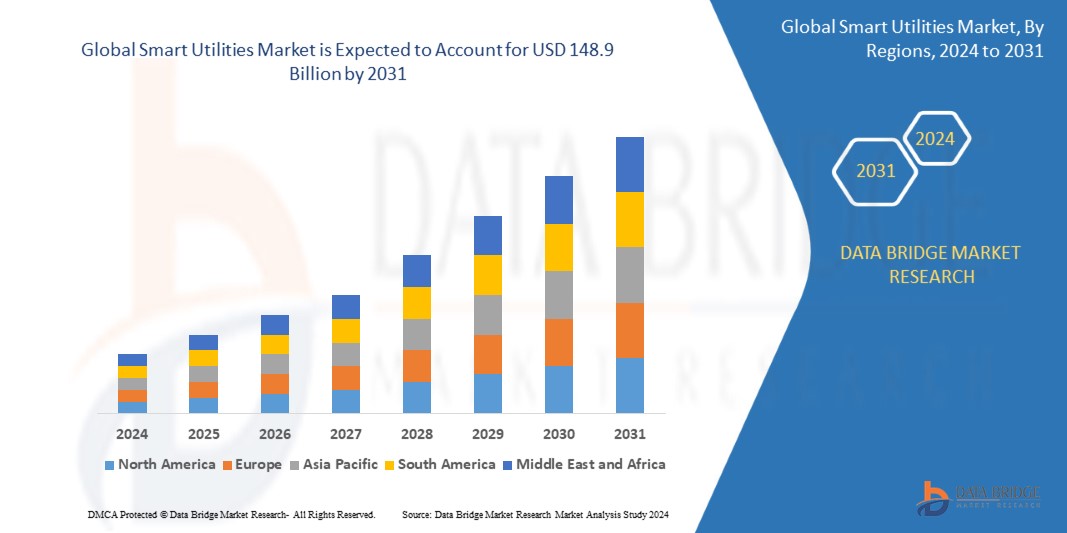
Global Smart Utilities Market was valued at USD 50.03 billion in 2023 and is expected to reach USD 148.9 billion by 2031, registering a CAGR of 12.9% during the forecast period of 2024-2031. In addition to the market insights such as market value, growth rate, market segments, geographical coverage, market players, and market scenario, the market report curated by the Data Bridge Market Research team also includes in-depth expert analysis, import/export analysis, pricing analysis, production consumption analysis, and pestle analysis.
Report Scope and Market Segmentation
|
Report Metric |
Details |
|
Forecast Period |
2024-2031 (Customizable to 2016-2021) |
|
Base Year |
2022 |
|
Historic Years |
2021 |
|
Quantitative Units |
Revenue in USD Billion, Volume in Units, Pricing in USD |
|
Segments Covered |
Components (Hardware, Software, and Services), Technology (Wired and wired-less), Applications (Meter Hardware, Communications and Networking, Power Quality Equipment, and Technologies) |
|
Countries Covered |
U.S., Canada, Mexico, Brazil, Argentina, Rest of South America, Germany, Italy, U.K., France, Spain, Netherlands, Belgium, Switzerland, Turkey, Russia, Rest of Europe, Japan, China, India, South Korea, Australia, Singapore, Malaysia, Thailand, Indonesia, Philippines, Rest of Asia-Pacific, Saudi Arabia, U.A.E, South Africa, Egypt, Israel, and Rest of the Middle East and Africa |
|
Market Players Covered |
General Electric (U.S.), ABB (Switzerland), Siemens (Germany), Schneider Electric (France), Itron Inc. (U.S.), Cisco Systems, Inc. (U.S.), IBM (U.S.), Oracle (U.S.), Honeywell International (U.S.), Eaton (US.), Tech Mahindra Limited. (India), Tantalus (Canada), Mitsubishi Electric Corporation (Japan), SAP (Germany), Wipro (India), Trilliant Holdings Inc. (U.S.), Globema (Poland), Kamstrup (Denmark), Xylem. (U.S.), Enel X S.r.l. (Italy), eSMART Technologies SA (Norway), Esyasoft (India), Grid4C (U.S.), C3.ai, Inc. (U.S.), and Networked Energy Services. (U.S.) |
|
Market Opportunities |
|
Market Definition
Smart utilities integrates digital communication and advanced analytics into traditional electrical grids, enhancing efficiency, reliability, and sustainability. Enabling bidirectional communication between utilities and consumers optimizes energy distribution, monitors grid performance in real-time, and accommodates renewable energy sources. Smart grids empower users with data-driven insights, promoting energy conservation and cost savings.
Global Smart Utilities Market Dynamics
Drivers
- Rising Grid Reliability and Resilience
Smart grids bolster power system reliability and resilience through real-time monitoring, and swift outage response. For instance, advanced sensors detect anomalies in electricity flow, enabling proactive maintenance to prevent potential failures. Additionally, automated systems swiftly pinpoint and isolate faults, rerouting power to minimize service disruptions. These capabilities ensure uninterrupted power supply, even during adverse conditions, bolstering grid resilience and customer satisfaction.
- Growing Electric Vehicle (EV) Integration
The surge in the adoption of EV requires smart charging infrastructure and grid management solutions. These technologies accommodate rising electricity demand and optimize charging schedules. Through intelligently managing EV charging, they mitigate strain on the grid during peak periods, promoting efficiency and reliability in the transition to widespread electric transportation.
Opportunities
- Data Analytics and IoT Integration
Smart grid tech leverages advanced data analytics, machine learning, and IoT devices to analyze energy usage patterns, optimize grid operations, and forecast maintenance requirements for improved efficiency and reliability. For instance, by utilizing real-time data from smart meters and sensors, utilities can identify peak demand periods, optimize energy distribution, and proactively address potential system failures, resulting in significant cost savings and operational efficiencies.
- Initiatives for Grid Modernization
Governments and utilities globally are investing in grid modernization to upgrade aging infrastructure, boost grid security, and comply with evolving regulations. This commitment drives the adoption of smart grid technologies, facilitating real-time monitoring, predictive maintenance, and efficient energy management. Such initiatives are crucial for ensuring reliable, resilient, and sustainable power systems in the modern era.
Restraints/Challenges
- High Initial Investment
The implementation of smart grid technology demands substantial upfront investment in infrastructure, sensors, communication networks, and software systems. This financial barrier often deters utilities and governments from adopting these advancements, hindering the widespread deployment of smart grid solutions despite their potential benefits for efficiency and sustainability in the long term.
- Cybersecurity Concerns
Smart grids face cybersecurity risks such as hacking and malware, endangering power supply, and data integrity. Countering these threats demands robust measures, complicated by evolving cyber-attacks and grid system intricacies. Ensuring grid stability against cyber threats requires ongoing vigilance and investment in cybersecurity infrastructure.
The market report provides details of new recent developments, trade regulations, market share, analyses opportunities in terms of emerging revenue pockets, changes in market regulations, strategic market growth analysis, market size, category market growths, application niches and dominance, product approvals, product launches, geographic expansions, technological innovations in the market. To gain more info on the business intelligence market contact Data Bridge Market Research for an analyst brief, our team will help you take an informed market decision to achieve market growth.
Recent Development
- In 2021, Impact Solar, a Thailand-based energy company, collaborated with Hitachi ABB Power Grids to deploy an energy storage system within Thailand's largest owned microgrid, enhancing energy management and reliability for the region's infrastructure
- In 2021, Schneider Electric completed the acquisition of DC Systems BV, a leading provider of smart systems. This strategic move enables Schneider Electric to integrate advanced innovations in electrical systems, strengthening its position in the evolving energy market
Global Smart Utilities Market Scope
The global smart utilities market is segmented on the basis of components, technology, and applications. The growth among segments helps you analyze niche pockets of growth and strategies to approach the market and determine your core application areas and the difference in your target markets.
Components
- Hardware
- Software
- Services
Technology
- Wired
- Wired-less
Applications
- Meter Hardware
- Communications and Networking
- Power Quality Equipment
- Technologies
Global Smart Utilities Market Region Analysis/Insights
The global smart utilities market is segmented on the basis of components, technology, and applications. The countries covered in the report are U.S., Canada, Mexico, Germany, France, U.K., Netherlands, Switzerland, Belgium, Russia, Italy, Spain, Turkey, Rest of Europe, China, Japan, India, South Korea, Singapore, Malaysia, Australia, Thailand, Indonesia, Philippines, Rest of Asia-Pacific, Saudi Arabia, U.A.E., Israel, Egypt, South Africa, Rest of Middle East and Africa, Brazil, Argentina, and Rest of South America.
North America is expected to witness significant growth in the market. This growth is driven by increasing investments and developments in the power supply sector, coupled with the modernization of grid infrastructure, contributing to regional market expansion.
Asia-Pacific is expected to dominate the market due to the region's increasing demand for reliable and secure power supply. This trend is anticipated to persist over the forecast period, driving significant growth in the market.
High Government Investment to Gain Benefits of Online Gambling Tax
The global smart utilities market also provides you with a detailed market analysis for every region’s growth for capital equipment, installed base of different kinds of products for the market, the impact of technology using lifeline curves, and changes in battery regulatory scenarios and their impact on the variable frequency drive market. The data is available for the historic period 2010-2020.
Competitive Landscape and Global Smart Utilities Market Share Analysis
The global smart utilities market is segmented on the basis of components, technology & applications. Details included are company overview, company financials, revenue generated, market potential, investment in research and development, new market initiatives, global presence, production sites and facilities, production capacities, company strengths and weaknesses, product launch, product width and breadth, and application dominance. The above data points provided are only related to the companies' focus related to the market
Some of the major players operating in the global smart utilities market are
- General Electric (U.S.)
- ABB (Switzerland)
- Siemens (Germany)
- Schneider Electric (France)
- Itron Inc. (U.S.)
- Cisco Systems, Inc. (U.S.)
- IBM (U.S.)
- Oracle (U.S.)
- Honeywell International (U.S.)
- Eaton (US.)
- Tech Mahindra Limited (India)
- Tantalus (Canada)
- Mitsubishi Electric Corporation (Japan)
- SAP (Germany)
- Wipro (India)
- Trilliant Holdings INC. (U.S.)
- Globema (Poland)
- Kamstrup (Denmark)
- Xylem (U.S.)
- Enel X S.r.l. (Italy)
SKU-
Obtenha acesso online ao relatório sobre a primeira nuvem de inteligência de mercado do mundo

- Painel interativo de análise de dados
- Painel de análise da empresa para oportunidades de elevado potencial de crescimento
- Acesso de analista de pesquisa para personalização e customização. consultas
- Análise da concorrência com painel interativo
- Últimas notícias, atualizações e atualizações Análise de tendências
- Aproveite o poder da análise de benchmark para um rastreio abrangente da concorrência
Metodologia de Investigação
A recolha de dados e a análise do ano base são feitas através de módulos de recolha de dados com amostras grandes. A etapa inclui a obtenção de informações de mercado ou dados relacionados através de diversas fontes e estratégias. Inclui examinar e planear antecipadamente todos os dados adquiridos no passado. Da mesma forma, envolve o exame de inconsistências de informação observadas em diferentes fontes de informação. Os dados de mercado são analisados e estimados utilizando modelos estatísticos e coerentes de mercado. Além disso, a análise da quota de mercado e a análise das principais tendências são os principais fatores de sucesso no relatório de mercado. Para saber mais, solicite uma chamada de analista ou abra a sua consulta.
A principal metodologia de investigação utilizada pela equipa de investigação do DBMR é a triangulação de dados que envolve a mineração de dados, a análise do impacto das variáveis de dados no mercado e a validação primária (especialista do setor). Os modelos de dados incluem grelha de posicionamento de fornecedores, análise da linha de tempo do mercado, visão geral e guia de mercado, grelha de posicionamento da empresa, análise de patentes, análise de preços, análise da quota de mercado da empresa, normas de medição, análise global versus regional e de participação dos fornecedores. Para saber mais sobre a metodologia de investigação, faça uma consulta para falar com os nossos especialistas do setor.
Personalização disponível
A Data Bridge Market Research é líder em investigação formativa avançada. Orgulhamo-nos de servir os nossos clientes novos e existentes com dados e análises que correspondem e atendem aos seus objetivos. O relatório pode ser personalizado para incluir análise de tendências de preços de marcas-alvo, compreensão do mercado para países adicionais (solicite a lista de países), dados de resultados de ensaios clínicos, revisão de literatura, mercado remodelado e análise de base de produtos . A análise de mercado dos concorrentes-alvo pode ser analisada desde análises baseadas em tecnologia até estratégias de carteira de mercado. Podemos adicionar quantos concorrentes necessitar de dados no formato e estilo de dados que procura. A nossa equipa de analistas também pode fornecer dados em tabelas dinâmicas de ficheiros Excel em bruto (livro de factos) ou pode ajudá-lo a criar apresentações a partir dos conjuntos de dados disponíveis no relatório.











