



U.S. Healthcare Information Technology (IT) Integration Market, By Product and Services (Product and Services), Application (Medical Device Integration, Internal Integration, Hospital Integration, Lab Integration, Clinics Integration and Radiology Integration), Facility Size (Large, Medium and Small), Purchase Mode (Group Purchase Organization and Individual), End User (Hospitals, Laboratory, Diagnostic Centers, Radiology Centers and Clinics) - Industry Trends and Forecast to 2029.
U.S. Healthcare Information Technology (IT) Integration Market Analysis and Insights
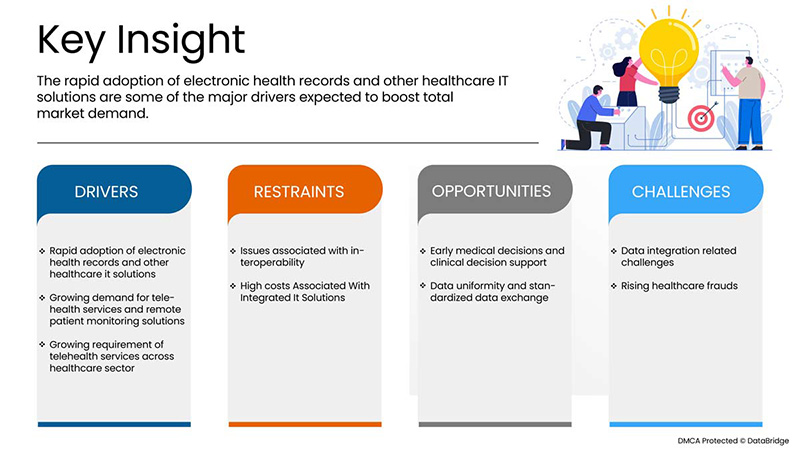
The increasing adoption of electronic health records and other healthcare it solutions, growing demand for telehealth services and remote patient monitoring solutions and growing requirement of telehealth services across healthcare sector are the factors that are expected to drive the market growth.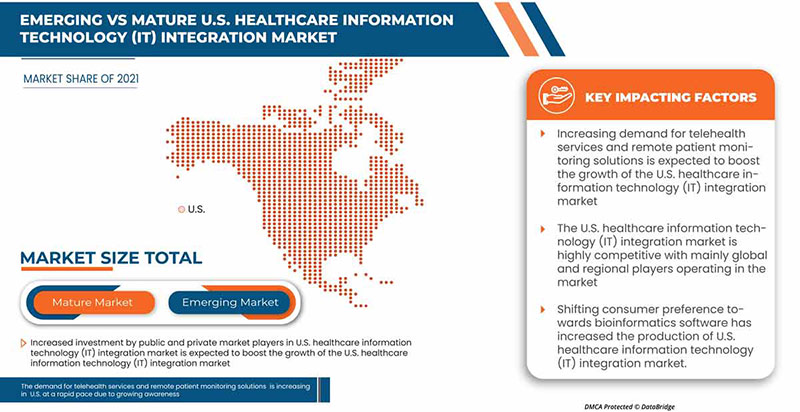
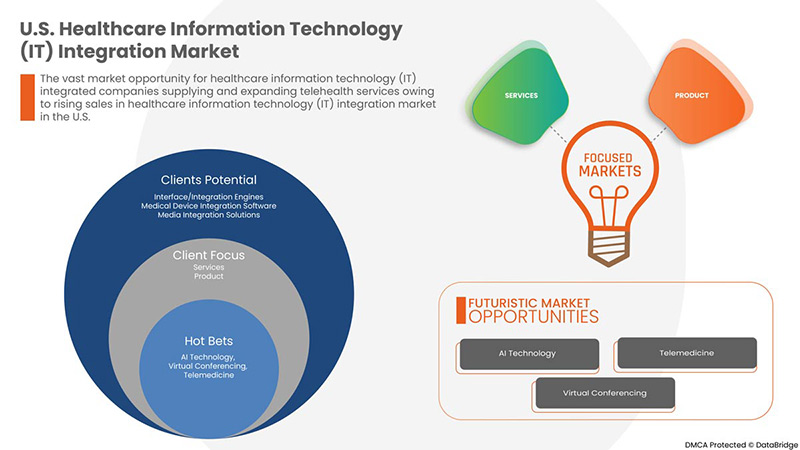
However, issues associated with interoperability, and high costs associated with integrated IT solutions are expected to restrain the market growth.
The rising technological progressions in clinical trial imaging for diagnosis and treatment of chronic diseases are expected to drive market growth. Data Bridge Market Research analyzes that the U.S. healthcare information technology (IT) integration market will grow at a CAGR of 13.7%, during the forecast period of 2022 to 2029.
|
Report Metric |
Details |
|
Forecast Period |
2022 to 2029 |
|
Base Year |
2021 |
|
Historic Years |
2020 (Customizable to 2019-2014) |
|
Quantitative Units |
Revenue in USD Million, and Pricing in USD |
|
Segments Covered |
By Product and Services (Product and Services), Application (Medical Device Integration, Internal Integration, Hospital Integration, Lab Integration, Clinics Integration and Radiology Integration), Facility Size (Large, Medium and Small), Purchase Mode (Group Purchase Organization and Individual), End User (Hospitals, Laboratory, Diagnostic Centers, Radiology Centers and Clinics) |
|
Countries Covered |
U.S. |
|
Market Players Covered |
Lyniate, Redox, Inc., carepoint health, Nextgen Healthcare Inc., Interfaceware, Inc. Koninklijke Philips, Oracle, AVI-SPL, INC., Allscripts Healthcare solutions, Inc, Epic systems corporation, Qualcomm life Inc., Capsule technologies Inc. Orion health, Quality syetems, Inc., Cerner corporation, Intersystems corporation, intersystem corporation, Infor Inc., GE Healthcare, MCKESSON Corporation, Meditech among others |
Market Definition
Healthcare IT integration is the area of IT involving the design, development, creation, use, and maintenance of information systems for the healthcare industry. Automated and interoperable healthcare information systems will continue to improve medical care and public health, lower costs, increase efficiency, reduce errors and improve patient satisfaction, while also optimizing reimbursement for ambulatory and inpatient healthcare providers. The importance of health IT results from the combination of evolving technology and changing government policies that influence the quality of patient care.
Some of the healthcare IT integration products are interface/integration engines, medical device integration software and media integration solutions and services, implementation & integration, support & maintenance, training and education, and consulting. Health IT makes it possible for health care providers to better manage patient care through the secure use and sharing of health information. By developing secure and private Electronic Health Records (EHRs) for most Americans and making health information available electronically, when and where it is needed, health IT can improve the quality of care, even as it makes health care more cost-effective. With the help of health IT, health care providers will have accurate and complete information about patient's health. That way, providers can give the best possible care, whether during a routine visit or a medical emergency. This is especially important if a patient has a serious medical condition and this is the way to securely share information with patients and their family members over the internet.
The patients and their families can fully take part in decisions about their healthcare and information to help diagnose health problems, reduce medical errors, and provide safer care at lower costs. During the forecast period, technological developments in healthcare IT integration are anticipated to drive market growth.
U.S. Healthcare Information Technology (IT) Integration Market Dynamics
Drivers
- Rapid adoption of electronic health records and other healthcare it solutions
Patient data is complex, confidential, and often unstructured. Incorporating this information into the healthcare delivery process is a challenge that must be met in order to realize the opportunity to improve patient care. Although Electronic Health Record (HER) has been in use for over a decade, the market has recently accelerated due to government initiatives in different countries to improve patient data security.
For instance,
- In June 2021, health funding agencies such as the National Institute of Health (NIH), in U.S., had funded for the digital healthcare IT solutions
- In March 2020, the Office of the National Coordinator for Health Information Technology (ONC) issued a report on the funding opportunity (NOFO), under the Leading Edge Acceleration Projects (LEAP) in Health Information Technology (Health IT)
IT services help to integrate various end-users throughout the healthcare system, including hospitals, nursing units, pharmacies, and health insurance companies. However, the integration of this data and its availability in real time are essential for healthcare professionals to ensure effective decision making. The rapid adoption of electronic health records and other healthcare it solutions, is expected to drive the market growth.
- Growing demand for telehealth services and remote patient monitoring solutions
Currently, telehealth services are being requested for monitoring and consulting purposes. Advances in healthcare solutions have helped to deliver educational content and ensure uninterrupted communication between patients and healthcare providers. The successful operation of remote patient monitoring solutions depends on the successful integration of medical and Information and Communications Technology (ICT) devices that enable the delivery of medical services over long distances.
For instance,
- In 2021, according to a report, by the U.S. Department of Health and Human Services found that Medicare telehealth utilization increased 63-fold between 2019 and 2020
- In July 2020, in Europe, a study conducted by HIMSS and Siemens Healthineers found that 93% of healthcare facilities had adopted at least one type of telemedicine service or solution just prior to the COVID-19 outbreak
With advancements in technology, these solutions play an important role in improving remote monitoring and patient compliance, and subsequently their quality of life. Therefore, the growing demand for remote monitoring solutions and remote devices is expected to drive the growth of the U.S. healthcare information technology (IT) integration solution providers in the coming years.
Opportunities
- Early medical decisions and clinical decision support
Technology has opened doors to improve and support healthcare that plays a major role to play in making medicine more precise and shaping care delivery. Innovative technologies, such as AI, robotics, and automation, are crucial enablers for expanding precision medicine, transforming care delivery, and improving patient experience.
For instance,
- In 2020, according to the National Centre for Biotech Information (NCBI), clinical decision support system (CDSS) is intended to improve healthcare delivery by enhancing medical decisions with targeted clinical knowledge, patient information, and other health information
The medical decisions taken are primarily fruitful as it significantly affects the development of better and advanced medical imaging products in the market. Therefore, the surge in early medical decisions and clinical decision support is expected to create a greater opportunity for the market.
- Increasing awareness among people
Healthcare IT Integration offers alternative options for receiving healthcare services U.S.ly, improving access and reducing costs associated with traveling for services. However, the full potential of healthcare IT has not been realized with slow and fragmented uptake.
For instance,
- In 2019, According to National Centre for Biotech Information (NCBI) the Software for the Evolution of Knowledge in Medicine (SEKMED) is an interactive and dynamic working Web platform employing a multidimensional approach to knowledge, which considers the various dimensions linked to clinical practice such as scientific, organizational, professional, and experiential. The solution also allows collaboration and interactions through an iterative and continuous process of knowledge generation supported by the involvement of CoP.
These awareness programs and events have raised the market growth and providing opportunities for the companies to grow as these awareness programs or publications helps people to get the needs or requirements of the healthcare IT integration.
Restraints/Challenges
- High costs associated with integrated IT solutions
High upfront acquisition costs, ongoing maintenance costs, and disruptions to workflows that contribute to temporary losses act as a restrain for the market growth.
For instance,
- According to ScienceSoft USA Corporation, cost of ultrasound software is USD 30,000 to integrate a healthcare solution with one EHR system is required and USD 150,000 is required to enable EHR integration capabilities of a software product.
Moreover, maintenance and support costs after the EHR integration implementation are expected to further hinder the market growth.
- Data integration related challenges
Information related to patients have created from different departments and at all points of treatment within the healthcare organization, making it more highly information-intensive industry and reliable patient records, However, it is essential to give reliable information by combining huge amounts of data in order to produce comprehensive and trustworthy patient records. Because a variety of medical equipment and diagnostic instruments are used in healthcare systems and is a growing need to connect all of these systems in to assist healthcare practitioners in responding quickly at various care delivery points.
For instance,
- In October 2016, According to the Published report in 2016 International Conference on Innovations in Science, Engineering and Technology (ICISET), they mentioned and analyzed different problems for healthcare data integration in Bangladesh to develop a national level health data warehouse for the citizen and Discovering the hidden knowledge from different health data repositories requires the integration of health data from widely diversified sources.
COVID-19 Impact on the U.S. Healthcare Information Technology (IT) Integration Market
Diagnostic imaging services have been time-consuming and complicated by the need for strict infection control and prevention practices developed to contain the risk of transmission and protect healthcare personnel. Hence, the decision to image suspected patients or COVID-19-positive patients is based on their impact on the improvement of patient status. The use of health information technology (HIT) during the coronavirus disease 2019 (COVID-19) pandemic has rapidly increased. During the pandemic, HIT has been used to provide telehealth services, education on the severe acute respiratory syndrome coronavirus 2 disease, updates on epidemiology and treatments, and most recently, access to scheduling systems for the COVID-19 vaccines.
Recent Developments
- In August 2022, Oracle announced the availability of Rapid direct connections to Oracle Cloud Infrastructure (OCI) that helps Internet2 member institutions make a move to the cloud. Through an Internet2 Cloud Connect dedicated network connection, institutions can utilize their existing Internet2 connections to extend their data center to OCI in a matter of days for no additional fee from Internet2 for up to 5Gbps. This makes it easy for organizations to access and use cloud resources to support research, collaboration, and the academic enterprise without significant new investments.
- In June 2022, Epic Systems Corporation has announced its plan to join a new health information exchange framework to improve health data interoperability across the country. The Trusted Exchange Framework and Common Agreement (TEFCA) have brought information networks together to help ensure that all people benefit from complete, longitudinal health records wherever they receive care. This has helped company to expand its business.
U.S. Healthcare Information Technology (IT) Integration Market Scope
The U.S. healthcare information technology (IT) integration market is segmented into five notable segments based on product and services, application, facility size, purchase mode, and end user. The growth amongst these segments will help you analyze meager growth segments in the industries and provide the users with a valuable market overview and market insights to help them make strategic decisions for identifying core market applications.
Products and Services
- Services
- Product
Based on product and services, the market is segmented into services and product.
Application
- Medical Device Integration
- Internal Integration
- Hospital Integration
- Lab Integration
- Clinics Integration
- Radiology Integration
- Other Applications
Based on application, the market is segmented into medical device integration, internal integration, hospital integration, lab integration, clinics integration, radiology integration and other applications.
Facility Size
- Large
- Medium
- Small
Based on facility size, the market is segmented into large, medium and small.
Purchase Mode
- Group Purchase Organization
- Individual
Based on purchase mode, the market is segmented into group purchase organization and individual.
End user
- Hospitals
- Laboratory
- Diagnostic Centers
- Radiology Centers
- Clinics
- Others
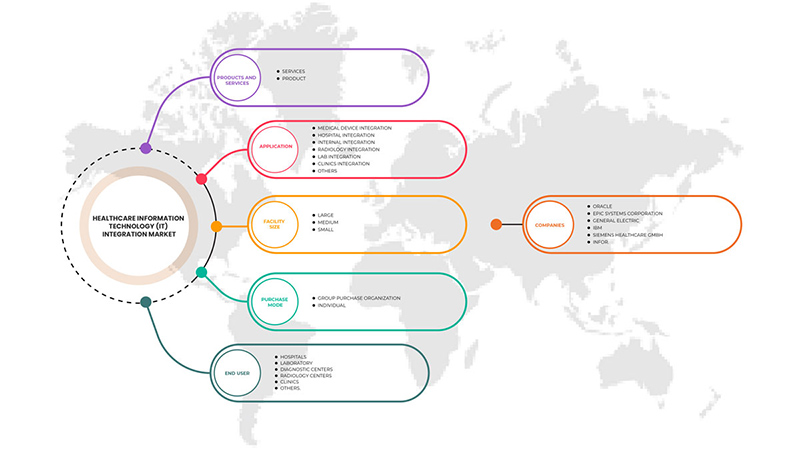
Based on end user, the market is segmented into hospitals, laboratory, diagnostic centers, radiology centers, clinics and others.
U.S. Healthcare Information Technology (IT) Integration Market Regional Analysis/Insights
The U.S. healthcare information technology (IT) integration market is analyzed, and market size insights and trends are provided by regions, product and services, application, facility size, purchase mode, and end user as referenced above.
The country covered in this market report is the U.S.
U.S. is expected to dominate the market because of its latest advanced technology and inventions in healthcare IT integration.
The country section of the report also provides individual market-impacting factors and changes in regulations in the market domestically that impact the current and future trends of the market. Data points such as new sales, replacement sales, country demographics, disease epidemiology, and import-export tariffs are some of the major pointers used to forecast the market scenario for individual countries. Also, the presence and availability of North American brands and their challenges faced due to large or scarce competition from local and domestic brands impact on sales channels are considered while providing forecast analysis of the country data.
Competitive Landscape and U.S. Healthcare Information Technology (IT) Integration Market Share Analysis
The U.S. healthcare information technology (IT) integration market competitive landscape provides details on the competitor. Details included are company overview, company financials, revenue generated, market potential, investment in R&D, new market initiatives, the North America presence, production sites and facilities, production capacities, company strengths and weaknesses, product launch, product width, and breadth, and application dominance. The above data points provided are only related to the companies' focus related to the U.S. healthcare information technology (IT) integration market.
Some of the major players operating in the market are Lyniate, Redox, Inc., carepoint health, Nextgen Healthcare Inc., Interfaceware, Inc. Koninklijke Philips, Oracle, AVI-SPL, INC., Allscripts Healthcare solutions, Inc, Epic systems corporation, Qualcomm life Inc., Capsule technologies Inc. Orion health, Quality syetems, Inc., Cerner corporation, Intersystems corporation, intersystem corporation, Infor Inc., GE Healthcare, MCKESSON Corporation, Meditech among others.
SKU-
Obtenha acesso online ao relatório sobre a primeira nuvem de inteligência de mercado do mundo

- Painel interativo de análise de dados
- Painel de análise da empresa para oportunidades de elevado potencial de crescimento
- Acesso de analista de pesquisa para personalização e customização. consultas
- Análise da concorrência com painel interativo
- Últimas notícias, atualizações e atualizações Análise de tendências
- Aproveite o poder da análise de benchmark para um rastreio abrangente da concorrência
Índice
1 INTRODUÇÃO
1.1 OBJETIVOS DO ESTUDO
1.2 DEFINIÇÃO DE MERCADO
1.3 VISÃO GERAL DO MERCADO DE INTEGRAÇÃO DE TECNOLOGIA DA INFORMAÇÃO (TI) EM SAÚDE DOS EUA
1.4 MOEDA E PREÇOS
1.5 LIMITAÇÕES
1.6 MERCADOS COBERTOS
2 SEGMENTAÇÃO DE MERCADO
2.1 MERCADOS COBERTOS
2.2 ÂMBITO GEOGRÁFICO
2,3 ANOS CONSIDERADOS PARA O ESTUDO
2.4 MODELO DE VALIDAÇÃO DE DADOS TRIPÉ DBMR
2.5 ENTREVISTAS PRINCIPAIS COM PRINCIPAIS LÍDERES DE OPINIÃO
2.6 MODELAGEM MULTIVARIADA
2.7 GRADE DE COBERTURA DE APLICAÇÃO DE MERCADO
2.8 CURVA DE VIDA DE PRODUTOS E SERVIÇOS
2.9 GRADE DE POSIÇÃO DE MERCADO DBMR
2.1 FONTES SECUNDÁRIAS
2.11 PREMISSAS
3 RESUMO EXECUTIVO
4 VISÃO PREMIUM
4.1 TECNOLOGIAS DE TI POTENCIAIS PARA SAÚDE
4.1.1 REGISTROS ELETRÔNICOS DE SAÚDE (RES)
4.1.2 REGISTROS MÉDICOS ELETRÔNICOS (EMRS)
4.1.3 INTELIGÊNCIA ARTIFICIAL (IA)
4.1.4 TELEMEDICINA
5 ANÁLISE DE PARCELA DE MERCADO DE INTEGRAÇÃO DE TECNOLOGIA DA INFORMAÇÃO EM SAÚDE (TI) DOS EUA
6 REGULAMENTOS
7 VISÃO GERAL DO MERCADO
7.1 MOTORISTAS
7.1.1 ADOÇÃO RÁPIDA DE REGISTROS ELETRÔNICOS DE SAÚDE E OUTRAS SOLUÇÕES DE TI PARA ASSISTÊNCIA MÉDICA
7.1.2 CRESCENTE DEMANDA POR SERVIÇOS DE TELESSAÚDE E SOLUÇÕES DE MONITORAMENTO REMOTO DE PACIENTES
7.1.3 NECESSIDADE CRESCENTE DE SERVIÇOS DE TELESSAÚDE EM TODO O SETOR DE SAÚDE
7.2 RESTRIÇÕES
7.2.1 QUESTÕES ASSOCIADAS À INTEROPERABILIDADE
7.2.2 ALTOS CUSTOS ASSOCIADOS ÀS SOLUÇÕES DE TI INTEGRADAS
7.3 OPORTUNIDADES
7.3.1 DECISÕES MÉDICAS PRECOCES E APOIO À DECISÃO CLÍNICA
7.3.2 UNIFORMIDADE DE DADOS E TROCA DE DADOS PADRÃO
7.3.3 AUMENTANDO A CONSCIENTIZAÇÃO DAS PESSOAS
7.4 DESAFIOS
7.4.1 DESAFIOS RELACIONADOS À INTEGRAÇÃO DE DADOS
7.4.2 FRAUDES CRESCENTES NA ÁREA DE SAÚDE
8 MERCADO DE INTEGRAÇÃO DE TECNOLOGIA DA INFORMAÇÃO (TI) EM SAÚDE NOS EUA, POR PRODUTO E SERVIÇOS
8.1 VISÃO GERAL
8.2 SERVIÇOS
8.2.1 SUPORTE E MANUTENÇÃO
8.2.2 IMPLEMENTAÇÃO E INTEGRAÇÃO
8.2.3 TREINAMENTO E EDUCAÇÃO
8.2.4 CONSULTORIA
8.3 PRODUTO
8.3.1 MOTORES DE INTERFACE/INTEGRAÇÃO
8.3.1.1 Organização de Compras em Grupo
8.3.1.2 Individual
8.3.2 SOFTWARE DE INTEGRAÇÃO DE DISPOSITIVOS MÉDICOS
8.3.2.1 Organização de Compras em Grupo
8.3.2.2 Individual
8.3.3 SOLUÇÕES DE INTEGRAÇÃO DE MÍDIA
8.3.3.1 Organização de Compras em Grupo
8.3.3.2 Individual
8.3.4 OUTRAS FERRAMENTAS DE INTEGRAÇÃO
9 MERCADO DE INTEGRAÇÃO DE TECNOLOGIA DA INFORMAÇÃO (TI) EM SAÚDE NOS EUA, POR APLICAÇÃO
9.1 VISÃO GERAL
9.2 INTEGRAÇÃO DE DISPOSITIVOS MÉDICOS
9.3 INTEGRAÇÃO HOSPITALAR
9.4 INTEGRAÇÃO INTERNA
9.5 INTEGRAÇÃO DE RADIOLOGIA
9.6 INTEGRAÇÃO DE LABORATÓRIO
9.7 INTEGRAÇÃO DE CLÍNICAS
9.8 OUTROS
10 MERCADOS DE INTEGRAÇÃO DE TECNOLOGIA DA INFORMAÇÃO (TI) EM SAÚDE NOS EUA, POR TAMANHO DE INSTALAÇÃO
10.1 VISÃO GERAL
10.2 GRANDE
10.3 MÉDIO
10.4 PEQUENO
11 MERCADO DE INTEGRAÇÃO DE TECNOLOGIA DA INFORMAÇÃO (TI) EM SAÚDE DOS EUA, POR MODO DE COMPRA
11.1 VISÃO GERAL
11.2 ORGANIZAÇÃO DE COMPRAS EM GRUPO
11.3 INDIVIDUAL
12 MERCADO DE INTEGRAÇÃO DE TECNOLOGIA DA INFORMAÇÃO (TI) EM SAÚDE NOS EUA, POR USUÁRIO FINAL
12.1 VISÃO GERAL
12.2 HOSPITAL
12.3 CENTROS DE DIAGNÓSTICO
12.4 CENTROS DE RADIOLOGIA
12.5 LABORATÓRIO
12.6 CLÍNICAS
12.7 OUTROS
13 MERCADO DE INTEGRAÇÃO DE TECNOLOGIA DA INFORMAÇÃO (TI) EM SAÚDE DOS EUA: CENÁRIO DA EMPRESA
13.1 ANÁLISE DE AÇÕES DA EMPRESA: EUA
14 ANÁLISE SWOT
15 PERFIL DA EMPRESA
15.1 ORACLE (AMBOS OS PROVEDORES)
15.1.1 RESUMO DA EMPRESA
15.1.2 ANÁLISE DE RECEITA
15.1.3 PORTFÓLIO DE PRODUTOS
15.1.4 DESENVOLVIMENTOS RECENTES
15.2 EPIC SYSTEMS CORPORATION (PROVEDORES DE EMR)
15.2.1 RESUMO DA EMPRESA
15.2.2 PORTFÓLIO DE PRODUTOS
15.2.3 DESENVOLVIMENTO RECENTE
15.3 ELÉTRICA GERAL
15.3.1 RESUMO DA EMPRESA
15.3.2 ANÁLISE DE RECEITA
15.3.3 PORTFÓLIO DE PRODUTOS
15.3.4 DESENVOLVIMENTOS RECENTES
15.4 IBM (PROVEDORES DE INTEGRAÇÃO)
15.4.1 RESUMO DA EMPRESA
15.4.2 ANÁLISE DE RECEITA
15.4.3 PORTFÓLIO DE PRODUTOS
15.4.4 DESENVOLVIMENTOS RECENTES
15.5 SIEMENS HEALTHCARE GMBH (PROVEDORES DE INTEGRAÇÃO)
15.5.1 RESUMO DA EMPRESA
15.5.2 ANÁLISE DE RECEITA
15.5.3 PORTFÓLIO DE PRODUTOS
15.5.4 DESENVOLVIMENTOS RECENTES
15.6 ALLSCRIPTS HEALTHCARE, LLC E/OU SUAS AFILIADAS (PROVEDORES DE EMR)
15.6.1 RESUMO DA EMPRESA
15.6.2 ANÁLISE DE RECEITA
15.6.3 PORTFÓLIO DE PRODUTOS
15.6.4 DESENVOLVIMENTOS RECENTES
15.7 COGNIZANT (PROVEDORES DE INTEGRAÇÃO)
15.7.1 RESUMO DA EMPRESA
15.7.2 ANÁLISE DE RECEITA
15.7.3 PORTFÓLIO DE PRODUTOS
15.7.4 DESENVOLVIMENTOS RECENTES
1.5 INFORMAÇÕES.
15.7.5 RESUMO DA EMPRESA
15.7.6 PORTFÓLIO DE PRODUTOS
15.7.7 DESENVOLVIMENTO RECENTE
15.8 CORPORAÇÃO INTERSYSTEM (PROVEDORES DE INTEGRAÇÃO)
15.8.1 RESUMO DA EMPRESA
15.8.2 PORTFÓLIO DE PRODUTOS
15.8.3 DESENVOLVIMENTOS RECENTES
15.9 INTERFACEWARE INC. (PROVEDORES DE INTEGRAÇÃO)
15.9.1 RESUMO DA EMPRESA
15.9.2 PORTFÓLIO DE PRODUTOS
15.9.3 DESENVOLVIMENTOS RECENTES
15.1 KONNKLIJKE PHILIPS NV (2021) (AMBOS OS FORNECEDORES)
15.10.1 RESUMO DA EMPRESA
15.10.2 ANÁLISE DE RECEITA
15.10.3 PORTFÓLIO DE PRODUTOS
15.10.4 DESENVOLVIMENTOS RECENTES
15.11 LINIATO
15.11.1 RESUMO DA EMPRESA
15.11.2 PORTFÓLIO DE PRODUTOS
15.11.3 DESENVOLVIMENTOS RECENTES
15.12 MASIMO (2021) (PROVEDORES DE INTEGRAÇÃO)
15.12.1 RESUMO DA EMPRESA
15.12.2 ANÁLISE DE RECEITA
15.12.3 PORTFÓLIO DE PRODUTOS
15.12.4 DESENVOLVIMENTO RECENTE
15.13 MDI SOLUTIONS (PROVEDORES DE INTEGRAÇÃO)
15.13.1 RESUMO DA EMPRESA
15.13.2 PORTFÓLIO DE PRODUTOS
15.13.3 DESENVOLVIMENTOS RECENTES
15.14 MEDICAL INFORMATION TECHNOLOGY, INC. (PROVEDORES DE EMR)
15.14.1 RESUMO DA EMPRESA
15.14.2 PORTFÓLIO DE PRODUTOS
15.14.3 DESENVOLVIMENTOS RECENTES
15.15 NXGN MANAGEMENT, LLC (PROVEDORES DE EMR)
15.15.1 RESUMO DA EMPRESA
15.15.2 ANÁLISE DE RECEITA
15.15.3 PORTFÓLIO DE PRODUTOS
15.15.4 DESENVOLVIMENTOS RECENTES
15.16 ORION HEALTH GROUP (PROVEDORES DE INTEGRAÇÃO)
15.16.1 RESUMO DA EMPRESA
15.16.2 ANÁLISE DE RECEITA
1.11.3. PORTFÓLIO DE PRODUTOS 115
15.16.3 DESENVOLVIMENTOS RECENTES
15.17 REDOX, INC. (PROVEDORES DE INTEGRAÇÃO)
15.17.1 RESUMO DA EMPRESA
15.17.2 PORTFÓLIO DE PRODUTOS
15.17.3 DESENVOLVIMENTOS RECENTES
15.18 SUMMIT HEALTHCARE SERVICES, INC. (PROVEDORES DE INTEGRAÇÃO)
15.18.1 RESUMO DA EMPRESA
15.18.2 PORTFÓLIO DE PRODUTOS
15.18.3 DESENVOLVIMENTOS RECENTES
15.19 QVERA (PROVEDORES DE INTEGRAÇÃO)
15.19.1 RESUMO DA EMPRESA
15.19.2 PORTFÓLIO DE PRODUTOS
15.19.3 DESENVOLVIMENTOS RECENTES
16 QUESTIONÁRIO
17 RELATÓRIOS RELACIONADOS
Lista de Tabela
TABELA 1 MERCADO DE INTEGRAÇÃO DE TECNOLOGIA DA INFORMAÇÃO (TI) EM SAÚDE NOS EUA, POR PRODUTO E SERVIÇOS, 2020-2029 (US$ MILHÕES)
TABELA 2 SERVIÇOS NOS EUA NO MERCADO DE INTEGRAÇÃO DE TECNOLOGIA DA INFORMAÇÃO (TI) EM SAÚDE, POR PRODUTO E SERVIÇOS, 2020-2029 (US$ MILHÕES)
TABELA 3 PRODUTO DOS EUA NO MERCADO DE INTEGRAÇÃO DE TECNOLOGIA DA INFORMAÇÃO (TI) EM SAÚDE, POR PRODUTO E SERVIÇOS, 2020-2029 (US$ MILHÕES)
TABELA 4 MECANISMOS DE INTERFACE/INTEGRAÇÃO DOS EUA NO MERCADO DE INTEGRAÇÃO DE TECNOLOGIA DA INFORMAÇÃO (TI) EM SAÚDE, POR PRODUTO E SERVIÇOS, 2020-2029 (US$ MILHÕES)
TABELA 5 SOFTWARE DE INTEGRAÇÃO DE DISPOSITIVOS MÉDICOS NO MERCADO DE INTEGRAÇÃO DE TECNOLOGIA DA INFORMAÇÃO (TI) DA SAÚDE, POR PRODUTO E SERVIÇOS, 2020-2029 (US$ MILHÕES)
TABELA 6 SOLUÇÕES DE INTEGRAÇÃO DE MÍDIA NOS EUA NO MERCADO DE INTEGRAÇÃO DE TECNOLOGIA DA INFORMAÇÃO (TI) NA ÁREA DE SAÚDE, POR PRODUTO E SERVIÇOS, 2020-2029 (US$ MILHÕES)
TABELA 7 MERCADO DE INTEGRAÇÃO DE TECNOLOGIA DA INFORMAÇÃO (TI) EM SAÚDE NOS EUA, POR APLICAÇÃO, 2020-2029 (US$ MILHÕES)
TABELA 8 MERCADO DE INTEGRAÇÃO DE TECNOLOGIA DA INFORMAÇÃO (TI) EM SAÚDE NOS EUA, POR TAMANHO DE INSTALAÇÃO, 2020-2029 (US$ MILHÕES)
TABELA 9 MERCADO DE INTEGRAÇÃO DE TECNOLOGIA DA INFORMAÇÃO (TI) EM SAÚDE NOS EUA, POR MODALIDADE DE COMPRA, 2020-2029 (US$ MILHÕES)
TABELA 10 MERCADO DE INTEGRAÇÃO DE TECNOLOGIA DA INFORMAÇÃO (TI) EM SAÚDE NOS EUA, POR USUÁRIO FINAL, 2020-2029 (US$ MILHÕES)
Lista de Figura
FIGURA 1 MERCADO DE INTEGRAÇÃO DE TECNOLOGIA DA INFORMAÇÃO (TI) EM SAÚDE DOS EUA: SEGMENTAÇÃO
FIGURA 2 MERCADO DE INTEGRAÇÃO DE TECNOLOGIA DA INFORMAÇÃO (TI) EM SAÚDE DOS EUA: TRIANGULAÇÃO DE DADOS
FIGURA 3 MERCADO DE INTEGRAÇÃO DE TECNOLOGIA DA INFORMAÇÃO (TI) EM SAÚDE DOS EUA: ANÁLISE DROC
FIGURA 4 MERCADO DE INTEGRAÇÃO DE TECNOLOGIA DA INFORMAÇÃO (TI) EM SAÚDE DOS EUA: ANÁLISE DE MERCADO REGIONAL VS. PAÍS
FIGURA 5 MERCADO DE INTEGRAÇÃO DE TECNOLOGIA DA INFORMAÇÃO (TI) EM SAÚDE NOS EUA: ANÁLISE DE PESQUISA DA EMPRESA
FIGURA 6 MERCADO DE INTEGRAÇÃO DE TECNOLOGIA DA INFORMAÇÃO (TI) EM SAÚDE DOS EUA: DEMOGRAFIA DAS ENTREVISTAS
FIGURA 7 MERCADO DE INTEGRAÇÃO DE TECNOLOGIA DA INFORMAÇÃO (TI) EM SAÚDE DOS EUA: GRADE DE COBERTURA DE APLICAÇÕES DE MERCADO
FIGURA 8 MERCADO DE INTEGRAÇÃO DE TECNOLOGIA DA INFORMAÇÃO (TI) EM SAÚDE DOS EUA: GRADE DE POSIÇÃO DE MERCADO DE DBMR
FIGURA 9 MERCADO DE INTEGRAÇÃO DE TECNOLOGIA DA INFORMAÇÃO (TI) EM SAÚDE DOS EUA: SEGMENTAÇÃO
FIGURA 10 A CRESCENTE DEMANDA POR SOLUÇÕES DE TI PARA SAÚDE, SERVIÇOS DE TELESSAÚDE E SOLUÇÕES DE MONITORAMENTO REMOTO DE PACIENTES DEVE IMPULSIONAR O MERCADO DE INTEGRAÇÃO DE TECNOLOGIA DA INFORMAÇÃO (TI) PARA SAÚDE NOS EUA NO PERÍODO PREVISTO DE 2022 A 2029
FIGURA 11 O SEGMENTO DE SERVIÇOS DEVE SER REPRESENTANTE DA MAIOR PARCIALIDADE DO MERCADO DE INTEGRAÇÃO DE TECNOLOGIA DA INFORMAÇÃO (TI) EM SAÚDE NOS EUA DE 2022 A 2029
FIGURA 12 MOTIVADORES, RESTRIÇÕES, OPORTUNIDADES E DESAFIOS DO MERCADO DE INTEGRAÇÃO DE TECNOLOGIA DA INFORMAÇÃO (TI) EM SAÚDE NOS EUA
FIGURA 13 MERCADO DE INTEGRAÇÃO DE TECNOLOGIA DA INFORMAÇÃO (TI) EM SAÚDE NOS EUA: POR PRODUTO E SERVIÇOS, 2021
FIGURA 14 MERCADO DE INTEGRAÇÃO DE TECNOLOGIA DA INFORMAÇÃO (TI) EM SAÚDE NOS EUA: POR PRODUTO E SERVIÇOS, 2022-2029 (US$ MILHÕES)
FIGURA 15 MERCADO DE INTEGRAÇÃO DE TECNOLOGIA DA INFORMAÇÃO (TI) EM SAÚDE DOS EUA: POR PRODUTO E SERVIÇOS, CAGR (2022-2029)
FIGURA 16 MERCADO DE INTEGRAÇÃO DE TECNOLOGIA DA INFORMAÇÃO (TI) EM SAÚDE NOS EUA: POR PRODUTO E SERVIÇOS, CURVA DE VIDA
FIGURA 17 MERCADO DE INTEGRAÇÃO DE TECNOLOGIA DA INFORMAÇÃO (TI) EM SAÚDE NOS EUA: POR APLICAÇÃO, 2021
FIGURA 18 MERCADO DE INTEGRAÇÃO DE TECNOLOGIA DA INFORMAÇÃO (TI) EM SAÚDE NOS EUA: POR APLICAÇÃO, 2022-2029 (US$ MILHÕES)
FIGURA 19 MERCADO DE INTEGRAÇÃO DE TECNOLOGIA DA INFORMAÇÃO (TI) EM SAÚDE DOS EUA: POR APLICAÇÃO, CAGR (2022-2029)
FIGURA 20 MERCADO DE INTEGRAÇÃO DE TECNOLOGIA DA INFORMAÇÃO (TI) EM SAÚDE DOS EUA: POR APLICAÇÃO, CURVA DE LINHA DE SALVAÇÃO
FIGURA 21 MERCADO DE INTEGRAÇÃO DE TECNOLOGIA DA INFORMAÇÃO (TI) EM SAÚDE NOS EUA: POR TAMANHO DE INSTALAÇÃO, 2021
FIGURA 22 MERCADO DE INTEGRAÇÃO DE TECNOLOGIA DA INFORMAÇÃO (TI) EM SAÚDE NOS EUA: POR TAMANHO DE INSTALAÇÃO, 2022-2029 (US$ MILHÕES)
FIGURA 23 MERCADO DE INTEGRAÇÃO DE TECNOLOGIA DA INFORMAÇÃO (TI) EM SAÚDE DOS EUA: POR TAMANHO DE INSTALAÇÃO, CAGR (2022-2029)
FIGURA 24 MERCADO DE INTEGRAÇÃO DE TECNOLOGIA DA INFORMAÇÃO (TI) EM SAÚDE DOS EUA: POR TAMANHO DA INSTALAÇÃO, CURVA DE VIDA
FIGURA 25 MERCADO DE INTEGRAÇÃO DE TECNOLOGIA DA INFORMAÇÃO (TI) EM SAÚDE NOS EUA: POR MODALIDADE DE COMPRA, 2021
FIGURA 26 MERCADO DE INTEGRAÇÃO DE TECNOLOGIA DA INFORMAÇÃO (TI) EM SAÚDE NOS EUA: POR MODALIDADE DE COMPRA, 2022-2029 (US$ MILHÕES)
FIGURA 27 MERCADO DE INTEGRAÇÃO DE TECNOLOGIA DA INFORMAÇÃO (TI) EM SAÚDE NOS EUA: POR MODALIDADE DE COMPRA, CAGR (2022-2029)
FIGURA 28 MERCADO DE INTEGRAÇÃO DE TECNOLOGIA DA INFORMAÇÃO (TI) EM SAÚDE DOS EUA: POR MODO DE COMPRA, CURVA DE LINHA DE VIDA
FIGURA 29 MERCADO DE INTEGRAÇÃO DE TECNOLOGIA DA INFORMAÇÃO (TI) EM SAÚDE NOS EUA: POR USUÁRIO FINAL, 2021
FIGURA 30 MERCADO DE INTEGRAÇÃO DE TECNOLOGIA DA INFORMAÇÃO (TI) EM SAÚDE DOS EUA: POR USUÁRIO FINAL, 2022-2029 (US$ MILHÕES)
FIGURA 31 MERCADO DE INTEGRAÇÃO DE TECNOLOGIA DA INFORMAÇÃO (TI) EM SAÚDE DOS EUA: POR USUÁRIO FINAL, CAGR (2022-2029)
FIGURA 32 MERCADO DE INTEGRAÇÃO DE TECNOLOGIA DA INFORMAÇÃO (TI) EM SAÚDE DOS EUA: POR USUÁRIO FINAL, CURVA DE VIDA
FIGURA 33 MERCADO DE INTEGRAÇÃO DE TECNOLOGIA DA INFORMAÇÃO (TI) EM SAÚDE DOS EUA: PARTICIPAÇÃO DA EMPRESA EM 2021 (%)

Metodologia de Investigação
A recolha de dados e a análise do ano base são feitas através de módulos de recolha de dados com amostras grandes. A etapa inclui a obtenção de informações de mercado ou dados relacionados através de diversas fontes e estratégias. Inclui examinar e planear antecipadamente todos os dados adquiridos no passado. Da mesma forma, envolve o exame de inconsistências de informação observadas em diferentes fontes de informação. Os dados de mercado são analisados e estimados utilizando modelos estatísticos e coerentes de mercado. Além disso, a análise da quota de mercado e a análise das principais tendências são os principais fatores de sucesso no relatório de mercado. Para saber mais, solicite uma chamada de analista ou abra a sua consulta.
A principal metodologia de investigação utilizada pela equipa de investigação do DBMR é a triangulação de dados que envolve a mineração de dados, a análise do impacto das variáveis de dados no mercado e a validação primária (especialista do setor). Os modelos de dados incluem grelha de posicionamento de fornecedores, análise da linha de tempo do mercado, visão geral e guia de mercado, grelha de posicionamento da empresa, análise de patentes, análise de preços, análise da quota de mercado da empresa, normas de medição, análise global versus regional e de participação dos fornecedores. Para saber mais sobre a metodologia de investigação, faça uma consulta para falar com os nossos especialistas do setor.
Personalização disponível
A Data Bridge Market Research é líder em investigação formativa avançada. Orgulhamo-nos de servir os nossos clientes novos e existentes com dados e análises que correspondem e atendem aos seus objetivos. O relatório pode ser personalizado para incluir análise de tendências de preços de marcas-alvo, compreensão do mercado para países adicionais (solicite a lista de países), dados de resultados de ensaios clínicos, revisão de literatura, mercado remodelado e análise de base de produtos . A análise de mercado dos concorrentes-alvo pode ser analisada desde análises baseadas em tecnologia até estratégias de carteira de mercado. Podemos adicionar quantos concorrentes necessitar de dados no formato e estilo de dados que procura. A nossa equipa de analistas também pode fornecer dados em tabelas dinâmicas de ficheiros Excel em bruto (livro de factos) ou pode ajudá-lo a criar apresentações a partir dos conjuntos de dados disponíveis no relatório.











