Europe Smart Pills Market Segmentation, By Type (Multiparameter Monitoring and Single Parameter Monitoring), Disease Indication (Occult GI Bleeding, Crohn’s Disease, Small Bowel Tumors, Celiac Disease, Inherited Polyposis Syndromes, and Mental Disorders), Application (Capsule Endoscopy, Drug Delivery, and Patient Monitoring of Cancer), End User (Hospital, Diagnostic Centers, and Others)-Industry Trends and Forecast to 2033
Europe Smart Pills Market Size
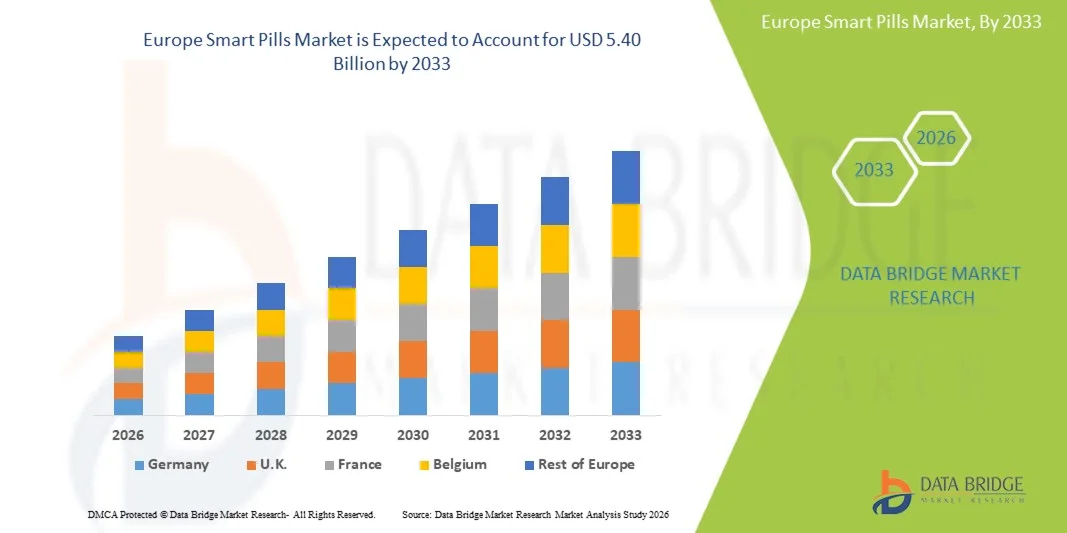
- The Europe smart pills market size was valued at USD 1.33 billion in 2025 and is expected to reach USD 5.40 billion by 2033, at a CAGR of 19.17% during the forecast period
- The market growth is largely fueled by the increasing adoption of advanced digital healthcare solutions and innovative ingestible sensor technologies, enabling real-time monitoring of patient health and treatment adherence
- Furthermore, rising demand from healthcare providers and patients for precise, non-invasive, and data-driven diagnostic and therapeutic solutions is positioning smart pills as an essential tool in modern healthcare management. These converging factors are accelerating the uptake of smart pills, thereby significantly boosting the industry's growth
Europe Smart Pills Market Analysis
- Smart pills, comprising ingestible sensors and digitally-enabled capsules for monitoring drug adherence and physiological conditions, are increasingly vital components of modern healthcare systems due to their real-time tracking capabilities, improved patient compliance, and integration with digital health platforms
- The escalating demand for smart pills is primarily fueled by the growing adoption of digital health technologies, rising chronic disease prevalence, and an increasing emphasis on personalized medicine and patient-centric care
- Germany dominated the Europe smart pills market with the largest revenue share of 32.7% in 2025, characterized by advanced healthcare infrastructure, strong R&D investments, and early adoption of digital therapeutics, with hospitals and outpatient clinics witnessing substantial uptake driven by innovations from both established pharmaceutical companies and health-tech startups
- The U.K. is expected to be the fastest growing country in the Europe smart pills market in 2025, due to government initiatives supporting digital healthcare, rising patient awareness, and increasing integration of multiparameter monitoring technologies in clinical practice
- Multiparameter monitoring segment dominated the Europe smart pills market with a market share of 43.2% in 2025, driven by its ability to track multiple vital signs, enhance clinical decision-making, and improve patient outcomes through comprehensive health data collection and integration with digital health platforms
Report Scope and Europe Smart Pills Market Segmentation
|
Attributes |
Europe Smart Pills Key Market Insights |
|
Segments Covered |
|
|
Countries Covered |
Europe
|
|
Key Market Players |
|
|
Market Opportunities |
|
|
Value Added Data Infosets |
In addition to the insights on market scenarios such as market value, growth rate, segmentation, geographical coverage, and major players, the market reports curated by the Data Bridge Market Research also include in-depth expert analysis, patient epidemiology, pipeline analysis, pricing analysis, and regulatory framework |
Europe Smart Pills Market Trends
“Advanced Patient Monitoring and Data Integration”
- A significant and accelerating trend in the Europe smart pills market is the growing adoption of multiparameter monitoring technologies integrated with digital health platforms, enhancing real-time patient monitoring and treatment adherence
- For instance, the Proteus Discover system integrates sensors with mobile applications to track medication intake and physiological parameters, enabling physicians to remotely monitor patient progress and adherence
- AI and data analytics integration in smart pills allows predictive health insights, personalized dosing recommendations, and intelligent alerts for anomalies, improving patient outcomes. For instance, some systems can analyze ingestion patterns to flag missed doses or abnormal vital signs
- The seamless integration of smart pills with electronic health records and telemedicine platforms facilitates centralized patient management, allowing healthcare providers to monitor multiple parameters through a single interface
- This trend toward more intelligent, data-driven, and connected patient monitoring solutions is fundamentally reshaping expectations for digital therapeutics. For instance, companies such as etectRx are developing AI-enabled ingestible sensors capable of automatically alerting caregivers and physicians when treatment deviations occur
- The demand for smart pills that provide comprehensive multiparameter monitoring and seamless healthcare integration is rapidly increasing, as providers and patients prioritize improved adherence, better outcomes, and real-time clinical insights
- Growing patient engagement initiatives in Europe are promoting the adoption of smart pills by educating patients on the benefits of digital adherence monitoring. For instance, awareness campaigns in Germany and France are encouraging patients with chronic conditions to use ingestible sensors for better treatment outcomes
Europe Smart Pills Market Dynamics
Driver
“Rising Need for Treatment Adherence and Chronic Disease Management”
- The increasing prevalence of chronic diseases and the need for precise treatment adherence is a significant driver for the heightened adoption of smart pills
- For instance, in March 2025, Proteus Digital Health announced a collaboration with a European hospital network to deploy ingestible sensor systems for patients on complex medication regimens, aiming to improve adherence and clinical outcomes
- As patients and healthcare providers seek reliable methods to track medication intake and monitor health remotely, smart pills offer advanced features such as digital adherence tracking, physiological monitoring, and automated alerts
- Furthermore, the rising focus on personalized medicine and patient-centric care is making smart pills an integral component of modern therapy, enabling tailored treatment plans.
- The convenience of real-time health data, remote monitoring, and integration with mobile health applications are key factors propelling adoption in both hospital and outpatient settings. The trend toward patient empowerment and digital therapeutics further accelerates market growth
- Expansion of reimbursement policies and insurance coverage for digital therapeutics in several European countries is expected to further drive smart pill adoption. For instance, Germany’s Digital Health Act is enabling reimbursement for certain digital adherence solutions
- Increasing investments by healthcare providers in remote patient monitoring infrastructure are also driving demand. For instance, hospitals in the U.K. and France are deploying smart pill systems to reduce readmission rates and improve chronic disease management
Restraint/Challenge
“High Cost and Regulatory Compliance Barriers”
- Concerns surrounding the regulatory approval processes and reimbursement frameworks for smart pills pose a significant challenge to broader market penetration. As smart pills involve ingestible devices and patient data collection, strict compliance requirements can delay commercialization
- For instance, reports of prolonged CE marking approvals in the EU have made some healthcare providers cautious about adopting smart pill solutions in clinical practice
- Addressing these regulatory and compliance challenges through robust clinical validation, data security measures, and alignment with healthcare standards is crucial for market acceptance. Companies such as Proteus and etectRx emphasize safety, efficacy, and compliance in their marketing to reassure stakeholders
- In addition, the relatively high cost of smart pill systems compared to traditional therapies can be a barrier to adoption, particularly in price-sensitive healthcare settings or regions with limited reimbursement coverage. While costs are gradually decreasing, premium solutions with integrated sensors and analytics often remain expensive
- Overcoming these challenges through regulatory support, reimbursement frameworks, and more affordable solutions will be vital for sustained adoption and long-term growth of smart pills in Europe
- Data privacy concerns around patient-generated health data pose an additional challenge, as compliance with GDPR and other privacy regulations is required. For instance, hospitals must ensure that ingestible sensor data is securely stored and shared only with authorized personnel
- Limited awareness and skepticism among some patients regarding ingestible devices can hinder adoption. For instance, campaigns are needed to educate patients about the safety and benefits of smart pills to improve acceptance in clinical practice
Europe Smart Pills Market Scope
The market is segmented on the basis of type, disease indication, application, and end user
- By Type
On the basis of type, the Europe smart pills market is segmented into multiparameter monitoring and single parameter monitoring. The multiparameter monitoring segment dominated the market in 2025 with the largest revenue share of 43.2%, driven by its ability to track multiple vital signs such as heart rate, temperature, and pH levels in a single ingestible sensor. Hospitals and outpatient care centers often prefer multiparameter smart pills for chronic disease management and complex treatment regimens, where monitoring multiple parameters simultaneously improves clinical decision-making. The segment benefits from strong integration with digital health platforms and electronic health records, allowing real-time data collection and remote monitoring by healthcare providers. Multiparameter smart pills also enhance patient adherence and reduce hospital readmissions by providing comprehensive health insights. In addition, ongoing R&D efforts to improve sensor accuracy and miniaturization further strengthen the dominance of this segment. The segment’s adoption is also supported by growing collaborations between pharmaceutical companies and health-tech startups to develop next-generation multiparameter solutions
The single parameter monitoring segment is expected to witness the fastest CAGR of 21.7% from 2026 to 2033, fueled by its cost-effectiveness and simplicity for monitoring specific physiological parameters such as drug absorption or gastrointestinal pH. Single parameter pills are increasingly adopted in outpatient care, clinical trials, and patient self-monitoring scenarios where only targeted data is required. Their smaller size and ease of use make them suitable for pediatric and elderly populations who may have difficulty ingesting larger devices. The segment is further driven by increasing demand from research institutions and diagnostic centers for specialized monitoring applications. Continuous innovation in sensor technology and integration with mobile health applications is expected to expand the use of single parameter smart pills in European healthcare settings.
- By Disease Indication
On the basis of disease indication, the Europe smart pills market is segmented into occult gastrointestinal bleeding, Crohn’s disease, small bowel tumors, celiac disease, inherited polyposis syndromes, and mental disorders. The occult gastrointestinal bleeding segment dominated the market in 2025, owing to the high prevalence of gastrointestinal disorders and the critical need for early detection. Smart pills with capsule endoscopy capabilities allow clinicians to visualize the gastrointestinal tract non-invasively, providing accurate detection of bleeding sites without traditional endoscopy. Hospitals and diagnostic centers prefer smart pills for occult bleeding due to improved patient comfort, reduced procedure time, and enhanced diagnostic accuracy. The segment is further supported by increasing awareness among physicians and patients about minimally invasive diagnostic solutions. Technological advancements in high-resolution imaging sensors and real-time data transmission enhance the effectiveness of these pills. Collaborations between healthcare providers and smart pill manufacturers are also contributing to the widespread adoption in Europe.
The Crohn’s disease segment is expected to witness the fastest CAGR from 2026 to 2033, driven by rising incidence rates and the need for continuous disease monitoring. Smart pills help track inflammation and gastrointestinal changes over time, enabling personalized treatment adjustments. They also reduce the frequency of invasive colonoscopies, improving patient adherence and comfort. Research on targeted drug delivery for Crohn’s patients further drives demand for disease-specific smart pills. Patient-centric care models and telemedicine adoption in Europe accelerate the integration of smart pill monitoring for Crohn’s disease management.
- By Application
On the basis of application, the Europe smart pills market is segmented into capsule endoscopy, drug delivery, and patient monitoring of cancer. The capsule endoscopy segment dominated the market in 2025, driven by its non-invasive diagnostic capabilities for the gastrointestinal tract. Capsule endoscopy enables clinicians to detect polyps, tumors, and bleeding sites with minimal patient discomfort compared to traditional procedures. Hospitals widely adopt capsule endoscopy smart pills due to improved diagnostic accuracy, faster procedure times, and reduced hospitalization needs. The segment also benefits from increasing clinical awareness and training programs for gastroenterologists. Integration with image analytics and AI-assisted reporting enhances the efficiency of data interpretation. Continuous improvements in imaging resolution, battery life, and data storage capacity further strengthen the segment’s dominance.
The drug delivery segment is expected to witness the fastest CAGR from 2026 to 2033, fueled by growing demand for targeted therapies and personalized medicine. Smart pills for drug delivery allow precise release of medications in specific areas of the gastrointestinal tract, improving efficacy and reducing side effects. Adoption is driven by the increasing prevalence of chronic diseases and oncology treatments requiring localized drug release. Integration with digital monitoring ensures real-time adherence tracking, improving patient outcomes. Pharmaceutical collaborations and clinical trials are further expanding the segment’s application in Europe.
- By End User
On the basis of end user, the Europe smart pills market is segmented into hospitals, diagnostic centers, and others. The hospitals segment dominated the market in 2025, accounting for the largest revenue share due to the extensive use of smart pills in inpatient monitoring, chronic disease management, and advanced diagnostics. Hospitals benefit from multiparameter monitoring and capsule endoscopy solutions for improving patient outcomes and reducing readmission rates. The segment is further supported by strong infrastructure, trained medical staff, and high adoption of digital health systems. Collaborations with smart pill manufacturers and integration into hospital information systems drive seamless adoption. The segment also receives continuous support from reimbursement policies in countries such as Germany and the U.K.
The diagnostic centers segment is expected to witness the fastest CAGR from 2026 to 2033, driven by the growing demand for specialized, outpatient diagnostic services and minimally invasive procedures. Diagnostic centers prefer smart pills for targeted disease monitoring and early detection of gastrointestinal and metabolic disorders. The increasing adoption of telemedicine and remote patient monitoring solutions further accelerates demand in this segment. Rising patient awareness and convenience-driven adoption also contribute to rapid growth.
Europe Smart Pills Market Regional Analysis
- Germany dominated the Europe smart pills market with the largest revenue share of 32.7% in 2025, characterized by advanced healthcare infrastructure, strong R&D investments, and early adoption of digital therapeutics, with hospitals and outpatient clinics witnessing substantial uptake driven by innovations from both established pharmaceutical companies and health-tech startups
- Healthcare providers and patients in the country highly value the ability of smart pills to provide real-time monitoring, improve treatment adherence, and enable multiparameter tracking for chronic and complex diseases
- This widespread adoption is further supported by government initiatives promoting digital health, high clinical awareness among physicians, and growing integration of smart pill data with electronic health records, establishing smart pills as a preferred solution in hospitals, outpatient clinics, and research centers
The U.K. Smart Pills Market Insight
The U.K. smart pills market is anticipated to grow at a noteworthy CAGR during the forecast period, driven by the rising adoption of telemedicine, digital health platforms, and patient-centric care initiatives. For instance, hospitals and outpatient clinics are integrating smart pills for chronic disease monitoring, drug adherence tracking, and early diagnostics. Growing concerns over medication non-compliance and the need for better treatment outcomes are encouraging healthcare providers to adopt ingestible sensor technologies. The U.K.’s robust healthcare infrastructure, coupled with government support for digital therapeutics, is expected to continue stimulating market growth. Patient awareness campaigns and training programs for healthcare professionals further support adoption. In addition, integration with mobile health applications and AI-driven analytics is enhancing the value proposition of smart pills in the U.K.
Germany Smart Pills Market Insight
The Germany smart pills market is expected to expand at a considerable CAGR during the forecast period, fueled by strong R&D investments, advanced healthcare infrastructure, and a high level of digital health adoption. For instance, hospitals and research centers in Germany are increasingly deploying multiparameter monitoring smart pills for chronic disease management and clinical trials. Germany’s focus on precision medicine, regulatory support, and reimbursement for digital therapeutics promotes adoption of ingestible sensor technologies. The integration of smart pills with hospital information systems and electronic medical records allows real-time patient monitoring and personalized treatment adjustments. Growing collaborations between pharmaceutical companies and digital health startups further drive innovation. German patients and healthcare providers value data-driven insights, improved adherence, and non-invasive monitoring solutions provided by smart pills.
France Smart Pills Market Insight
The France smart pills market is witnessing significant growth due to increasing government support for digital health, rising prevalence of gastrointestinal and chronic diseases, and a growing focus on patient-centric care. For instance, hospitals and diagnostic centers are adopting capsule endoscopy smart pills and drug delivery systems for non-invasive diagnostics and treatment monitoring. Integration with telemedicine platforms and electronic health records enhances workflow efficiency and patient outcomes. France’s robust healthcare system and reimbursement policies for digital therapeutics encourage adoption of ingestible sensors. Patient education initiatives and awareness programs are helping increase acceptance of smart pill technologies. Collaboration with health-tech startups and pharmaceutical companies is fostering development of next-generation smart pill solutions.
Italy Smart Pills Market Insight
The Italy smart pills market is poised for steady growth during the forecast period, driven by increasing adoption of digital therapeutics, rising chronic disease burden, and growing healthcare infrastructure modernization. For instance, hospitals and outpatient clinics are integrating smart pills for multiparameter monitoring and adherence tracking in patients with complex treatment regimens. Italy’s emphasis on telemedicine and patient monitoring solutions supports the adoption of ingestible sensor technologies. Collaborations between technology providers and healthcare institutions facilitate clinical research and improved patient outcomes. Awareness campaigns and government initiatives promoting digital health adoption further encourage market growth. Patients and clinicians increasingly value the non-invasive and data-driven advantages offered by smart pills.
Europe Smart Pills Market Share
The Europe Smart Pills industry is primarily led by well-established companies, including:
- Medtronic (Ireland)
- CapsoVision, Inc. (U.S.)
- Olympus Corporation (Japan)
- Check‑Cap Ltd. (Israel)
- Koninklijke Philips N.V. (Netherlands)
- Jinshan Science & Technology (Group) Co., Ltd. (China)
- Otsuka Pharmaceutical Co., Ltd. (Japan)
- Proteus Digital Health (U.S.)
- Rani Therapeutics (U.S.)
- etectRx, Inc. (U.S.)
- Ankon Medical Technologies (China)
- PillDrill (U.S.)
- Medimetrics Personalized Drug Delivery B.V. (Netherlands)
- BodyCap (France)
- ANX Robotica (U.S.)
- Pop Test Abuse Deterrent Technology LLC (U.S.)
- Progenity Inc. (U.S.)
- Innurvation Inc. (U.S.)
- IntroMedic Co., Ltd. (South Korea)
What are the Recent Developments in Europe Smart Pills Market?
- In January 2026, literature on capsule endoscopy current applications and future directions highlighted emergence of magnetically controlled, drug‑delivering capsule endoscopes with integrated therapeutic capabilities indicating the field’s trajectory toward multifunctional smart pills combining imaging and targeted therapy
- In July 2025, scientific collaboration announcements detailed the design of next‑generation video capsule endoscopy systems with AI‑assisted imaging, enabling enhanced diagnostics of the small intestine with lower energy consumption and improved image processing directly on the capsule a technological advancement pointing toward smarter, more capable devices for gastrointestinal diagnostics
- In May 2025, Belgian research hub Imec presented a miniaturised ingestible sensor prototype for real‑time gut health monitoring, designed to measure redox balance, pH, and temperature throughout the gastrointestinal tract with first‑in‑human volunteer measurements, positioning this innovation as a possible next‑generation smart pill platform for chronic disease monitoring
- In February 2023, researchers developed an ingestible sensor that can track its location through the GI tract with applications in diagnosing motility disorders while this work originated in the U.S., the underlying technology and its clinical research are highly influential for European GI smart‑pill applications and stimulate similar research and clinical interest in Europe
- In July 2022, a €6 million European research consortium (AICE) was launched involving NHS Highland, University of Strathclyde, and partners across the EU to integrate AI in large‑bowel capsule endoscopy image analysis, aiming to reduce barriers to adoption by improving diagnostic efficiency and cost‑effectiveness a significant Europe‑wide smart‑pill‑related clinical initiative
SKU-
Получите онлайн-доступ к отчету на первой в мире облачной платформе рыночной аналитики
- Интерактивная панель анализа данных
- Панель анализа компании для возможностей с высоким потенциалом роста
- Доступ аналитика-исследователя для настройки и запросов
- Анализ конкурентов с помощью интерактивной панели
- Последние новости, обновления и анализ тенденций
- Используйте возможности сравнительного анализа для комплексного отслеживания конкурентов
Методология исследования
Сбор данных и анализ базового года выполняются с использованием модулей сбора данных с большими размерами выборки. Этап включает получение рыночной информации или связанных данных из различных источников и стратегий. Он включает изучение и планирование всех данных, полученных из прошлого заранее. Он также охватывает изучение несоответствий информации, наблюдаемых в различных источниках информации. Рыночные данные анализируются и оцениваются с использованием статистических и последовательных моделей рынка. Кроме того, анализ доли рынка и анализ ключевых тенденций являются основными факторами успеха в отчете о рынке. Чтобы узнать больше, пожалуйста, запросите звонок аналитика или оставьте свой запрос.
Ключевой методологией исследования, используемой исследовательской группой DBMR, является триангуляция данных, которая включает в себя интеллектуальный анализ данных, анализ влияния переменных данных на рынок и первичную (отраслевую экспертную) проверку. Модели данных включают сетку позиционирования поставщиков, анализ временной линии рынка, обзор рынка и руководство, сетку позиционирования компании, патентный анализ, анализ цен, анализ доли рынка компании, стандарты измерения, глобальный и региональный анализ и анализ доли поставщика. Чтобы узнать больше о методологии исследования, отправьте запрос, чтобы поговорить с нашими отраслевыми экспертами.
Доступна настройка
Data Bridge Market Research является лидером в области передовых формативных исследований. Мы гордимся тем, что предоставляем нашим существующим и новым клиентам данные и анализ, которые соответствуют и подходят их целям. Отчет можно настроить, включив в него анализ ценовых тенденций целевых брендов, понимание рынка для дополнительных стран (запросите список стран), данные о результатах клинических испытаний, обзор литературы, обновленный анализ рынка и продуктовой базы. Анализ рынка целевых конкурентов можно проанализировать от анализа на основе технологий до стратегий портфеля рынка. Мы можем добавить столько конкурентов, о которых вам нужны данные в нужном вам формате и стиле данных. Наша команда аналитиков также может предоставить вам данные в сырых файлах Excel, сводных таблицах (книга фактов) или помочь вам в создании презентаций из наборов данных, доступных в отчете.