



Global Blocking Buffers Market Segmentation, By Composition (Salt Solution, Detergent, and Blocking Agent), End- Users (Hospitals, Clinical Laboratories, Pharmaceutical and Biotechnology Companies and Contract Research Organisations, Blood Banks, Research and Academic Laboratories, and Others), Application (Quantitative Western Blot, Chemiluminescent Western Blots, In-Cell Western Assay, In-Gel Western, Protein Array, and Glycoprotein Detection)– Industry Trends and Forecast to 2033
Blocking Buffers Market Size
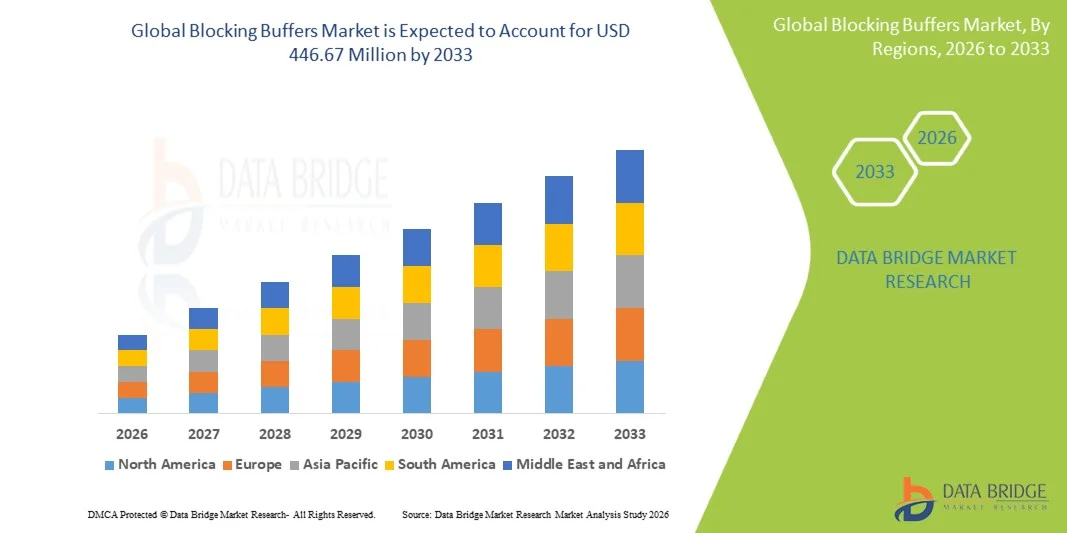
- The global blocking buffers market size was valued at USD 302.33 million in 2025 and is expected to reach USD 446.67 million by 2033, at a CAGR of 5.00% during the forecast period
- The market growth is largely driven by the increasing adoption of life science research techniques, including immunoassays, western blotting, ELISA, and protein analysis, where blocking buffers play a critical role in minimizing non-specific binding and improving assay accuracy
- Furthermore, rising investments in biotechnology, pharmaceutical R&D, and diagnostic development, along with expanding applications in academic and clinical laboratories, are strengthening the demand for high-quality reagents, thereby accelerating the uptake of blocking buffer solutions across research and diagnostic workflows
Blocking Buffers Market Analysis
- Blocking buffers, widely used reagents in life science research and diagnostics, are essential components in experimental workflows such as western blotting, immunoassays, and protein detection techniques due to their ability to prevent non-specific binding and improve signal accuracy and reproducibility in laboratory settings
- The escalating demand for blocking buffers is primarily fueled by the growing adoption of advanced proteomics and molecular biology techniques, increasing investments in biotechnology and pharmaceutical research, and the rising need for reliable and high-quality reagents in drug discovery, diagnostics, and academic research applications
- North America dominated the blocking buffers market with the largest revenue share of 42.3% in 2025, characterized by strong R&D infrastructure, high research funding, and the presence of leading biotechnology and pharmaceutical companies, with the U.S. witnessing significant usage of blocking buffers across academic institutes, research organizations, and diagnostic laboratories
- Asia-Pacific is expected to be the fastest growing region in the blocking buffers market during the forecast period driven by expanding biotechnology sectors, increasing government investments in life sciences research, rising diagnostic testing activities, and growing outsourcing of research and clinical studies to countries such as China and India
- Quantitative Western Blot segment dominated the blocking buffers market with a share of 35.9% in 2025, driven by its widespread use in protein quantification, high accuracy in measuring protein expression levels, and strong adoption in research, clinical diagnostics, and pharmaceutical studies
Report Scope and Blocking Buffers Market Segmentation
|
Attributes |
Blocking Buffers Key Market Insights |
|
Segments Covered |
|
|
Countries Covered |
North America
Europe
Asia-Pacific
Middle East and Africa
South America
|
|
Key Market Players |
|
|
Market Opportunities |
|
|
Value Added Data Infosets |
In addition to the insights on market scenarios such as market value, growth rate, segmentation, geographical coverage, and major players, the market reports curated by the Data Bridge Market Research also include in-depth expert analysis, patient epidemiology, pipeline analysis, pricing analysis, and regulatory framework |
Blocking Buffers Market Trends
“Advancements in High-Performance and Application-Specific Buffer Formulations”
- A significant and accelerating trend in the global blocking buffers market is the development of advanced, application-specific formulations designed to improve assay sensitivity, reduce background noise, and enhance reproducibility in complex molecular and diagnostic workflows
- For instance, modern blocking buffers based on optimized protein, detergent, and synthetic compositions are being widely used in western blotting and ELISA to achieve higher signal-to-noise ratios and more consistent experimental outcomes across laboratories
- Innovations in buffer chemistry, including the use of recombinant proteins and specialized additives, enable improved compatibility with diverse assay platforms such as chemiluminescent detection and protein arrays, while minimizing cross-reactivity and non-specific binding
- The growing integration of standardized and ready-to-use blocking buffer solutions into laboratory protocols allows researchers to streamline workflows, reduce preparation variability, and maintain consistency across high-throughput experiments
- The rising emphasis on reproducible research and quality control standards in life sciences is encouraging manufacturers to develop highly validated and batch-consistent buffer products tailored for specific experimental conditions
- This trend toward more efficient, reliable, and application-tailored blocking buffer solutions is reshaping expectations in life science research, as companies increasingly develop formulations optimized for specific proteins, detection systems, and experimental conditions
Blocking Buffers Market Dynamics
Driver
“Rising Demand Driven by Expansion of Life Science Research and Protein Analysis Applications”
- The increasing demand for blocking buffers is primarily driven by the rapid expansion of biotechnology, pharmaceutical research, and academic studies focused on protein expression, proteomics, and molecular diagnostics
- For instance, growing adoption of techniques such as western blotting, ELISA, immunohistochemistry, and protein arrays is significantly increasing the need for effective blocking reagents to ensure accurate and reliable results
- As researchers and laboratories focus on improving experimental precision and reproducibility, blocking buffers play a crucial role in minimizing non-specific binding and enhancing assay performance across diverse applications
- Furthermore, rising investments in drug discovery, biomarker identification, and disease research are boosting the use of advanced analytical techniques that depend heavily on high-quality blocking buffers
- The increasing prevalence of diagnostic testing and expansion of laboratory infrastructure globally are key factors propelling the adoption of blocking buffers in both research and clinical environments
- Growing outsourcing of research activities to contract research organizations (CROs) and diagnostic laboratories is also contributing to higher consumption of standardized blocking buffer solutions across outsourced workflows
Restraint/Challenge
“Variability in Buffer Performance and Limited Awareness in Emerging Markets”
- Concerns related to variability in buffer performance across different assay conditions and lack of standardization in formulations pose a significant challenge to consistent adoption in certain laboratory settings
- For instance, differences in protein composition, pH stability, and compatibility with specific assay types can impact experimental outcomes, leading to inconsistencies if not properly optimized
- Addressing these performance-related challenges requires careful selection and validation of buffer formulations, which can increase complexity and time requirements for researchers and technicians
- In addition, limited awareness and adoption of specialized blocking buffer products in emerging markets, where cost constraints and reliance on basic reagents remain high, can hinder market penetration
- High dependence on protocol optimization and technical expertise for effective usage of advanced blocking buffers can further limit adoption among small and resource-constrained laboratories
- Overcoming these challenges through improved product standardization, user education, wider distribution networks, and the development of cost-effective, easy-to-use blocking buffer solutions will be essential for sustained market growth
Blocking Buffers Market Scope
The market is segmented on the basis of composition, end-users, and application.
- By Composition
On the basis of composition, the blocking buffers market is segmented into salt solution, detergent, and blocking agent. The blocking agent segment dominated the market with the largest market revenue share in 2025, driven by its superior ability to effectively minimize non-specific binding across a wide range of immunoassays and protein analysis techniques. Blocking agents such as proteins and synthetic compounds are widely used due to their compatibility with multiple assay formats, including western blotting and ELISA. Their consistent performance in reducing background noise and improving signal clarity makes them the preferred choice in research and diagnostic workflows. In addition, the availability of standardized formulations and their adaptability to different experimental conditions further strengthen their dominant position in the market. The extensive use of blocking agents in both academic and commercial laboratories also contributes to their widespread adoption.
The detergent segment is expected to witness the fastest growth rate from 2026 to 2033, driven by increasing demand for more refined and optimized buffer formulations that enhance membrane protein studies and reduce non-specific hydrophobic interactions. Detergent-based blocking buffers are gaining traction in specialized applications such as in-cell western assays and protein array analyses where controlled surface interactions are critical. Their ability to improve assay specificity and compatibility with advanced detection systems is encouraging broader adoption. Furthermore, growing research in membrane biology and protein-protein interaction studies is fueling the need for detergent-based solutions. Continuous innovation in mild and non-denaturing detergents is also expanding their application scope across sensitive experimental protocols.
- By End-Users
On the basis of end-users, the blocking buffers market is segmented into hospitals, clinical laboratories, pharmaceutical and biotechnology companies and contract research organisations (CROs), blood banks, research and academic laboratories, and others. The pharmaceutical and biotechnology companies and CROs segment dominated the market with the largest revenue share in 2025, driven by extensive utilization of blocking buffers in drug discovery, biomarker validation, and high-throughput screening processes. These organizations conduct large volumes of protein-based assays, where blocking buffers are essential to ensure accuracy and reproducibility. Increasing outsourcing of research activities to CROs further boosts demand for standardized reagents, including blocking buffers. Strong investments in R&D pipelines and clinical trials also contribute to high consumption in this segment. In addition, the need for consistent and validated experimental outcomes in regulatory submissions reinforces the reliance on high-quality blocking buffers.
The research and academic laboratories segment is expected to witness the fastest growth rate from 2026 to 2033, driven by rising government funding for life science research and the expansion of academic research programs globally. Increasing focus on proteomics, molecular biology, and disease research is accelerating the adoption of techniques that require blocking buffers. Academic institutions are also increasingly engaging in collaborative research projects and advanced experimental studies, further driving reagent consumption. The growing number of publications and experimental studies involving western blotting and immunoassays supports higher usage in this segment. Moreover, expanding laboratory infrastructure in emerging economies is contributing to increased adoption of blocking buffer products in academic settings.
- By Application
On the basis of application, the blocking buffers market is segmented into quantitative western blot, chemiluminescent western blots, in-cell western assay, in-gel western, protein array, and glycoprotein detection. The quantitative western blot segment dominated the market with the largest revenue share of 35.9% in 2025, driven by its widespread use in protein quantification, expression analysis, and validation studies across research and diagnostic applications. Blocking buffers play a crucial role in this technique by reducing background interference and ensuring accurate quantification of target proteins. The high reproducibility and reliability of quantitative western blotting make it a preferred method in both academic and pharmaceutical research. Its extensive use in studying disease mechanisms and drug responses further strengthens its dominant position. The compatibility of blocking buffers with chemiluminescent and fluorescence-based detection systems also supports its widespread adoption.
The protein array segment is expected to witness the fastest growth rate from 2026 to 2033, driven by increasing demand for high-throughput protein analysis and multiplexed biomarker detection. Protein arrays enable simultaneous analysis of multiple proteins, making them highly efficient for large-scale screening applications. Blocking buffers are essential in these assays to prevent non-specific binding and ensure data accuracy across multiple targets. Growing applications in personalized medicine, biomarker discovery, and systems biology are accelerating the adoption of protein array technologies. Advances in microarray platforms and increasing integration with automated analytical systems are further supporting the rapid growth of this segment.
Blocking Buffers Market Regional Analysis
- North America dominated the blocking buffers market with the largest revenue share of 42.3% in 2025, characterized by strong R&D infrastructure, high research funding, and the presence of leading biotechnology and pharmaceutical companies
- Research institutions and laboratories in the region widely utilize blocking buffers in applications such as western blotting, ELISA, and protein analysis, supported by a high volume of ongoing R&D activities and clinical studies
- The strong emphasis on innovation, coupled with substantial government and private funding for drug discovery and biomedical research, continues to drive the demand for high-quality reagents, including blocking buffers, across both academic and commercial settings
U.S. Blocking Buffers Market Insight
The U.S. blocking buffers market captured the largest revenue share of 80% in North America in 2025, fueled by the strong presence of biotechnology and pharmaceutical industries and the rapid expansion of life science research activities. Researchers and laboratories in the country are increasingly prioritizing high-quality reagents for applications such as western blotting, ELISA, and protein assays to ensure accuracy and reproducibility. The growing number of academic research institutions, coupled with significant public and private funding for biomedical research, further supports market growth. Moreover, the widespread adoption of advanced laboratory technologies and high-throughput screening platforms is significantly contributing to the demand for blocking buffers across research and diagnostic applications.
Europe Blocking Buffers Market Insight
The Europe blocking buffers market is projected to expand at a substantial CAGR throughout the forecast period, primarily driven by strong regulatory frameworks, increasing investments in pharmaceutical R&D, and the presence of well-established research institutions. The region’s focus on high-quality standards in diagnostics and laboratory practices is encouraging the use of reliable reagents such as blocking buffers. Growing collaborations between academic institutes and industry players, along with rising emphasis on proteomics and molecular biology research, are fostering market adoption. In addition, increasing demand for standardized experimental protocols and advanced analytical techniques across laboratories is supporting steady growth in the region.
U.K. Blocking Buffers Market Insight
The U.K. blocking buffers market is anticipated to grow at a noteworthy CAGR during the forecast period, driven by a strong biotechnology sector and increasing research activities in life sciences and clinical diagnostics. The country’s emphasis on innovation, combined with government support for research funding, is encouraging the adoption of advanced laboratory reagents. The presence of leading universities, research organizations, and CROs is further boosting demand for blocking buffers in protein analysis and immunoassay applications. In addition, the growing focus on precision medicine and biomarker discovery is contributing to increased usage of high-performance blocking buffer solutions.
Germany Blocking Buffers Market Insight
The Germany blocking buffers market is expected to expand at a considerable CAGR during the forecast period, fueled by the country’s advanced pharmaceutical industry, strong engineering capabilities, and emphasis on scientific research. Germany’s well-developed laboratory infrastructure and commitment to quality and standardization are promoting the adoption of reliable blocking buffer formulations. Increasing investments in biotechnology, proteomics, and molecular diagnostics are further driving demand across research and clinical settings. Moreover, the integration of automation and standardized workflows in laboratories is enhancing the consistent use of blocking buffers in various analytical applications.
Asia-Pacific Blocking Buffers Market Insight
The Asia-Pacific blocking buffers market is poised to grow at the fastest CAGR during the forecast period, driven by rapid expansion in biotechnology research, increasing healthcare expenditure, and growing pharmaceutical manufacturing activities in countries such as China, Japan, and India. The region is witnessing rising adoption of advanced laboratory techniques supported by expanding research infrastructure and government initiatives promoting scientific innovation. Increasing outsourcing of research and clinical studies to Asia-Pacific countries is further boosting reagent consumption. In addition, improving accessibility and affordability of laboratory consumables is encouraging broader adoption of blocking buffers across academic, clinical, and industrial laboratories.
Japan Blocking Buffers Market Insight
The Japan blocking buffers market is gaining momentum due to the country’s technologically advanced research environment, strong focus on innovation, and high standards in laboratory practices. The increasing use of proteomics, molecular diagnostics, and protein analysis techniques is driving demand for high-quality blocking buffers. Japan’s emphasis on precision and reproducibility in scientific research further supports the adoption of standardized reagents. In addition, the integration of automated laboratory systems and growing applications in biomedical research and diagnostics are contributing to steady market growth in the country.
India Blocking Buffers Market Insight
The India blocking buffers market accounted for a significant share in Asia-Pacific in 2025, attributed to the rapid expansion of the biotechnology and pharmaceutical sectors, along with increasing investments in healthcare infrastructure. The growing number of academic institutions, research laboratories, and diagnostic centers is driving demand for reagents used in protein analysis and immunoassays. Government initiatives supporting life sciences research and the rise of contract research organizations are further contributing to market growth. In addition, increasing awareness of advanced diagnostic techniques and the availability of cost-effective laboratory solutions are encouraging wider adoption of blocking buffers across the country.
Blocking Buffers Market Share
The Blocking Buffers industry is primarily led by well-established companies, including:
- Thermo Fisher Scientific Inc. (U.S.)
- Bio-Rad Laboratories, Inc. (U.S.)
- Merck KGaA (Germany)
- Abcam plc (U.K.)
- Cell Signaling Technology, Inc. (U.S.)
- GenScript Biotech Corporation (China)
- CANDOR Bioscience GmbH (Germany)
- Calbiotech, Inc. (U.S.)
- Rockland Immunochemicals, Inc. (U.S.)
- Advansta, Inc. (U.S.)
- Boston Bioproducts, Inc. (U.S.)
- Takara Bio Inc. (Japan)
- PerkinElmer, Inc. (U.S.)
- OriGene Technologies, Inc. (U.S.)
- BPS Bioscience, Inc. (U.S.)
- Meridian Bioscience, Inc. (U.S.)
- Surmodics IVD, Inc. (U.S.)
- Bio-Techne Corporation (U.S.)
- Tocris Bioscience (U.S.)
What are the Recent Developments in Global Blocking Buffers Market?
- In May 2024, Merck KGaA (operating as MilliporeSigma in the U.S. and Canada) advanced its portfolio of blocking buffers used in immunoassays and cell-based applications, including protein-based and protein-free formulations designed to minimize background interference. These buffers are widely used in research and industrial laboratories for Western blotting, ELISA, and immunohistochemistry. The company’s continued product enhancements support improved assay reproducibility and sensitivity across life science
- In September 2023, LI-COR Biosciences promoted the use of optimized blocking buffers compatible with its western blot imaging systems, particularly formulations designed to reduce background fluorescence in near-infrared detection. These blocking buffers are tailored for fluorescence-based protein detection workflows, improving signal clarity and quantitative accuracy. LI-COR’s continued support for compatible reagents reflects the integration of instrumentation and consumables in the blocking buffer ecosystem
- In June 2022, Vector Laboratories highlighted and expanded its portfolio of blocking reagents, including BLOXALL™ Dual Enzyme Blocking Solution, which is used in immunohistochemistry (IHC) to block endogenous peroxidase and alkaline phosphatase activity. This development supports improved staining specificity and reduced background in tissue-based assays, which is critical for accurate diagnostic and research outcomes
- In November 2021, Bio-Rad Laboratories continued to promote and distribute its EveryBlot™ Blocking Buffer, a rapid blocking solution designed to reduce western blot blocking time to approximately 5 minutes while improving signal-to-noise ratios. This solution gained traction in laboratories for streamlining workflows and increasing sensitivity in protein detection applications
- In March 2021, Thermo Fisher Scientific expanded the availability and use of its blocking reagents such as StartingBlock™ and SuperBlock™ buffers, which are widely used in ELISA, Western blotting, and immunoassays to reduce non-specific binding and improve assay sensitivity. These buffers became increasingly adopted in research and diagnostic workflows due to their protein-free formulations and consistent performance across applications
SKU-
Получите онлайн-доступ к отчету на первой в мире облачной платформе рыночной аналитики

- Интерактивная панель анализа данных
- Панель анализа компании для возможностей с высоким потенциалом роста
- Доступ аналитика-исследователя для настройки и запросов
- Анализ конкурентов с помощью интерактивной панели
- Последние новости, обновления и анализ тенденций
- Используйте возможности сравнительного анализа для комплексного отслеживания конкурентов
Методология исследования
Сбор данных и анализ базового года выполняются с использованием модулей сбора данных с большими размерами выборки. Этап включает получение рыночной информации или связанных данных из различных источников и стратегий. Он включает изучение и планирование всех данных, полученных из прошлого заранее. Он также охватывает изучение несоответствий информации, наблюдаемых в различных источниках информации. Рыночные данные анализируются и оцениваются с использованием статистических и последовательных моделей рынка. Кроме того, анализ доли рынка и анализ ключевых тенденций являются основными факторами успеха в отчете о рынке. Чтобы узнать больше, пожалуйста, запросите звонок аналитика или оставьте свой запрос.
Ключевой методологией исследования, используемой исследовательской группой DBMR, является триангуляция данных, которая включает в себя интеллектуальный анализ данных, анализ влияния переменных данных на рынок и первичную (отраслевую экспертную) проверку. Модели данных включают сетку позиционирования поставщиков, анализ временной линии рынка, обзор рынка и руководство, сетку позиционирования компании, патентный анализ, анализ цен, анализ доли рынка компании, стандарты измерения, глобальный и региональный анализ и анализ доли поставщика. Чтобы узнать больше о методологии исследования, отправьте запрос, чтобы поговорить с нашими отраслевыми экспертами.
Доступна настройка
Data Bridge Market Research является лидером в области передовых формативных исследований. Мы гордимся тем, что предоставляем нашим существующим и новым клиентам данные и анализ, которые соответствуют и подходят их целям. Отчет можно настроить, включив в него анализ ценовых тенденций целевых брендов, понимание рынка для дополнительных стран (запросите список стран), данные о результатах клинических испытаний, обзор литературы, обновленный анализ рынка и продуктовой базы. Анализ рынка целевых конкурентов можно проанализировать от анализа на основе технологий до стратегий портфеля рынка. Мы можем добавить столько конкурентов, о которых вам нужны данные в нужном вам формате и стиле данных. Наша команда аналитиков также может предоставить вам данные в сырых файлах Excel, сводных таблицах (книга фактов) или помочь вам в создании презентаций из наборов данных, доступных в отчете.











