


Global Digital Behavioural Health Services Market Segmentation, By Technology (Telecare and Telehealth), mHealth (Wearables, Apps, and Digital Health System), End Use (Providers, Community Clinics, Hospitals, Private Practices, Payers, and Patients)- Industry Trends and Forecast to 2033
Digital Behavioural Health Services Market Size
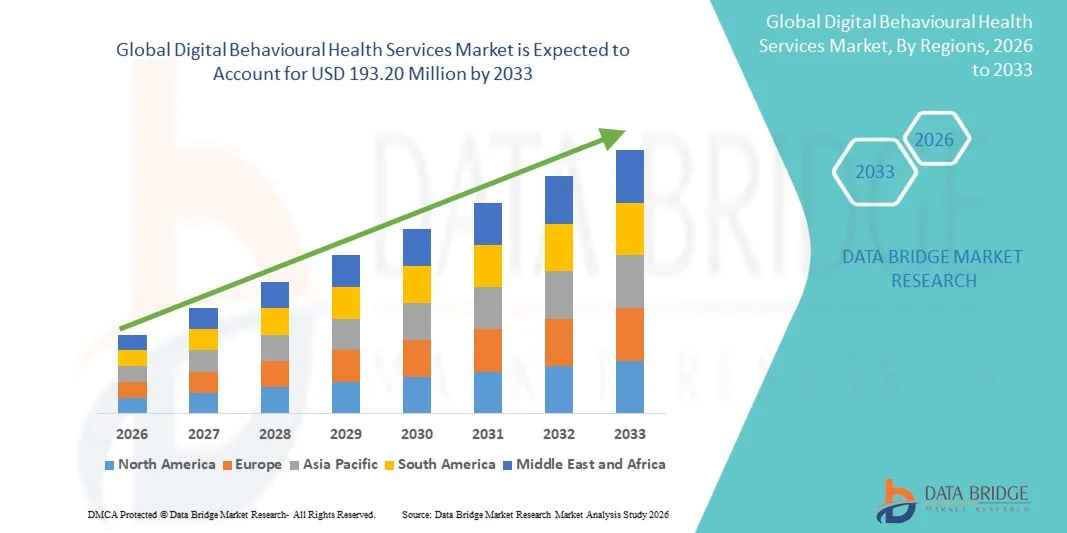
- The global digital behavioural health services market size was valued at USD 101.34 million in 2025 and is expected to reach USD 193.20 million by 2033, at a CAGR of 8.40% during the forecast period
- The market growth is largely fueled by the increasing adoption of digital mental health platforms, telehealth services, and mobile-based therapy solutions, which are expanding access to behavioral healthcare services across diverse populations
- Furthermore, rising awareness regarding mental health disorders, growing demand for remote counseling, AI-driven mental health monitoring, and personalized digital therapy tools, and the need for convenient and confidential care options are positioning digital behavioral health services as a key component of modern healthcare delivery. These factors are collectively accelerating the adoption of digital behavioral health solutions, thereby significantly boosting the industry’s growth
Digital Behavioural Health Services Market Analysis
- Digital behavioural health services, which include online therapy platforms, telepsychiatry, mobile mental health applications, and AI-driven psychological support tools, are becoming essential components of modern healthcare delivery as they provide accessible, scalable, and convenient mental health care for individuals across diverse demographics and geographic locations
- The growing demand for digital behavioural health services is primarily driven by increasing global awareness of mental health conditions, expanding adoption of telehealth technologies, and a rising need for accessible and cost-effective treatment options for disorders such as anxiety, depression, and substance use
- North America dominated the digital behavioural health services market with the largest revenue share of 41.3% in 2025, supported by advanced digital healthcare infrastructure, high adoption of telehealth platforms, strong insurance coverage for mental health services, and the presence of leading digital health companies in the U.S., which continues to witness rapid growth in virtual therapy and remote mental health monitoring services
- Asia-Pacific is expected to be the fastest growing region in the digital behavioural health services market during the forecast period due to expanding internet penetration, growing smartphone usage, increasing government initiatives to improve mental healthcare access, and rising awareness of digital mental health platforms among younger populations
- Telehealth segment dominated the digital behavioural health services market with a market share of 44.7% in 2025, driven by the rapid adoption of virtual consultations, remote psychiatric evaluations, and online therapy sessions, enabling healthcare providers to deliver timely mental health care while improving accessibility, convenience, and continuity of treatment for patients
Report Scope and Digital Behavioural Health Services Market Segmentation
|
Attributes |
Digital Behavioural Health Services Key Market Insights |
|
Segments Covered |
|
|
Countries Covered |
North America
Europe
Asia-Pacific
Middle East and Africa
South America
|
|
Key Market Players |
|
|
Market Opportunities |
|
|
Value Added Data Infosets |
In addition to the insights on market scenarios such as market value, growth rate, segmentation, geographical coverage, and major players, the market reports curated by the Data Bridge Market Research also include in-depth expert analysis, patient epidemiology, pipeline analysis, pricing analysis, and regulatory framework |
Digital Behavioural Health Services Market Trends
“Expansion of AI-Driven and Personalized Digital Mental Health Solutions”
- A significant and accelerating trend in the global digital behavioural health services market is the increasing integration of artificial intelligence (AI), data analytics, and mobile health technologies into digital mental health platforms. These advancements are enabling more personalized, scalable, and proactive behavioral healthcare services for patients worldwide
- For instance, companies such as Lyra Health and Headspace Health offer AI-supported digital platforms that match users with appropriate therapists, provide guided meditation and mental health programs, and track behavioral health progress through mobile applications. Similarly, Talkspace provides digital therapy and psychiatric services through a secure online platform accessible via smartphones and web portals
- AI integration in digital behavioural health platforms enables features such as symptom tracking, predictive mental health risk assessment, and personalized therapy recommendations based on user behavior and engagement patterns. Some platforms use machine learning algorithms to monitor patient progress and alert clinicians if significant changes in emotional or behavioral patterns are detected
- Furthermore, digital behavioural health services are increasingly integrated with telehealth systems, wearable health technologies, and electronic health records (EHRs), enabling continuous patient monitoring and more coordinated care. These connected systems allow healthcare providers to deliver timely interventions and improve long-term treatment outcomes
- The integration of digital mental health services with employer wellness programs, insurance platforms, and healthcare providers is also strengthening adoption across both clinical and non-clinical settings. Companies such as Spring Health and BetterHelp are expanding enterprise-focused mental health programs to improve workforce well-being and accessibility to therapy services
- The increasing use of data-driven insights and digital assessment tools is also helping healthcare providers deliver more targeted and outcome-focused treatment strategies, supporting better patient engagement and improving overall mental health outcomes
- This growing shift toward intelligent, personalized, and digitally connected behavioral healthcare solutions is transforming the mental health care landscape. As a result, healthcare providers and technology companies are investing heavily in AI-powered digital therapy platforms to improve accessibility, patient engagement, and treatment effectiveness
Digital Behavioural Health Services Market Dynamics
Driver
“Rising Mental Health Awareness and Increasing Adoption of Telehealth Services”
- The increasing prevalence of mental health disorders worldwide, along with growing awareness regarding the importance of mental well-being, is a key factor driving demand for digital behavioural health services
- For instance, in October 2023, Headspace Health partnered with Cigna Healthcare to expand access to digital mental health resources for health plan members, offering virtual therapy, mental health coaching, and self-guided wellness programs through digital platforms. Such strategic collaborations by key companies are expected to accelerate the growth of the digital behavioural health services market during the forecast period
- As healthcare providers seek to address the shortage of mental health professionals and improve accessibility to care, digital behavioral health platforms provide scalable solutions that allow therapists and psychiatrists to reach patients remotely. These platforms also enable continuous patient engagement through mobile applications, virtual consultations, and digital therapy programs
- Furthermore, the rapid adoption of telehealth technologies and supportive government policies encouraging digital healthcare services are contributing to the widespread use of digital behavioural health solutions across hospitals, clinics, and individual consumers
- The convenience of accessing therapy sessions from home, reduced stigma associated with seeking mental health support, and flexible scheduling options are encouraging individuals to adopt digital behavioural health platforms. In addition, increasing investments in digital health infrastructure and mental health awareness campaigns are further supporting market growth
- Moreover, rising corporate investments in employee mental wellness programs are driving demand for digital behavioral health platforms, as organizations increasingly integrate virtual counseling, stress management tools, and mental health monitoring services into workplace wellness strategies
Restraint/Challenge
“Data Privacy Concerns and Limited Access to Digital Infrastructure”
- Concerns related to patient data privacy, cybersecurity risks, and regulatory compliance represent significant challenges to the widespread adoption of digital behavioural health services. Since these platforms handle highly sensitive psychological and personal health information, maintaining strict data protection and regulatory compliance is critical
- For instance, several digital health platforms must comply with strict healthcare data protection frameworks such as HIPAA in the United States and GDPR in Europe, which can increase operational complexity and compliance costs for service providers
- Addressing these concerns requires strong cybersecurity frameworks, encrypted data transmission, secure authentication protocols, and transparent privacy policies to ensure patient trust and regulatory compliance. Companies such as Teladoc Health and Amwell emphasize robust data protection systems and secure telehealth platforms to ensure patient confidentiality
- In addition, limited internet connectivity and digital literacy in certain developing regions may restrict access to digital behavioural health platforms, creating disparities in service adoption. In some areas, individuals may also prefer traditional face-to-face therapy due to cultural perceptions surrounding mental health care
- Furthermore, reimbursement limitations and varying insurance coverage for digital mental health services in different countries may slow the adoption of these platforms, particularly in regions where telehealth policies are still evolving
- Overcoming these barriers through improved digital infrastructure, stronger cybersecurity standards, supportive reimbursement frameworks, and patient education regarding the benefits and safety of digital behavioral health services will be essential for sustained market expansion
Digital Behavioural Health Services Market Scope
The market is segmented on the basis of technology, mHealth, and end use.
- By Technology
On the basis of technology, the digital behavioural health services market is segmented into telecare and telehealth. The telehealth segment dominated the market with the largest market revenue share of 44.7% in 2025, driven by the rapid expansion of virtual mental health consultations and online therapy platforms. Telehealth solutions allow psychiatrists, psychologists, and counselors to provide remote diagnosis, therapy sessions, and medication management through secure digital platforms. The growing adoption of video conferencing technologies and digital communication tools has significantly improved accessibility to behavioral healthcare services, particularly for individuals living in remote or underserved areas. Healthcare providers are increasingly utilizing telehealth platforms to reduce patient wait times and improve the efficiency of mental health treatment. Furthermore, the convenience of accessing therapy from home and the reduction of stigma associated with visiting mental health clinics have strengthened the demand for telehealth-based behavioral health services.
The telecare segment is expected to witness the fastest growth rate from 2026 to 2033, fueled by the rising need for continuous remote monitoring and long-term care support for individuals with chronic mental health conditions. Telecare technologies allow healthcare professionals and caregivers to monitor patients’ behavioral health status through connected devices, alert systems, and digital communication tools. These services are particularly beneficial for elderly patients and individuals requiring continuous supervision or assistance. Increasing investments in remote care infrastructure and the growing use of digital monitoring technologies are supporting the adoption of telecare solutions. In addition, government initiatives focused on improving remote healthcare accessibility and reducing hospitalization rates are expected to further drive telecare adoption during the forecast period.
- By mHealth
On the basis of mHealth, the digital behavioural health services market is segmented into wearables, apps, and digital health systems. The apps segment dominated the market with the largest market revenue share in 2025, primarily driven by the widespread adoption of smartphone-based mental health applications. These apps provide a wide range of behavioral health services including mood tracking, meditation programs, cognitive behavioral therapy exercises, and virtual therapy sessions. The convenience of accessing mental health support through mobile devices has significantly increased user engagement and accessibility to mental health resources. In addition, many digital health companies are incorporating artificial intelligence and data analytics into these apps to deliver personalized therapy recommendations and progress tracking. The affordability and easy accessibility of mobile mental health applications make them a preferred option for individuals seeking convenient mental health support.
The wearables segment is anticipated to witness the fastest growth rate from 2026 to 2033, driven by increasing adoption of wearable devices capable of monitoring physiological and behavioral indicators related to mental health. Wearables such as smartwatches and fitness trackers can track stress levels, sleep patterns, heart rate variability, and other biometric indicators that help assess mental well-being. These devices enable continuous monitoring and early detection of stress or anxiety symptoms, allowing healthcare providers to intervene proactively. Integration of wearable technology with mobile health applications and digital behavioral health platforms is further enhancing patient engagement and personalized care. The increasing consumer adoption of health monitoring devices and growing awareness of preventive mental healthcare are expected to accelerate the growth of this segment.
- By End Use
On the basis of end use, the digital behavioural health services market is segmented into providers, community clinics, hospitals, private practices, payers, and patients. The providers segment dominated the market with the largest market revenue share in 2025, as healthcare providers increasingly adopt digital behavioral health platforms to expand access to mental health care services. Providers including psychiatrists, psychologists, and licensed therapists utilize digital platforms to conduct virtual consultations, deliver therapy programs, and monitor patient progress remotely. The increasing shortage of mental health professionals in many regions has further accelerated the use of digital platforms by healthcare providers to manage larger patient populations efficiently. Hospitals and healthcare networks are also integrating digital behavioral health services into their care systems to improve treatment outcomes and reduce operational costs. The growing focus on integrated healthcare delivery and remote patient management is further strengthening the role of providers in this market.
The patients segment is expected to witness the fastest growth rate from 2026 to 2033, driven by increasing awareness of mental health issues and the growing preference for self-guided and digitally accessible therapy solutions. Many individuals are adopting digital behavioral health platforms to access therapy sessions, self-help tools, and mental wellness programs conveniently through smartphones and online platforms. The flexibility, privacy, and ease of use offered by these services make them attractive for individuals who may hesitate to seek traditional in-person therapy. In addition, the increasing availability of subscription-based digital therapy platforms and employer-sponsored mental health programs is encouraging patient adoption. The growing emphasis on preventive mental healthcare and digital wellness solutions is expected to further accelerate patient engagement in the digital behavioral health services market.
Digital Behavioural Health Services Market Regional Analysis
- North America dominated the digital behavioural health services market with the largest revenue share of 41.3% in 2025, supported by advanced digital healthcare infrastructure, high adoption of telehealth platforms, strong insurance coverage for mental health services
- Consumers and healthcare providers in the region highly value the convenience, confidentiality, and flexibility offered by digital behavioural health services, which allow individuals to access therapy, counseling, and mental health support through mobile applications and online platforms
- This widespread adoption is further supported by advanced healthcare infrastructure, strong insurance coverage for mental health services, a high level of digital literacy, and the presence of leading digital health companies, establishing digital behavioural health platforms as a preferred solution for mental health care delivery among patients and healthcare providers
U.S. Digital Behavioural Health Services Market Insight
The U.S. digital behavioural health services market captured the largest revenue share within North America in 2025, fueled by the rapid adoption of telehealth platforms and increasing awareness of mental health care. Consumers and healthcare providers are increasingly prioritizing accessible and flexible therapy solutions delivered through digital platforms. The growing demand for virtual counseling, mental health apps, and remote psychiatric services is significantly supporting market growth. Moreover, the presence of leading digital health companies and strong insurance coverage for telehealth services is further accelerating the expansion of digital behavioural health platforms across the country.
Europe Digital Behavioural Health Services Market Insight
The Europe digital behavioural health services market is projected to expand at a substantial CAGR throughout the forecast period, primarily driven by increasing awareness of mental health disorders and the growing demand for accessible psychological care. The rise of telemedicine services and supportive government initiatives promoting digital healthcare solutions are encouraging the adoption of digital behavioral health platforms. European consumers are also increasingly seeking confidential and convenient mental health support through digital channels. The region is witnessing growing integration of digital mental health solutions across hospitals, community clinics, and employer wellness programs.
U.K. Digital Behavioural Health Services Market Insight
The U.K. digital behavioural health services market is anticipated to grow at a noteworthy CAGR during the forecast period, driven by the increasing demand for remote mental health consultations and the expansion of telehealth services. In addition, growing awareness regarding mental health issues and strong support from the National Health Service (NHS) for digital healthcare solutions are encouraging adoption. The U.K.’s advanced digital infrastructure and high smartphone penetration are further enabling individuals to access mental health services through online therapy platforms and mobile applications. These factors are expected to support the continued growth of the digital behavioral health services market in the country.
Germany Digital Behavioural Health Services Market Insight
The Germany digital behavioural health services market is expected to expand at a considerable CAGR during the forecast period, fueled by rising awareness of mental health conditions and the increasing adoption of digital healthcare technologies. Germany’s strong healthcare infrastructure and emphasis on innovation are supporting the integration of telehealth and digital therapy platforms across healthcare institutions. The country is also witnessing increasing demand for secure and privacy-focused digital mental health solutions, aligning with strict healthcare data protection regulations. As a result, digital behavioural health services are gaining traction among healthcare providers and patients across Germany.
Asia-Pacific Digital Behavioural Health Services Market Insight
The Asia-Pacific digital behavioural health services market is poised to grow at the fastest CAGR during the forecast period of 2026 to 2033, driven by rapid digitalization, expanding internet penetration, and increasing awareness of mental health care across emerging economies such as China, India, and Japan. The region’s growing adoption of smartphones and mobile health applications is enabling greater access to mental health resources. Furthermore, government initiatives aimed at strengthening digital healthcare infrastructure and addressing mental health challenges are supporting the adoption of digital behavioral health platforms. These factors are contributing to the rapid expansion of the market across Asia-Pacific.
Japan Digital Behavioural Health Services Market Insight
The Japan digital behavioural health services market is gaining momentum due to the country’s advanced technological ecosystem, increasing mental health awareness, and growing demand for accessible healthcare solutions. The adoption of digital therapy platforms and telepsychiatry services is rising as individuals seek convenient and confidential mental health support. Moreover, the integration of digital behavioral health tools with wearable health devices and mobile applications is enhancing patient engagement and treatment monitoring. Japan’s aging population is also expected to drive demand for remote mental health support services in both residential and healthcare settings.
India Digital Behavioural Health Services Market Insight
The India digital behavioural health services market accounted for a significant market share in Asia Pacific in 2025, attributed to the country’s expanding digital infrastructure, increasing smartphone usage, and growing awareness of mental health issues. India is emerging as a promising market for digital mental health platforms, with rising adoption of mobile health applications and online therapy services among urban populations. Government initiatives promoting digital healthcare and telemedicine are also encouraging the use of digital behavioral health services. In addition, the presence of domestic digital health startups and increasing investments in mental health technology are expected to support the continued expansion of the market in India.
Digital Behavioural Health Services Market Share
The Digital Behavioural Health Services industry is primarily led by well-established companies, including:
- Teladoc Health, Inc. (U.S.)
- Talkspace, Inc. (U.S.)
- Headspace Inc. (U.S.)
- Amwell (U.S.)
- Lyra Health, Inc. (U.S.)
- Spring Health (U.S.)
- Woebot Health (U.S.)
- Big Health Inc. (U.S.)
- Quartet Health, Inc. (U.S.)
- Brightside Health, Inc. (U.S.)
- Meru Health, Inc. (U.S.)
- Mindstrong Health (U.S.)
- Calm.com, Inc. (U.S.)
- Happify Health (U.S.)
- Eleos Health, Inc. (U.S.)
- Modern Health, Inc. (U.S.)
- Cerebral Inc. (U.S.)
- Wysa Ltd. (U.K.)
- SilverCloud Health (Ireland)
What are the Recent Developments in Global Digital Behavioural Health Services Market?
- In November 2025, Cigna Healthcare announced a collaboration with Headspace to provide more than 7 million health plan members access to digital mental health resources. Through this partnership, members can use the Headspace platform for meditation programs, cognitive behavioral therapy-based tools, sleep support, and emotional check-ins. The collaboration also introduced Ebb, an AI-powered mental health companion that helps users reflect on their emotions and manage stress through guided conversation
- In June 2025, Headspace launched a direct-to-consumer therapy service, enabling individuals to access professional mental health care directly through its digital platform. The service allows users to connect with licensed therapists and receive virtual therapy sessions alongside Headspace’s existing meditation and mental wellness tools. This launch represents a major expansion of Headspace’s offerings beyond employer-based services, enabling broader access to digital behavioral healthcare through mobile applications and online platforms
- In March 2025, digital mental health company Wysa acquired U.S.-based behavioral health provider April Health to expand integrated virtual psychiatric care services. The acquisition combines Wysa’s AI-driven mental health platform with April Health’s clinical care coordination model, enabling primary care providers to deliver behavioral health support more effectively
- In April 2024, Headspace launched direct-to-consumer mental health coaching services, allowing users to receive one-on-one support from certified mental health coaches through its mobile application. The service offers structured guidance to help individuals manage stress, build resilience, and improve emotional well-being using clinically validated approaches such as cognitive behavioral therapy techniques
- In January 2023, Headspace Health expanded its digital mental healthcare services to international markets starting with the United Kingdom, offering organizations access to a unified platform that combines meditation, behavioral health coaching, counseling, and employee assistance programs (EAPs). This expansion allowed employers to provide integrated digital mental health support to their workforce through a single platform
SKU-
Получите онлайн-доступ к отчету на первой в мире облачной платформе рыночной аналитики

- Интерактивная панель анализа данных
- Панель анализа компании для возможностей с высоким потенциалом роста
- Доступ аналитика-исследователя для настройки и запросов
- Анализ конкурентов с помощью интерактивной панели
- Последние новости, обновления и анализ тенденций
- Используйте возможности сравнительного анализа для комплексного отслеживания конкурентов
Методология исследования
Сбор данных и анализ базового года выполняются с использованием модулей сбора данных с большими размерами выборки. Этап включает получение рыночной информации или связанных данных из различных источников и стратегий. Он включает изучение и планирование всех данных, полученных из прошлого заранее. Он также охватывает изучение несоответствий информации, наблюдаемых в различных источниках информации. Рыночные данные анализируются и оцениваются с использованием статистических и последовательных моделей рынка. Кроме того, анализ доли рынка и анализ ключевых тенденций являются основными факторами успеха в отчете о рынке. Чтобы узнать больше, пожалуйста, запросите звонок аналитика или оставьте свой запрос.
Ключевой методологией исследования, используемой исследовательской группой DBMR, является триангуляция данных, которая включает в себя интеллектуальный анализ данных, анализ влияния переменных данных на рынок и первичную (отраслевую экспертную) проверку. Модели данных включают сетку позиционирования поставщиков, анализ временной линии рынка, обзор рынка и руководство, сетку позиционирования компании, патентный анализ, анализ цен, анализ доли рынка компании, стандарты измерения, глобальный и региональный анализ и анализ доли поставщика. Чтобы узнать больше о методологии исследования, отправьте запрос, чтобы поговорить с нашими отраслевыми экспертами.
Доступна настройка
Data Bridge Market Research является лидером в области передовых формативных исследований. Мы гордимся тем, что предоставляем нашим существующим и новым клиентам данные и анализ, которые соответствуют и подходят их целям. Отчет можно настроить, включив в него анализ ценовых тенденций целевых брендов, понимание рынка для дополнительных стран (запросите список стран), данные о результатах клинических испытаний, обзор литературы, обновленный анализ рынка и продуктовой базы. Анализ рынка целевых конкурентов можно проанализировать от анализа на основе технологий до стратегий портфеля рынка. Мы можем добавить столько конкурентов, о которых вам нужны данные в нужном вам формате и стиле данных. Наша команда аналитиков также может предоставить вам данные в сырых файлах Excel, сводных таблицах (книга фактов) или помочь вам в создании презентаций из наборов данных, доступных в отчете.











