



Global Lower Extremities Trauma Devices Market Segmentation, By Type (Internal Fixators and External Fixators), Surgical Site (Hips & Pelvis, Lower Leg, Foot & Ankle, Knee, and Thigh), End- User (Hospitals and Ambulatory Surgical Centre)- Industry Trends and Forecast to 2033
Lower Extremities Trauma Devices Market Size
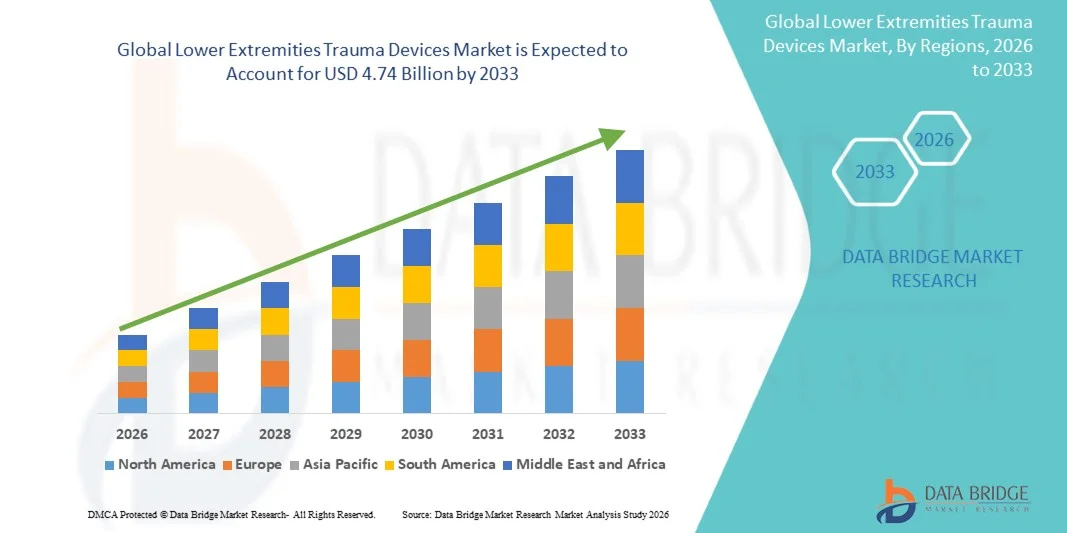
- The global lower extremities trauma devices market size was valued at USD 2.45 billion in 2025 and is expected to reach USD 4.74 billion by 2033, at a CAGR of 8.60% during the forecast period
- The market growth is largely fueled by the rising prevalence of lower limb injuries due to road accidents, sports-related injuries, and an aging population prone to fractures and osteoporosis. Technological advancements in fixation devices, minimally invasive surgical solutions, and orthopedic implants are further driving the adoption of these devices across hospitals and trauma centers globally
- Furthermore, increasing awareness among patients and healthcare providers about faster recovery, improved mobility, and better quality of life post-trauma is strengthening demand for innovative trauma devices. These converging factors are accelerating the uptake of lower extremities trauma solutions, thereby significantly boosting the industry's growth
Lower Extremities Trauma Devices Market Analysis
- Lower extremities trauma devices, including internal fixators and external fixators, are increasingly vital components of modern orthopedic trauma care in both hospital and ambulatory surgical settings due to their ability to stabilize fractures, support faster recovery, and improve patient mobility and outcomes
- The escalating demand for lower extremities trauma devices is primarily fueled by the rising incidence of road traffic accidents, sports injuries, and age-related fractures, along with technological advancements in minimally invasive surgical procedures, bioengineered implants, and enhanced fixation devices
- North America dominated the lower extremities trauma devices market with the largest revenue share of 40.9% in 2025, characterized by a well-established healthcare infrastructure, high healthcare expenditure, and a strong presence of key orthopedic device manufacturers. The U.S. experienced substantial growth in device adoption, particularly in hospitals, driven by innovations in internal and external fixators, patient-specific implants, and robotic-assisted orthopedic surgeries
- Asia-Pacific is expected to be the fastest-growing region in the lower extremities trauma devices market during the forecast period due to increasing urbanization, a rising elderly population, growing awareness of advanced orthopedic treatments, and expanding healthcare infrastructure in countries such as China and India
- Internal fixators segment dominated the lower extremities trauma devices market with a share of 55.3% in 2025, driven by their effectiveness in stabilizing fractures and widespread adoption across trauma surgeries
Report Scope and Lower Extremities Trauma Devices Market Segmentation
|
Attributes |
Lower Extremities Trauma Devices Key Market Insights |
|
Segments Covered |
|
|
Countries Covered |
North America
Europe
Asia-Pacific
Middle East and Africa
South America
|
|
Key Market Players |
|
|
Market Opportunities |
|
|
Value Added Data Infosets |
In addition to the insights on market scenarios such as market value, growth rate, segmentation, geographical coverage, and major players, the market reports curated by the Data Bridge Market Research also include in-depth expert analysis, patient epidemiology, pipeline analysis, pricing analysis, and regulatory framework |
Lower Extremities Trauma Devices Market Trends
“Advancements in Minimally Invasive and Bioengineered Fixation Devices”
- A significant and accelerating trend in the global lower extremities trauma devices market is the growing adoption of minimally invasive surgical techniques and bioengineered fixation devices, enhancing patient recovery and surgical precision
- For instance, intramedullary nails with 3D-printed patient-specific designs are increasingly being used for complex fractures, allowing surgeons to achieve precise alignment and stability while minimizing soft tissue damage
- Integration of smart surgical tools and navigation systems enables real-time feedback during surgery, reducing errors and improving postoperative outcomes, while advanced coatings on implants promote faster bone healing and reduce infection risk
- The seamless combination of imaging-guided surgical techniques with innovative implant materials facilitates more efficient procedures and reduced hospitalization periods, benefiting both patients and healthcare providers
- This trend toward highly personalized, precise, and biologically optimized trauma devices is fundamentally reshaping orthopedic trauma care standards. Consequently, companies such as Stryker and DePuy Synthes are developing patient-specific fixation solutions with improved biomechanical performance and minimally invasive insertion options
- The demand for trauma devices that combine surgical precision, bioengineered materials, and minimally invasive approaches is growing rapidly across hospitals and ambulatory surgical centers as patient outcomes and efficiency become key priorities
- Rising collaboration between orthopedic device manufacturers and academic research centers is accelerating the development of next-generation implants, such as bioresorbable and antimicrobial-coated devices, further driving market innovation
Lower Extremities Trauma Devices Market Dynamics
Driver
“Increasing Incidence of Lower Limb Injuries and Technological Advancements”
- The rising prevalence of road traffic accidents, sports-related injuries, and age-related fractures is a significant driver for the heightened demand for lower extremities trauma devices
- For instance, in March 2025, Stryker launched an advanced intramedullary nail system with integrated surgical guides, enhancing fracture fixation and recovery times for orthopedic patients
- As healthcare providers seek solutions that reduce recovery time and complications, trauma devices offering minimally invasive and patient-specific designs are increasingly preferred over traditional implants
- Furthermore, the expanding adoption of advanced imaging, navigation systems, and bioengineered implants is making trauma devices integral to improving surgical accuracy and overall patient outcomes
- The growing number of hospitals and ambulatory surgical centers focusing on orthopedic trauma care, along with rising awareness among patients and surgeons, is propelling the adoption of innovative trauma solutions
- Increasing government initiatives and funding for orthopedic trauma research and infrastructure in emerging markets are supporting the adoption of advanced devices
- Growing collaboration between device manufacturers and digital health companies is enabling the integration of IoT-enabled implants and remote monitoring capabilities, enhancing post-surgery patient management
Restraint/Challenge
“High Device Costs and Regulatory Compliance Barriers”
- Concerns surrounding the high cost of advanced trauma devices and stringent regulatory approvals pose significant challenges to broader market penetration
- For instance, delays in FDA or CE clearance for novel implants can slow adoption, causing hospitals and surgeons to prefer established, approved devices over newer technologies
- Addressing cost constraints through insurance coverage, hospital procurement strategies, and scalable production is crucial for broader adoption, while navigating complex regulatory pathways remains a critical hurdle for manufacturers
- In addition, the requirement for surgeon training and clinical validation for new devices can limit rapid uptake, particularly in emerging markets with resource constraints
- While prices are gradually becoming more competitive for standard implants, premium bioengineered and patient-specific solutions remain costly, potentially restricting adoption in cost-sensitive regions
- Overcoming these challenges through streamlined regulatory approvals, targeted training programs, and more cost-effective device production will be vital for sustained market growth
- Variability in reimbursement policies across regions can delay adoption, particularly for novel or high-cost trauma devices, creating market uncertainty
- Limited awareness and hesitation among patients regarding advanced implants and minimally invasive procedures may further slow market penetration, especially in developing countries
Lower Extremities Trauma Devices Market Scope
The market is segmented on the basis of type, surgical site, and end-user.
- By Type
On the basis of type, the lower extremities trauma devices market is segmented into internal fixators and external fixators. Internal Fixators dominated the market with the largest revenue share of 55.3% in 2025, driven by their effectiveness in stabilizing fractures of the lower extremities and their widespread adoption in hospitals and trauma centers. Surgeons often prefer internal fixators due to their ability to provide rigid stabilization, minimize soft tissue damage, and support faster patient recovery compared to traditional methods. The segment also benefits from technological advancements such as bioengineered coatings, minimally invasive insertion techniques, and patient-specific designs, enhancing surgical outcomes and reducing infection risks. Increasing orthopedic trauma cases, particularly in the lower leg and thigh, further boost demand for internal fixators. Their compatibility with advanced imaging and navigation systems also facilitates precise surgical placement. The established clinical efficacy and long-term reliability of internal fixators continue to drive the segment’s dominance globally.
External Fixators are anticipated to witness the fastest growth rate from 2026 to 2033, fueled by rising demand for complex fracture management and open trauma cases, especially in emergency and orthopedic trauma centers. External fixators offer flexible stabilization for fractures that are difficult to manage internally and are particularly useful for patients with multiple injuries or high-risk surgical profiles. The segment is also benefiting from innovations in lightweight materials, modular designs, and adjustable configurations, which improve patient comfort and surgical convenience. Increasing awareness of advanced trauma care and rising hospital infrastructure investments in emerging markets are further accelerating the adoption of external fixators. In addition, external fixators are widely used in outpatient orthopedic procedures and ambulatory surgical centers, contributing to their fast growth.
- By Surgical Site
On the basis of surgical site, the market is segmented into hips & pelvis, lower leg, foot & ankle, knee, and thigh. Lower Leg dominated the market in 2025 due to the high incidence of tibia and fibula fractures from road traffic accidents, sports injuries, and falls among the elderly. Lower leg trauma often requires precise fixation for proper mobility restoration, making both internal and external fixators essential in treatment. Surgeons favor devices that reduce recovery time, minimize complications, and provide durable stabilization, driving consistent demand. Increasing awareness of postoperative rehabilitation and faster mobility recovery also supports market growth. The segment benefits from technological integration with navigation systems and bioengineered implants to ensure accurate placement. Growing hospital and trauma center capacities in North America and Europe further reinforce dominance in this surgical site segment.
Foot & Ankle is expected to witness the fastest growth from 2026 to 2033, driven by rising sports injuries, urban accidents, and increased participation in physically demanding activities. Foot and ankle fractures require specialized, precise devices that can accommodate complex bone structures while allowing early mobility. The development of compact, minimally invasive internal fixators and adjustable external fixators enhances the segment’s attractiveness. Emerging markets are seeing growing investments in orthopedic trauma care facilities, contributing to rising adoption. Surgeons increasingly prefer devices that reduce surgical time and postoperative complications, further accelerating growth. The expanding use of patient-specific implants and bioengineered materials also supports this segment’s rapid expansion.
- By End-User
On the basis of end-user, the market is segmented into hospitals and ambulatory surgical centers (ASCs). Hospitals dominated the market in 2025 with 75% revenue share, driven by their concentration of orthopedic trauma care, advanced surgical facilities, and skilled surgeons. Hospitals handle the majority of complex fractures requiring internal or external fixators, particularly for multi-trauma patients. The segment benefits from technological adoption, including navigation-assisted surgery, bioengineered implants, and integrated recovery programs. High patient volumes, growing incidence of road accidents, and increasing geriatric trauma cases further sustain demand. Hospitals also serve as primary centers for clinical trials and product validation, reinforcing their market dominance. Partnerships with device manufacturers for training and research also enhance the segment’s competitive position.
Ambulatory Surgical Centers (ASCs) are expected to witness the fastest growth during the forecast period due to rising outpatient orthopedic procedures and the increasing preference for minimally invasive surgeries. ASCs provide cost-effective, convenient care for patients with isolated fractures or less severe trauma, reducing hospital burden and improving patient turnaround. Growing investments in ASC infrastructure, particularly in emerging markets, support this segment’s rapid adoption. Surgeons and patients increasingly prefer ASCs for their efficiency, shorter wait times, and personalized care. Integration of advanced devices such as modular internal and external fixators suitable for outpatient procedures accelerates growth. Increasing awareness among patients and orthopedic specialists about ASC capabilities further contributes to this segment’s expansion.
Lower Extremities Trauma Devices Market Regional Analysis
- North America dominated the lower extremities trauma devices market with the largest revenue share of 40.9% in 2025, characterized by a well-established healthcare infrastructure, high healthcare expenditure, and a strong presence of key orthopedic device manufacturers
- Patients and healthcare providers in the region highly value the effectiveness, precision, and reliability of internal and external fixators, along with minimally invasive surgical techniques and patient-specific implants that enhance recovery outcomes
- This widespread adoption is further supported by high healthcare expenditure, a strong presence of leading orthopedic device manufacturers, and growing hospital and trauma center capacities, establishing advanced trauma devices as the preferred solution for managing lower extremity fractures in both hospital and ambulatory surgical settings
U.S. Lower Extremities Trauma Devices Market Insight
The U.S. lower extremities trauma devices market captured the largest revenue share of 42% in 2025 within North America, fueled by a high incidence of road traffic accidents, sports injuries, and age-related fractures. Hospitals and trauma centers increasingly prioritize advanced internal and external fixators, minimally invasive surgical techniques, and patient-specific implants to improve recovery outcomes. The growing trend of outpatient orthopedic procedures and the adoption of navigation-assisted surgeries further propel the market. Moreover, technological integration, including bioengineered coatings and real-time surgical feedback systems, is significantly contributing to market expansion. Strong healthcare infrastructure, high healthcare expenditure, and a concentration of leading orthopedic device manufacturers reinforce market leadership.
Europe Lower Extremities Trauma Devices Market Insight
The Europe lower extremities trauma devices market is projected to expand at a substantial CAGR throughout the forecast period, driven by increasing orthopedic trauma cases and stringent regulatory standards ensuring high-quality medical devices. Growing urbanization, coupled with improved healthcare access and infrastructure, is fostering adoption of advanced trauma devices. European healthcare providers are increasingly incorporating internal and external fixators in hospitals and surgical centers to manage complex fractures. The region also sees growth in both new orthopedic facilities and renovations of trauma units, enhancing device utilization. Consumer awareness about faster recovery and minimally invasive options further supports market expansion.
U.K. Lower Extremities Trauma Devices Market Insight
The U.K. lower extremities trauma devices market is anticipated to grow at a noteworthy CAGR during the forecast period, driven by rising fracture incidences, sports injuries, and an aging population. Hospitals and trauma centers are adopting advanced fixation devices to enhance patient outcomes and reduce recovery times. Increasing emphasis on outpatient orthopedic procedures and ambulatory surgical care is boosting device usage. Moreover, the UK’s robust healthcare infrastructure and high adoption of innovative trauma solutions are expected to stimulate market growth. Regulatory support for high-quality trauma devices further encourages the integration of minimally invasive and bioengineered implants in clinical practice.
Germany Lower Extremities Trauma Devices Market Insight
The Germany lower extremities trauma devices market is expected to expand at a considerable CAGR during the forecast period, fueled by technological advancements, awareness of improved orthopedic care, and rising prevalence of fractures in the aging population. Germany’s well-developed healthcare infrastructure, emphasis on innovation, and early adoption of bioengineered implants promote the adoption of advanced trauma devices. Both internal and external fixators are increasingly used in hospitals and surgical centers for complex lower limb fractures. The integration of navigation-assisted surgeries and minimally invasive techniques is enhancing surgical precision and patient recovery. A strong focus on patient safety and clinical outcomes aligns with local expectations, supporting market growth.
Asia-Pacific Lower Extremities Trauma Devices Market Insight
The Asia-Pacific lower extremities trauma devices market is poised to grow at the fastest CAGR of 14% during the forecast period of 2026 to 2033, driven by increasing road accidents, sports injuries, and rising geriatric population in countries such as China, India, and Japan. Growing urbanization, expanding hospital infrastructure, and rising awareness of advanced orthopedic treatments are accelerating adoption. Technological advancements, including patient-specific internal fixators and minimally invasive surgery, further drive demand. In addition, government initiatives promoting healthcare modernization and trauma care accessibility are supporting growth. The increasing availability of affordable trauma devices and expansion of domestic manufacturing capabilities are making devices more accessible to a wider patient base.
Japan Lower Extremities Trauma Devices Market Insight
The Japan lower extremities trauma devices market is gaining momentum due to the country’s aging population, high awareness of advanced medical care, and strong focus on patient outcomes. The adoption of minimally invasive internal and external fixators is rising, supported by technologically advanced hospitals and surgical centers. Integration of imaging-guided navigation systems and bioengineered implants is improving surgical precision and postoperative recovery. Growing prevalence of sports injuries and fractures among the elderly is further fueling demand. Moreover, Japan’s emphasis on high-quality, reliable medical devices aligns with patient and provider expectations, boosting market growth across residential and commercial healthcare settings.
India Lower Extremities Trauma Devices Market Insight
The India lower extremities trauma devices market accounted for the largest market revenue share in Asia-Pacific in 2025, attributed to rapid urbanization, high road traffic accident rates, and increasing awareness of advanced orthopedic care. Hospitals and ambulatory surgical centers are increasingly adopting internal and external fixators to manage complex fractures. Rising government initiatives for healthcare modernization, expanding hospital infrastructure, and the growing middle-class population are key factors driving the market. Affordable trauma device options and the presence of domestic manufacturers further support adoption. The increasing focus on minimally invasive procedures and faster recovery times is fueling the market across both public and private healthcare sectors.
Lower Extremities Trauma Devices Market Share
The Lower Extremities Trauma Devices industry is primarily led by well-established companies, including:
- Stryker Corporation (U.S.)
- Zimmer Biomet (U.S.)
- Smith & Nephew (U.K.)
- Medtronic (Ireland)
- Enovis (U.S.)
- Orthofix Medical Inc. (U.S.)
- Exactech, Inc. (U.S.)
- NuVasive, Inc. (U.S.)
- B. Braun SE (Germany)
- Globus Medical, Inc. (U.S.)
- CONMED Corporation (U.S.)
- MicroPort Orthopedics (China)
- Össur hf. (Iceland)
- Paragon Medical (U.S.)
- Integra LifeSciences Corporation (U.S.)
- Acumed LLC (U.S.)
- Medartis AG (Switzerland)
- Advanced Orthopaedic Solutions (U.S.)
- Meril Life Sciences (India)
What are the Recent Developments in Global Lower Extremities Trauma Devices Market?
- In November 2025, Pace Surgical announced FDA 510(k) clearance for its Ultra Compression Screw System™, a novel internal fixation device indicated for arthrodesis, osteotomies, fractures, and nonunion of the foot and ankle, engineered to deliver predictable compression, high pull‑out strength, and consistent torque addressing longstanding challenges in achieving reliable bone apposition and stable union during reconstructive trauma procedures
- In July 2025, Dev4 received FDA 510(k) clearance for its Eleganz™ Fusion Screw System, an internal fixation solution aimed at bone reconstruction and fracture repair, allowing surgeons to use the system for fusion and fixation of small bone fractures, expanding options in trauma care devices
- In March 2025, Zimmer Biomet announced plans to acquire Paragon 28 in a deal valued at approximately USD 1.1 billion, strengthening Zimmer’s trauma and fracture repair capability and expanding its specialized foot and ankle device portfolio including trauma fixation tools for lower limb fractures
- In October 2024, Johnson & Johnson MedTech launched its VOLT™ Variable Angle Optimized Locking Technology Plating System designed to improve fracture management with enhanced flexibility, stability, and performance across a broad range of orthopedic procedures including lower extremity fixation, marking a significant innovation in trauma plating solutions
- In October 2023, DePuy Synthes received FDA 510(k) clearance for its TriLEAP™ Lower Extremity Anatomic Plating System, a modular plating solution designed to support internal fixation and fusion procedures in the forefoot, midfoot, and hindfoot regions; this clearance enables orthopedic and foot & ankle specialists to use a diverse set of contoured plates that enhance surgical flexibility and improve fracture stabilization options in complex lower extremity trauma cases
SKU-
Получите онлайн-доступ к отчету на первой в мире облачной платформе рыночной аналитики

- Интерактивная панель анализа данных
- Панель анализа компании для возможностей с высоким потенциалом роста
- Доступ аналитика-исследователя для настройки и запросов
- Анализ конкурентов с помощью интерактивной панели
- Последние новости, обновления и анализ тенденций
- Используйте возможности сравнительного анализа для комплексного отслеживания конкурентов
Методология исследования
Сбор данных и анализ базового года выполняются с использованием модулей сбора данных с большими размерами выборки. Этап включает получение рыночной информации или связанных данных из различных источников и стратегий. Он включает изучение и планирование всех данных, полученных из прошлого заранее. Он также охватывает изучение несоответствий информации, наблюдаемых в различных источниках информации. Рыночные данные анализируются и оцениваются с использованием статистических и последовательных моделей рынка. Кроме того, анализ доли рынка и анализ ключевых тенденций являются основными факторами успеха в отчете о рынке. Чтобы узнать больше, пожалуйста, запросите звонок аналитика или оставьте свой запрос.
Ключевой методологией исследования, используемой исследовательской группой DBMR, является триангуляция данных, которая включает в себя интеллектуальный анализ данных, анализ влияния переменных данных на рынок и первичную (отраслевую экспертную) проверку. Модели данных включают сетку позиционирования поставщиков, анализ временной линии рынка, обзор рынка и руководство, сетку позиционирования компании, патентный анализ, анализ цен, анализ доли рынка компании, стандарты измерения, глобальный и региональный анализ и анализ доли поставщика. Чтобы узнать больше о методологии исследования, отправьте запрос, чтобы поговорить с нашими отраслевыми экспертами.
Доступна настройка
Data Bridge Market Research является лидером в области передовых формативных исследований. Мы гордимся тем, что предоставляем нашим существующим и новым клиентам данные и анализ, которые соответствуют и подходят их целям. Отчет можно настроить, включив в него анализ ценовых тенденций целевых брендов, понимание рынка для дополнительных стран (запросите список стран), данные о результатах клинических испытаний, обзор литературы, обновленный анализ рынка и продуктовой базы. Анализ рынка целевых конкурентов можно проанализировать от анализа на основе технологий до стратегий портфеля рынка. Мы можем добавить столько конкурентов, о которых вам нужны данные в нужном вам формате и стиле данных. Наша команда аналитиков также может предоставить вам данные в сырых файлах Excel, сводных таблицах (книга фактов) или помочь вам в создании презентаций из наборов данных, доступных в отчете.











