



Global Remote Learning Technology Spending Market Segmentation, By Solution (Software and Services), Learning Mode (Instructor-Led Training and Learning, Self-Paced eLearning, Blended/ Hybrid eLearning, Social Learning, Collaborative Learning, and Simulation Learning), End Users (Individual and Government Organizations and Academic Institutions) – Industry Trends and Forecast to 2032
Remote Learning Technology Spending Market Analysis
The remote learning technology spending market has witnessed significant growth, driven by advancements in digital education tools and increased adoption across educational institutions and businesses. The COVID-19 pandemic accelerated the shift towards online learning, highlighting the need for robust digital platforms and sparking substantial investments in remote learning technologies. Innovations such as AI-driven personalized learning, interactive and immersive experiences with AR/VR, and advanced learning management systems (LMS) have transformed how education and training are delivered. Companies such as Microsoft, Adobe, and SAP have expanded their offerings to meet the growing demand for flexible and scalable solutions. In addition, the integration of cloud-based technologies has facilitated seamless access to resources and courses from anywhere, boosting the appeal of remote learning. The market is also supported by increased smartphone penetration and improved internet connectivity, particularly in regions such as Asia-Pacific, where mobile learning has become a popular option. As educational institutions and enterprises recognize the long-term benefits of remote learning, ongoing advancements in user experience, data analytics, and content delivery are expected to sustain the market’s growth trajectory.
Remote Learning Technology Spending Market Size
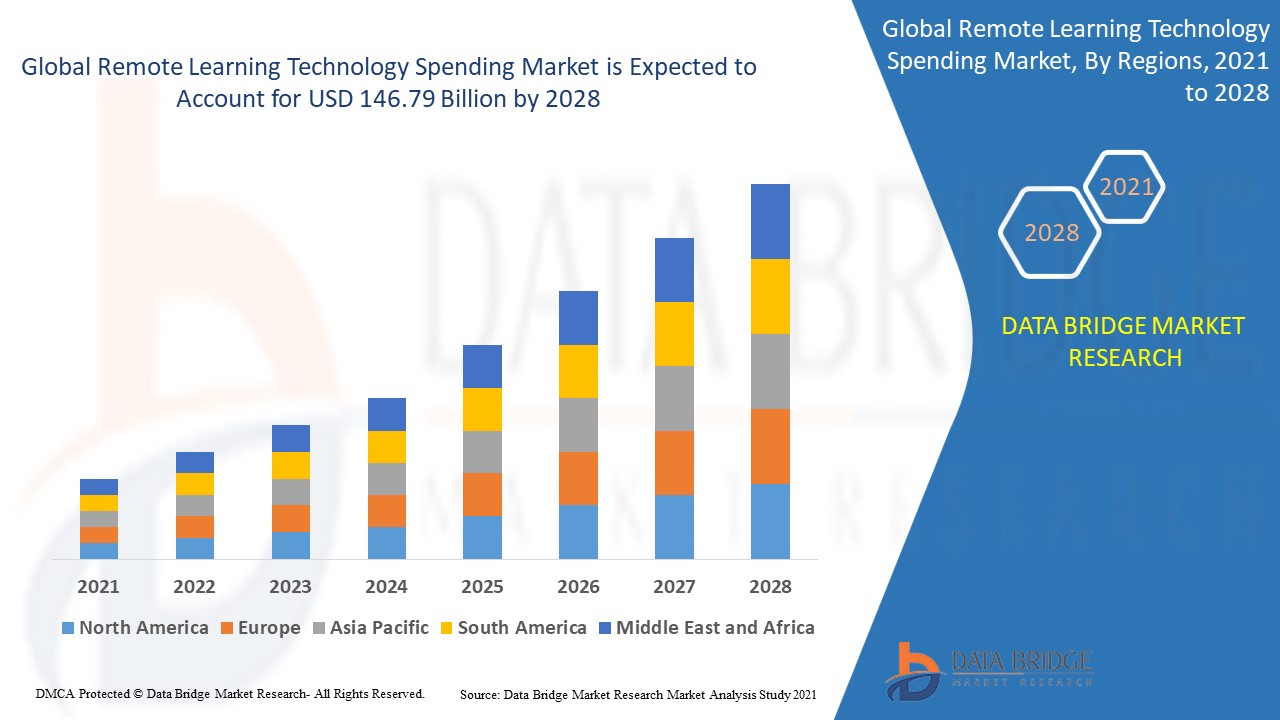
The global remote learning technology spending market size was valued at USD 84.80 billion in 2024 and is projected to reach USD 254.06 billion by 2032, with a CAGR of 14.70% during the forecast period of 2025 to 2032. In addition to the market insights such as market value, growth rate, market segments, geographical coverage, market players, and market scenario, the market report curated by the Data Bridge Market Research team includes in-depth expert analysis, import/export analysis, pricing analysis, production consumption analysis, and pestle analysis.
Remote Learning Technology Spending Market Trends
“Increasing Adoption of AI-Powered Personalized Learning Platforms”
A significant trend in the remote learning technology spending market is the adoption of AI-powered personalized learning platforms. These platforms leverage artificial intelligence to create adaptive learning paths tailored to individual student needs, enhancing engagement and knowledge retention. For instance, platforms such as Adobe Captivate and Instructure's Canvas have incorporated AI to deliver targeted content and real-time feedback, which has proven valuable for both students and educators. This trend is driven by the demand for more interactive and effective learning experiences that can cater to diverse learning paces and styles. The use of machine learning algorithms allows educators to gain insights into student progress and customize teaching strategies accordingly. With remote learning becoming a permanent fixture in educational and corporate settings, this technology is expected to grow as more institutions invest in sophisticated, scalable solutions to improve accessibility and learning outcomes.
Report Scope and Remote Learning Technology Spending Market Segmentation
|
Attributes |
Remote Learning Technology Spending Key Market Insights |
|
Segments Covered |
|
|
Countries Covered |
U.S., Canada and Mexico in North America, Germany, France, U.K., Netherlands, Switzerland, Belgium, Russia, Italy, Spain, Turkey, Rest of Europe in Europe, China, Japan, India, South Korea, Singapore, Malaysia, Australia, Thailand, Indonesia, Philippines, Rest of Asia-Pacific (APAC) in the Asia-Pacific (APAC), Saudi Arabia, U.A.E, South Africa, Egypt, Israel, Rest of Middle East and Africa (MEA) as a part of Middle East and Africa (MEA), Brazil, Argentina and Rest of South America as part of South America |
|
Key Market Players |
Oracle (U.S.), Microsoft (U.S.), IBM (U.S.), Adobe (U.S.), WizIQ (India), OnDemand, Inc. (U.S.), Cornerstone (U.S.), Hurix (India), Skillsoft (U.S.), Anthology Inc. (U.S.), e-Zest Solutions (India), Allen Interactions (U.S.), LTGplc (U.K.), SAP (Germany), Instructure, Inc. (U.S.), Infor (U.S.), Intuition (Ireland), Kallidus Limited (U.K.), and City & Guilds Group (U.K.) |
|
Market Opportunities |
|
|
Value Added Data Infosets |
In addition to the market insights such as market value, growth rate, market segments, geographical coverage, market players, and market scenario, the market report curated by the Data Bridge Market Research team includes in-depth expert analysis, import/export analysis, pricing analysis, production consumption analysis, and pestle analysis. |
Remote Learning Technology Spending Market Definition
Remote learning technology spending refers to the financial investments made by educational institutions, businesses, and governments in digital tools and platforms designed to facilitate learning outside traditional classroom settings. This includes expenditures on software, hardware, learning management systems (LMS), virtual classrooms, video conferencing tools, AI-driven educational applications, and other digital resources that enable remote education and training. The spending supports the development, implementation, and maintenance of technology solutions that enhance accessibility, engagement, and educational outcomes for learners of all ages and backgrounds.
Remote Learning Technology Spending Market Dynamics
Drivers
- Increasing Digitization of Economies
The increasing digitization of economies has significantly boosted the remote learning technology spending market, as businesses and educational institutions prioritize digital transformation to keep up with modern demands. According to a report by the World Economic Forum, digital transformation is expected to add USD 100 trillion to the global economy by 2025, underlining the urgency for adopting advanced digital solutions, including remote learning technologies. This shift has been particularly evident in emerging markets, where governments and private sectors are investing heavily in digital infrastructure to enhance accessibility to education and training. For instance, in countries such as India and Brazil, rapid internet expansion and smartphone usage have catalyzed the use of e-learning platforms, making education more inclusive and accessible. The digitization trend is driving educational institutions and organizations to adopt scalable remote learning technologies to stay competitive, making it a crucial driver for market growth.
- Increasing Demand for Flexible Learning Solutions
The increasing demand for flexible learning solutions has become a major driver for the remote learning technology spending market, as both educational institutions and businesses adapt to new learning preferences. The shift towards hybrid and remote education models, accelerated by the COVID-19 pandemic, highlighted the need for versatile and scalable digital tools. For instance, a survey by Educause revealed that 93% of higher education leaders planned to continue offering remote and hybrid learning options post-pandemic, emphasizing the ongoing need for robust learning technologies. The flexibility offered by online learning solutions enables institutions to reach a broader audience, accommodate different learning styles, and adapt to changing circumstances, such as public health concerns or geographic limitations. This trend is driving investments in advanced learning platforms that provide features such as interactive content, AI-driven assessments, and seamless integration with other digital tools, further propelling the growth of the remote learning technology market.
Opportunities
- Increasing Advancements in Technology
Advancements in technology have created significant market opportunities for the remote learning technology spending sector, with innovations in artificial intelligence (AI), virtual reality (VR), and augmented reality (AR) enhancing the effectiveness and interactivity of learning platforms. For instance, AI-powered learning platforms such as Canvas and Blackboard use machine learning algorithms to personalize content and provide real-time feedback, making education more adaptable to individual needs. VR and AR technologies, such as those offered by platforms such as ClassVR, provide immersive experiences that simulate real-world environments, which can be especially beneficial for subjects such as medicine, engineering, and science. These technological advancements improve engagement and retention and enable remote learning to become more interactive and practical, bridging the gap between traditional classroom experiences and online education. As educational institutions and businesses look to improve learning outcomes and training effectiveness, the demand for these advanced technologies is expected to grow, presenting substantial opportunities for investment and development in the remote learning technology market.
- Growing Penetration of the Internet, Smartphones, and Laptops
The growing penetration of the internet, smartphones, laptops, and other devices has created a significant market opportunity for remote learning technology spending. With the number of internet users globally reaching over 5 billion in 2023, and smartphone penetration exceeding 90% in regions such as Asia-Pacific and Latin America, more people now have access to online education platforms than ever before. For instance, platforms such as Coursera and Udemy have seen exponential growth in user numbers, driven by the widespread use of mobile devices and laptops that make e-learning accessible anytime and anywhere. In addition, affordable and high-speed internet in developing countries is breaking down barriers to education, enabling more students to take part in remote learning programs. This increasing accessibility is propelling the demand for advanced e-learning solutions that are compatible with various devices, creating a lucrative opportunity for companies to innovate and cater to a larger, more diverse audience.
Restraints/Challenges
- High Costs and Budget Constraints
High costs and budget constraints are a significant challenge in the remote learning technology spending market, as they can limit the ability of schools, universities, and individuals to adopt and maintain effective digital learning solutions. The initial investment required to purchase hardware such as laptops, tablets, and necessary software can be substantial, making it difficult for underfunded schools and lower-income families to afford. For instance, during the COVID-19 pandemic, many school districts faced major financial challenges when trying to equip students with the technology needed for remote learning, highlighting the gap between those with adequate resources and those without. Beyond the initial costs, ongoing expenses such as software updates, maintenance, technical support, and training add to the financial burden. Budget constraints can force educational institutions to make difficult choices between investing in remote learning technologies and other essential needs, ultimately impacting the quality and accessibility of education. This challenge underscores the need for affordable technology solutions, government support programs, and partnerships between the public and private sectors to ensure equitable access to remote learning tools and resources.
- Cybersecurity and Data Privacy
Cybersecurity and data privacy are significant challenges in the remote learning technology spending market, as the increased use of online platforms heightens the risk of data breaches, hacking, and other cyber threats. Remote learning systems handle a large volume of sensitive student data, including personal information, academic records, and payment details, making them attractive targets for cybercriminals. For instance, during the rapid shift to online education caused by the COVID-19 pandemic, there were multiple reports of schools and universities experiencing cyberattacks, including ransomware incidents that disrupted classes and compromised student data. The challenge is compounded by the need to comply with data protection regulations such as GDPR or CCPA, which can be complex and costly to navigate. Ensuring robust cybersecurity measures and data privacy protocols adds to the operational costs and requires ongoing investment in secure infrastructure, employee training, and incident response plans. Failure to address these challenges can lead to trust issues, potential legal repercussions, and a reluctance to adopt remote learning solutions. This highlights the need for secure, compliant platforms and strategies that protect student information while maintaining the functionality of remote learning systems.
This market report provides details of new recent developments, trade regulations, import-export analysis, production analysis, value chain optimization, market share, impact of domestic and localized market players, analyses opportunities in terms of emerging revenue pockets, changes in market regulations, strategic market growth analysis, market size, category market growths, application niches and dominance, product approvals, product launches, geographic expansions, technological innovations in the market. To gain more info on the market contact Data Bridge Market Research for an Analyst Brief, our team will help you take an informed market decision to achieve market growth.
Remote Learning Technology Spending Market Scope
The market is segmented on the basis of solution, learning mode, and end users. The growth amongst these segments will help you analyze meagre growth segments in the industries and provide the users with a valuable market overview and market insights to help them make strategic decisions for identifying core market applications.
Solution
- Software
- Services
Learning Mode
- Instructor-Led Training and Learning
- Self-Paced eLearning
- Blended/Hybrid eLearning
- Social Learning
- Collaborative Learning
- Simulation Learning
End Users
- Individual
- Government Organizations
- Academic Institutions
Remote Learning Technology Spending Market Regional Analysis
The market is analyzed and market size insights and trends are provided by country, solution, learning mode, and end users as referenced above.
The countries covered in the market report are U.S., Canada, Mexico in North America, Germany, Sweden, Poland, Denmark, Italy, U.K., France, Spain, Netherland, Belgium, Switzerland, Turkey, Russia, Rest of Europe in Europe, Japan, China, India, South Korea, New Zealand, Vietnam, Australia, Singapore, Malaysia, Thailand, Indonesia, Philippines, Rest of Asia-Pacific (APAC) in Asia-Pacific (APAC), Brazil, Argentina, Rest of South America as a part of South America, U.A.E, Saudi Arabia, Oman, Qatar, Kuwait, South Africa, Rest of Middle East and Africa (MEA) as a part of Middle East and Africa (MEA).
North America leads the remote learning technology spending market and is expected to maintain and grow its market share throughout the forecast period. This growth is driven by the increasing adoption of remote learning solutions among small and medium-sized enterprises (SMEs) and academic institutions seeking more flexible and effective education and training methods. The region’s robust infrastructure, strong emphasis on technological advancements, and support for digital transformation have further fueled this trend. In addition, the need for innovative and accessible learning tools, accelerated by factors such as the COVID-19 pandemic, has reinforced the demand for remote learning technology in North America.
Asia-Pacific is anticipated to exhibit the highest growth rate in the remote learning technology spending market during the forecast period. This surge is driven by increased internet access and widespread smartphone adoption, particularly in developing countries such as India and China. The region's shift towards digital platforms and online business models has further fueled the demand for remote learning solutions, creating significant market growth opportunities. As businesses and educational institutions adapt to evolving technology needs and prioritize online accessibility, the demand for innovative remote learning tools continues to rise, making Asia-Pacific a key player in the expansion of this market.
The country section of the report also provides individual market impacting factors and changes in market regulation that impact the current and future trends of the market. Data points such as down-stream and upstream value chain analysis, technical trends and porter's five forces analysis, case studies are some of the pointers used to forecast the market scenario for individual countries. Also, the presence and availability of global brands and their challenges faced due to large or scarce competition from local and domestic brands, impact of domestic tariffs and trade routes are considered while providing forecast analysis of the country data.
Remote Learning Technology Spending Market Share
The market competitive landscape provides details by competitor. Details included are company overview, company financials, revenue generated, market potential, investment in research and development, new market initiatives, global presence, production sites and facilities, production capacities, company strengths and weaknesses, product launch, product width and breadth, application dominance. The above data points provided are only related to the companies' focus related to market.
Remote Learning Technology Spending Market Leaders Operating in the Market Are:
- Oracle (U.S.)
- Microsoft (U.S.)
- IBM (U.S.)
- Adobe (U.S.)
- WizIQ (India)
- OnDemand, Inc. (U.S.)
- Cornerstone (U.S.)
- Hurix (India)
- Skillsoft (U.S.)
- Anthology Inc. (U.S.)
- e-Zest Solutions (India)
- Allen Interactions (U.S.)
- LTGplc (U.K.)
- SAP (Germany)
- Instructure, Inc. (U.S.)
- Infor (U.S.)
- Intuition (Ireland)
- Kallidus Limited (U.K.)
- City & Guilds Group (U.K.)
Latest Developments in Remote Learning Technology Spending Market
- In February 2024, Mr. Dharmendra Pradhan, the Minister of Education and Minister of Skill Development and Entrepreneurship of India, inaugurated a partnership between the National Skill Development Corporation (NSDC) and TeamLease EdTech. This collaboration is aimed at boosting employability through skill development, with a focus on promoting work-integrated degree programs
- In November 2023, Stones2Milestones, an Indian EdTech platform, collaborated with Finnish Global Education Solutions Oy to integrate the Finnish education model into Indian schools. The partnership emphasizes numeracy and literacy development, teacher professional training, and the creation of advanced technology solutions for global implementation
- In April 2023, Echo360 launched new EdTech SaaS platforms, including EchoPollTM for interactive polling, EchoVideoTM with improved editing tools and accessibility, and ExamViewTM featuring advanced assessment capabilities. These new offerings are designed to enhance learning experiences, focusing on student engagement, accessibility, and streamlined workflows, reinforcing Echo360's position as a leader in the EdTech space
- In September 2020, 2U, Inc. partnered with Colgate University to offer students an enriched and engaging online learning experience amid the COVID-19 pandemic. This collaboration aimed to provide college faculty with unique opportunities for skill development and to reimagine existing teaching methodologies to enhance their current approaches
- In July 2020, Blackboard, Inc. launched a data-driven, scalable student retention solution designed to enable educational institutions to offer personalized coaching and early student intervention
SKU-
Получите онлайн-доступ к отчету на первой в мире облачной платформе рыночной аналитики

- Интерактивная панель анализа данных
- Панель анализа компании для возможностей с высоким потенциалом роста
- Доступ аналитика-исследователя для настройки и запросов
- Анализ конкурентов с помощью интерактивной панели
- Последние новости, обновления и анализ тенденций
- Используйте возможности сравнительного анализа для комплексного отслеживания конкурентов
Методология исследования
Сбор данных и анализ базового года выполняются с использованием модулей сбора данных с большими размерами выборки. Этап включает получение рыночной информации или связанных данных из различных источников и стратегий. Он включает изучение и планирование всех данных, полученных из прошлого заранее. Он также охватывает изучение несоответствий информации, наблюдаемых в различных источниках информации. Рыночные данные анализируются и оцениваются с использованием статистических и последовательных моделей рынка. Кроме того, анализ доли рынка и анализ ключевых тенденций являются основными факторами успеха в отчете о рынке. Чтобы узнать больше, пожалуйста, запросите звонок аналитика или оставьте свой запрос.
Ключевой методологией исследования, используемой исследовательской группой DBMR, является триангуляция данных, которая включает в себя интеллектуальный анализ данных, анализ влияния переменных данных на рынок и первичную (отраслевую экспертную) проверку. Модели данных включают сетку позиционирования поставщиков, анализ временной линии рынка, обзор рынка и руководство, сетку позиционирования компании, патентный анализ, анализ цен, анализ доли рынка компании, стандарты измерения, глобальный и региональный анализ и анализ доли поставщика. Чтобы узнать больше о методологии исследования, отправьте запрос, чтобы поговорить с нашими отраслевыми экспертами.
Доступна настройка
Data Bridge Market Research является лидером в области передовых формативных исследований. Мы гордимся тем, что предоставляем нашим существующим и новым клиентам данные и анализ, которые соответствуют и подходят их целям. Отчет можно настроить, включив в него анализ ценовых тенденций целевых брендов, понимание рынка для дополнительных стран (запросите список стран), данные о результатах клинических испытаний, обзор литературы, обновленный анализ рынка и продуктовой базы. Анализ рынка целевых конкурентов можно проанализировать от анализа на основе технологий до стратегий портфеля рынка. Мы можем добавить столько конкурентов, о которых вам нужны данные в нужном вам формате и стиле данных. Наша команда аналитиков также может предоставить вам данные в сырых файлах Excel, сводных таблицах (книга фактов) или помочь вам в создании презентаций из наборов данных, доступных в отчете.











