The global slewing bearings market is experiencing growth driven by expanding applications across construction, mining, renewable energy, industrial automation, and material-handling industries. Increasing infrastructure development and rising demand for heavy machinery are strengthening the need for reliable rotational components capable of supporting heavy axial, radial, and moment loads. Slewing bearings are widely used in cranes, excavators, drilling equipment, and lifting systems to enable smooth rotation and improve operational efficiency.
Furthermore, the expansion of wind energy installations is increasing demand for bearings used in turbine yaw and pitch systems. Growing investments in automated manufacturing, robotics, and precision machinery are also creating opportunities for advanced bearing solutions. In addition, manufacturers are focusing on improving load capacity, durability, sealing performance, and lubrication efficiency to meet demanding operating conditions, reduce equipment downtime, and extend service life across industrial applications.
Access Full Report @ https://www.databridgemarketresearch.com/reports/global-slewing-bearings-market
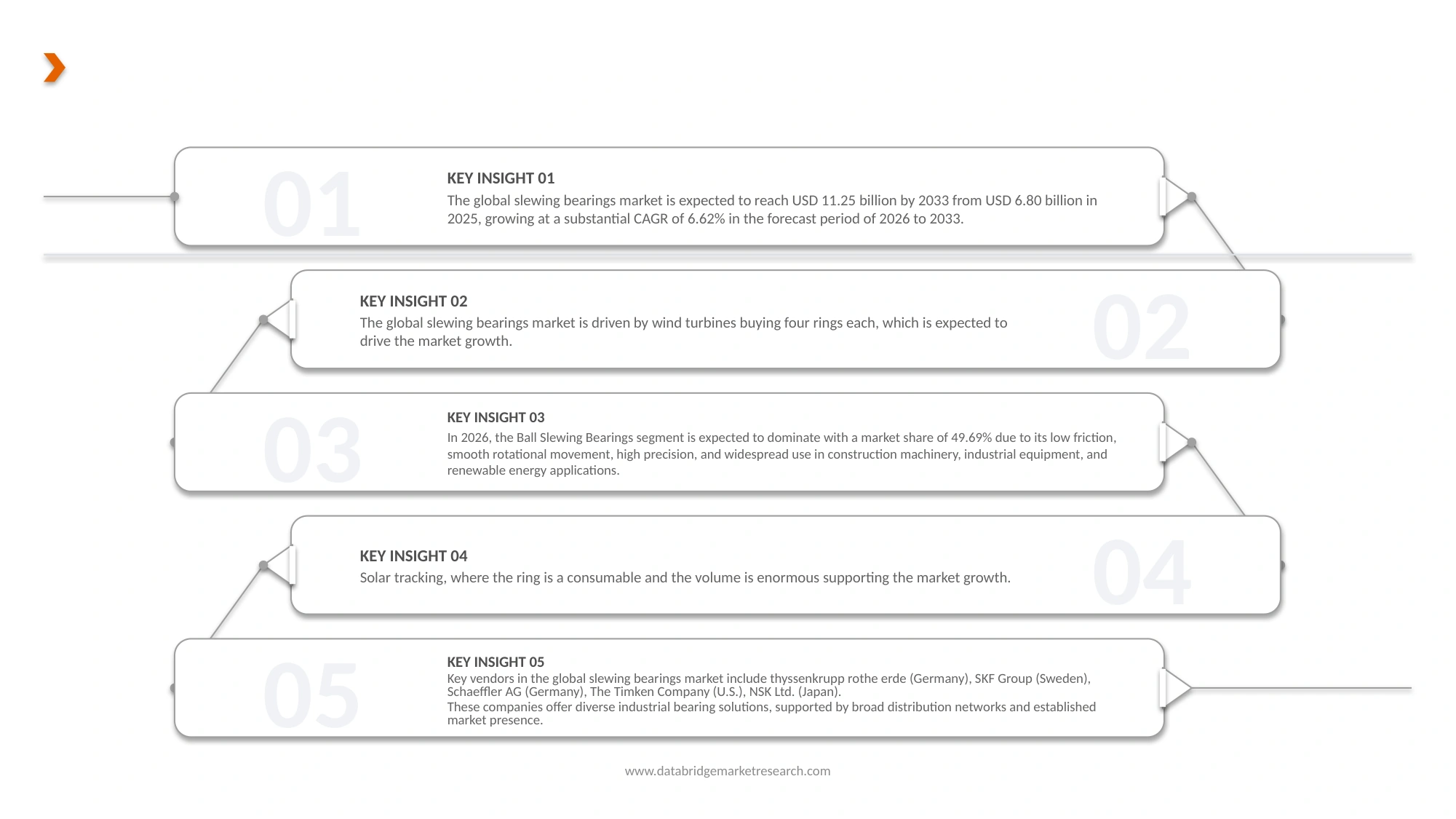
Data Bridge market research analyzes that the Global Slewing Bearings Market is expected to reach USD 11.25 billion by 2033 from USD 6.80 billion in 2025, growing at a substantial CAGR of 6.62% in the forecast period of 2026 to 2033.
Key Findings of the Study
Wind Turbines Buying Four Rings Each
The increasing installation of wind turbines is driving demand in the global slewing bearings market, as these systems require specialized bearings to support rotational movement and withstand heavy operational loads. A typical wind turbine commonly uses multiple large slewing bearings, with four rings or bearing units potentially required depending on the turbine design and configuration. These components are used in critical systems, including blade pitch adjustment and nacelle yaw positioning, enabling turbines to optimize blade angles and align with changing wind directions.
The expansion of onshore and offshore wind energy projects is increasing demand for durable, high-load-capacity bearings that can operate reliably under variable weather conditions. Furthermore, growing investments in renewable energy infrastructure and the development of larger-capacity turbines are creating opportunities for manufacturers to supply advanced slewing bearings with improved fatigue resistance, sealing performance, and service life.
Report Scope and Market Segmentation
|
Report Metric
|
Details
|
|
Forecast Period
|
2026 to 2033
|
|
Base Year
|
2025
|
|
Historic Years
|
2018-2024 (Customizable to 2013-2017)
|
|
Quantitative Units
|
Revenue in USD millions
|
|
Segments Covered
|
By Product Type (Ball Slewing Bearings, Roller Slewing Bearings, Ball and Roller Combination Slewing Bearings, Wire Race Slewing Bearings, Thin Section Slewing Bearings, Segmental Slewing Bearings, Customized Slewing Bearings), By Mounting Configuration (Flanged, Non-Flanged, Integral Mounting, Split), By Load Capacity (Light Duty, Medium Duty, Heavy Duty, Ultra-Heavy Duty), By Sealing Type (Single Seal, Double Seal, Contact Seal, Non-Contact Seal, High-Performance Sealed), By Application (Construction Equipment, Mining Equipment, Wind Energy, Industrial Machinery & Automation, Marine & Offshore Equipment, Agriculture & Forestry Equipment, Railway Equipment, Medical Equipment, Aerospace & Defense Equipment, Amusement Equipment, Port Equipment, Solar Energy Equipment, Automotive & Transportation, Power Transmission, Material Handling & Logistics, Others), By Distribution Channel (OEM, Aftermarket, Direct Sales, System Integrators / Equipment Manufacturers, Industrial Dealers), By Gear Configuration (External Gear, Internal Gear, Gearless), By Material (Carbon Steel, Alloy Steel, Stainless Steel, Hardened Steel, Corrosion-Resistant Materials, Special Alloys), By Manufacturing Process (Forged, Rolled Ring, Machined, Precision Ground, Heat Treated), By End User Industry (Construction, Mining, Renewable Energy, Industrial Manufacturing, Marine & Offshore, Agriculture & Forestry, Railway, Aerospace & Defense, Healthcare, Material Handling & Logistics, Ports & Harbors, Amusement & Recreation, Energy & Utilities, Automotive & Transportation, Power Transmission, Others)
|
|
Countries Covered
|
China, Japan, India, South Korea, Thailand, Malaysia, Indonesia, Vietnam, Taiwan, Philippines, Singapore, New Zealand, Australia, Rest of Asia-Pacific, Germany, France, Spain, U.K., Italy, Turkey, Poland, Belgium, Netherlands, Sweden, Russia, Switzerland, Denmark, Finland, Norway, Rest of Europe, U.S., Mexico, Canada, Brazil, Argentina, Colombia, Chile, Peru, Ecuador, Uruguay, Paraguay, Bolivia, Venezuela, Rest of South America, South Africa, Egypt, Saudi Arabia, U.A.E, Israel, Kuwait, Oman, Qatar, Bahrain, Rest of Middle East & Africa
|
|
Market Players Covered
|
|
|
Data Points Covered in the Report
|
In addition to the insights on market scenarios such as market value, growth rate, segmentation, geographical coverage, and major players, the market reports curated by the Data Bridge Market Research also include in-depth expert analysis, geographically represented company-wise production and capacity, network layouts of distributors and partners, detailed and updated price trend analysis and deficit analysis of supply chain and demand.
|
Segment Analysis
The global slewing bearings market is segmented into ten notable segments based on product type, mounting configuration, load capacity, sealing type, application, distribution channel, gear configuration, material, manufacturing process, and end user industry.
- On the basis of product type, the global slewing bearings market is segmented into ball slewing bearings, roller slewing bearings, ball and roller combination slewing bearings, wire race slewing bearings, thin section slewing bearings, segmental slewing bearings, customized slewing bearing.
In 2026, the ball slewing bearings segment is expected to dominate the market
In 2026, the ball slewing bearings segment is expected to dominate due to its low friction, smooth rotational performance, high precision, and ability to support axial and radial loads, making it suitable for construction machinery, industrial equipment, and renewable energy applications.
- On the basis of mounting configuration, the global slewing bearings market is segmented into flanged, non-flanged, integral mounting, split.
In 2026, the non-flanged segment is expected to dominate the market
In 2026, the non-flanged segment is expected to dominate the non-dairy creamer market due to its suitability for conventional product designs, cost-effective manufacturing, ease of integration, and widespread use across standard industrial applications.
- On the basis of load capacity, the global slewing bearings market is segmented into light duty, medium duty, heavy duty, ultra-heavy duty.
In 2026, the heavy duty segment is expected to dominate the market
In 2026, the heavy duty segment is expected to dominate the global slewing bearings market due to its high load-bearing capacity, durability, and suitability for demanding applications in construction machinery, mining equipment, cranes, and wind turbines.
- On the basis of sealing type, the global slewing bearings market is segmented into single seal, double seal, contact seal, non-contact seal, high-performance sealed.
In 2026, the double seal segment is expected to dominate the market
In 2026, the double seal segment is expected to dominate the global slewing bearings market due to its enhanced protection against dust, moisture, and other contaminants, helping improve bearing reliability, reduce maintenance requirements, and extend service life in harsh operating environments.
- On the basis of application, the global slewing bearings market is segmented into construction equipment, mining equipment, wind energy, industrial machinery & automation, marine & offshore equipment, agriculture & forestry equipment, railway equipment, medical equipment, aerospace & defense equipment, amusement equipment, port equipment, solar energy equipment, automotive & transportation, power transmission, material handling & logistics, other
In 2026, the construction equipment segment is anticipated to dominate the market
In 2026, the construction equipment segment is expected to dominate the global slewing bearings market due to increasing infrastructure development, rising investments in construction projects, and growing demand for excavators, cranes, and other heavy machinery that require durable bearings for smooth rotation, load support, and operational efficiency.
- On the basis of distribution channel, the global slewing bearings market is segmented into OEM, aftermarket, direct sales, system integrators / equipment manufacturers, industrial dealers.
In 2026, the OEM segment is anticipated to dominate the market
In 2026, the OEM segment is expected to dominate the global slewing bearings market due to increasing demand for original components in newly manufactured construction equipment, industrial machinery, and wind turbines, alongside the need for reliable performance, precise engineering, and compatibility with equipment specifications.
- On the basis of gear configuration, the global slewing bearings market is segmented into external gear, internal gear, gearless.
In 2026, the internal gear segment is anticipated to dominate the market
In 2026, the internal gear segment is expected to dominate the global slewing bearings market due to its compact design, protection of gear teeth from external contaminants, and suitability for applications requiring reliable rotational movement and efficient torque transmission in construction machinery, cranes, and industrial equipment.
- On the basis of material, the global slewing bearings market is segmented into carbon steel, alloy steel, stainless steel, hardened steel, corrosion-resistant materials, special alloy.
In 2026, the alloy steel segment is anticipated to dominate the market
In 2026, the alloy steel segment is expected to dominate the non-dairy creamer market due to the widespread use of creamers in instant coffee, tea premixes, vending beverages, and ready-to-mix formulations. Non-dairy creamers help manufacturers achieve consistent whiteness, creamy texture, flavor enhancement, and product stability across large-scale production. Increasing demand for convenient beverage solution.
- On the basis of manufacturing process, the global slewing bearings market is segmented into forged, rolled ring, machined, precision ground, heat treated.
In 2026, the rolled ring segment is anticipated to dominate the market
In 2026, the rolled ring segment is expected to dominate the global slewing bearings market due to its high structural strength, improved material integrity, dimensional consistency, and ability to withstand heavy loads and demanding operating conditions across construction machinery, mining equipment, and wind energy applications.
- On the basis of end user industry, the global slewing bearings market is segmented into construction, mining, renewable energy, industrial manufacturing, marine & offshore, agriculture & forestry, railway, aerospace & defense, healthcare, material handling & logistics, ports & harbors, amusement & recreation, energy & utilities, automotive & transportation, power transmission, others.
In 2026, the construction segment is anticipated to dominate the market
In 2026, the construction segment is expected to dominate the non-dairy creamer market due to the widespread use of creamers in instant coffee, tea premixes, vending beverages, and ready-to-mix formulations. Non-dairy creamers help manufacturers achieve consistent whiteness, creamy texture, flavor enhancement, and product stability across large-scale production. Increasing demand for convenient beverage solution.
Major Players
thyssenkrupp rothe erde (Germany), SKF Group (Sweden), Schaeffler AG (Germany), The Timken Company (U.S.), NSK Ltd. (Japan), among others are the major players dealing in the market.
Regional Analysis
Geographically, the country covered in the global slewing bearings market report is China, Japan, India, South Korea, Thailand, Malaysia, Indonesia, Vietnam, Taiwan, Philippines, Singapore, New Zealand, Australia, Rest of Asia-Pacific, Germany, France, Spain, U.K., Italy, Turkey, Poland, Belgium, Netherlands, Sweden, Russia, Switzerland, Denmark, Finland, Norway, Rest of Europe, U.S., Mexico, Canada, Brazil, Argentina, Colombia, Chile, Peru, Ecuador, Uruguay, Paraguay, Bolivia, Venezuela, Rest of South America, South Africa, Egypt, Saudi Arabia, U.A.E, Israel, Kuwait, Oman, Qatar, Bahrain, Rest of Middle East & Africa.
As per Data Bridge Market Research analysis:
Asia-Pacific is the dominant region in the global slewing bearings market
Asia-Pacific is the dominant region in the global slewing bearings market, driven by rapid industrialization, expanding infrastructure development, and strong growth in construction and manufacturing activities. Countries such as China, India, Japan, and South Korea contribute to regional demand through extensive production of construction machinery, mining equipment, industrial automation systems, and heavy-duty machinery. Increasing investments in renewable energy projects, particularly wind power installations, are further supporting the adoption of slewing bearings for turbine yaw and pitch systems. The presence of established bearing manufacturers, cost-efficient production capabilities, and well-developed industrial supply chains strengthens the region's market position. In addition, rising urbanization, government-backed infrastructure projects, and growing demand for advanced material-handling equipment are creating further opportunities for market expansion across Asia-Pacific.
South America is estimated to be the fastest-growing region in the global slewing bearings market
South America is expected to be the fastest-growing region in the global slewing bearings market, driven by increasing investments in infrastructure development, mining operations, renewable energy projects, and industrial equipment. Growing demand for construction machinery, including cranes, excavators, and material-handling systems, is supporting the adoption of slewing bearings across the region. Brazil and other developing economies are creating opportunities through infrastructure modernization, expanding mining activities, and increasing investments in wind energy installations. Slewing bearings are essential for enabling smooth rotational movement, supporting heavy loads, and improving equipment reliability in demanding operating environments. Furthermore, rising industrialization and the need to enhance machinery performance are encouraging demand for durable, high-capacity bearing solutions. Increasing focus on equipment maintenance, operational efficiency, and reduced downtime is also expected to contribute to market growth across South America.
Market Developments
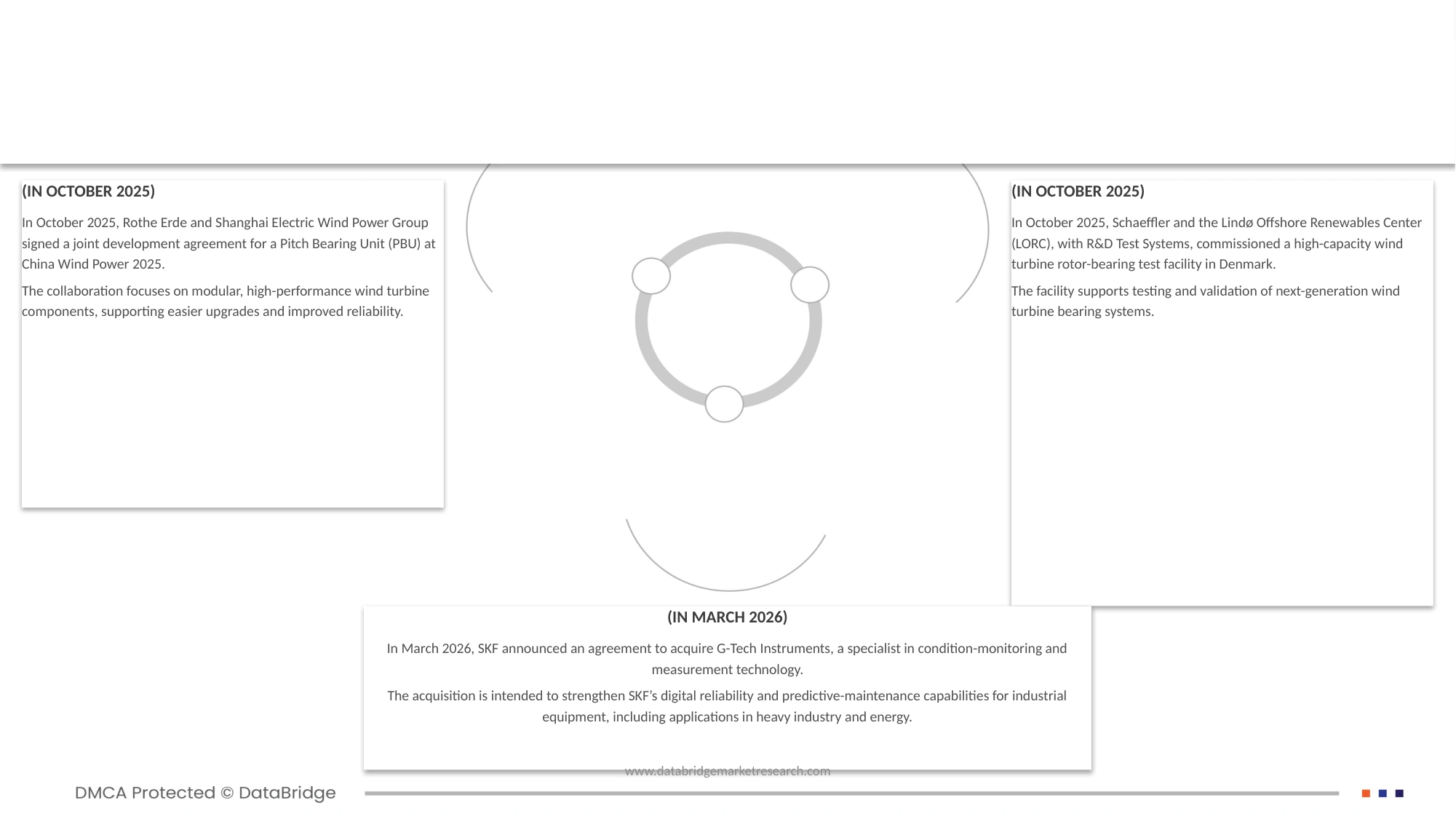
- In October 2025, Rothe Erde and Shanghai Electric Wind Power Group signed a joint development agreement for a Pitch Bearing Unit (PBU) at China Wind Power 2025. The collaboration focuses on modular, high-performance wind turbine components, supporting easier upgrades and improved reliability.
- In October 2025, Schaeffler and the Lindø Offshore Renewables Center (LORC), with R&D Test Systems, commissioned a high-capacity wind turbine rotor-bearing test facility in Denmark. The facility supports testing and validation of next-generation wind turbine bearing systems.
- In March 2026, SKF announced an agreement to acquire G-Tech Instruments, a specialist in condition-monitoring and measurement technology. The acquisition is intended to strengthen SKF’s digital reliability and predictive-maintenance capabilities for industrial equipment, including applications in heavy industry and energy.
- In March 2026, Timken acquired the assets and related businesses of Bijur Delimon International, a manufacturer of automated lubrication systems. The acquisition expands Timken’s lubrication capabilities for industries such as mining, rail, and power generation, which also use heavy-duty bearing systems.
- In May 2026, NSK signed a memorandum of understanding with Delta Electronics to collaborate on robotics technology, including actuator development, system integration, prototyping, and potential commercialization. The collaboration reflects growing demand for precision motion components in automated manufacturing and robotics.
As per Data Bridge Market Research analysis:
For more detailed information about the Global slewing bearings market report, click here – https://www.databridgemarketresearch.com/reports/global-slewing-bearings-market