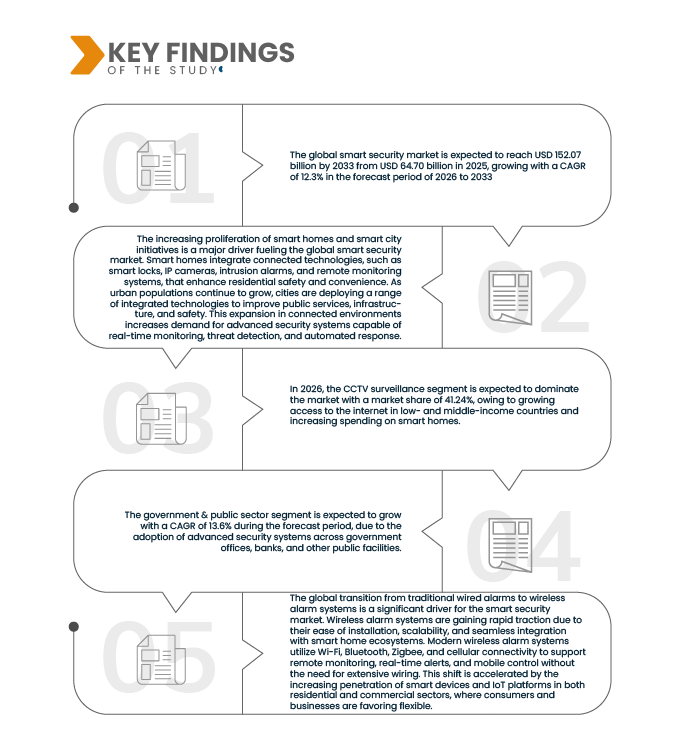
The increasing proliferation of smart homes and smart city initiatives is a major driver fueling the global smart security market. Smart homes integrate connected technologies, such as smart locks, IP cameras, intrusion alarms, and remote monitoring systems, that enhance residential safety and convenience. As urban populations continue to grow, cities are deploying a range of integrated technologies to improve public services, infrastructure, and safety. This expansion in connected environments increases demand for advanced security systems capable of real‑time monitoring, threat detection, and automated response. By enhancing situational awareness and reducing response times, smart security technologies have become essential components of both individual households and large‑scale urban ecosystems. The adoption of these solutions not only addresses crime prevention and public safety but also contributes to the overall quality of life in increasingly interconnected urban environments.
Access Full Report @ https://www.databridgemarketresearch.com/reports/global-smart-security-market
Data Bridge Market Research analyses that the Global Smart Security Market is expected to reach USD 152.07 billion by 2033 from USD 64.70 billion in 2025, growing with a CAGR of 12.3% in the forecast period of 2026 to 2033.
Key Findings of the Study
Increasing Adoption of Wireless Alarm Systems
The global transition from traditional wired alarms to wireless alarm systems is a significant driver for the smart security market. Wireless alarm systems are gaining rapid traction due to their ease of installation, scalability, and seamless integration with smart home ecosystems. Modern wireless alarm systems utilize Wi‑Fi, Bluetooth, Zigbee, and cellular connectivity to support remote monitoring, real‑time alerts, and mobile control without the need for extensive wiring. This shift is accelerated by the increasing penetration of smart devices and IoT platforms in both residential and commercial sectors, where consumers and businesses are favoring flexible, DIY‑friendly security solutions over complex wired setups. The growing consumer preference for cloud‑based control, smartphone access, and modular expansion further strengthens the adoption of wireless alarm systems, boosting overall demand in the global smart security landscape.
Report Scope and Market Segmentation
|
Report Metric
|
Details
|
|
Forecast Period
|
2026 to 2033
|
|
Base Year
|
2025
|
|
Historic Years
|
2024 (Customizable from 2018-2023)
|
|
Quantitative Units
|
Revenue in USD Billion
|
|
Segments Covered
|
By Type (CCTV Surveillance, Access Control, Security & Intruder Alarms, and Others), Connection Type (Wireless and Wired), Sales Channel (Indirect and Direct), Industry (Commercial, Residential, Industrial, Government & Public Sector, and Others)
|
|
Countries Covered
|
U.S., Canada, Mexico, Germany, U.K., France, Italy, Spain, Russia, Turkey, Netherlands, Norway, Finland, Denmark, Sweden, Poland, Switzerland, Belgium, Rest of Europe, China, Japan, India, South Korea, Australia, Indonesia, Thailand, Malaysia, Singapore, Philippines, Rest of Asia-Pacific, Brazil, Argentina, rest of South America. U.A.E., Saudi Arabia, South Africa, Egypt, Israel, and the rest of Middle East and Africa
|
|
Market Players Covered
|
Anson (Shenzhen) (China), ASSA ABLOY (Sweden), Axis Communications (Sweden), Dahua Technology (China), FLIR Systems (U.S.), Hangzhou Hikvision (China), Honeywell (U.S.), Johnson Controls (Ireland), K.M. Electronics (India), Mantra Softech (India), NRG Energy (U.S.), Ooma (U.S.), Panasonic Life Solutions (Japan), Resideo (U.S.), Ring LLC (U.S.), Robert Bosch (Germany), Safesky Tech (China), Samsung (South Korea), Securico (India), Shenzhen Pilot Guards (China), Shenzhen Shanan Technology (China), Siemens (Germany), Snap One (U.S.), Spectra Technovision (India), and Surmount Energy (China)
|
|
Data Points Covered in the Report
|
In addition to the market insights such as market value, growth rate, market segments, geographical coverage, market players, and market scenario, the market report curated by the Data Bridge Market Research team includes in-depth expert analysis, import/export analysis, pricing analysis, production consumption analysis, and pestle analysis.
|
Segment Analysis
The global smart security market is segmented into four notable segments based on the type, connection type, sales channel, and industry.
- On the basis of type, the global smart security market is segmented into CCTV surveillance, access control, security & intruder alarms, and others.
In 2026, the CCTV surveillance segment is expected to dominate the global smart security market
In 2026, the CCTV surveillance segment is expected to dominate the global smart security market with 41.28% market share due to the growing need for continuous monitoring and advanced security solutions across residential, commercial, and industrial environments.
- On the basis of connection type, the global smart security market is segmented into wireless and wired.
In 2026, the wireless segment is expected to dominate the global smart security market
In 2026, the wireless segment is expected to dominate the market with a market share of 72.70%, owing to growing preference for flexible, easy-to-install, and scalable security solutions. Wireless smart security systems eliminate the need for complex wiring infrastructure, reducing installation time and costs for residential and commercial users.
- On the basis of sales channel, the global smart security market is segmented into indirect and direct. In 2026, the indirect segment is expected to dominate the market with a market share of 65.00%, owing to extensive distribution networks of third-party retailers, system integrators, security service providers, and e-commerce platforms.
- On the basis of industry, the global smart security market is segmented into commercial, residential, industrial, government & public sector, and others. In 2026, the commercial segment is expected to dominate the market with a market share of 35.61%, owing to increasing adoption of advanced security systems across offices, retail stores, hotels, banks, and other commercial facilities.
Major Players
Data Bridge Market Research analyzes some of the major market players operating in the market are Anson (Shenzhen) (China), ASSA ABLOY (Sweden), Axis Communications (Sweden), Dahua Technology (China), FLIR Systems (U.S.), Hangzhou Hikvision (China).
Market Developments
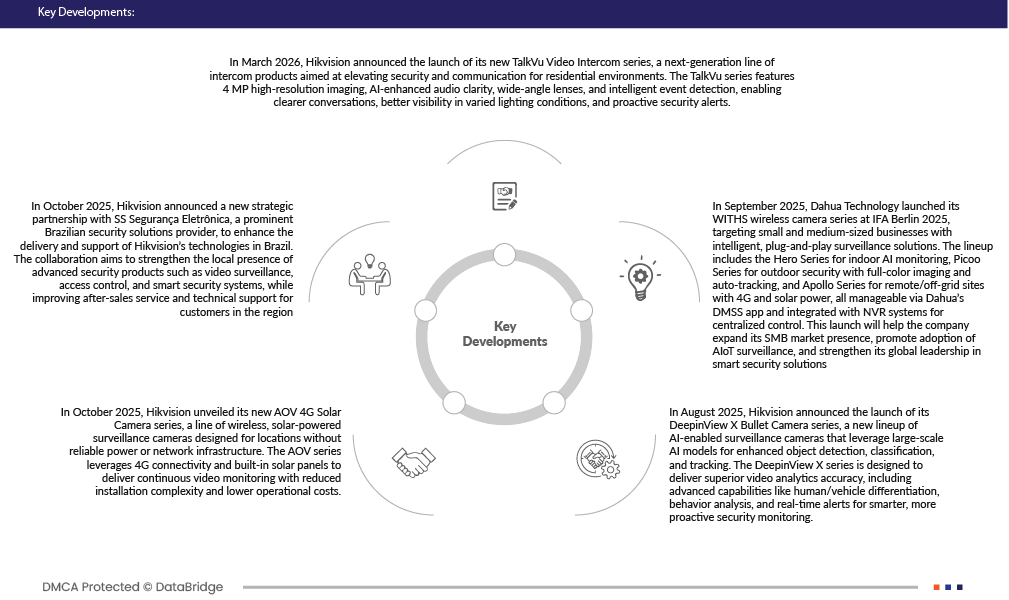
- In March 2026, Hikvision announced the launch of its new TalkVu Video Intercom series, a next‑generation line of intercom products aimed at elevating security and communication for residential environments. The TalkVu series features 4 MP high‑resolution imaging, AI‑enhanced audio clarity, wide‑angle lenses, and intelligent event detection, enabling clearer conversations, better visibility in varied lighting conditions, and proactive security alerts.
- In October 2025, Hikvision announced a new strategic partnership with SS Segurança Eletrônica, a prominent Brazilian security solutions provider, to enhance the delivery and support of Hikvision’s technologies in Brazil. The collaboration aims to strengthen the local presence of advanced security products such as video surveillance, access control, and smart security systems, while improving after‑sales service and technical support for customers in the region.
- In October 2025, Hikvision unveiled its new AOV 4G Solar Camera series, a line of wireless, solar‑powered surveillance cameras designed for locations without reliable power or network infrastructure. The AOV series leverages 4G connectivity and built‑in solar panels to deliver continuous video monitoring with reduced installation complexity and lower operational costs.
- In August 2025, Hikvision announced the launch of its DeepinView X Bullet Camera series, a new lineup of AI‑enabled surveillance cameras that leverage large‑scale AI models for enhanced object detection, classification, and tracking. The DeepinView X series is designed to deliver superior video analytics accuracy, including advanced capabilities like human/vehicle differentiation, behavior analysis, and real‑time alerts for smarter, more proactive security monitoring.
- In September 2025, Dahua Technology launched its WITHS wireless camera series at IFA Berlin 2025, targeting small and medium-sized businesses with intelligent, plug-and-play surveillance solutions. The lineup includes the Hero Series for indoor AI monitoring, Picoo Series for outdoor security with full-color imaging and auto-tracking, and Apollo Series for remote/off-grid sites with 4G and solar power, all manageable via Dahua’s DMSS app and integrated with NVR systems for centralized control. This launch will help the company expand its SMB market presence, promote adoption of AIoT surveillance, and strengthen its global leadership in smart security solutions.
Regional Analysis
Geographically, the country covered in the global Smart Security market report is U.S., Canada, Mexico, Germany, U.K., France, Italy, Spain, Russia, Turkey, Netherlands, Norway, Finland, Denmark, Sweden, Poland, Switzerland, Belgium, Rest of Europe, China, Japan, India, South Korea, Australia, Indonesia, Thailand, Malaysia, Singapore, Philippines, Rest of Asia-Pacific, Brazil, Argentina, rest of South America. U.A.E., Saudi.
As per Data Bridge Market Research analysis:
Asia Pacific is the dominant region in the global smart security market
Asia Pacific leads the global smart security market due to rapid urbanization, increasing investments in smart city initiatives, and the growing adoption of advanced security technologies across residential, commercial, and industrial sectors. Countries such as China, India, Japan, and South Korea are witnessing strong demand for smart surveillance, access control, and integrated security systems driven by rising concerns over public safety and property protection. Additionally, the expansion of smart homes, increasing internet penetration, and the widespread adoption of Internet of Things (IoT)-enabled devices are further accelerating the deployment of smart security solutions across the region. Government initiatives to strengthen public surveillance infrastructure and the presence of major electronics manufacturers are also contributing to the Asia Pacific’s leadership in the global smart security market.
Asia-Pacific is estimated to be the fastest-growing region in the global smart security market
Asia-Pacific is expected to be the fastest-growing region in the global smart security market from 2026 to 2033, driven by rapid urbanization, expanding smart city initiatives, and increasing investments in digital infrastructure across emerging economies. Rising concerns regarding public safety, property protection, and crime prevention are encouraging governments, businesses, and households to adopt advanced security solutions such as smart surveillance, access control, and intrusion detection systems. Additionally, the growing adoption of smart homes, increasing internet and smartphone penetration, and the rapid expansion of commercial and residential infrastructure are further accelerating the demand for smart security technologies across the region. Continuous technological advancements and the presence of major electronics manufacturers are also supporting the strong growth of the smart security market in Asia-Pacific.
For more detailed information about Global Smart Security market click here – https://www.databridgemarketresearch.com/reports/global-smart-security-market