Hyperscale operators are buying accelerators that no longer fit on one die. In 2026, Compute Chiplets and Accelerator Chiplets are expected to dominate demand as NVIDIA, AMD and Google assemble training parts from multiple stitched dies. Data Centers & Cloud Computing is the end user setting the volume, and its purchase order is now written around a package instead of a chip.
The mechanism is physical. ASML's EUV scanners expose a field of 26 mm by 33 mm, so any design needing more silicon than that has to be split and re-joined inside the package. Buyers accept the added assembly cost because a stitched part ships in the current generation, while a larger monolithic die cannot be printed at all.
Access Full Report @ https://www.databridgemarketresearch.com/reports/global-chiplet-market
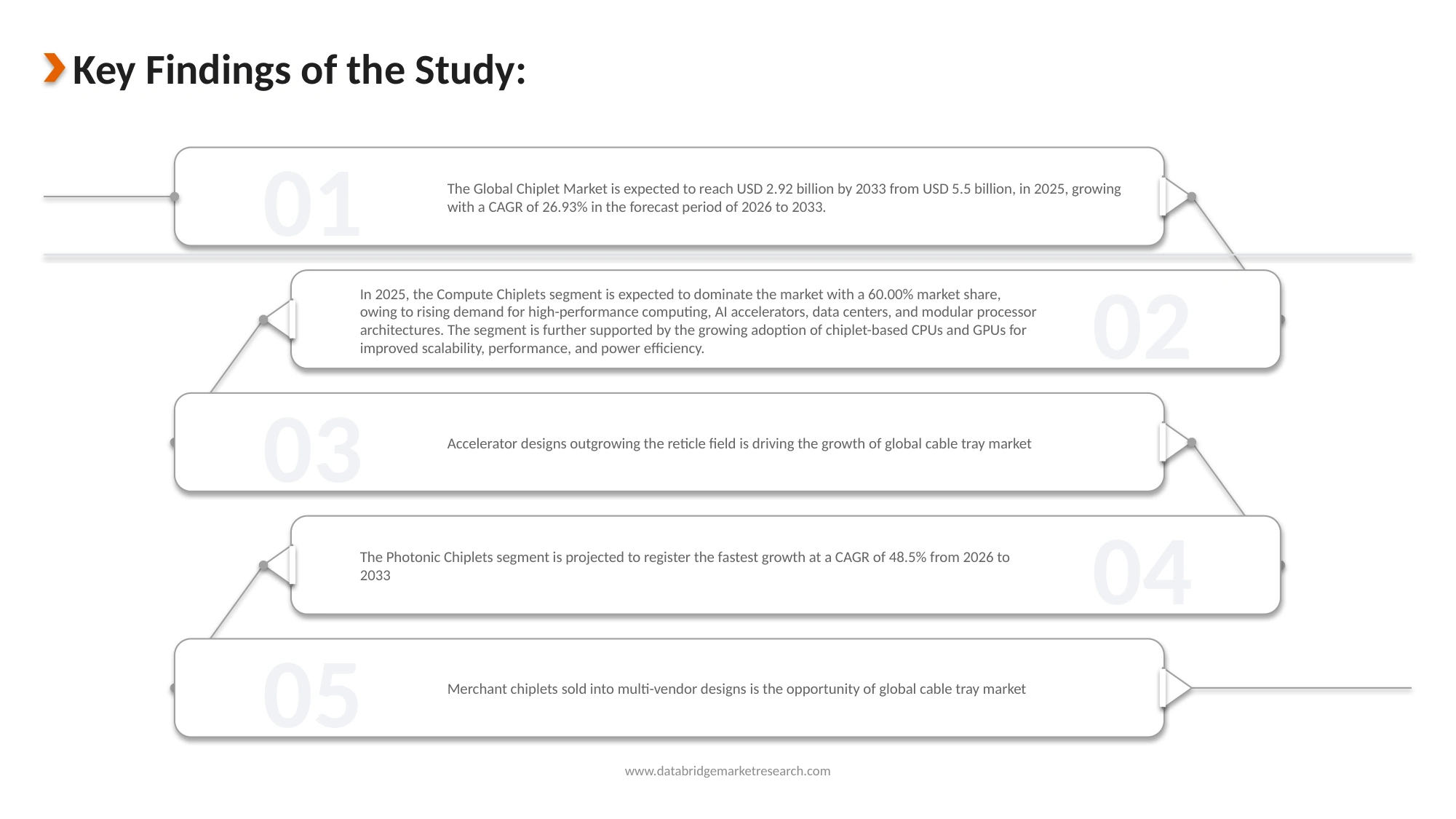
Data Bridge market research analyzes that the Global Chiplet Market is expected to reach USD 2.92 billion by 2033 from USD 5.5 billion, in 2025, growing with a CAGR of 26.93% in the forecast period of 2026 to 2033.
Key Findings of the Study
Leading-Edge Wafer Cost Forcing Mixed-Node Partitioning
Fabless designers are moving analogue content, I/O and cache off the leading-edge node. In 2026, Below 3 nm and 3–5 nm are expected to carry only the compute content of a product, with I/O Chiplets and Analog & Mixed-Signal Chiplets held at 8–14 nm or Above 28 nm where transistors are cheaper and already qualified. The mechanism is yield and stalled scaling. SRAM and analogue circuits shrink far less than logic at each new node while wafer prices keep climbing, so paying leading-edge rates for them erases margin. Smaller dies also yield better, so a design split four ways recovers silicon that one large die would have scrapped.
Report Scope and Market Segmentation
|
Report Metric
|
Details
|
|
Forecast Period
|
2026 to 2033
|
|
Base Year
|
2025
|
|
Historic Years
|
2018-2024 (Customizable to 2013-2017)
|
|
Quantitative Units
|
Revenue in USD millions
|
|
Segments Covered
|
By Product Type (Compute Chiplets, Memory Chiplets, I/O Chiplets, Connectivity Chiplets, Analog & Mixed-Signal Chiplets, Security Chiplets, Accelerator Chiplets, Photonic Chiplets, Custom Chiplets, Others), Packaging Technology (2D Packaging, 2.1D Packaging, 2.5D Packaging, 3D Packaging, Fan-Out Packaging, Embedded Bridge Packaging, Wafer-Level Packaging, System-in-Package (SiP), Others), Advanced Packaging Platform (Chip-on-Wafer-on-Substrate (CoWoS), Foveros Packaging, Embedded Multi-Die Interconnect Bridge (EMIB), Others), Integration Type (Homogeneous Integration, Heterogeneous Integration, Monolithic Replacement, Multi-Vendor Integration, Single-Vendor Integration, Others), Interconnect Standard (Universal Chiplet Interconnect Express (UCIe), Bunch of Wires (BoW), Advanced Interface Bus (AIB), OpenHBI, CCIX, Proprietary Interfaces, Others), Process Node (Below 3 nm, 3–5 nm, 5–7 nm, 8–14 nm, 15–28 nm, Above 28 nm), Architecture (Homogeneous Architecture, Heterogeneous Architecture, Multi-Die Architecture, Modular Architecture, Disaggregated Architecture, Others), Communication Technology (Electrical Die-to-Die, Optical Die-to-Die, Hybrid Communication, Others), Manufacturing Model (Fabless, Integrated Device Manufacturer (IDM), Foundry Manufactured, Outsourced Semiconductor Assembly and Test (OSAT), Others), Die Material (Silicon, Silicon Photonics, Gallium Arsenide (GaAs), Silicon Carbide (SiC), Gallium Nitride (GaN), Others), By Business Model (Proprietary Chiplets, Merchant Chiplets, Open Ecosystem Chiplets, Third-Party IP Chiplets, Custom Chiplets, Others), By Design Approach (Standard Chiplets, Custom Chiplets, Reusable Chiplets, Domain-Specific Chiplets, Application-Specific Chiplets, Others), End User (Data Centers & Cloud Computing, Consumer Electronics, Automotive, Telecommunications & Networking, Industrial & Healthcare, Aerospace & Defense, Others)
|
|
Countries Covered
|
U.S., Canada, Mexico, Germany, U.K., France, Italy, Spain, Netherlands, Switzerland, Sweden, Russia, Belgium, Turkey, Norway, Denmark, Finland, Rest of Europe, China, Japan, India, Australia, South Korea, Taiwan, Thailand, Indonesia, Malaysia, Singapore, Philippines, Hong Kong, New Zealand, Rest of Asia-Pacific, Brazil, Argentina, Colombia, Chile, Peru, Ecuador, Uruguay, Venezuela, Bolivia, Paraguay, Rest of South America, Saudi Arabia, South Africa, U.A.E, Israel, Egypt, Kuwait, Qatar, Oman, Bahrain, and Rest of Middle East & Africa
|
|
Market Players Covered
|
|
|
Data Points Covered in the Report
|
In addition to the insights on market scenarios such as market value, growth rate, segmentation, geographical coverage, and major players, the market reports curated by the Data Bridge Market Research also include in-depth expert analysis, geographically represented company-wise production and capacity, network layouts of distributors and partners, detailed and updated price trend analysis and deficit analysis of supply chain and demand.
|
Segment Analysis
The Global Chiplet Market into the following segments, on the basis of Chiplet Function, Packaging Technology, Advanced Packaging Platform, Integration Type, Interconnect Standard, Process Node, Architecture, Communication Technology, Manufacturing Model, Die Material, Business Model, Design Approach and End User.
- On the basis of Chiplet Function is segmented into Compute Chiplets, Memory Chiplets, I/O Chiplets, Connectivity Chiplets, Analog & Mixed-Signal Chiplets, Security Chiplets, Accelerator Chiplets, Photonic Chiplets, Custom Chiplets, Others.
In 2026, the Compute Chiplets segment is expected to dominate the market
In 2026, the Compute Chiplets segment is expected to dominate the global cable tray market with a 59.75% market share, due to increasing demand for high-performance computing, AI infrastructure, and advanced semiconductor architectures. The growing adoption of chiplet-based designs is further supported by the need for improved processing efficiency, scalability, and integration in next-generation computing systems.
- On the basis of Packaging Technology is segmented into 2D Packaging, 2.1D Packaging, 2.5D Packaging, 3D Packaging, Fan-Out Packaging, Embedded Bridge Packaging, Wafer-Level Packaging, System-in-Package (SiP), Others.
In 2026, the 2.5D Packaging segment is expected to dominate the market
In 2026, the 2.5D Packaging segment is expected to dominate the global cable tray market with a 47.63% market share, due to its increasing adoption in advanced electronic packaging applications, improved thermal management, and the ability to provide higher integration and performance compared with conventional packaging technologies.
- On the basis of Advanced Packaging Platform is segmented into Chip-on-Wafer-on-Substrate (CoWoS), Foveros Packaging, Embedded Multi-Die Interconnect Bridge (EMIB).
In 2026, the Chip-on-Wafer-on-Substrate (CoWoS) segment is expected to dominate the market
In 2026, the Chip-on-Wafer-on-Substrate (CoWoS) segment is expected to dominate the global advanced packaging market, with a market share of 33.88%, due to its growing adoption in high-performance computing, AI accelerators, and advanced semiconductor applications. Its ability to integrate multiple chips with high bandwidth and improved power efficiency is further supporting its demand.
- On the basis of Integration Type is segmented into Homogeneous Integration, Heterogeneous Integration, Monolithic Replacement, Multi-Vendor Integration, Single-Vendor Integration, Others
In 2026, the Heterogeneous Integration segment is expected to dominate the market
In 2026, the Heterogeneous Integration segment is expected to dominate the global cable tray market with a 50.98% market share, due to its increasing adoption in complex electrical and data infrastructure applications, where integrated systems require efficient cable management, enhanced flexibility, and improved space utilization.
- On the basis of Interconnect Standard is segmented into Universal Chiplet Interconnect Express (UCIe), Bunch of Wires (BoW), Advanced Interface Bus (AIB), OpenHBI, CCIX, Proprietary Interfaces, Others
In 2026, the Proprietary Interfaces segment is expected to dominate the market
In 2026, the Proprietary Interfaces segment is expected to dominate the global cable tray market with a market share of 66.25%, due to their widespread adoption in modern electrical and data infrastructure, ease of integration, and ability to provide reliable, customized cable management solutions across commercial, industrial, and data center applications.
- On the basis of Process Node is segmented into Below 3 nm, 3–5 nm, 5–7 nm, 8–14 nm, 15–28 nm, Above 28 nm.
In 2026, the 3–5 nm segment is expected to dominate the market
In 2026, the 3–5 nm segment is expected to dominate the global cable tray market with a 60.50% market share, due to increasing demand for compact and high-performance components in advanced electronic and semiconductor applications. The segment is further supported by growing investments in advanced manufacturing technologies and the increasing adoption of miniaturized devices.
- On the basis of Architecture is segmented into Homogeneous Architecture, Heterogeneous Architecture, Multi-Die Architecture, Modular Architecture, Disaggregated Architecture, Others
In 2026, the Heterogeneous Architecture segment is expected to dominate the market
In 2026, the Heterogeneous Architecture segment is expected to dominate the global cable tray market with a 34.53% market share, due to its flexibility in accommodating diverse cable types, complex network configurations, and varying installation requirements. Its ability to support efficient cable management in commercial, industrial, and infrastructure applications is further driving adoption.
- On the basis of Communication Technology is segmented into Electrical Die-to-Die, Optical Die-to-Die, Hybrid Communication, Others.
In 2026, the Electrical Die-to-Die segment is expected to dominate the market
In 2026, the Electrical Die-to-Die segment is expected to dominate the global cable tray market with a 90.51% market share, due to its widespread adoption in high-speed data transmission and modern networking infrastructure. Increasing demand for reliable, high-bandwidth connectivity in data centers and telecommunications infrastructure is further supporting its dominance.
- On the basis of Manufacturing Model is segmented into Fabless, Integrated Device Manufacturer (IDM), Foundry Manufactured, Outsourced Semiconductor Assembly and Test (OSAT), Others.
In 2026, the Fabless segment is expected to dominate the market
In 2026, the Fabless segment is expected to dominate the global cable tray market with a market share of 70.30%, due to its strong adoption across data centers, commercial buildings, industrial facilities, and infrastructure projects. Its lightweight design, cost efficiency, and ease of installation are further supporting its widespread use.
- On the basis of Die Material is segmented into Silicon, Silicon Photonics, Gallium Arsenide (GaAs), Silicon Carbide (SiC), Gallium Nitride (GaN), Others.
In 2026, the Silicon segment is expected to dominate the market
In 2026, the Silicon segment is expected to dominate the global cable tray market with a 93.38% market share, driven by its widespread use, excellent durability, corrosion resistance, and ability to withstand demanding environmental conditions. Its strong performance and reliability make it suitable for industrial, commercial, and infrastructure applications.
- On the basis of Business Model is segmented into Proprietary Chiplets, Merchant Chiplets, Open Ecosystem Chiplets, Third-Party IP Chiplets, Custom Chiplets, Others.
In 2026, the Proprietary Chiplets segment is expected to dominate the market
In 2026, the Proprietary Chiplets segment is expected to dominate the global cable tray market with a market share of 77.31%, due to their increasing adoption in high-performance computing, data centers, and advanced semiconductor applications. Their ability to provide customized designs, enhanced performance, and efficient integration is further supporting segment growth.
- On the basis of Design Approach is segmented into Standard Chiplets, Custom Chiplets, Reusable Chiplets, Domain-Specific Chiplets, Application-Specific Chiplets, Others.
In 2026, the Custom Chiplets segment is expected to dominate the market
In 2026, the Custom Chiplets segment is expected to dominate the global cable tray market with a 37.41% market share, due to increasing demand for customized and application-specific solutions, along with growing adoption of modular designs in data centers and industrial infrastructure.
- On the basis of End User is segmented into Data Centers & Cloud Computing, Consumer Electronics, Automotive, Telecommunications & Networking, Industrial & Healthcare, Aerospace & Defense, Others.
In 2026, the Data Centers & Cloud Computing segment is expected to dominate the market
In 2026, the Data Centers & Cloud Computing segment is expected to dominate the global cable tray market with a 77.50% market share, due to rapid data center expansion, increasing cloud computing adoption, and rising investments in hyperscale and edge data center infrastructure. Growing demand for reliable power distribution, structured cabling, and efficient cable management systems is further supporting segment growth.
Major Players
Advanced Micro Devices (AMD) (U.S.), Intel Corporation (U.S.), NVIDIA Corporation (U.S.), Broadcom Inc. (U.S.), Marvell Technology, Inc. (U.S.)
Market Developments
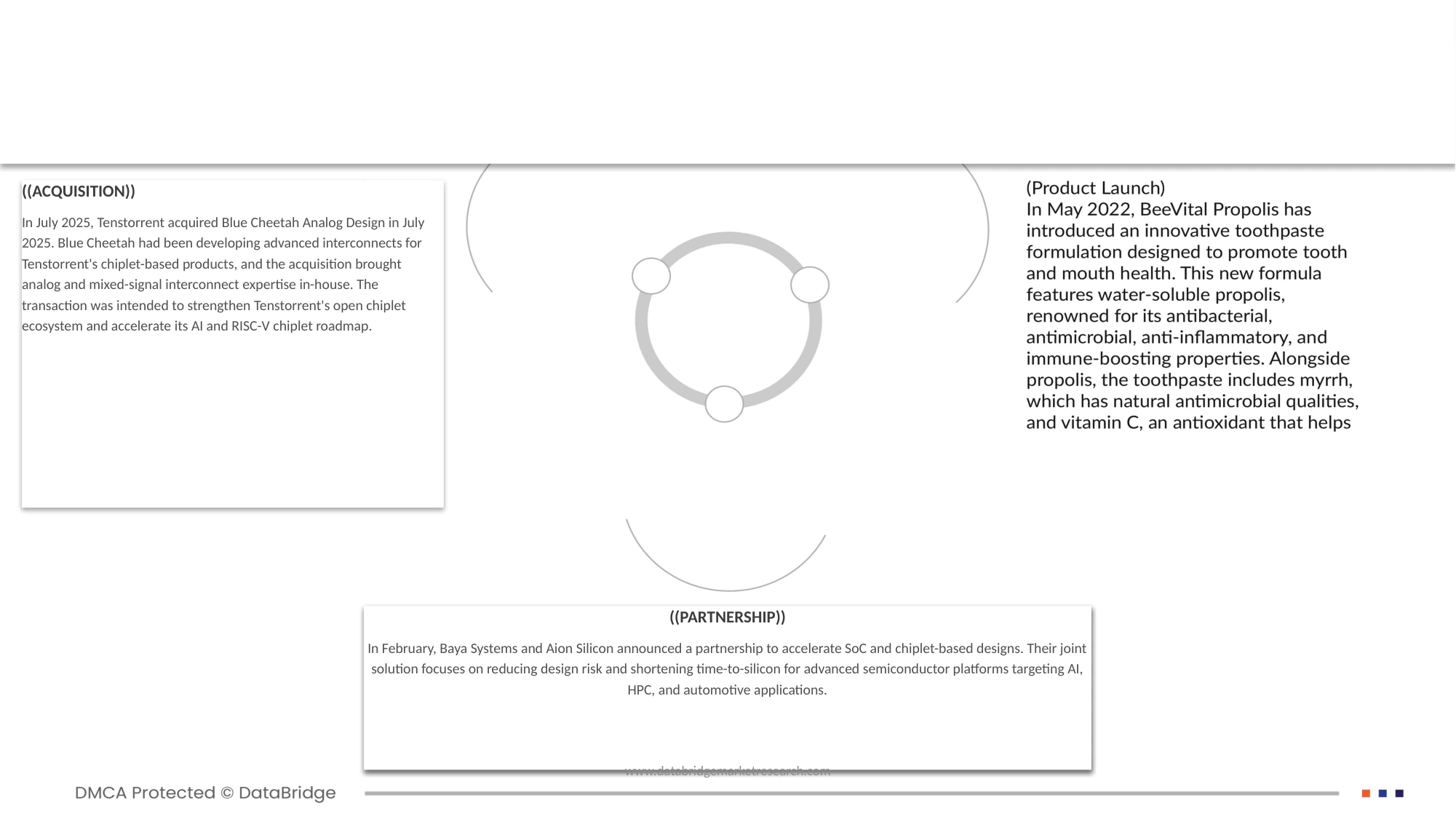
- In July 2025, Tenstorrent acquired Blue Cheetah Analog Design in July 2025. Blue Cheetah had been developing advanced interconnects for Tenstorrent's chiplet-based products, and the acquisition brought analog and mixed-signal interconnect expertise in-house. The transaction was intended to strengthen Tenstorrent's open chiplet ecosystem and accelerate its AI and RISC-V chiplet roadmap.
- In January 2026, Cadence Design Systems launched its Chiplet Spec-to-Packaged Parts ecosystem collaborating with Samsung Foundry, Arm, Arteris, eMemory, M31 Technology, Silicon Creations, Trilinear Technologies, and proteanTecs. The ecosystem is designed to provide pre-validated chiplet solutions for physical AI, data-center, and HPC applications.
- In February, Baya Systems and Aion Silicon announced a partnership to accelerate SoC and chiplet-based designs. Their joint solution focuses on reducing design risk and shortening time-to-silicon for advanced semiconductor platforms targeting AI, HPC, and automotive applications.
- In January 2026, Intel launched its Core Ultra Series 3 / Panther Lake processors in January 2026. The architecture incorporates a separate graphics chiplet, highlighting the continued movement toward modular chiplet-based processor designs in mainstream computing.
- In April 2025, Intel launched the Intel Foundry Chiplet Alliance in April 2025 as part of its Accelerator Alliance. The initiative brings together IP, EDA, design-service, and ecosystem partners to develop interoperable and secure chiplet solutions for government and commercial applications.
As per Data Bridge Market Research analysis:
For more detailed information about the Global Chiplet Market report, click here – https://www.databridgemarketresearch.com/reports/global-chiplet-market