



Seguridad Generativa AI Segmentation, Por Oferta (Software y Servicios), Software Generativo de Seguridad Ciberseguridad IA (Tres Detección e Inteligencia, Software de Evaluación de Riesgos, Software de Gestión de Exhibiciones, Software de Simulación y Prevención, Software de Orientación de Remediación, Plataformas de Caza de Amenazas y Software de Análisis de Código), Software de Seguridad Ciberseguridad para IA
¿Cuál es el tamaño y tasa de crecimiento del mercado de ciberseguridad de la IA Generativa
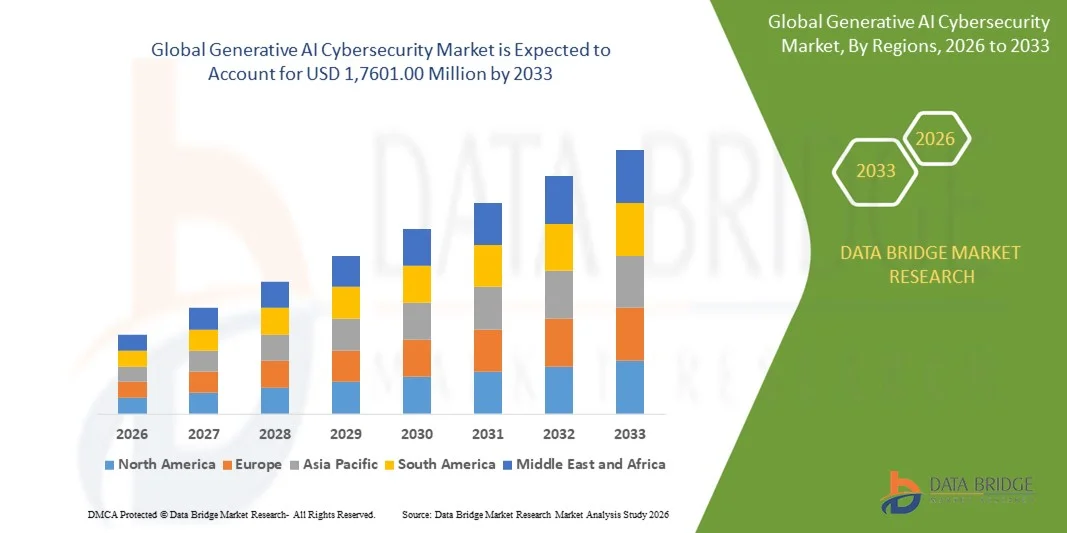
- De acuerdo con Data Bridge Market Research Analysis, el tamaño del mercado de ciberseguridad generativa global fue valorado enUSD 976.14 millones en 2025y se espera que alcanceUSD 1,7601,00 millones en 2033, aCAGR of 43.55%durante el período previsto
- El crecimiento del mercado se ve impulsado en gran medida por la creciente sofisticación de las amenazas cibernéticas y la creciente adopción de soluciones de seguridad impulsadas por los ai en todas las empresas
- Aumentar las inversiones en las herramientas de investigación de ai, seguridad en la nube y automatización están acelerando el despliegue de plataformas de ciberseguridad ai generativas
Tamaño del mercado
- Valor mundial del mercado (2025):976,14 millones de dólares
- Valor de mercado esperado (2033):USD 1,7601,00 millones
- CAGR prefabricado (2026–2033):43.55%
Generative AI Cybersecurity Market Analysis
- El mercado está presenciando una rápida expansión debido a la capacidad de los ai generativos para identificar patrones complejos de ataque, automatizar la inteligencia de amenazas y mejorar la toma de decisiones en tiempo real
- La creciente preocupación por las infracciones de los datos, los ransomware, los ataques de phishing y las vulnerabilidades de los modelos están impulsando a las organizaciones a integrar las estructuras generadoras de aiciberseguridadsoluciones en diversas industrias
- América del Norte dominaba el mercado generativo de seguridad cibernética con la mayor cuota de ingresos en 2025, impulsado por la adopción temprana de soluciones avanzadas de ciberseguridad, la fuerte presencia de los principales proveedores de IA y seguridad, y el aumento de las inversiones en detección de amenazas impulsadas por IA
- Se espera que la región de Asia y el Pacífico sea testigo de la tasa de crecimiento más alta del mundogenerative AI cibersecuritymarket, driven by rising cybersecurity threats, accelerated AI adoption, expanding digital economies, and strong government initiatives supporting AI and cibersecurity development
- El segmento de software mantuvo la mayor cuota de ingresos del mercado en 2025 impulsada por la fuerte demanda de detección de amenazas impulsadas por los ai, sistemas de respuesta automatizados y capacidades avanzadas de análisis en todas las empresas. El software de ciberseguridad de ai generativo permite el monitoreo en tiempo real, la inteligencia de amenazas predictivas y el despliegue escalable, por lo que es una opción preferida entre las grandes organizaciones
Report Scope and Generative AI Cybersecurity Market Segmentation
|
Atributos |
Generative AI Cybersecurity Key Market Insights |
|
Segmentos cubiertos |
|
|
Países cubiertos |
América del Norte
Europa
Asia y el Pacífico
Oriente Medio y África
América del Sur
|
|
Principales jugadores del mercado |
|
|
Oportunidades de mercado |
|
|
Valor añadido Data Infosets |
Además de las ideas del mercado, como el valor de mercado, la tasa de crecimiento, los segmentos de mercado, la cobertura geográfica, los jugadores de mercado y el escenario de mercado, el informe del mercado comisariado por el equipo de Investigación del Mercado de Datos del Puente incluye análisis profundo de expertos, análisis de importaciones/exportaciones, análisis de precios, análisis de consumo de producción y análisis de plagas. |
¿Cuál es la tendencia clave en el mercado generador de seguridad cibernética
Rising Adoption of AI-Driven Threat Detection and Response Solutions
- La creciente complejidad y frecuencia de los ciberataques están formando significativamente el mercado generativo de ciberseguridad ai, ya que las organizaciones buscan soluciones avanzadas capaces de identificar amenazas desconocidas y automatizar respuestas de seguridad. Las tecnologías generadoras de ai están ganando tracción debido a su capacidad de analizar vastos conjuntos de datos, simular escenarios de ataque y mejorar la inteligencia de amenazas en tiempo real, fortaleciendo su adopción en entornos de BFSI, salud, gobierno y TI empresarial
- Aumentar la dependenciacloud computing, la transformación digital y los modelos de trabajo remotos han acelerado la demanda de plataformas de ciberseguridad ai generativas que pueden detectar proactivamente vulnerabilidades y prevenir violaciones de datos a gran escala. Las empresas están implementando cada vez más herramientas ai-powered para abordar ransomware, phishing, ataques de cero días y amenazas internas, impulsando la innovación continua en las arquitecturas de seguridad
- Los requisitos regulatorios de cumplimiento y la mayor conciencia de la privacidad de los datos y la seguridad modelo influyen en las decisiones de compra, y las organizaciones priorizan soluciones de ciberseguridad transparentes, explicables y adaptables. Los proveedores están haciendo hincapié en la automatización, la escalabilidad y la integración con la infraestructura de seguridad existente para diferenciar las ofertas y construir la confianza de los clientes a largo plazo
- Por ejemplo, en 2024, los principales proveedores de tecnología de EE.UU. y Europa ampliaron sus carteras de ciberseguridad integrando capacidades generativas de ai para la caza de amenazas, respuesta automática de incidentes y evaluación predictiva de riesgos. Estos acontecimientos se introdujeron para hacer frente al aumento de la demanda de las empresas para una detección más rápida y reducir los tiempos de respuesta, apoyando la adopción en grandes empresas y sectores de infraestructura críticos
- Si bien la adopción de soluciones de ciberseguridad ai generativas está acelerando, el crecimiento sostenido del mercado depende de la formación continua del modelo, la calidad de los datos y el equilibrio de la automatización con la supervisión humana. Los proveedores se centran en mejorar la exactitud de los modelos, reducir los falsos positivos y mejorar la rendición de cuentas para apoyar una aceptación más amplia de las empresas
Generative AI Cybersecurity Market Dynamics
Conductor
Necesidad creciente para soluciones de ciberseguridad avanzadas y automatizadas
- El aumento de las amenazas cibernéticas, incluyendo el malware sofisticado, ransomware-as-a-servicio, y ataques ai-powered, son un importante conductor para el mercado de ciberseguridad de ai generativo. Las organizaciones están adoptando cada vez más herramientas generadoras para automatizar la detección de amenazas, mejorar la velocidad de respuesta y fortalecer la postura de seguridad en los complejos ecosistemas digitales
- Ampliar el despliegue de ai generativo en aplicaciones empresariales, plataformas cloud y dispositivos conectados está impulsando la demanda de soluciones especializadas de ciberseguridad capaces de proteger modelos de ai, datos de entrenamiento y capas de aplicaciones. Esta tendencia apoya una adopción más amplia en industrias como BFSI, telecomunicaciones e informática, salud y gobierno
- Los proveedores de tecnología y los proveedores de seguridad cibernética están invirtiendo activamente en la innovación en materia de seguridad, las alianzas estratégicas y la integración de las plataformas para mejorar la exactitud de la detección y la eficiencia operacional. Estos esfuerzos están respaldados por el aumento de los presupuestos institucionales para la modernización de la ciberseguridad y las iniciativas de resiliencia digital
- Por ejemplo, en 2023, las principales empresas de ciberseguridad de EE.UU. y Europa informaron de una mayor adopción de inteligencia de amenazas generativas y plataformas automatizadas de remediación entre grandes empresas. Estos despliegues mejoraron la detección de amenazas persistentes avanzadas y la reducción de los tiempos de respuesta a incidentes, fortaleciendo la confianza del cliente y la adopción reiterada
- Aunque la seguridad impulsada por la automatización apoya la expansión del mercado, la inversión continua en talentos cualificados, prácticas éticas y marcos de gobernanza sigue siendo esencial para mantener el crecimiento y la confianza a largo plazo
Restraint/Challenge
Complejidad de Alta Implementación y preocupaciones de privacidad de datos
- La complejidad de integrar soluciones generativas de ciberseguridad ai con la infraestructura de seguridad existente sigue siendo un reto fundamental, en particular para las pequeñas y medianas empresas. Los altos costos de despliegue, las necesidades de infraestructura y la necesidad de profesionales cualificados pueden limitar la adopción entre organizaciones que tengan en cuenta el presupuesto
- La privacidad de los datos, la transparencia modelo y las preocupaciones de cumplimiento regulatorio también restringen el crecimiento del mercado, ya que las empresas siguen siendo prudentes al exponer datos confidenciales a sistemas impulsados por los ai. La falta de marcos estandarizados para la gobernanza de la seguridad de los ai añade además a las barreras de adopción en las industrias reglamentadas
- Los desafíos operacionales como el sesgo modelo, los falsos positivos y la dependencia de datos de capacitación de alta calidad pueden afectar la eficacia de la solución. Las organizaciones deben invertir en la vigilancia, validación y supervisión humana continuas para garantizar un desempeño y un cumplimiento fiables
- Por ejemplo, en 2024, las empresas de Asia y el Pacífico y América Latina informaron de una adopción más lenta de plataformas de ciberseguridad ai generativas debido a preocupaciones por la soberanía de los datos, los requisitos de cumplimiento y los limitados conocimientos especializados internos de los ai. These factors led some organizations to delay large-scale deployments
- Para hacer frente a estos desafíos será necesario simplificar los modelos de despliegue, reforzar las medidas de protección de datos, lograr una gobernanza transparente y centrar las iniciativas de sensibilización.Colaboraciónentre proveedores de tecnología, reguladores y empresas será fundamental para desbloquear todo el potencial de crecimiento del mercado mundial de ciberseguridad generativa ai
Generative AI Cybersecurity Market Scope
El mercado se segmenta sobre la base de la oferta, software de ciberseguridad ai generativo, software de ciberseguridad para ai generativo, tipo de seguridad y usuario final.
- Ofreciendo
Sobre la base de la oferta, el mercado generativo de ciberseguridad ai se segmenta en software y servicios. El segmento de software mantuvo la mayor cuota de ingresos del mercado en 2025 impulsada por la fuerte demanda de detección de amenazas impulsadas por los ai, sistemas de respuesta automatizados y capacidades avanzadas de análisis en todas las empresas. El software de ciberseguridad de ai generador permite el monitoreo en tiempo real, la inteligencia de amenazas predictivas y el despliegue escalable, por lo que es una opción preferida entre las grandes organizaciones.
Se espera que el segmento de servicios sea testigo de la tasa de crecimiento más rápida de 2026 a 2033, impulsada por el aumento de la demanda de servicios de seguridad gestionados, consultoría, integración y optimización continua de modelos. Las organizaciones dependen cada vez más de la experiencia de terceros para implementar, gestionar y personalizar soluciones generativas de ciberseguridad ai.
- Por Generative AI Cybersecurity Software
Sobre la base del software de ciberseguridad ai generativo, el mercado se segmenta en software de detección de amenazas e inteligencia, software de evaluación de riesgos, software de gestión de la exposición, software de simulación de phishing y prevención, software de guía de rehabilitación, plataformas de caza de amenazas y software de análisis de códigos. El segmento de software de detección de amenazas e inteligencia representó la mayor cuota de ingresos en 2025 debido a su papel crítico en la identificación de amenazas avanzadas, ataques de cero días y comportamiento anómalo utilizando modelos de ai generativos.
Se espera que el segmento de software de simulación y prevención de phishing sea testigo de la tasa de crecimiento más rápida de 2026 a 2033, impulsada por la creciente frecuencia de ataques de phishing generados por los ai y el creciente enfoque empresarial en la capacitación proactiva del empleado y la seguridad del correo electrónico.
- Por Cybersecurity Software for Generative AI
Sobre la base del software de ciberseguridad para los ai generativos, el mercado se segmenta en software de seguridad de datos generativos ai, software de seguridad de modelos generativos ai, software de seguridad de infraestructura generativa ai y software de seguridad de aplicaciones generativas ai. El segmento de software de seguridad modelo ai generativo mantuvo la mayor cuota de mercado en 2025, ya que las organizaciones priorizaron proteger los modelos ai de manipular, filtrar datos y ataques contenciosos.
Se espera que el segmento de software de seguridad de datos de ai generativo sea testigo del crecimiento más rápido de 2026 a 2033, impulsado por crecientes preocupaciones en torno al envenenamiento de datos, la privacidad de datos y el cumplimiento regulatorio relacionado con los conjuntos de datos de capacitación de ai.
- Por tipo de seguridad
Sobre la base del tipo de seguridad, el mercado generativo de ciberseguridad ai se segmenta en seguridad de red, seguridad de punta, seguridad de aplicaciones, seguridad de bases de datos y otros. El segmento de seguridad de la red dominaba el mercado en 2025 debido a la adopción generalizada de herramientas de monitoreo de red impulsadas por ai capaces de detectar patrones complejos de intrusión y ataques distribuidos.
Se espera que el segmento de seguridad de la aplicación sea testigo de la tasa de crecimiento más rápida de 2026 a 2033, impulsada por el rápido despliegue de aplicaciones habilitadas por los ai y la necesidad de asegurar capas de aplicación de vulnerabilidades y explotación malintencionada.
- Por Usuario final
Sobre la base del usuario final, el mercado se segmenta en BFSI, salud, gobierno, telecomunicaciones e informática, proveedores de tecnología, medios y entretenimiento, fabricación y otros. El segmento de BFSI representó la mayor cuota de ingresos en 2025 debido al alto gasto en ciberseguridad, requisitos regulatorios estrictos y la creciente exposición a amenazas cibernéticas financieras.
Se espera que el segmento sanitario sea testigo de la tasa de crecimiento más rápida de 2026 a 2033, impulsada por la digitalización rápida, el creciente uso de ai en los sistemas sanitarios, y la necesidad de proteger los datos sensibles de los pacientes de ciberataques avanzados.
Generative AI Cybersecurity Market Regional Analysis
- América del Norte dominaba el mercado generativo de seguridad cibernética con la mayor cuota de ingresos en 2025, impulsado por la adopción temprana de soluciones avanzadas de ciberseguridad, la fuerte presencia de los principales proveedores de IA y seguridad, y el aumento de las inversiones en detección de amenazas impulsadas por IA
- Organizations in the region highly value real-time threat intelligence, automatically response capabilities, and seamless integration of generative AI cybersecurity solutions with existing security infrastructure such as SIEM and SOAR platforms
- Esta adopción generalizada cuenta con un alto gasto en tecnología de la información, un ecosistema digital maduro y una creciente preocupación por las amenazas cibernéticas impulsadas por AI, estableciendo la ciberseguridad generativa de la IA como una solución crítica en todas las empresas y organismos gubernamentales
U.S. Generative AI Cybersecurity Market Insight
El mercado de ciberseguridad de la IA generativa estadounidense captó la mayor cuota de ingresos en 2025 dentro de Norteamérica, alimentada por el rápido despliegue de tecnologías de IA generativas en todas las empresas y el aumento de la sofisticación del ciberataque. Las organizaciones están priorizando soluciones avanzadas de seguridad basadas en la inteligencia artificial para proteger infraestructura crítica, entornos en la nube y datos confidenciales. La fuerte demanda de los proveedores de BFSI, salud y tecnología, junto con la innovación continua de las empresas nacionales de ciberseguridad, sigue impulsando el crecimiento del mercado.
Europe Generative AI Cybersecurity Market Insight
Se espera que el mercado de ciberseguridad de la IA generativa europea sea testigo de la tasa de crecimiento más rápida de 2026 a 2033, impulsada principalmente por normas estrictas de protección de datos y el creciente enfoque en la gobernanza y el cumplimiento de la IA. El aumento de la transformación digital en todas las industrias y el aumento de la conciencia sobre los riesgos de seguridad relacionados con la IA son una adopción alentadora. Las empresas están implementando cada vez más soluciones generativas de seguridad cibernética para garantizar el cumplimiento regulatorio, proteger los activos digitales y fortalecer los marcos de seguridad de toda la empresa.
UK Generative AI Cybersecurity Market Insight
Se espera que el mercado de ciberseguridad de la IA generativa de los Estados Unidos sea testigo de un fuerte crecimiento de 2026 a 2033, impulsado por el aumento de la adopción de tecnologías de IA en todas las empresas y la creciente preocupación por la resistencia cibernética. El enfoque cada vez mayor en asegurar modelos de IA, datos de entrenamiento y aplicaciones basadas en la nube está acelerando la demanda. Las iniciativas de seguridad cibernética dirigidas por el Gobierno y las inversiones en inteligencia de amenazas avanzadas apoyan aún más la expansión del mercado.
Germany Generative AI Cybersecurity Market Insight
Se espera que el mercado de seguridad cibernética de Alemania sea testigo de un crecimiento constante de 2026 a 2033, alimentado por el creciente énfasis en la privacidad de los datos, la ciberseguridad industrial y el despliegue seguro de la IA. La sólida base industrial e industrial de Alemania impulsa la demanda de soluciones de seguridad impulsadas por AI para proteger sistemas conectados y tecnologías operacionales. El énfasis en el cumplimiento, la transparencia y la seguridad de la infraestructura digital apoya la adopción continua del mercado.
Asia-Pacific Generative AI Cybersecurity Market Insight
Se espera que el mercado de ciberseguridad generativa en Asia y el Pacífico sea testigo de la tasa de crecimiento más rápida de 2026 a 2033, impulsada por la digitalización rápida, la adopción en la nube en expansión y el aumento de las amenazas cibernéticas en las economías emergentes. La creciente inversión en IA, la creciente penetración en Internet y las iniciativas gubernamentales que apoyan la seguridad digital están acelerando el crecimiento del mercado en sectores como BFSI, telecomunicaciones y manufactura.
Japón Generative AI Cybersecurity Market Insight
Se espera que el mercado de ciberseguridad de la IA en Japón experimente un notable crecimiento de 2026 a 2033 debido a la fuerte adopción de tecnologías avanzadas y a la creciente atención en la seguridad de sistemas impulsados por IA. Las empresas están invirtiendo en soluciones generativas de seguridad cibernética para proteger infraestructura crítica, activos de datos y aplicaciones inteligentes. La integración de la seguridad de la IA con los sistemas institucionales de TI y la infraestructura inteligente está apoyando aún más el crecimiento del mercado.
China Generative AI Cybersecurity Market Insight
El mercado de ciberseguridad de la IA generativa de China representó la mayor cuota de ingresos en Asia y el Pacífico en 2025, atribuida a la rápida adopción de IA, la transformación digital a gran escala y el creciente énfasis en la seguridad de los datos. La expansión de ciudades inteligentes, plataformas de nube y aplicaciones impulsadas por IA ha aumentado la demanda de soluciones de seguridad cibernética generativas sólidas. Los fuertes proveedores nacionales de tecnología y las iniciativas gubernamentales de apoyo siguen impulsando la expansión del mercado.
Generative AI Cybersecurity Market Share
La industria Generativa de Seguridad Cibernética AI está dirigida principalmente por empresas bien establecidas, incluyendo:
• OpenAI (U.S.)
•Microsoft (Estados Unidos)
• Google (U.S.)
• IBM (Estados Unidos)
•Palo Alto Networks (Estados Unidos)
• Darktrace (U.K.)
• Sophos (U.K.)
•CrowdStrike (U.S.)
• Fortinet (U.S.)
• Tecnologías de software de puntos de control (Israel)
•Cisco Systems (U.S.)
• Broadcom (Estados Unidos)
• Rapid7 (U.S.)
• Trend Micro (Japón)
• Splunk (Estados Unidos)
Últimas novedades en el mercado mundial de ciberseguridad IA
- En agosto de 2025, SentinelOne, adquisición, anunció la adquisición de Prompt Security para fortalecer su Plataforma de Singularidad nativa de AI, lo que permitió mejorar la visibilidad en tiempo real y los controles avanzados de seguridad para las cargas de trabajo generativas de IA y IA. Este desarrollo mejora la detección proactiva de amenazas y la respuesta inteligente de incidentes. Se espera que la medida fortalezca la adopción de medidas de seguridad de la AI a nivel institucional. También aumenta la intensidad competitiva en el mercado de seguridad cibernética mediante la ampliación de las capacidades de plataforma
- En julio de 2025, Accenture y Microsoft, expansión de alianzas estratégicas, invirtieron conjuntamente en soluciones generativas de ciberseguridad impulsadas por AI centradas en la modernización de los Centros de Operaciones de Seguridad. La iniciativa implementa análisis de amenazas impulsados por AI y flujos de trabajo de seguridad automatizados para acelerar la detección y respuesta de amenazas. Esta colaboración aumenta la eficiencia operacional en entornos complejos de IA y TI. Se espera que se acelere la adopción empresarial de plataformas de ciberseguridad habilitadas por AI
- En julio de 2025, Palo Alto Networks, adquisición, adquirió Protect AI para mejorar su cartera de ciberseguridad de IA generativa e integrar más la seguridad de IA en su Plataforma Operativa de Seguridad. El desarrollo refuerza la protección de los modelos de IA, los datos de capacitación y la detección de amenazas específicas de IA. Esto permite a las empresas asegurar los despliegues de inteligencia artificial de manera más eficaz. La adquisición refuerza la posición de Palo Alto Networks en soluciones de ciberseguridad centradas en AI
- En julio de 2025, CrowdStrike y NVIDIA, colaboración tecnológica, se asociaron para integrar los oleoductos AI optimizados por GPU con grandes modelos de lenguaje para aplicaciones avanzadas de ciberseguridad. La colaboración permite una detección de amenazas más rápida, identificación de anomalías en tiempo real y tiempos de respuesta acelerados. Aprovechar el rendimiento de la GPU mejora la escalabilidad para entornos de amenaza a gran escala. Esta asociación aborda la creciente complejidad y el volumen del ciberataque moderno
- En abril de 2025, Fortinet, mejora del producto, amplió sus capacidades de FortiAI dentro de la plataforma Tejido de Seguridad añadiendo características avanzadas de IA generativas a través de múltiples productos. Estas mejoras mejoran la precisión de detección de amenazas, aceleran el triaje de incidentes y apoyan el uso seguro del modelo AI. Las mejoras ayudan a las organizaciones a defender contra los ataques impulsados por AI. This development supports regulatory compliance and strengthens market confidence in AI-integrated cibersecurity solutions
SKU-
Obtenga acceso en línea al informe sobre la primera nube de inteligencia de mercado del mundo

- Panel de análisis de datos interactivo
- Panel de análisis de empresas para oportunidades con alto potencial de crecimiento
- Acceso de analista de investigación para personalización y consultas
- Análisis de la competencia con panel interactivo
- Últimas noticias, actualizaciones y análisis de tendencias
- Aproveche el poder del análisis de referencia para un seguimiento integral de la competencia
Metodología de investigación
La recopilación de datos y el análisis del año base se realizan utilizando módulos de recopilación de datos con muestras de gran tamaño. La etapa incluye la obtención de información de mercado o datos relacionados a través de varias fuentes y estrategias. Incluye el examen y la planificación de todos los datos adquiridos del pasado con antelación. Asimismo, abarca el examen de las inconsistencias de información observadas en diferentes fuentes de información. Los datos de mercado se analizan y estiman utilizando modelos estadísticos y coherentes de mercado. Además, el análisis de la participación de mercado y el análisis de tendencias clave son los principales factores de éxito en el informe de mercado. Para obtener más información, solicite una llamada de un analista o envíe su consulta.
La metodología de investigación clave utilizada por el equipo de investigación de DBMR es la triangulación de datos, que implica la extracción de datos, el análisis del impacto de las variables de datos en el mercado y la validación primaria (experto en la industria). Los modelos de datos incluyen cuadrícula de posicionamiento de proveedores, análisis de línea de tiempo de mercado, descripción general y guía del mercado, cuadrícula de posicionamiento de la empresa, análisis de patentes, análisis de precios, análisis de participación de mercado de la empresa, estándares de medición, análisis global versus regional y de participación de proveedores. Para obtener más información sobre la metodología de investigación, envíe una consulta para hablar con nuestros expertos de la industria.
Personalización disponible
Data Bridge Market Research es líder en investigación formativa avanzada. Nos enorgullecemos de brindar servicios a nuestros clientes existentes y nuevos con datos y análisis que coinciden y se adaptan a sus objetivos. El informe se puede personalizar para incluir análisis de tendencias de precios de marcas objetivo, comprensión del mercado de países adicionales (solicite la lista de países), datos de resultados de ensayos clínicos, revisión de literatura, análisis de mercado renovado y base de productos. El análisis de mercado de competidores objetivo se puede analizar desde análisis basados en tecnología hasta estrategias de cartera de mercado. Podemos agregar tantos competidores sobre los que necesite datos en el formato y estilo de datos que esté buscando. Nuestro equipo de analistas también puede proporcionarle datos en archivos de Excel sin procesar, tablas dinámicas (libro de datos) o puede ayudarlo a crear presentaciones a partir de los conjuntos de datos disponibles en el informe.











