The expanding adoption of Flexible Printed Circuits (FPCs) in automotive and medical electronics constitutes a significant driver for the global FPC market. In the automotive sector, vehicle electrification, advanced driver assistance systems, and increasing in-cabin functionality are prompting OEMs and tier suppliers to specify thinner, lighter, and more comfortable interconnects that reduce harness complexity and enable higher integration density requirements that FPC technology satisfies. In medical electronics, the growth of wearable monitors, implantable sensors, and minimally invasive diagnostic platforms is accelerating demand for bendable, biocompatible interconnects and embedded sensor arrays. Regulators and funding agencies are reinforcing this trajectory through targeted guidance and innovation programs.
Public-sector and industry innovation programmes that fund flexible hybrid electronics and support supply-chain resilience further lower technical and commercial barriers to scale, thereby converting application-level demand into procurable volumes for FPC suppliers.
Access Full Report @ https://www.databridgemarketresearch.com/reports/global-flexible-printed-circuit-fpc-market
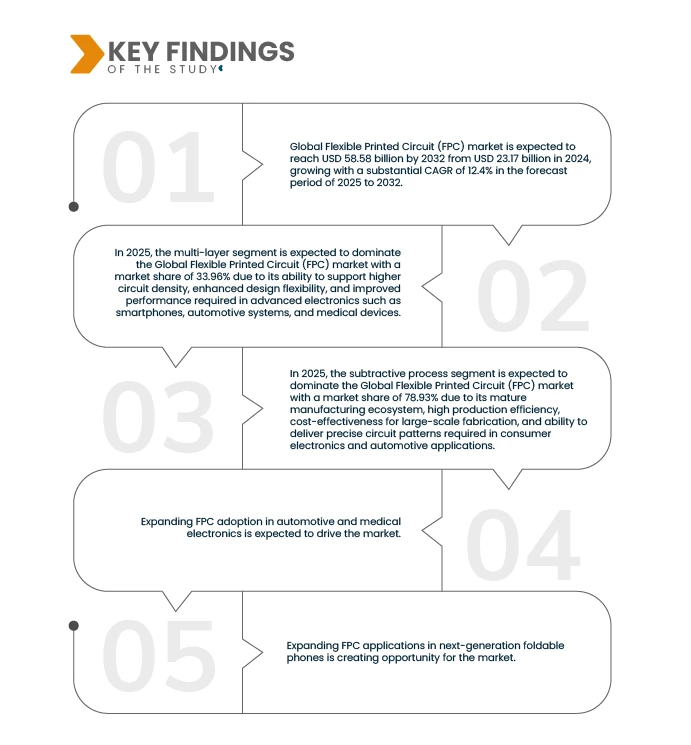
Data Bridge market research analyzes that the Global Flexible Printed Circuit (FPC) Market is expected to reach USD 58.58 billion by 2032 from USD 23.17 billion in 2024, growing with a substantial CAGR of 12.4% in the forecast period of 2025 to 2032.
Key Findings of the Study
Growing Demand for Flexible Circuits in Electric and Hybrid Vehicles
The accelerating shift toward electric and hybrid vehicle production constitutes a significant driver for the global Flexible Printed Circuit (FPC) market. As Original Equipment Manufacturers (OEMs) and tier suppliers reengineer vehicle architectures to accommodate battery systems, advanced driver assistance, enhanced infotainment, and light weighting imperatives, the demand for highly integrated, thinner, and more conformable wiring and interconnect solutions rises. Flexible printed circuits offer a compelling combination of reduced mass, compact form factor, and high routing density that suits the electrified mobility ecosystem. The growing recognition by governments and industry of these requirements, through targeted programmes and investments, further reinforces the upward trajectory of FPC adoption in automotive applications.
Report Scope and Market Segmentation
|
Report Metric
|
Details
|
|
Forecast Period
|
2025 to 2032
|
|
Base Year
|
2024
|
|
Historic Years
|
2018-2023 (Customizable to 2013-2017)
|
|
Quantitative Units
|
Revenue in USD Billion
|
|
Segments Covered
|
Type (Multi-Layer, Double Sided, Single Sided, Rigid Flexible Circuit, Dual Access, Sculptured FPC and Others), Manufacturing Process (Subtractive Process, Additive Process, Adhesive and Adhesiveless Lamination), Material (Base Material and Conductor Material), Flexibility (Static Flex (Flex-To-Install), Dynamic Flex (Flex-To-Fit/Move), and Rollable / Foldable), Form Factor (Standard Thickness, Ultra-Thin (<50 µM), Thick (>200 µM)), End-User (Consumer Electronics, Automotive, Industrial & Robotics, IoT & Smart Devices, Medical Devices, Telecommunication, Aerospace & Defense, and Others), Distribution Channel (Direct Sales and In-Direct Sales)
|
|
Countries Covered
|
Germany, France, United Kingdom, Italy, Sweden, Netherlands, Switzerland, Spain, Finland, Norway, Denmark, Turkey, Belgium, Russia, Rest of Europe, U.S., Canada, Mexico, Brazil, Argentina, Colombia, Chile, Peru, Venezuela, Ecuador, Uruguay, Paraguay, Bolivia, Rest of South America, China, Japan, South Korea, Taiwan, India, Vietnam, Singapore, Malaysia, Thailand, Philippines, Indonesia, Australia, New Zealand, Rest of Asia-Pacific, U.A.E., Saudi Arabia, Israel, South Africa, Egypt, Qatar, Kuwait, Oman, Bahrain, Rest of Middle East and Africa.
|
|
Market Players Covered
|
NOK CORPORATION (Japan), Zhen Ding Tech. Group Technology Holding Limited (Taiwan), Nitto Denko Corporation (Japan), Fujikura Printed Circuits Ltd. (Subsidiary of Fujikura Ltd.) (Japan), Sumitomo Electric Industries, Ltd. (Japan), Flexium Interconnect Inc. (Taiwan), Amphenol Corporation (United States), MFLEX (United States), IBIDEN (Japan), Würth Elektronik eiSos GmbH & Co. KG (Germany), Interflex Co., Ltd. (South Korea), TTM Technologies Inc. (United States), Cicor Group (Switzerland), and MFS Technology (Singapore)
|
|
Data Points Covered in the Report
|
In addition to the insights on market scenarios such as market value, growth rate, segmentation, geographical coverage, and major players, the market reports curated by the Data Bridge Market Research also include in-depth expert analysis, geographically represented company-wise production and capacity, network layouts of distributors and partners, detailed and updated price trend analysis and deficit analysis of supply chain and demand.
|
Segment Analysis
Global Flexible Printed Circuit (FPC) market is segmented into seven notable segments which are type, manufacturing process, material, flexibility, form factor, end-user, and distribution channel.
- On the basis of type the global Flexible Printed Circuit (FPC) market is segmented into multi layer, double sided, single sided, rigid flexible circuit, dual access, sculptured FPC, and others
In 2025, the multi-layer segment is expected to dominate the global Flexible Printed Circuit (FPC) market
In 2025, multi-layer segment is expected to dominate the market with the market share of 33.96% primarily due to their superior design flexibility, high circuit density, and enhanced reliability in complex electronic assemblies. The growing adoption of multi-layer FPCs in smartphones, automotive electronics, and medical devices—driven by the need for compact, high-performance interconnections, is further strengthening their market leadership.
- On the basis of manufacturing process, the global Flexible Printed Circuit (FPC) market is segmented into subtractive process, additive process, adhesive and adhesiveless lamination
In 2025, the subtractive process segment is expected to dominate the global Flexible Printed Circuit (FPC) market
In 2025, the subtractive process segment is expected to dominate the market with the market share of 78.93%, owing to its precision, cost-effectiveness, and suitability for mass production. This process offers superior circuit definition, consistent quality, and compatibility with a wide range of materials, making it the preferred choice for manufacturing high-performance FPCs used in consumer electronics, automotive systems, and medical devices.
- On the basis of material, the global Flexible Printed Circuit (FPC) market is segmented into base material and conductor material. In 2025, the base material segment is expected to dominate the global Flexible Printed Circuit (FPC) market with the market share of 61.40%
- On the basis of flexibility, the global Flexible Printed Circuit (FPC) market is segmented into static flex (flex-to-install), dynamic flex (flex-to-fit/move), rollable / foldable. In 2025, the static flex (flex-to-install) segment is expected to dominate the global flexible printed circuit (FPC) market due to 60.38%
- On the basis of form factor, the global Flexible Printed Circuit (FPC) market is segmented into standard thickness, ultra-thin (<50 µm), thick (>200 µm). In 2025, the standard thickness segment is expected to dominate the global Flexible Printed Circuit (FPC) market with the market share of 65.82%
- On the basis of end-user, the global Flexible Printed Circuit (FPC) market is segmented into consumer electronics, automotive, industrial & robotics, IoT & smart devices, medical devices, telecommunication, aerospace & defense, and others. In 2025, the consumer electronics segment is expected to dominate the global Flexible Printed Circuit (FPC) market with a market share of 39.54%
- On the basis of distribution channel, the global Flexible Printed Circuit (FPC) market is segmented into the direct sales and in-direct sales. In 2025, the direct sales segment is expected to dominate the global Flexible Printed Circuit (FPC) market with a market share of 69.27%
Major Players
Data Bridge Market Research Analyses NOK CORPORATION (Japan), Zhen Ding Tech. Group Technology Holding Limited (Taiwan), Nitto Denko Corporation (Japan), Fujikura Printed Circuits Ltd. (Subsidiary of Fujikura Ltd.) (Japan), Sumitomo Electric Industries, Ltd. (Japan) as the major players in the market.
Market Developments
- In April 2024, a News release by the European Commission highlighted the BAYFLEX initiative (via the European Commission’s CORDIS database), which reported on the development of flexible organic electronic sensor patches engineered on bendable substrates for electrophysiological signal detection and classification — a clear example of flexible electronics for medical monitoring
- In June 2025, the Innovative Advanced Materials (IAMs) for conformable, flexible, or stretchable electronics call (Horizon-Europe topic HORIZON-CL4-2025-03-MATERIALS-47) was published on Horizon Europe, explicitly referencing wearable electronics, e-textiles, and well-being solutions, including health/wearable/implantable medical domains that depend on flexible, conformable, or stretchable circuit technologies like FPC
- In July 2024, EARTO, the European Association of Research and Technology Organizations, published a position paper on advanced materials for healthcare. The European Association of Research and Technology Organizations published a position paper noting flexible and implantable electronics as a priority for healthcare research and technology development, recognizing the need for biocompatible flexible substrates and integrated sensor systems that depend on flexible interconnect solutions.
- In February 2025, the European Innovation Council (EIC) Pathfinder programme announced funding for a multi-country consortium developing ultra-thin bio-integrated electronic films for continuous physiological monitoring, emphasizing advances in stretchable interconnects, flexible substrates, and low-power circuit integration essential for next-generation wearable and implantable medical devices.
- In September 2024, the Fraunhofer-Gesellschaft launched a new cross-institute initiative on “Hybrid Flexible Electronics for Medical Diagnostics,” focusing on printable conductive materials, flexible micro-sensor arrays, and conformable circuit architectures, technologies that directly rely on flexible PCB platforms for smart patches, minimally invasive diagnostic tools, and body-adaptive medical electronics.
Geographical Analysis
The countries covered in the market are Germany, France, United Kingdom, Italy, Sweden, Netherlands, Switzerland, Spain, Finland, Norway, Denmark, Turkey, Belgium, Russia, rest of Europe, U.S., Canada, Mexico, Brazil, Argentina, Colombia, Chile, Peru, Venezuela, Ecuador, Uruguay, Paraguay, Bolivia, rest of South America, China, Japan, South Korea, Taiwan, India, Vietnam, Singapore, Malaysia, Thailand, Philippines, Indonesia, Australia, New Zealand, rest of Asia-Pacific, U.A.E., Saudi Arabia, Israel, South Africa, Egypt, Qatar, Kuwait, Oman, Bahrain, rest of Middle East and Africa.
As per Data Bridge Market Research analysis:
Asia-Pacific is expected to be the dominant and fastest growing region in the global Flexible Printed Circuit (FPC) market
Asia-Pacific is expected to be the dominant and fastest-growing region in the global Flexible Printed Circuit (FPC) market due to its strong electronics manufacturing base, rising consumer electronics demand, expanding automotive and industrial applications, presence of leading PCB suppliers, and continuous investments in semiconductor and flexible packaging technologies.
For more detailed information about the Global Flexible Printed Circuit (FPC) Market report, click here – https://www.databridgemarketresearch.com/reports/global-flexible-printed-circuit-fpc-market