


Segmentation mondiale du marché de la préservation des cosmétiques, par produit (Esters de Paraben, Donateurs de formaldéhyde, Dérivés de phénol, Alcools, Composé quaternaire, Acides organiques), type (Préservateurs naturels, Préservateurs synthétiques, Préservateurs organiques, Préservateurs antimicrobiens), application (Skin and Sun Care, Soins des cheveux, Produits de toilette, Parfums et Parfums, Maquillage et Couleur), type de formulation (formulations basées sur l'eau, formules à base d'huile, formules d'émulsion) - Tendances de l'industrie et prévisions jusqu'en 2033
Quelle est la taille et le taux de croissance du marché de la préservation des cosmétiques
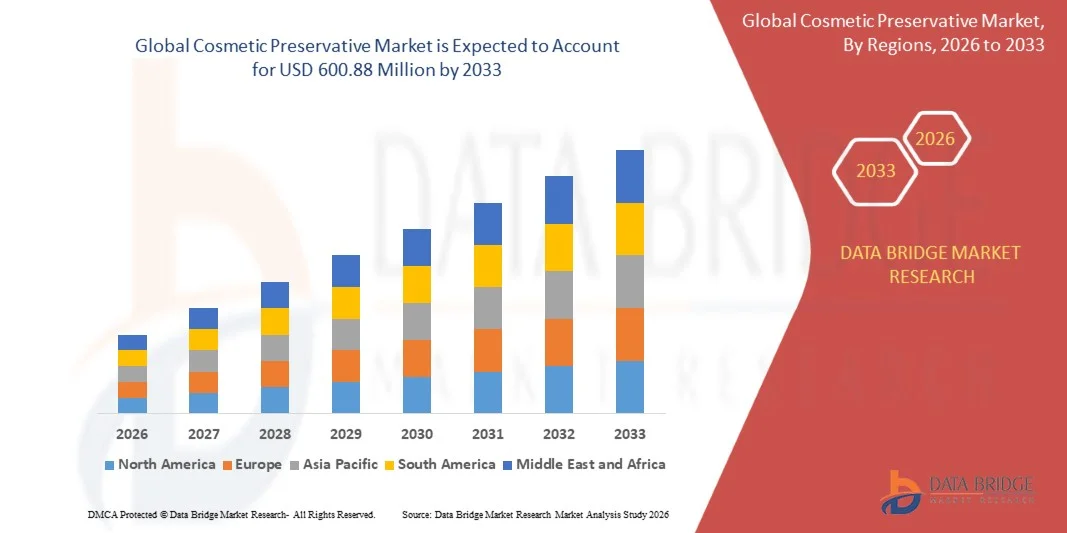
- Selon l'analyse de Data Bridge Market Research, le marché des conservateurs cosmétiques était évalué à 391,53 millions de dollars en 2025 et devrait atteindre 600,88 millions de dollars d'ici 2033, soit une augmentation de 5,50 % entre 2026 et 2033.
- Le marché connaît une croissance soutenue grâce à l'expansion rapide de l'industrie mondiale des soins personnels et des soins de la peau, à l'augmentation de la pénétration du commerce électronique qui prolonge le temps de transit et de stockage des produits et à l'innovation accrue en matière de formulation visant à améliorer la sécurité des produits et la stabilité des tablettes.
- La tendance croissante des consommateurs à adopter des cosmétiques propres, sans parabènes et sûrs sur le plan de la dermatologie, conjuguée à une surveillance réglementaire rigoureuse de la sécurité des ingrédients, oblige les fabricants à investir dans des systèmes de préservation avancés, multifonctionnels et dérivés naturellement des soins de la peau, des soins capillaires et des produits cosmétiques colorés.
Taille du marché et prévisions
- Valeur du marché mondial (2025): 391,53 millions de dollars
- Valeur marchande prévue (2033) : 600,88 millions de dollars
- Prévisions TCAC (2026-2033): 5,50 %
- Région phare en 2025 : Amérique du Nord
- Région de croissance la plus rapide: Asie-Pacifique
Quels sont les principaux débouchés du marché de la préservation des cosmétiques
- L'Amérique du Nord a dominé le marché mondial des conservateurs cosmétiques avec la plus grande part de revenus de 35,20 % en 2025, soutenue par des dépenses élevées en beauté et en soins personnels, une hausse des revenus disponibles et une forte demande de formulations dermatologiques conformes à la sécurité.
- On s'attend à ce que l'Asie-Pacifique soit la région qui connaît la croissance la plus rapide avec un TCAC de 6,9 % entre 2026 et 2033, alimenté par l'urbanisation rapide, l'augmentation des revenus disponibles et l'accroissement des influences occidentales en matière de beauté et de toilettage en Chine, en Inde et au Japon.
- Le segment des dérivés du phénol a dominé le marché avec une part de 28,60 % en 2025, en raison de l'utilisation généralisée du phénoxyéthanol pour son efficacité antimicrobienne à large spectre et sa stabilité à des pH variables.
- Les acides organiques sont le type de produit qui connaît la croissance la plus rapide et qui devrait enregistrer un TCAC de 6,80 %, ce qui reflète la demande croissante de systèmes de préservation plus doux et compatibles avec la peau.
- Le segment des conservateurs synthétiques a dominé la catégorie de type avec une part des revenus de 54,20 % en 2025, en raison d'une efficacité supérieure, d'un rapport coût-efficacité et d'une acceptation réglementaire établie depuis longtemps dans toutes les formulations du marché de masse.
- Les conservateurs naturels sont le segment de type qui connaît la croissance la plus rapide, qui devrait afficher un TCAC de 7,50 %, propulsé par le mouvement de beauté propre et la reformulation loin des parabènes et des rejets de formaldéhyde.
- En 2025, le segment des soins de la peau et du soleil représentait 34,60 % de la part de marché, en raison de la hausse de la demande mondiale de lotions, de sérums, de crèmes et de crèmes solaires qui nécessitent une protection microbienne robuste.
- Les formulations à base d'eau représentaient la plus grande part de 46,30 % en 2025, étant donné leur grande sensibilité à la contamination microbienne et leur dépendance à l'égard de systèmes de préservation efficaces.
Portée du rapport et segmentation des marchés de préservation des cosmétiques
|
Attributs |
Cosmétiques Préservatifs Principales perspectives du marché |
|
Segments couverts |
|
|
Pays couverts |
Amérique du Nord
Europe
Asie-Pacifique
Moyen-Orient et Afrique
Amérique du Sud
|
|
Principaux acteurs du marché |
|
|
Possibilités de marché |
|
|
Infos sur la valeur ajoutée |
Outre les informations sur les scénarios du marché, tels que la valeur du marché, le taux de croissance, la segmentation, la couverture géographique et les principaux acteurs, les rapports de marché établis par Data Bridge Market Research comprennent également une analyse approfondie des experts, une production et une capacité géographiquement représentées par l'entreprise, des schémas de réseau des distributeurs et des partenaires, une analyse détaillée et actualisée des tendances des prix et une analyse du déficit de la chaîne d'approvisionnement et de la demande. |
Quelle est la tendance clé du marché de la préservation des cosmétiques
- Les marques de cosmétiques et les fabricants d'ingrédients reformulent de plus en plus les produits autour des systèmes de préservation naturels, d'origine végétale et multifonctionnels afin de s'aligner sur le mouvement de beauté propre et l'examen croissant des ingrédients synthétiques par les consommateurs.
- Par exemple, en avril 2025, Clariant a terminé l'acquisition de Lucas Meyer Cosmetics, une initiative conçue pour renforcer son portefeuille d'ingrédients cosmétiques de grande valeur et axés sur la durabilité et élargir sa conservation naturelle et ses offres d'ingrédients actifs.
- La bioconservation à l'aide d'agents antimicrobiens botaniques comme l'extrait de romarin, le thé vert et les graines de pamplemousse gagne en traction, offrant une protection à large spectre tout en soutenant les allégations de produits biologiques et sans parabènes.
- Les technologies d'encapsulation qui permettent une libération contrôlée et prolongée des agents de conservation améliorent la durée de conservation du produit tout en permettant aux formulateurs de réduire la charge de conservation globale.
- Par exemple, en avril 2025, Ashland a introduit de nouvelles technologies de plate-forme visant à améliorer la durabilité et l'efficacité de la formulation, ce qui reflète le virage de l'industrie vers des solutions responsables de préservation de la prochaine génération.
- À mesure que la demande d'étiquettes propres et les systèmes de livraison basés sur l'encapsulation continuent de mûrir, l'innovation en matière de conservateur cosmétique devrait se concentrer de plus en plus sur les ingrédients qui combinent l'efficacité antimicrobienne et des profils durables compatibles avec la peau.
Quels sont les principaux moteurs du marché de la préservation des cosmétiques
- L'expansion rapide du commerce électronique mondial a transformé la distribution des produits cosmétiques, avec des périodes de transit et de stockage plus longues augmentant le risque de dégradation microbienne et la demande de systèmes de préservation durables et performants.
- Par exemple, la croissance des canaux de vente au détail en ligne de première beauté incite les formulateurs à prioriser les conservateurs qui maintiennent la stabilité et la sécurité des produits dans les délais de livraison prolongés, en particulier pour les crèmes à base d'eau, les sérums et les lotions.
- La croissance continue de l'industrie mondiale des soins de la peau, des soins capillaires et des cosmétiques colorés augmente de façon significative le volume de formulations dépendantes des conservateurs qui entrent sur le marché.
- Par exemple, en avril 2025, l'acquisition de Lucas Meyer Cosmetics par Clarient visait à élargir son empreinte dans les catégories d'ingrédients de soins personnels écoconscients à forte croissance, soulignant comment l'augmentation de la demande de soins personnels remodele les stratégies d'innovation et d'approvisionnement des conservateurs.
- Comme les fabricants de soins personnels comptent de plus en plus sur une préservation efficace et conforme à la réglementation pour soutenir la sécurité des produits et la distribution élargie, les conservateurs cosmétiques demeureront un facteur essentiel de la croissance de l'industrie.
Quels sont les facteurs qui entravent la croissance du marché de la préservation des cosmétiques
- La demande croissante des consommateurs pour les produits de soins personnels naturels et biologiques pousse les marques vers des solutions de rechange sans conservateur ou à base de plantes, dont beaucoup offrent une durée de conservation plus courte et une efficacité antimicrobienne inférieure à celle des conservateurs synthétiques conventionnels.
- Ce changement crée un compromis entre la formulation et le maintien d'une protection solide contre la contamination microbienne, ce qui complique le développement des produits pour les fabricants.
- L'évolution des préoccupations en matière de sécurité concernant les effets à long terme sur la santé et l'environnement de certains agents de conservation synthétiques, comme les parabènes, entraîne une pression de reformulation, même lorsque les substituts naturels prouvés demeurent limités.
- Par exemple, en mars 2022, Sharon Laboratories a finalisé son acquisition de RES Pharma Industriale en Italie afin de renforcer ses capacités en matière d'ingrédients de soins personnels, ce qui reflète l'ampleur des investissements requis pour mettre au point des solutions de conservation de la prochaine génération plus sûres qui répondent aux besoins des organismes de réglementation et des consommateurs.
- La difficulté d'identifier des solutions de rechange naturelles efficaces et largement acceptées qui répondent aux normes réglementaires tout en adéquation avec la performance des conservateurs synthétiques continue de freiner le rythme de la reformulation à l'échelle du marché.
Comment le marché de préservation des cosmétiques est-il segmenté
Le marché des conservateurs cosmétiques est segmenté en fonction du produit, du type, de l'application et du type de formulation.
- Par produit
Sur la base du produit, le marché mondial des conservateurs cosmétiques est segmenté en esters de parabène, donneurs de formaldéhyde, dérivés de phénol, alcools, composés quaternaires et acides organiques. Le segment des dérivés du phénol a dominé le marché avec une part de 28,60 % en 2025, en raison de l'utilisation généralisée du phénoxyéthanol pour son efficacité antimicrobienne à large spectre, de son faible potentiel d'irritation et de sa stabilité dans une large gamme de pH dans les formulations à base d'eau.
Le segment des acides organiques devrait enregistrer la croissance la plus rapide à un TCAC de 6,80 % de 2026 à 2033, en raison de la demande croissante de systèmes de préservation plus doux et compatibles avec la peau qui s'harmonisent avec les tendances de la peau sensible et de la formulation d'étiquettes propres.
- Par type
Sur la base du type, le marché mondial des conservateurs cosmétiques est segmenté en conservateurs naturels, conservateurs synthétiques, conservateurs organiques et conservateurs antimicrobiens. Le segment des conservateurs synthétiques a dominé le marché avec une part de 54,20 % en 2025, soutenue par une efficacité antimicrobienne supérieure, un rapport coût-efficacité et une acceptation réglementaire de longue date dans les formulations de soins de la peau, de soins capillaires et de cosmétiques de couleur.
Le segment des conservateurs naturels devrait connaître la croissance la plus rapide à un TCAC de 7,50 % entre 2026 et 2033, propulsé par le mouvement de beauté propre, la reformulation loin des parabènes et des rejets de formaldéhyde, et l'augmentation de la préférence des consommateurs pour les ingrédients antimicrobiens dérivés de plantes.
- Par demande
Sur la base de l'application, le marché mondial des conservateurs cosmétiques est segmenté en soins de la peau et du soleil, soins capillaires, articles de toilette, parfums et parfums, maquillage et couleur. Le segment des soins de la peau et du soleil a dominé le marché avec une part de 34,60 % en 2025, sous l'effet de la hausse de la demande mondiale de lotions, de sérums, de crèmes et d'écrans solaires qui nécessitent une protection robuste contre la contamination microbienne pendant l'entreposage et l'utilisation prolongées.
Le segment des soins capillaires devrait connaître le TCAC le plus rapide de 6,40 % entre 2026 et 2033, alimenté par une demande croissante de shampooings multifonctionnels, de conditionneurs et de produits coiffants qui nécessitent des systèmes de conservation stables et durables.
- Par type de formulation
Sur la base du type de formulation, le marché mondial des conservateurs cosmétiques est segmenté en formulations à base d'eau, formulations à base d'huile et formulations d'émulsion. Le segment des formulations à base d'eau a dominé le marché avec une part de 46,30 % en 2025, étant donné la grande sensibilité des produits contenant de l'eau tels que les crèmes, les shampooings et les lotions à la croissance microbienne et la dépendance résultante à des systèmes de préservation efficaces.
Le segment des formulations d'émulsion devrait enregistrer le TCAC le plus rapide de 6,90 % entre 2026 et 2033, sous l'effet de la popularité croissante des produits cosmétiques à base de crème et de lotion qui nécessitent des solutions de préservation stables en double phase.
Quelle région détient la plus grande part du marché de la préservation des cosmétiques
- L'Amérique du Nord a dominé le marché des conservateurs cosmétiques et a représenté la plus grande part des revenus de 35,20 % en 2025, soutenue par des dépenses élevées en beauté et en soins personnels, une hausse des revenus disponibles et une forte demande de formulations cosmétiques dermatologiques conformes à la sécurité.
- La région bénéficie également d'un cadre réglementaire bien établi, d'une forte prévalence de produits de soins ciblés qui répondent à des préoccupations telles que le vieillissement prématuré et l'acné, et d'une forte présence de fabricants d'ingrédients de premier plan qui investissent dans des technologies de préservation de pointe. On s'attend à ce que l'accent soit mis de façon continue sur la reformulation de l'étiquette propre et les produits de soins personnels de qualité supérieure pour maintenir la position de chef de file de l'Amérique du Nord.
Aperçu du marché des cosmétiques aux États-Unis
Le marché américain des conservateurs cosmétiques connaît une croissance constante, soutenue par de fortes dépenses de consommation en soins de la peau et cosmétiques de couleur, une demande croissante de formulations dermatologiques sûres et l'adoption croissante de systèmes multifonctionnels et naturels de préservation. L'examen réglementaire croissant de la sécurité des ingrédients et l'expansion du commerce électronique de détail de beauté renforcent encore la demande de solutions de préservation stables et durables partout au pays.
Aperçu du marché de la préservation des cosmétiques au Canada
Le marché canadien des produits de préservation des cosmétiques ne cesse de croître, en raison de la sensibilisation accrue des consommateurs aux produits de soins personnels propres et sans parabène, de l'investissement croissant dans la fabrication de cosmétiques au pays et de la demande croissante de produits de soins de la peau et de soins capillaires de qualité supérieure. Le renforcement de la surveillance réglementaire de la sécurité des ingrédients cosmétiques continue d'appuyer l'adoption de systèmes de conservation avancés et conformes.
Aperçu du marché de la préservation des cosmétiques en Asie-Pacifique
Le marché des conservateurs cosmétiques en Asie et dans le Pacifique devrait connaître une croissance rapide, en raison de l'urbanisation croissante, de l'augmentation des revenus disponibles et de l'accroissement des influences occidentales en matière de beauté et de toilettage dans des pays comme la Chine, l'Inde et le Japon. L'expansion de la fabrication de cosmétiques au pays, l'augmentation des ventes de beauté dans le commerce électronique et la sensibilisation accrue des consommateurs à la sécurité des produits appuient davantage l'expansion du marché régional.
Chine Cosmétiques Préservative Market Insight
Le marché chinois des conservateurs cosmétiques connaît une croissance rapide, soutenu par la grande base de fabrication de cosmétiques, l'augmentation des revenus disponibles de la classe moyenne et l'accent accru de la réglementation sur la sécurité des ingrédients et la transparence de l'étiquetage. L'adoption croissante de systèmes de préservation naturels et multifonctionnels dans les marques cosmétiques nationales et internationales renforce encore la croissance du marché dans le pays.
India Cosmetic Preservative Market Insight
Le marché indien des agents de conservation des cosmétiques connaît une croissance constante, en raison de l'augmentation des dépenses en soins personnels, de l'expansion de la production de cosmétiques au pays et de la préférence croissante des consommateurs pour des produits de beauté abordables, sûrs et durables. La sensibilisation accrue aux formulations d'étiquettes propres et le renforcement des normes réglementaires en matière de cosmétiques contribuent à la demande croissante de solutions de préservation avancées dans le pays.
Quelles sont les meilleures entreprises du marché de la préservation des cosmétiques
L'industrie du conservateur cosmétique est principalement dirigée par des entreprises bien établies, notamment :
- DOW(États-Unis)
- Fabrication Penta (États-Unis)
- Clariant AG(Suisse)
- Struchem Co., Ltd. (Corée du Sud)
- AE Chemie, Inc (États-Unis)
- La société Procter & Gamble(États-Unis)
- BASE SE(Allemagne)
- Ashland(États-Unis)
- Lonza(Suisse)
- Akema S.r.l (Italie)
- Symrise AG(Allemagne)
- THOR INC(États-Unis)
- Dadia Industries chimiques (Inde)
- Gujarat Organic Limited (Inde)
- Evonik Industries AG(Allemagne)
- ISCA UK Ltd (Royaume-Uni)
- Salicylates and Chemicals Pvt. Ltd. (Inde)
- Chemipol (Espagne)
- Sharon Laboratories Ltd. (Israël)
- Brenntag AG(Allemagne)
Quels sont les derniers développements sur le marché de la préservation des cosmétiques
- En avril 2025, Clariant a achevé son acquisition de Lucas Meyer Cosmetics pour environ 810 millions de dollars, renforçant son portefeuille d'ingrédients cosmétiques de grande valeur et élargissant son empreinte dans des ingrédients de soins personnels respectueux de l'environnement et axés sur la durabilité.
- En avril 2025, Ashland a introduit de nouvelles technologies de plate-forme axées sur l'amélioration de la durabilité et de l'efficacité de la formulation, en soutenant la réduction des déchets et l'amélioration de l'efficacité énergétique tout en répondant aux besoins changeants des clients dans le secteur des soins personnels.
- En mars 2022, Sharon Laboratories a finalisé son acquisition de RES Pharma Industriale, un fabricant de produits chimiques spécialisé en Italie, intégrant les technologies de pointe, la R-D et les capacités de production dans sa division des ingrédients de soins personnels.
- En août 2021, Clariant a terminé l'acquisition de la participation restante dans Beraca, spécialiste des ingrédients de soins personnels brésiliens, renforçant son portefeuille d'ingrédients naturels et élargissant sa présence dans le secteur des cosmétiques en croissance en Amérique du Sud.
- En décembre 2021, Clariant a acquis l'entreprise américaine BASF d'attapulgite, élargissant ses capacités d'ingrédients durables en Amérique du Nord et renforçant sa position de fournisseur important de matériaux à base d'argile naturelle utilisés dans les applications de soins personnels.
SKU-
Accédez en ligne au rapport sur le premier cloud mondial de veille économique

- Tableau de bord d'analyse de données interactif
- Tableau de bord d'analyse d'entreprise pour les opportunités à fort potentiel de croissance
- Accès d'analyste de recherche pour la personnalisation et les requêtes
- Analyse de la concurrence avec tableau de bord interactif
- Dernières actualités, mises à jour et analyse des tendances
- Exploitez la puissance de l'analyse comparative pour un suivi complet de la concurrence
Table des matières
1. INTRODUCTION
1.1 OBJECTIVES OF THE STUDY
1.2 MARKET DEFINITION
1.3 OVERVIEW OF GLOBAL COSMETIC PRESERVATIVES MARKET
1.4 CURRENCY AND PRICING
1.5 LIMITATION
1.6 MARKETS COVERED
2. MARKET SEGMENTATION
2.1 KEY TAKEAWAYS
2.2 ARRIVING AT THE GLOBAL COSMETIC PRESERVATIVES MARKET SIZE
2.3 VENDOR POSITIONING GRID
2.4 MARKETS COVERED
2.5 GEOGRAPHIC SCOPE
2.6 YEARS CONSIDERED FOR THE STUDY
2.7 RESEARCH METHODOLOGY
2.8 TECHNOLOGY LIFE LINE CURVE
2.9 MULTIVARIATE MODELLING
2.10 PRIMARY INTERVIEWS WITH KEY OPINION LEADERS
2.11 DBMR MARKET POSITION GRID
2.12 MARKET APPLICATION COVERAGE GRID
2.13 DBMR MARKET CHALLENGE MATRIX
2.14 IMPORT AND EXPORT DATA
2.15 SECONDARY SOURCES
2.16 GLOBAL COSMETIC PRESERVATIVES MARKET : RESEARCH SNAPSHOT
2.17 ASSUMPTIONS
3. MARKET OVERVIEW
3.1 DRIVERS
3.2 RESTRAINTS
3.3 OPPORTUNITIES
3.4 CHALLENGES
4. EXECUTIVE SUMMARY
5. PREMIUM INSIGHTS
5.1 RAW MATERIAL COVERAGE
5.2 PRODUCTION CONSUMPTION ANALYSIS
5.3 IMPORT EXPORT SCENARIO
5.4 TECHNOLOGICAL ADVANCEMENT BY MANUFACTURERS
5.5 PORTER’S FIVE FORCES
5.6 VENDOR SELECTION CRITERIA
5.7 PESTEL ANALYSIS
5.8 REGULATION COVERAGE
5.8.1 PRODUCT CODES
5.8.2 CERTIFIED STANDARDS
5.8.3 SAFETY STANDARDS
5.8.3.1. MATERIAL HANDLING & STORAGE
5.8.3.2. TRANSPORT & PRECAUTIONS
5.8.3.3. HARAD IDENTIFICATION
6. PRICING ANALYSIS
7. PRODUCTION CAPACITY OVERVIEW
8. SUPPLY CHAIN ANALYSIS
8.1 OVERVIEW
8.2 LOGISTIC COST SCENARIO
8.3 IMPORTANCE OF LOGISTICS SERVICE PROVIDERS
9. CLIMATE CHANGE SCENARIO
9.1 ENVIRONMENTAL CONCERNS
9.2 INDUSTRY RESPONSE
9.3 GOVERNMENT’S ROLE
10. GLOBAL COSMETIC PRESERVATIVES MARKET, BY TYPE, 2021-2030, (USD MILLION) (KILO TONS)
10.1 OVERVIEW
10.2 PARABENS
10.2.1 GERMABEN II
10.2.2 METHYLPARBEN
10.2.3 PROPYLPARABEN
10.2.4 BUTYLPARABEN
10.2.5 OTHERS
10.3 FORMALDAHYDE RELEASERS
10.3.1 GERMALL PLUS
10.3.2 DMDM HYDANTOIN
10.3.3 IMADOZOLIDINYL UREA
10.3.4 DIAZOLIDINYL UREA
10.3.5 OTHERS
10.4 ISOTHIAZOLINONES
10.5 PHENOXYETHANOL
10.5.1 OPTIPHEN
10.5.2 OPTIPHEN PLUS
10.5.3 OTHERS
10.6 ORGANIC ACIDS
10.6.1 BENZOIC ACID/SODIUM BENZOATE
10.6.2 SORBIC ACID/POTASSIUM SORBATE
10.6.3 LEVULINIC ACID
10.6.4 ANISIC ACID
10.6.5 OTHERS
10.7 ALCOHOLS
10.8 INORGANICS
10.9 QUATERNARY COMPOUNDS
10.10 OTHERS
11. GLOBAL COSMETIC PRESERVATIVES MARKET, BY NATURE, 2021-2030, (USD MILLION)
11.1 OVERVIEW
11.2 NATURAL
11.3 SYNTHETIC
12. GLOBAL COSMETIC PRESERVATIVES MARKET, BY FORM, 2021-2030, (USD MILLION)
12.1 OVERVIEW
12.2 CRYSTALLINE
12.3 POWDER
12.4 LIQUID
13. GLOBAL COSMETIC PRESERVATIVES MARKET, BY APPLICATION, 2021-2030, (USD MILLION)
13.1 OVERVIEW
13.2 CREAMS
13.3 LOTIONS
13.4 OILS
13.5 TONER
13.6 MASK
13.7 GEL
13.8 SERUM
13.9 FOAMS
13.10 OTHERS
14. GLOBAL COSMETIC PRESERVATIVES MARKET, BY END-USE, 2021-2030, (USD MILLION)
14.1 OVERVIEW
14.2 BABY
14.2.1 BABY, BY CATEGORY
14.2.1.1. BABY POWDER
14.2.1.2. BABY CREAM
14.2.1.3. BABY EYE LINER
14.2.1.4. OTHERS
14.2.2 BABY, BY TYPE
14.2.2.1. PARABENS
14.2.2.2. FORMALDAHYDE RELEASERS
14.2.2.3. ISOTHIAZOLINONES
14.2.2.4. PHENOXYETHANOL
14.2.2.5. ORGANIC ACIDS
14.2.2.6. ALCOHOLS
14.2.2.7. INORGANICS
14.2.2.8. QUATERNARY COMPOUNDS
14.2.2.9. OTHERS
14.3 BATH
14.3.1 BATH, BY CATEGORY
14.3.1.1. SOAPS
14.3.1.2. BODY WASH
14.3.1.3. SANITIZER
14.3.1.4. CLEANSERS
14.3.1.5. SPORTS THERAPY
14.3.1.6. SHAMPOO
14.3.1.7. CONDITIONER
14.3.1.8. OTHERS
14.3.2 BATH, BY TYPE
14.3.2.1. PARABENS
14.3.2.2. FORMALDAHYDE RELEASERS
14.3.2.3. ISOTHIAZOLINONES
14.3.2.4. PHENOXYETHANOL
14.3.2.5. ORGANIC ACIDS
14.3.2.6. ALCOHOLS
14.3.2.7. INORGANICS
14.3.2.8. QUATERNARY COMPOUNDS
14.3.2.9. OTHERS
14.4 EYE MAKEUP
14.4.1 EYE MAKEUP, BY CATEGORY
14.4.1.1. EYE LINER
14.4.1.2. MASCARA
14.4.1.3. OTHERS
14.4.2 EYE MAKEUP, BY TYPE
14.4.2.1. PARABENS
14.4.2.2. FORMALDAHYDE RELEASERS
14.4.2.3. ISOTHIAZOLINONES
14.4.2.4. PHENOXYETHANOL
14.4.2.5. ORGANIC ACIDS
14.4.2.6. ALCOHOLS
14.4.2.7. INORGANICS
14.4.2.8. QUATERNARY COMPOUNDS
14.4.2.9. OTHERS
14.5 FRAGRANCE AND DEODORANTS
14.5.1 FRAGRANCE AND DEODORANTS, BY APPLICATION
14.5.1.1. AEROSOL DEODORANTS
14.5.1.2. ROLL-ON DEODORANTS
14.5.1.3. GEL DEODRANT
14.5.1.4. INVISIBLE SOLID DEODORANT
14.5.1.5. SOLID DEODORANT
14.5.1.6. CRYSTAL DEODORANT
14.5.1.7. WIPES DEODORANT
14.5.1.8. ANTIPERSPIRANT DEODORANT
14.5.1.9. UNSCENTED DEODORANT
14.5.1.10. STICK DEODORANTS
14.5.1.11. OTHERS
14.5.2 FRAGRANCE AND DEODORANTS, BY TYPE
14.5.2.1. PARABENS
14.5.2.2. FORMALDAHYDE RELEASERS
14.5.2.3. ISOTHIAZOLINONES
14.5.2.4. PHENOXYETHANOL
14.5.2.5. ORGANIC ACIDS
14.5.2.6. ALCOHOLS
14.5.2.7. INORGANICS
14.5.2.8. QUATERNARY COMPOUNDS
14.5.2.9. OTHERS
14.6 HAIR CARE
14.6.1 HAIR CARE, BY APPLICATION
14.6.1.1. HAIR OIL
14.6.1.2. HAIR GEL
14.6.1.3. SHAMPOO
14.6.1.4. OTHERS
14.6.2 HAIR CARE, BY TYPE
14.6.2.1. PARABENS
14.6.2.2. FORMALDAHYDE RELEASERS
14.6.2.3. ISOTHIAZOLINONES
14.6.2.4. PHENOXYETHANOL
14.6.2.5. ORGANIC ACIDS
14.6.2.6. ALCOHOLS
14.6.2.7. INORGANICS
14.6.2.8. QUATERNARY COMPOUNDS
14.6.2.9. OTHERS
14.7 HAIR COLOR
14.7.1 HAIR COLOR, BY APPLICATION
14.7.1.1. DYE
14.7.1.2. MEHENDI
14.7.1.3. OTHERS
14.7.2 HAIR COLOR, BY TYPE
14.7.2.1. PARABENS
14.7.2.2. FORMALDAHYDE RELEASERS
14.7.2.3. ISOTHIAZOLINONES
14.7.2.4. PHENOXYETHANOL
14.7.2.5. ORGANIC ACIDS
14.7.2.6. ALCOHOLS
14.7.2.7. INORGANICS
14.7.2.8. QUATERNARY COMPOUNDS
14.7.2.9. OTHERS
14.8 ORAL CARE
14.8.1 ORAL CARE, BY APPLICATION
14.8.1.1. MOUTH WASH
14.8.1.2. TOOTHPASTE
14.8.1.3. SPRAYMINTS
14.8.1.4. OTHERS
14.8.2 ORAL CARE, BY TYPE
14.8.2.1. PARABENS
14.8.2.2. FORMALDAHYDE RELEASERS
14.8.2.3. ISOTHIAZOLINONES
14.8.2.4. PHENOXYETHANOL
14.8.2.5. ORGANIC ACIDS
14.8.2.6. ALCOHOLS
14.8.2.7. INORGANICS
14.8.2.8. QUATERNARY COMPOUNDS
14.8.2.9. OTHERS
14.9 SHAVING
14.9.1 SHAVING, BY APPLICATION
14.9.1.1. SCRUB
14.9.1.2. CLEANSER
14.9.1.3. NOURISHING OIL
14.9.1.4. SHAVING CRÈME
14.9.1.5. AFTER-SHAVE LOTION
14.9.1.6. BEARD CARE
14.9.1.6.1. CREAMS
14.9.1.6.2. OILS
14.9.1.6.3. OTHERS
14.9.1.7. OTHERS
14.9.2 SHAVING, BY TYPE
14.9.2.1. PARABENS
14.9.2.2. FORMALDAHYDE RELEASERS
14.9.2.3. ISOTHIAZOLINONES
14.9.2.4. PHENOXYETHANOL
14.9.2.5. ORGANIC ACIDS
14.9.2.6. ALCOHOLS
14.9.2.7. INORGANICS
14.9.2.8. QUATERNARY COMPOUNDS
14.9.2.9. OTHERS
14.10 SKIN CARE
14.10.1 SKIN CARE, BY APPLICATION
14.10.1.1. MULTI-PURPOSE
14.10.1.2. ANTI-AGING COSMETIC
14.10.1.3. SKIN WHITENING COSMETIC
14.10.1.4. SENSITIVE SKIN CARE
14.10.1.5. ANTI-ACNE
14.10.1.6. DRY SKIN CARE
14.10.1.7. WARTS REMOVAL
14.10.1.8. INFANT SKIN CARE
14.10.1.9. ANTI-SCARS SOLUTION
14.10.1.10. MOLE REMOVAL
14.10.1.11. MULTI UTILITY
14.10.1.12. MAKE UP REMOVAL
14.10.1.13. MOISTURIZING
14.10.1.14. UV PROTECTIVE
14.10.1.15. OTHERS
14.10.2 SKIN CARE, BY TYPE
14.10.2.1. PARABENS
14.10.2.2. FORMALDAHYDE RELEASERS
14.10.2.3. ISOTHIAZOLINONES
14.10.2.4. PHENOXYETHANOL
14.10.2.5. ORGANIC ACIDS
14.10.2.6. ALCOHOLS
14.10.2.7. INORGANICS
14.10.2.8. QUATERNARY COMPOUNDS
14.10.2.9. OTHERS
14.11 LIP CARE
14.11.1 LIP CARE, BY APPLICATION
14.11.1.1. LIP BALM
14.11.1.2. LIPSTICS
14.11.1.3. OTHERS
14.11.2 LIP CARE, BY TYPE
14.11.2.1. PARABENS
14.11.2.2. FORMALDAHYDE RELEASERS
14.11.2.3. ISOTHIAZOLINONES
14.11.2.4. PHENOXYETHANOL
14.11.2.5. ORGANIC ACIDS
14.11.2.6. ALCOHOLS
14.11.2.7. INORGANICS
14.11.2.8. QUATERNARY COMPOUNDS
14.11.2.9. OTHERS
14.12 OTHERS
15. GLOBAL COSMETIC PRESERVATIVES MARKET, COMPANY LANDSCAPE
15.1 COMPANY SHARE ANALYSIS: GLOBAL
15.2 COMPANY SHARE ANALYSIS: NORTH AMERICA
15.3 COMPANY SHARE ANALYSIS: EUROPE
15.4 COMPANY SHARE ANALYSIS: ASIA-PACIFIC
15.5 MERGERS & ACQUISITIONS
15.6 NEW PRODUCT DEVELOPMENT & APPROVALS
15.7 EXPANSIONS
15.8 REGULATORY CHANGES
15.9 PARTNERSHIP AND OTHER STRATEGIC DEVELOPMENTS
16. GLOBAL COSMETIC PRESERVATIVES MARKET, BY GEOGRAPHY, 2021-2030, (USD MILLION) (KILO TONS)
GLOBAL COSMETIC PRESERVATIVES MARKET (ALL SEGMENTATION PROVIDED ABOVE IS REPRESENTED IN THIS CHAPTER BY COUNTRY)
16.1 NORTH AMERICA
16.1.1 U.S.
16.1.2 CANADA
16.1.3 MEXICO
16.2 EUROPE
16.2.1 GERMANY
16.2.2 FRANCE
16.2.3 U.K.
16.2.4 ITALY
16.2.5 SPAIN
16.2.6 RUSSIA
16.2.7 TURKEY
16.2.8 NETHERLANDS
16.2.9 SWITZERLAND
16.2.10 BELGIUM
16.2.11 NORWAY
16.2.12 SWEDEN
16.2.13 FINLAND
16.2.14 DENMARK
16.2.15 POLAND
16.2.16 REST OF EUROPE
16.3 ASIA-PACIFIC
16.3.1 JAPAN
16.3.2 CHINA
16.3.3 SOUTH KOREA
16.3.4 INDIA
16.3.5 AUSTRALIA
16.3.6 NEW ZEALAND
16.3.7 SINGAPORE
16.3.8 THAILAND
16.3.9 MALAYSIA
16.3.10 INDONESIA
16.3.11 PHILIPPINES
16.3.12 VIETNAM
16.3.13 HONG KONG
16.3.14 TAIWAN
16.3.15 REST OF ASIA-PACIFIC
16.4 SOUTH AMERICA
16.4.1 BRAZIL
16.4.2 ARGENTINA
16.4.3 REST OF SOUTH AMERICA
16.5 MIDDLE EAST AND AFRICA
16.5.1 SOUTH AFRICA
16.5.2 SAUDI ARABIA
16.5.3 UAE
16.5.4 EGYPT
16.5.5 ISRAEL
16.5.6 OMAN
16.5.7 QATAR
16.5.8 KUWAIT
16.5.9 BAHRAIN
16.5.10 REST OF MIDDLE EAST AND AFRICA
17. GLOBAL COSMETIC PRESERVATIVES MARKET, COMPANY PROFILE
17.1 THE DOW CHEMICAL COMPANY
17.1.1 COMPANY OVERVIEW
17.1.2 REVENUE ANALYSIS
17.1.3 PRODUCT PORTFOLIO
17.1.4 SWOT ANALYSIS
17.1.5 PRODUCTION CAPACITY OVERVIEW
17.1.6 RECENT DEVELOPMENTS
17.2 ARKEMA FINE CHEMICALS
17.2.1 COMPANY OVERVIEW
17.2.2 REVENUE ANALYSIS
17.2.3 PRODUCT PORTFOLIO
17.2.4 SWOT ANALYSIS
17.2.5 PRODUCTION CAPACITY OVERVIEW
17.2.6 RECENT DEVELOPMENTS
17.3 ASHLAND INC.
17.3.1 COMPANY OVERVIEW
17.3.2 REVENUE ANALYSIS
17.3.3 PRODUCT PORTFOLIO
17.3.4 SWOT ANALYSIS
17.3.5 PRODUCTION CAPACITY OVERVIEW
17.3.6 RECENT DEVELOPMENTS
17.4 SPECTRUM CHEMICAL MANUFACTURING CORPORATION
17.4.1 COMPANY OVERVIEW
17.4.2 REVENUE ANALYSIS
17.4.3 PRODUCT PORTFOLIO
17.4.4 SWOT ANALYSIS
17.4.5 PRODUCTION CAPACITY OVERVIEW
17.4.6 RECENT DEVELOPMENTS
17.5 FINETECH INDUSTRY LIMITED
17.5.1 COMPANY OVERVIEW
17.5.2 REVENUE ANALYSIS
17.5.3 PRODUCT PORTFOLIO
17.5.4 SWOT ANALYSIS
17.5.5 PRODUCTION CAPACITY OVERVIEW
17.5.6 RECENT DEVELOPMENTS
17.6 BASF SE
17.6.1 COMPANY OVERVIEW
17.6.2 REVENUE ANALYSIS
17.6.3 PRODUCT PORTFOLIO
17.6.4 SWOT ANALYSIS
17.6.5 PRODUCTION CAPACITY OVERVIEW
17.6.6 RECENT DEVELOPMENTS
17.7 JINAN HAOHUA INDUSTRY CO., LTD
17.7.1 COMPANY OVERVIEW
17.7.2 REVENUE ANALYSIS
17.7.3 PRODUCT PORTFOLIO
17.7.4 SWOT ANALYSIS
17.7.5 PRODUCTION CAPACITY OVERVIEW
17.7.6 RECENT DEVELOPMENTS
17.8 CLARIANT AG
17.8.1 COMPANY OVERVIEW
17.8.2 REVENUE ANALYSIS
17.8.3 PRODUCT PORTFOLIO
17.8.4 SWOT ANALYSIS
17.8.5 PRODUCTION CAPACITY OVERVIEW
17.8.6 RECENT DEVELOPMENTS
17.9 BRENNTAG AG
17.9.1 COMPANY OVERVIEW
17.9.2 REVENUE ANALYSIS
17.9.3 PRODUCT PORTFOLIO
17.9.4 SWOT ANALYSIS
17.9.5 PRODUCTION CAPACITY OVERVIEW
17.9.6 RECENT DEVELOPMENTS
17.10 AE CHEMIE, INC.
17.10.1 COMPANY OVERVIEW
17.10.2 REVENUE ANALYSIS
17.10.3 PRODUCT PORTFOLIO
17.10.4 SWOT ANALYSIS
17.10.5 PRODUCTION CAPACITY OVERVIEW
17.10.6 RECENT DEVELOPMENTS
17.11 LONZA GROUP LTD.
17.11.1 COMPANY OVERVIEW
17.11.2 REVENUE ANALYSIS
17.11.3 PRODUCT PORTFOLIO
17.11.4 SWOT ANALYSIS
17.11.5 PRODUCTION CAPACITY OVERVIEW
17.11.6 RECENT DEVELOPMENTS
17.12 SYMRISE AG
17.12.1 COMPANY OVERVIEW
17.12.2 REVENUE ANALYSIS
17.12.3 PRODUCT PORTFOLIO
17.12.4 SWOT ANALYSIS
17.12.5 PRODUCTION CAPACITY OVERVIEW
17.12.6 RECENT DEVELOPMENTS
17.13 CHEMIPOL
17.13.1 COMPANY OVERVIEW
17.13.2 REVENUE ANALYSIS
17.13.3 PRODUCT PORTFOLIO
17.13.4 SWOT ANALYSIS
17.13.5 PRODUCTION CAPACITY OVERVIEW
17.13.6 RECENT DEVELOPMENTS
17.14 ISCA UK LTD
17.14.1 COMPANY OVERVIEW
17.14.2 REVENUE ANALYSIS
17.14.3 PRODUCT PORTFOLIO
17.14.4 SWOT ANALYSIS
17.14.5 PRODUCTION CAPACITY OVERVIEW
17.14.6 RECENT DEVELOPMENTS
17.15 ZHENGZHOU BAINAFO BIOENGINEERING CO., LTD.
17.15.1 COMPANY OVERVIEW
17.15.2 REVENUE ANALYSIS
17.15.3 PRODUCT PORTFOLIO
17.15.4 SWOT ANALYSIS
17.15.5 PRODUCTION CAPACITY OVERVIEW
17.15.6 RECENT DEVELOPMENTS
17.16 SCHÜLKE & MAYR GMBH
17.16.1 COMPANY OVERVIEW
17.16.2 REVENUE ANALYSIS
17.16.3 PRODUCT PORTFOLIO
17.16.4 SWOT ANALYSIS
17.16.5 PRODUCTION CAPACITY OVERVIEW
17.16.6 RECENT DEVELOPMENTS
NOTE: THE COMPANIES PROFILED IS NOT EXHAUSTIVE LIST AND IS AS PER OUR PREVIOUS CLIENT REQUIREMENT. WE PROFILE MORE THAN 100 COMPANIES IN OUR STUDY AND HENCE THE LIST OF COMPANIES CAN BE MODIFIED OR REPLACED ON REQUEST
18. RELATED REPORTS
19. QUESTIONNAIRE
20. ABOUT DATA BRIDGE MARKET RESEARCH

Méthodologie de recherche
La collecte de données et l'analyse de l'année de base sont effectuées à l'aide de modules de collecte de données avec des échantillons de grande taille. L'étape consiste à obtenir des informations sur le marché ou des données connexes via diverses sources et stratégies. Elle comprend l'examen et la planification à l'avance de toutes les données acquises dans le passé. Elle englobe également l'examen des incohérences d'informations observées dans différentes sources d'informations. Les données de marché sont analysées et estimées à l'aide de modèles statistiques et cohérents de marché. De plus, l'analyse des parts de marché et l'analyse des tendances clés sont les principaux facteurs de succès du rapport de marché. Pour en savoir plus, veuillez demander un appel d'analyste ou déposer votre demande.
La méthodologie de recherche clé utilisée par l'équipe de recherche DBMR est la triangulation des données qui implique l'exploration de données, l'analyse de l'impact des variables de données sur le marché et la validation primaire (expert du secteur). Les modèles de données incluent la grille de positionnement des fournisseurs, l'analyse de la chronologie du marché, l'aperçu et le guide du marché, la grille de positionnement des entreprises, l'analyse des brevets, l'analyse des prix, l'analyse des parts de marché des entreprises, les normes de mesure, l'analyse globale par rapport à l'analyse régionale et des parts des fournisseurs. Pour en savoir plus sur la méthodologie de recherche, envoyez une demande pour parler à nos experts du secteur.
Personnalisation disponible
Data Bridge Market Research est un leader de la recherche formative avancée. Nous sommes fiers de fournir à nos clients existants et nouveaux des données et des analyses qui correspondent à leurs objectifs. Le rapport peut être personnalisé pour inclure une analyse des tendances des prix des marques cibles, une compréhension du marché pour d'autres pays (demandez la liste des pays), des données sur les résultats des essais cliniques, une revue de la littérature, une analyse du marché des produits remis à neuf et de la base de produits. L'analyse du marché des concurrents cibles peut être analysée à partir d'une analyse basée sur la technologie jusqu'à des stratégies de portefeuille de marché. Nous pouvons ajouter autant de concurrents que vous le souhaitez, dans le format et le style de données que vous recherchez. Notre équipe d'analystes peut également vous fournir des données sous forme de fichiers Excel bruts, de tableaux croisés dynamiques (Fact book) ou peut vous aider à créer des présentations à partir des ensembles de données disponibles dans le rapport.











