





Global Artificial Sweeteners Market Size, Share and Trends Analysis Report
Market Size in USD Billion
CAGR :
% 
 USD
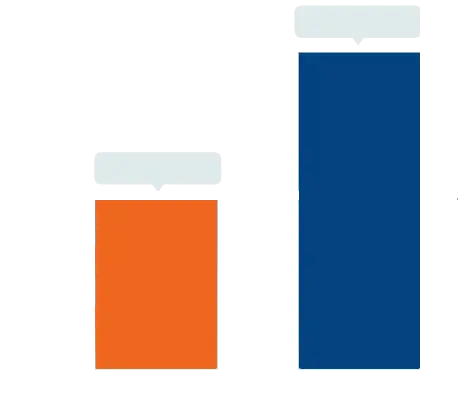
5.16 Billion
USD
6.67 Billion
2025
2033
USD
5.16 Billion
USD
6.67 Billion
2025
2033
 予測期間 予測期間 |
2026 –2033 |
 市場規模(基準年) 市場規模(基準年) |
USD 5.16 Billion |
 Market Size (Forecast Year) Market Size (Forecast Year) |
USD 6.67 Billion |
 CAGR CAGR |
% |
| Major Markets Players |
|
Global Artificial Sweeteners Market Segmentation, By Type (Aspartame, Acesulfame K, Saccharin, Sucralose, Neotame, and Others), Application (Bakery Products, Dairy products, Confectionery, Beverages, and Others) - Industry Trends and Forecast to 2033
What is the Global Artificial Sweeteners Market Size and Growth Rate?
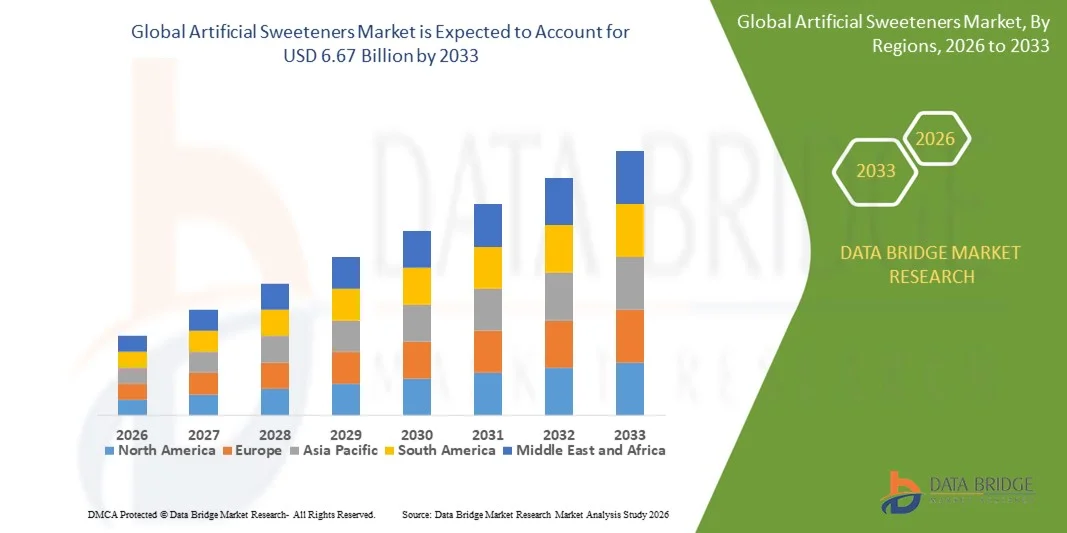
- The global artificial sweeteners market size was valued at USD 5.16 billion in 2025 and is expected to reach USD 6.67 billion by 2033, at a CAGR of 3.26% during the forecast period
- The increase in demand for ready-to-eat snack foods across the globe acts as one of the major factors driving the growth of artificial sweeteners market
- The increase in health consciousness among consumers to encourage the demand for healthier food choices, and high demand for sugar substitutes in various applications in the food & beverage industry accelerate the market growth
What are the Major Takeaways of Artificial Sweeteners Market?
- The rise in investments in research and development activities by manufacturers to develop newer and enhanced products, and surge in demand for natural sweeteners due to the rise in consumer inclination toward natural products further influence the market
- In addition, change in lifestyle, growth in health consciousness, rapid urbanization and fluctuations in the price and supply positively affect the artificial sweeteners market. Furthermore, diversification into other application sectors extends profitable opportunities to the market players
- North America dominated the artificial sweeteners market with a 39.8% revenue share in 2025, driven by strong demand for low-calorie beverages, sugar-free packaged foods, and rising health awareness across the U.S. and Canada
- Asia-Pacific is projected to register the fastest CAGR of 7.36% from 2026 to 2033, driven by rapid urbanization, rising disposable incomes, expanding food processing industries, and increasing health consciousness across China, Japan, India, South Korea, and Southeast Asia
- The Aspartame segment dominated the market with a 31.6% share in 2025, owing to its widespread use in carbonated beverages, tabletop sweeteners, sugar-free chewing gum, and low-calorie packaged foods
Report Scope and Artificial Sweeteners Market Segmentation
|
Attributes |
Artificial Sweeteners Key Market Insights |
|
Segments Covered |
|
|
Countries Covered |
North America
Europe
Asia-Pacific
Middle East and Africa
South America
|
|
Key Market Players |
|
|
Market Opportunities |
|
|
Value Added Data Infosets |
In addition to the insights on market scenarios such as market value, growth rate, segmentation, geographical coverage, and major players, the market reports curated by the Data Bridge Market Research also include in-depth expert analysis, pricing analysis, brand share analysis, consumer survey, demography analysis, supply chain analysis, value chain analysis, raw material/consumables overview, vendor selection criteria, PESTLE Analysis, Porter Analysis, and regulatory framework. |
What is the Key Trend in the Artificial Sweeteners Market?
Accelerating Shift Toward Natural, Zero-Calorie, and Clean-Label Sweetening Solutions
- The artificial sweeteners market is witnessing strong demand for plant-based, zero-calorie, and low-glycemic sweeteners as consumers increasingly seek healthier sugar alternatives in beverages, bakery, dairy, and confectionery products
- Manufacturers are focusing on clean-label formulations, improved taste profiles, and sugar-such as functionality to reduce bitterness and aftertaste traditionally associated with artificial sweeteners
- Growing preference for stevia, monk fruit, sucralose blends, and next-generation sweetener systems is driving reformulation across food and beverage portfolios worldwide
- For instance, in 2025, companies such as Cargill, Tate & Lyle, ADM, and Ingredion expanded their stevia and rare sugar portfolios to support reduced-sugar beverage and functional food applications
- Increasing regulatory pressure to reduce sugar consumption, combined with rising diabetes and obesity rates, is accelerating the shift toward high-intensity sweeteners across global markets
- As consumer awareness around health, calorie reduction, and metabolic wellness rises, Artificial Sweeteners will remain essential for sugar reformulation, product innovation, and long-term dietary transformation
What are the Key Drivers of Artificial Sweeteners Market?
- Rising prevalence of diabetes, obesity, and lifestyle-related disorders is increasing demand for low-calorie and sugar-free food and beverage products
- For instance, during 2024–2025, leading manufacturers such as Roquette, PureCircle, and Ajinomoto expanded production capacities for stevia and polyol-based sweeteners to meet growing global demand
- Growing adoption of diet beverages, sugar-free confectionery, sports nutrition, and functional foods is boosting sweetener consumption across the U.S., Europe, and Asia-Pacific
- Government initiatives promoting sugar reduction, front-of-pack labeling regulations, and sugar taxes are encouraging manufacturers to reformulate with alternative sweeteners
- Technological advancements in taste modulation, enzymatic bioconversion, and fermentation-based sweetener production are improving flavor quality and cost efficiency
- Supported by expanding health-conscious populations and continuous food innovation, the Artificial Sweeteners market is expected to witness steady long-term growth
Which Factor is Challenging the Growth of the Artificial Sweeteners Market?
- Concerns regarding the long-term health effects of certain synthetic sweeteners and ongoing regulatory scrutiny create uncertainty among consumers
- For instance, in 2024–2025, debates surrounding safety evaluations of specific high-intensity sweeteners influenced consumer perception and prompted stricter labeling discussions in several regions
- Taste limitations such as bitterness, metallic aftertaste, and blending complexity remain technical challenges for manufacturers
- Price volatility of raw materials and dependence on agricultural inputs (such as stevia leaves) can impact production costs
- Competition from natural sweeteners, sugar alcohols, and emerging rare sugars creates pricing pressure and intensifies market competition
- To address these challenges, companies are investing in advanced formulation technologies, consumer education, clean-label positioning, and diversified sourcing strategies to strengthen global adoption of Artificial Sweeteners
How is the Artificial Sweeteners Market Segmented?
The market is segmented on the basis of type and application.
- By Type
On the basis of type, the artificial sweeteners market is segmented into Aspartame, Acesulfame K, Saccharin, Sucralose, Neotame, and Others. The Aspartame segment dominated the market with a 31.6% share in 2025, owing to its widespread use in carbonated beverages, tabletop sweeteners, sugar-free chewing gum, and low-calorie packaged foods. Its high sweetness intensity, cost efficiency, and long-standing regulatory approvals across major markets have supported consistent global demand. Aspartame remains a preferred choice for beverage manufacturers due to its clean taste profile and blending compatibility with other sweeteners.
The Sucralose segment is expected to grow at the fastest CAGR from 2026 to 2033, driven by rising demand for heat-stable sweeteners in bakery and processed foods. Increasing preference for sugar-free and keto-friendly formulations, along with improved stability across temperature variations, is accelerating adoption of sucralose in diverse food processing applications.
- By Application
On the basis of application, the market is segmented into Bakery Products, Dairy Products, Confectionery, Beverages, and Others. The Beverages segment dominated the market with a 38.9% share in 2025, supported by strong consumption of diet soft drinks, energy drinks, flavored water, and ready-to-drink teas. Beverage manufacturers extensively use high-intensity sweeteners to meet sugar reduction targets, comply with sugar tax regulations, and cater to health-conscious consumers. The ability of artificial sweeteners to provide sweetness without increasing caloric value makes them essential in beverage reformulation strategies worldwide.
The Bakery Products segment is projected to grow at the fastest CAGR from 2026 to 2033, fueled by increasing demand for low-sugar baked goods, protein bars, and functional snacks. Technological advancements in sweetener blending and taste modulation are enabling improved texture, stability, and flavor balance in reduced-sugar bakery formulations.
Which Region Holds the Largest Share of the Artificial Sweeteners Market?
- North America dominated the artificial sweeteners market with a 39.8% revenue share in 2025, driven by strong demand for low-calorie beverages, sugar-free packaged foods, and rising health awareness across the U.S. and Canada. Increasing prevalence of obesity and diabetes has accelerated adoption of zero-calorie sweeteners in carbonated drinks, dairy alternatives, tabletop sweeteners, and functional nutrition products
- Leading companies in North America are investing in next-generation stevia blends, sucralose formulations, and clean-label sweetening solutions to meet evolving consumer preferences. Continuous product reformulation initiatives and sugar-reduction strategies by major food & beverage brands are strengthening regional market growth
- Strong regulatory frameworks, high consumer purchasing power, advanced food processing infrastructure, and ongoing innovation in taste modulation technologies further reinforce North America’s leadership position
U.S. Artificial Sweeteners Market Insight
The U.S. is the largest contributor in North America, supported by large-scale consumption of diet beverages, sugar-free snacks, and health-oriented packaged foods. Growing demand for keto, low-carb, and diabetic-friendly products is increasing the use of sucralose, aspartame, and stevia-based sweeteners. Major beverage manufacturers are actively reformulating products to reduce sugar content in response to regulatory guidelines and consumer demand. Strong R&D capabilities, presence of global ingredient manufacturers, and expanding functional food markets continue to drive steady market expansion across the country.
Canada Artificial Sweeteners Market Insight
Canada contributes significantly to regional growth, driven by increasing awareness of sugar reduction, rising demand for natural sweeteners, and supportive food labeling regulations. Growth in plant-based dairy alternatives, low-calorie beverages, and health-focused bakery products supports steady adoption. Government health initiatives and rising consumer preference for clean-label ingredients further strengthen artificial sweetener demand across food manufacturing industries.
Asia-Pacific Artificial Sweeteners Market
Asia-Pacific is projected to register the fastest CAGR of 7.36% from 2026 to 2033, driven by rapid urbanization, rising disposable incomes, expanding food processing industries, and increasing health consciousness across China, Japan, India, South Korea, and Southeast Asia. Growing consumption of processed foods, functional beverages, and reduced-sugar confectionery products is accelerating demand for high-intensity sweeteners. Expanding diabetic population and government-led sugar reduction campaigns further contribute to regional growth.
China Artificial Sweeteners Market Insight
China is the largest contributor to Asia-Pacific due to its massive food & beverage manufacturing base and strong production capacity for sucralose and saccharin. Rising domestic demand for diet beverages and export-oriented sweetener production supports continued market expansion.
Japan Artificial Sweeteners Market Insight
Japan shows steady growth supported by strong demand for low-calorie beverages, functional foods, and advanced sugar-reduction formulations. High consumer health awareness and innovation in specialty sweeteners drive consistent adoption.
India Artificial Sweeteners Market Insight
India is emerging as a major growth hub, driven by rising diabetic population, expanding packaged food consumption, and increasing penetration of diet beverages. Government health initiatives and growing urban middle-class demand further accelerate market growth.
South Korea Artificial Sweeteners Market Insight
South Korea contributes significantly due to strong demand for reduced-sugar beverages, functional drinks, and health-oriented snacks. Rapid innovation in food processing and increasing focus on wellness trends support sustained artificial sweetener adoption.
Which are the Top Companies in Artificial Sweeteners Market?
The artificial sweeteners industry is primarily led by well-established companies, including:
- zuChem Inc. (U.S.)
- Ingredion Incorporated (U.S.)
- BENEO (Germany)
- Cargill, Incorporated (U.S.)
- JK Sucralose Inc. (China)
- HYET Sweet (Netherlands)
- Roquette Frères (France)
- Mitsui Sugar Co., Ltd. (Japan)
- ADM (U.S.)
- Tate & Lyle (U.K.)
- Pyure Brands LLC (U.S.)
- PureCircle (U.S.)
- Ajinomoto Health & Nutrition North America, Inc. (U.S.)
- Alsiano (U.S.)
- StartingLine S.p.A. (Italy)
- NutraSweet Co. (U.S.)
- MAFCO Worldwide LLC (U.S.)
- Matsutani Chemical Industry Co., Ltd. (Japan)
- DuPont (U.S.)
- Foodchem International Corporation (China)
What are the Recent Developments in Global Artificial Sweeteners Market?
- In August 2025, the company posted its lowest second-quarter profit in five years, citing trade policy volatility and uncertainty in biofuel policies that negatively impacted crop processing margins and overall earnings expectations, highlighting the challenges facing the industry during volatile market conditions
- In August 2025, the company reported Q2 2025 results, noting that although North American corn wet-milling experienced higher profits from improved liquid sweetener margins, the overall Starches & Sweeteners segment operating profit declined 6% year-over-year, reflecting the mixed performance across business lines
- In July 2025, the company debuted an expanded ingredients portfolio and the Mouthfeel Lab at IFT FIRST 2025, showcasing new prototypes focused on sugar reduction, fiber fortification, and enhanced sensory mouthfeel, leveraging the combined expertise of Tate & Lyle and CP Kelco, demonstrating its commitment to innovation and product development
- In June 2025, the company launched the “All-Americas” Reb M campaign in partnership with Manus, emphasizing a fully North and South American supply chain for stevia Reb M to improve supply stability and responsiveness, strengthening regional supply reliability for customers
- In May 2025, the company introduced “ALFIE”, an Automated Laboratory for Ingredient Experimentation system unveiled in Singapore, which accelerates prototype development and characterization through advanced automation, reinforcing its focus on efficiency and innovation in ingredient testing
SKU-
世界初のマーケットインテリジェンスクラウドに関するレポートにオンラインでアクセスする

- インタラクティブなデータ分析ダッシュボード
- 成長の可能性が高い機会のための企業分析ダッシュボード
- カスタマイズとクエリのためのリサーチアナリストアクセス
- インタラクティブなダッシュボードによる競合分析
- 最新ニュース、更新情報、トレンド分析
- 包括的な競合追跡のためのベンチマーク分析のパワーを活用
調査方法
データ収集と基準年分析は、大規模なサンプル サイズのデータ収集モジュールを使用して行われます。この段階では、さまざまなソースと戦略を通じて市場情報または関連データを取得します。過去に取得したすべてのデータを事前に調査および計画することも含まれます。また、さまざまな情報ソース間で見られる情報の不一致の調査も含まれます。市場データは、市場統計モデルと一貫性モデルを使用して分析および推定されます。また、市場シェア分析と主要トレンド分析は、市場レポートの主要な成功要因です。詳細については、アナリストへの電話をリクエストするか、お問い合わせをドロップダウンしてください。
DBMR 調査チームが使用する主要な調査方法は、データ マイニング、データ変数が市場に与える影響の分析、および一次 (業界の専門家) 検証を含むデータ三角測量です。データ モデルには、ベンダー ポジショニング グリッド、市場タイムライン分析、市場概要とガイド、企業ポジショニング グリッド、特許分析、価格分析、企業市場シェア分析、測定基準、グローバルと地域、ベンダー シェア分析が含まれます。調査方法について詳しくは、お問い合わせフォームから当社の業界専門家にご相談ください。
カスタマイズ可能
Data Bridge Market Research は、高度な形成的調査のリーダーです。当社は、既存および新規のお客様に、お客様の目標に合致し、それに適したデータと分析を提供することに誇りを持っています。レポートは、対象ブランドの価格動向分析、追加国の市場理解 (国のリストをお問い合わせください)、臨床試験結果データ、文献レビュー、リファービッシュ市場および製品ベース分析を含めるようにカスタマイズできます。対象競合他社の市場分析は、技術ベースの分析から市場ポートフォリオ戦略まで分析できます。必要な競合他社のデータを、必要な形式とデータ スタイルでいくつでも追加できます。当社のアナリスト チームは、粗い生の Excel ファイル ピボット テーブル (ファクト ブック) でデータを提供したり、レポートで利用可能なデータ セットからプレゼンテーションを作成するお手伝いをしたりすることもできます。












