What is the Fiber-Based Thermoformed Protective Packaging Market Size and Growth Rate?
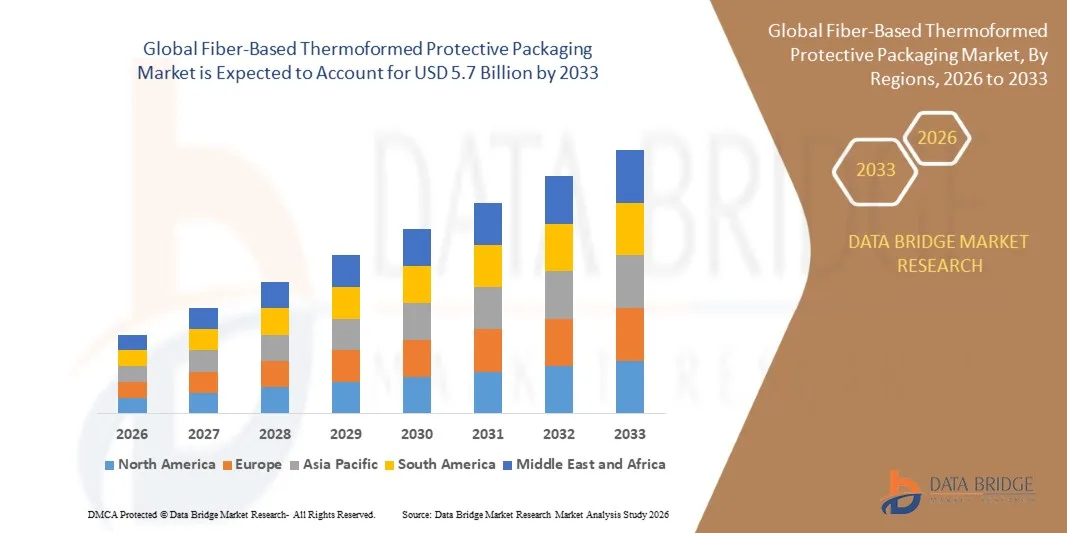
- As per Data Bridge Market Research analysis, the fiber-based thermoformed protective packaging market was valued at USD 3.1 billion in 2025 and is projected to reach USD 5.7 billion by 2033, growing at a CAGR of 7.90% from 2026 to 2033.
- The global fiber-based thermoformed protective packaging market is experiencing steady growth, driven by increasing demand for sustainable packaging alternatives, rising concerns over plastic waste, and the growing adoption of recyclable and biodegradable materials across food and beverage, electronics, healthcare, consumer goods, and industrial applications.
- The increasing use of molded fiber trays, inserts, end caps, and cushioning components to protect fragile products during storage and transportation is encouraging businesses to adopt advanced fiber-based thermoformed protective packaging solutions. Innovations in fiber molding technologies, improved structural strength, enhanced shock absorption, and customized packaging designs are gaining traction, offering effective product protection, reduced reliance on conventional plastic foams, and improved sustainability across e-commerce, electronics, and industrial supply chains.
Market Size & Forecast
- Global Market Value (2025): USD 3.1 Billion
- Expected Market Value (2033): USD 5.7 Billion
- Forecast CAGR (2026–2033): 7.90%
- Leading Region in 2025: North America
- Fastest Growing Region: Asia Pacific
What are the Major Takeaways of the Fiber-Based Thermoformed Protective Packaging Market?
- North America dominated the fiber-based thermoformed protective packaging market in 2025, supported by strong demand for sustainable packaging alternatives, established food and beverage and electronics industries, and increasing adoption of molded fiber solutions to reduce conventional plastic packaging waste.
- Asia Pacific is expected to be the fastest-growing region from 2026 to 2033, driven by expanding manufacturing activities, rising e-commerce shipments, growing electronics production, and increasing demand for sustainable protective packaging across China, India, Japan, and South Korea.
- The recycled paper pulp segment is expected to hold a significant market share in 2025, supported by the availability of recovered paper materials, cost advantages, and increasing demand for recyclable and resource-efficient packaging solutions.
- The thermoformed fiber packaging segment is expected to witness strong growth from 2026 to 2033, driven by its ability to produce lightweight, customized packaging components with consistent shapes, effective cushioning, and dimensional accuracy for fragile products.
- The electrical and electronics packaging segment is expected to account for a substantial share of the market, supported by rising demand for protective trays, inserts, and cushioning components that prevent product damage during handling, storage, and transportation.
- The industrial and e-commerce protective packaging segment is expected to grow significantly from 2026 to 2033, driven by increasing parcel shipments, demand for sustainable transit packaging, and the need for customized protective solutions for fragile and high-value products.
- The food and beverage segment is expected to remain an important end-use category, supported by increasing demand for molded fiber trays, containers, and protective packaging formats that offer product stability and help reduce dependence on conventional plastic materials.
Report Scope and Fiber-Based Thermoformed Protective Packaging Market Segmentation
|
Attributes |
Fiber-Based Thermoformed Protective Packaging Key Market Insights |
|
Segments Covered |
|
|
Countries Covered |
North America
Europe
Asia-Pacific
Middle East and Africa
South America
|
|
Key Market Players |
|
|
Market Opportunities |
|
|
Value Added Data Infosets |
In addition to the insights on market scenarios such as market value, growth rate, segmentation, geographical coverage, and major players, the market reports curated by the Data Bridge Market Research also include import export analysis, production capacity overview, production consumption analysis, price trend analysis, climate change scenario, supply chain analysis, value chain analysis, raw material/consumables overview, vendor selection criteria, PESTLE Analysis, Porter Analysis, and regulatory framework. |
What is the Key Trend in the Fiber-Based Thermoformed Protective Packaging Market?
- Manufacturers are increasingly developing molded fiber packaging with improved structural strength, cushioning performance, moisture resistance, and customized designs to expand its use across electronics, food and beverage, healthcare, household appliances, and e-commerce applications.
- For instance, in March 2024, PulPac continued advancing its Dry Molded Fiber technology, which uses fiber-based materials to manufacture packaging and other products with reduced water consumption during production compared with conventional wet-molding processes.
- Advances in fiber molding techniques and material formulations are helping manufacturers improve dimensional accuracy, surface finish, rigidity, and protective performance across different packaging applications.
- Packaging manufacturers are increasingly exploring thermoformed fiber trays, inserts, end caps, and cushioning components as alternatives to conventional plastic foam packaging, particularly for fragile electronics, consumer goods, and products requiring protection during transportation.
- For instance, in June 2024, Huhtamaki continued developing fiber-based packaging solutions that support the transition toward renewable and recyclable packaging materials across foodservice and consumer packaging applications.
- As businesses prioritize product protection, material recyclability, and reduced dependence on conventional plastics, continued improvements in fiber processing and thermoforming technologies are expected to support adoption across consumer and industrial supply chains.
What are the Key Drivers of the Fiber-Based Thermoformed Protective Packaging Market?
- The growing demand for sustainable protective packaging is increasing the adoption of thermoformed fiber solutions across electronics, household appliances, food and beverage, healthcare, and e-commerce applications. These solutions provide cushioning and structural support while offering alternatives to conventional plastic packaging.
- For instance, in March 2024, PulPac continued promoting Dry Molded Fiber technology for packaging applications, supporting the development of fiber-based alternatives to selected plastic products and conventional molded fiber formats.
- Manufacturers of electronics, consumer appliances, and industrial products are increasingly considering molded fiber trays, inserts, and cushioning components to minimize product movement, absorb impact, and improve protection during storage and transportation.
- For instance, in June 2024, Huhtamaki continued its focus on fiber-based packaging innovation, reflecting the broader industry shift toward renewable materials and packaging designs that support recyclability.
- With increasing emphasis on packaging sustainability, product safety, and material efficiency, fiber-based thermoformed protective packaging is expected to gain further traction across consumer, commercial, and industrial applications, subject to performance, cost, and end-of-life requirements.
What Factors are Challenging the Growth of the Fiber-Based Thermoformed Protective Packaging Market?
- Fiber-based thermoformed protective packaging can face performance limitations in humid environments because moisture absorption may cause softening, deformation, and reduced structural strength during storage and transportation.
- For instance, in September 2024, developments in fiber-based packaging applications continued to highlight the importance of moisture management and material selection, as exposure to moisture and condensation can affect the rigidity and cushioning performance of molded fiber components during transportation and storage.
- These limitations can restrict adoption in applications requiring prolonged exposure to moisture, high load-bearing capacity, or consistent dimensional stability throughout extended storage and distribution cycles.
- Integrating improved moisture resistance, mechanical strength, cushioning performance, and recyclability into a single packaging design can also require additional material development, manufacturing optimization, and application-specific testing.
- For instance, in October 2024, manufacturers continued exploring alternative fiber-molding processes and material formulations to improve packaging performance while reducing resource consumption and dependence on conventional plastics.
- The need to balance moisture resistance, protective performance, recyclability, manufacturing costs, and production efficiency continues to challenge the development of fiber-based thermoformed protective packaging, particularly for applications requiring durable protection under variable environmental and transportation conditions.
How is the Fiber-Based Thermoformed Protective Packaging Market Segmented?
The fiber-based thermoformed protective packaging market is segmented on the basis of material, type, product type, application, end-use industry and packaging format.
- By Material
On the basis of material, the fiber-based thermoformed protective packaging market is segmented into Recycled Paper Pulp, Virgin Wood Pulp, Non-Wood Fiber Pulp, and Others. The Recycled Paper Pulp segment is expected to dominate the market in 2025, supported by the availability of recovered paper materials, increasing demand for recyclable packaging, and growing efforts to reduce reliance on virgin raw materials. Recycled fibers are used in molded protective packaging components designed to cushion products and limit movement during storage and transportation. Growing demand for resource-efficient packaging solutions across electronics, consumer goods, and e-commerce is expected to support segment growth.
The Virgin Wood Pulp segment is expected to gain traction during the forecast period from 2026 to 2033, driven by demand for consistent fiber quality, structural strength, and reliable molding performance. Virgin wood pulp can support the production of protective packaging components requiring specific strength, surface quality, and dimensional characteristics. Continued improvements in fiber processing and material formulation are expected to influence adoption across applications requiring dependable product protection.
- By Type
On the basis of type, the fiber-based thermoformed protective packaging market is segmented into Thermoformed Fiber Packaging, Transfer-Molded Fiber Packaging, Thick-Wall Molded Fiber Packaging, and Processed Molded Fiber Packaging. The Thermoformed Fiber Packaging segment is expected to hold a significant market share in 2025, supported by its ability to produce precisely shaped packaging components with consistent dimensions and customized product fit. These solutions are suitable for electronics, consumer goods, and other fragile products requiring protective inserts and trays. Growing demand for lightweight packaging with reliable cushioning and improved product presentation is expected to support segment growth.
The Transfer-Molded Fiber Packaging segment is expected to experience growth from 2026 to 2033, supported by its suitability for manufacturing molded fiber components with customized shapes and protective structures. The process enables the production of packaging inserts and cushioning products for selected industrial and consumer applications. Demand will depend on molding efficiency, product complexity, required surface finish, material consumption, and the protective performance needed for individual applications.
- By Product Type
On the basis of product type, the fiber-based thermoformed protective packaging market is segmented into Trays, Inserts and Dividers, End Caps, Clamshells and Containers, and Others. The Trays segment is expected to account for a significant share of the market in 2025, supported by demand for organized product placement and protective separation during storage and transportation. Molded fiber trays can be designed with individual compartments to hold products securely, minimize movement, and reduce the risk of damage. Growing demand across electronics, food and beverage, and consumer goods applications is expected to support segment growth.
The Inserts and Dividers segment is expected to gain traction during the forecast period from 2026 to 2033, driven by increasing demand for customized packaging solutions that protect fragile products and separate individual components. These products help improve packaging organization, reduce product-to-product contact, and provide cushioning during distribution. Growing adoption of sustainable protective packaging across e-commerce, electronics, and industrial supply chains is expected to support segment growth.
- By Application
On the basis of application, the fiber-based thermoformed protective packaging market is segmented into Food and Beverage Packaging, Consumer Electronics Packaging, Household Appliances Packaging, Healthcare and Medical Device Packaging, Industrial and E-Commerce Protective Packaging, and Others. The Consumer Electronics Packaging segment is expected to account for a significant share of the market in 2025, driven by demand for protective trays, inserts, and cushioning components for electronic devices and accessories. Molded fiber packaging can help limit product movement and absorb impacts during handling, storage, and transportation. Growing electronics shipments and increasing interest in alternatives to conventional plastic foam packaging are expected to support segment growth.
The Industrial and E-Commerce Protective Packaging segment is expected to present growth opportunities during 2026–2033, supported by increasing parcel shipments and demand for protective packaging designed for distribution networks. Fiber-based inserts, end caps, and cushioning components can be customized to accommodate different product shapes and reduce movement inside shipping cartons. Growing demand for recyclable transit packaging and improved packaging efficiency is expected to support adoption across industrial and online retail supply chains.
- By End-Use Industry
On the basis of end-use industry, the fiber-based thermoformed protective packaging market is segmented into Food and Beverage, Electrical and Electronics, Healthcare and Pharmaceuticals, Consumer Goods, Industrial and Automotive, and Others. The Electrical and Electronics segment is expected to represent a significant share of the market in 2025, supported by demand for packaging that protects sensitive components against impacts, vibration, and movement during distribution. Molded fiber trays and inserts can provide product-specific compartments and cushioning while offering an alternative to selected conventional plastic packaging materials. Increasing electronics production and demand for protective shipping solutions are expected to contribute to segment growth.
The Industrial and Automotive segment is expected to offer growth opportunities from 2026 to 2033, driven by the need to protect components, spare parts, and precision-manufactured products during storage and transportation. Fiber-based protective packaging can be designed to accommodate individual component dimensions and reduce contact between products. Increasing emphasis on material efficiency and sustainable packaging procurement is expected to support adoption, subject to load-bearing, moisture-resistance, and application-specific performance requirements.
- By Packaging Format
On the basis of packaging format, the fiber-based thermoformed protective packaging market is segmented into Custom-Molded Inserts, Protective Trays, Clamshell Packaging, Cushioning Components, and Others. The Custom-Molded Inserts segment is expected to account for a significant market share in 2025, supported by its ability to accommodate product-specific shapes and provide cushioning for fragile or high-value items. These inserts help secure products within shipping containers, reduce movement during transit, and support organized product presentation. Growing demand for customized protective packaging across electronics, consumer goods, and industrial applications is expected to support the segment.
The Protective Trays segment is expected to provide growth opportunities during the forecast period from 2026 to 2033, driven by demand for organized product placement and protective separation during manufacturing, storage, and transportation. Thermoformed fiber trays can be designed with compartments that accommodate individual products or components while helping minimize movement and contact damage. Their adoption will depend on dimensional accuracy, structural strength, moisture resistance, production costs, and compatibility with automated packaging and handling systems.
Which Region Holds the Largest Share of the Fiber-Based Thermoformed Protective Packaging Market?
- North America is expected to hold a significant share of the fiber-based thermoformed protective packaging market in 2025, supported by demand for sustainable packaging alternatives, established electronics and consumer goods industries, and increasing adoption of molded fiber trays, inserts, and cushioning components.
- The region also benefits from established e-commerce networks, growing demand for protective packaging during product transportation, and increasing efforts to reduce dependence on conventional plastic foam materials. Rising interest in recyclable packaging solutions across electronics, healthcare, household appliances, and industrial applications is expected to support North America's position in the market.
U.S. Fiber-Based Thermoformed Protective Packaging Market Insight
The U.S. fiber-based thermoformed protective packaging market is witnessing growth, supported by demand for protective packaging across electronics, household appliances, healthcare, and e-commerce applications. Molded fiber trays, inserts, and cushioning components are used to protect fragile products during storage and transportation. Growing interest in recyclable packaging materials, together with demand for customized protective designs and efficient shipping solutions, is expected to support market development.
Asia-Pacific Fiber-Based Thermoformed Protective Packaging Market Insight
The Asia Pacific fiber-based thermoformed protective packaging market is expected to witness growth driven by expanding manufacturing activities, increasing electronics production, rising e-commerce shipments, and growing demand for sustainable packaging alternatives. Countries across the region are creating opportunities for molded fiber packaging used in consumer electronics, household appliances, food and beverage, and industrial applications. Increasing investments in packaging manufacturing and advancements in fiber-molding technologies are expected to support adoption, although moisture resistance, production costs, and material performance remain important considerations.
Japan Fiber-Based Thermoformed Protective Packaging Market Insight
The Japan fiber-based thermoformed protective packaging market is supported by demand for specialized protective packaging across electronics, precision components, household appliances, and consumer goods. Molded fiber trays and inserts can provide customized product positioning and cushioning during transportation and storage. Continued development of fiber-molding technologies, dimensional accuracy, and structural performance is expected to influence adoption across applications requiring reliable product protection.
China Fiber-Based Thermoformed Protective Packaging Market Insight
The China fiber-based thermoformed protective packaging market is growing, driven by demand from electronics manufacturing, household appliances, consumer goods, and e-commerce distribution. Molded fiber trays, end caps, and inserts can support product protection during domestic and international transportation while offering alternatives to selected conventional plastic packaging formats. Opportunities for market expansion will depend on manufacturing capabilities, material availability, packaging costs, and the ability of fiber-based products to maintain performance under varying storage and transportation conditions.
U.K. Fiber-Based Thermoformed Protective Packaging Market Insight
The U.K. fiber-based thermoformed protective packaging market is experiencing growth, supported by demand for sustainable protective packaging across e-commerce, electronics, healthcare, and consumer goods applications. Fiber-based trays, inserts, and cushioning components can help secure products during transit and reduce reliance on conventional plastic foam packaging. Increasing interest in recyclable materials, customized packaging designs, and resource-efficient distribution solutions is expected to contribute to market opportunities.
Germany Fiber-Based Thermoformed Protective Packaging Market Insight
The Germany fiber-based thermoformed protective packaging market is expanding, supported by demand from automotive, electrical and electronics, industrial manufacturing, and consumer goods industries. Molded fiber packaging can provide cushioning, component separation, and customized protection for products and parts during storage and transportation. Continued improvements in fiber processing, structural strength, dimensional stability, and moisture management are expected to influence adoption across German industrial and manufacturing supply chains.
Which are the Top Companies in Fiber-Based Thermoformed Protective Packaging Market?
The fiber-based thermoformed protective packaging industry is primarily led by well-established companies, including:
- Amcor plc (Australia)
- Huhtamaki Oyj (Finland)
- Sonoco Products Company (U.S.)
- UFP Technologies, Inc. (U.S.)
- Pactiv Evergreen Inc. (U.S.)
- Genpak, LLC (U.S.)
- Sabert Corporation (U.S.)
- Pro-Pac Packaging Limited (Australia)
- Cullen Packaging Ltd. (U.K.)
- PulPac AB (Sweden)
- Hartmann Packaging A/S (Denmark)
- Brødrene Hartmann A/S (Denmark)
- Tekni-Plex, Inc. (U.S.)
- Fabri-Kal (U.S.)
- Cellulose de la Loire (France)
- EnviroPAK Corporation (U.S.)
- Atlantic Pulp (U.S.)
- Keiding, Inc. (U.S.)
- Orcon Industries (U.S.)
What are Latest Developments in Fiber-Based Thermoformed Protective Packaging Market?
- In October 2025, HZ Green Pulp began full-scale commercial production of dry molded fiber coffee lids in Malaysia using PulPac’s technology. The launch marked the commercial scaling of molded fiber packaging and demonstrated the potential of fiber-forming technologies to support the transition from conventional plastic packaging to fiber-based alternatives.
- In April 2025, Fibmold highlighted its expansion into molded fiber packaging applications for electronics, cosmetics, and pharmaceuticals, building on its use of plant fibers such as sugarcane bagasse. This development reflects the growing potential of molded fiber materials for protective and product-specific packaging applications beyond food service.
- In July 2025, Parason dispatched its PFA-S1500 fully automatic molded fiber machine, designed for applications including electronics, cosmetics, tableware, and industrial packaging. The machine incorporates precision forming and automatic stacking capabilities, supporting manufacturing efficiency and the production of fiber-based packaging components for diverse end-use industries.
- In April 2026, Amcor announced advancements in its collaboration with Metsä Group and G. Mondini to develop an integrated fiber-based tray system for protein and chilled ready-meal applications. The solution combines a molded fiber tray with barrier materials and is designed to support product protection, shelf-life requirements, and reduced plastic use.
- Interactive Data Analysis Dashboard
- Company Analysis Dashboard for high growth potential opportunities
- Research Analyst Access for customization & queries
- Competitor Analysis with Interactive dashboard
- Latest News, Updates & Trend analysis
- Harness the Power of Benchmark Analysis for Comprehensive Competitor Tracking
Global Fiber Based Thermoformed Protective Packaging Market, Supply Chain Analysis and Ecosystem Framework
To support market growth and help clients navigate the impact of geopolitical shifts, DBMR has integrated in-depth supply chain analysis into its Global Fiber Based Thermoformed Protective Packaging Market research reports. This addition empowers clients to respond effectively to global changes affecting their industries. The supply chain analysis section includes detailed insights such as Global Fiber Based Thermoformed Protective Packaging Market consumption and production by country, price trend analysis, the impact of tariffs and geopolitical developments, and import and export trends by country and HSN code. It also highlights major suppliers with data on production capacity and company profiles, as well as key importers and exporters. In addition to research, DBMR offers specialized supply chain consulting services backed by over a decade of experience, providing solutions like supplier discovery, supplier risk assessment, price trend analysis, impact evaluation of inflation and trade route changes, and comprehensive market trend analysis.
Data collection and base year analysis are done using data collection modules with large sample sizes. The stage includes obtaining market information or related data through various sources and strategies. It includes examining and planning all the data acquired from the past in advance. It likewise envelops the examination of information inconsistencies seen across different information sources. The market data is analysed and estimated using market statistical and coherent models. Also, market share analysis and key trend analysis are the major success factors in the market report. To know more, please request an analyst call or drop down your inquiry.
The key research methodology used by DBMR research team is data triangulation which involves data mining, analysis of the impact of data variables on the market and primary (industry expert) validation. Data models include Vendor Positioning Grid, Market Time Line Analysis, Market Overview and Guide, Company Positioning Grid, Patent Analysis, Pricing Analysis, Company Market Share Analysis, Standards of Measurement, Global versus Regional and Vendor Share Analysis. To know more about the research methodology, drop in an inquiry to speak to our industry experts.
Data Bridge Market Research is a leader in advanced formative research. We take pride in servicing our existing and new customers with data and analysis that match and suits their goal. The report can be customized to include price trend analysis of target brands understanding the market for additional countries (ask for the list of countries), clinical trial results data, literature review, refurbished market and product base analysis. Market analysis of target competitors can be analyzed from technology-based analysis to market portfolio strategies. We can add as many competitors that you require data about in the format and data style you are looking for. Our team of analysts can also provide you data in crude raw excel files pivot tables (Fact book) or can assist you in creating presentations from the data sets available in the report.