



Global Live Ip Broadcast Equipment Market
시장 규모 (USD 10억)
연평균 성장률 :
% 
 USD
2.58 Billion
USD
9.14 Billion
2025
2033
USD
2.58 Billion
USD
9.14 Billion
2025
2033
 예측 기간 예측 기간 |
2026 –2033 |
 시장 규모(기준 연도) 시장 규모(기준 연도) |
USD 2.58 Billion |
 시장 규모(예측 연도) 시장 규모(예측 연도) |
USD 9.14 Billion |
 연평균 성장률 연평균 성장률 |
% |
| 주요 시장 플레이어 |
|
Global Live IP Broadcast Equipment Market Segmentation, By Product Type (Transmitter And Gap Fillers, Encoders And Convertor, Amplifiers, Antennas, Modulators and Repeaters, Routers and Switches, Video Servers, and Others), Application (Broadcast Stadiums, Outside Broadcast Vans, and Broadcast Production Centers) - Industry Trends and Forecast to 2033
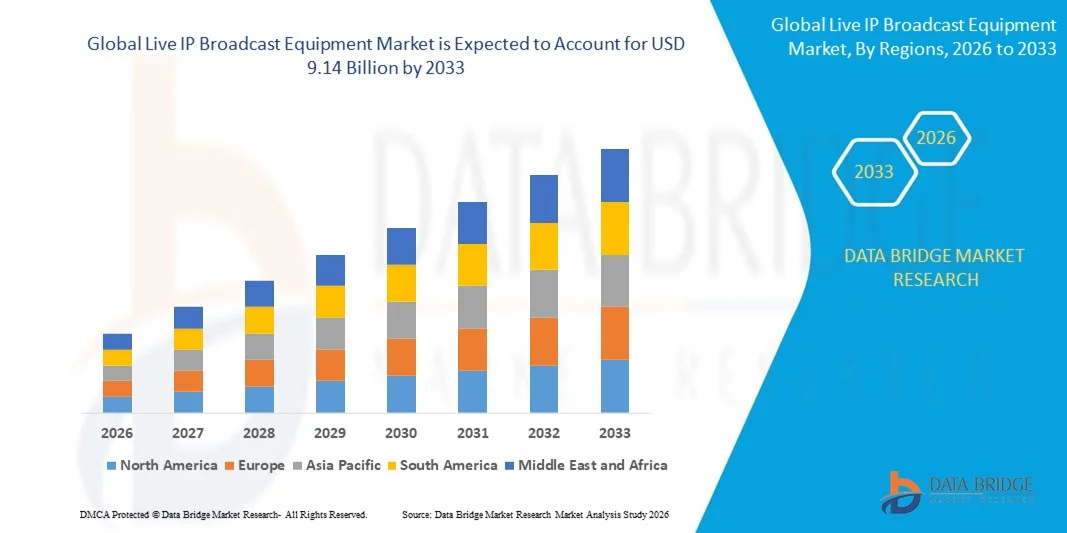
Live IP Broadcast Equipment Market Size
- The global live IP broadcast equipment market size was valued at USD 2.58 billion in 2025 and is expected to reach USD 9.14 billion by 2033, at a CAGR of 17.10% during the forecast period
- The market growth is largely fueled by the accelerating transition from traditional SDI-based workflows to flexible, software-defined, and IP-centric broadcast architectures, enabling broadcasters to streamline live production and reduce infrastructure complexity
- In addition, the increasing need for remote production, real-time content delivery, and scalable cloud-based broadcasting solutions is further strengthening the shift toward live IP systems
Live IP Broadcast Equipment Market Analysis
- Live IP broadcast equipment, enabling the real-time transport and management of audio and video signals over IP networks, is becoming a critical backbone for modern content production due to its high interoperability, operational efficiency, and adaptability across distributed production environments
- The rising demand for high-quality live streaming, multi-platform content delivery, and enhanced workflow automation is boosting industry adoption as broadcasters prioritize flexibility, scalability, and cost-efficient production models
- North America dominated the live IP broadcast equipment market with a share of over 45% in 2025, due to the strong transition of broadcasters toward IP-based production environments and the rising adoption of remote and cloud-enabled workflows
- Asia-Pacific is expected to be the fastest growing region in the live IP broadcast equipment market during the forecast period due to rapid digitalization, rising media consumption, and increased investments in broadcasting infrastructure
- Encoders and convertor segment dominated the market with a market share in 2025, due to their critical role in compressing, converting, and transmitting high-quality video over IP networks. Broadcasters rely on advanced encoders to support low-latency 4K/8K streaming, remote production, and cloud-based workflows, making them central to modern IP-based broadcast infrastructures. Their compatibility with hybrid systems and ability to link legacy SDI equipment with IP workflows further strengthens their dominance
Report Scope and Live IP Broadcast Equipment Market Segmentation
|
Attributes |
Live IP Broadcast Equipment Key Market Insights |
|
Segments Covered |
|
|
Countries Covered |
North America
Europe
Asia-Pacific
Middle East and Africa
South America
|
|
Key Market Players |
|
|
Market Opportunities |
|
|
Value Added Data Infosets |
In addition to the insights on market scenarios such as market value, growth rate, segmentation, geographical coverage, and major players, the market reports curated by the Data Bridge Market Research also include in-depth expert analysis, geographically represented company-wise production and capacity, network layouts of distributors and partners, detailed and updated price trend analysis and deficit analysis of supply chain and demand. |
Live IP Broadcast Equipment Market Trends
Growing Adoption of Cloud-Enabled Live Production Workflows
- A major trend in the Live IP Broadcast Equipment market is the rapid shift toward cloud-enabled live production workflows as broadcasters seek higher flexibility, scalability, and remote collaboration capabilities across live events. This shift is reshaping production environments by reducing dependence on traditional on-site infrastructure and enabling distributed teams to manage live broadcasts from multiple locations in real time
- For instance, Sony and Grass Valley offer cloud-native live production platforms that support real-time switching, processing, and content delivery through IP-based systems. These solutions allow broadcasters to simplify operations, optimize resource usage, and achieve faster turnaround for live content delivery
- Broadcasters are increasingly adopting cloud-centric IP tools to improve mobility and minimize physical hardware requirements for events such as sports tournaments, news broadcasting, and live entertainment. This is reinforcing the role of cloud workflows in enhancing operational resilience and cost efficiency
- The growing need for multi-camera live production with centralized control is driving interest in cloud-operated IP systems that provide seamless content synchronization across geographies. This trend is strengthening reliance on flexible production architectures capable of supporting large-scale live events
- Expansion of remote production models is boosting demand for cloud-enabled IP systems that allow decentralized teams to collaborate through shared processing environments. This is transforming traditional broadcast workflows by enabling faster deployment and greater continuity in dynamic production scenarios
- The rising adoption of cloud-based tools for live signal processing, monitoring, and content management is accelerating market growth. This increasing integration of virtualized production capabilities is shaping the transition toward more efficient, responsive, and scalable broadcasting ecosystems across the global media landscape
Live IP Broadcast Equipment Market Dynamics
Driver
Rising Shift from SDI to IP-Based Broadcast Infrastructure
- The transition from SDI-based systems to IP-enabled broadcast infrastructure is emerging as a major driver in the Live IP Broadcast Equipment market as broadcasters aim to improve workflow flexibility, maximize bandwidth efficiency, and support higher-resolution formats. IP systems enable scalable architectures that adapt to rapidly evolving production demands across live sports, news, and entertainment
- For instance, Evertz and Cisco supply IP routing platforms and network solutions that support seamless transport of high-bandwidth video signals for large-scale production environments. These systems enable broadcasters to modernize their facilities and achieve greater agility in handling multi-format content
- The shift to IP workflows is supporting 4K, 8K, HDR, and multi-camera live production, all of which require efficient signal transport and high connectivity performance. This transition is reinforcing the need for IP-based equipment designed to enhance throughput and minimize latency
- Adoption of software-defined networks is helping broadcasters improve network visibility, automate routing, and optimize resource allocation across live production stages. This capability is driving modernization of broadcast facilities and enabling more efficient operational control
- The increasing industry preference for interoperable and scalable IP architectures continues to strengthen this driver. The flexibility to integrate emerging technologies and manage complex broadcast workflows is positioning IP systems as essential for the next generation of live production
Restraint/Challenge
High Complexity in IP Integration and Network Management
- The Live IP Broadcast Equipment market faces challenges due to the technical complexity associated with integrating IP-based workflows into traditional broadcast environments, which often require significant network expertise and deep system interoperability. These complexities increase deployment timelines and elevate the need for specialized technical resources
- For instance, companies such as Sencore provide advanced monitoring and diagnostic tools to help broadcasters manage IP flow quality, yet the need for dedicated engineers to oversee IP configurations remains high. This adds operational challenges for broadcasters transitioning from SDI to IP
- Integrating real-time broadcast signals over IP requires strict synchronization, bandwidth management, and reliability assurance to prevent signal loss or latency. These requirements make system design and implementation significantly more difficult for live production settings
- High dependence on sophisticated network protocols and infrastructure increases the risk of configuration errors, security vulnerabilities, and performance inconsistencies. This elevates operational risks for broadcasters adopting IP workflows
- The persistent complexity involved in implementing and maintaining IP-based broadcasting systems continues to act as a restraint, forcing broadcasters to balance technological advancement with training, workflow adaptation, and infrastructural readiness
Live IP Broadcast Equipment Market Scope
The market is segmented on the basis of product type and application.
- By Product Type
On the basis of product type, the Live IP Broadcast Equipment market is segmented into transmitters and gap fillers, encoders and converters, amplifiers, antennas, modulators and repeaters, routers and switches, video servers, and others. The encoders and converters segment dominated the market in 2025, driven by their critical role in compressing, converting, and transmitting high-quality video over IP networks. Broadcasters rely on advanced encoders to support low-latency 4K/8K streaming, remote production, and cloud-based workflows, making them central to modern IP-based broadcast infrastructures. Their compatibility with hybrid systems and ability to link legacy SDI equipment with IP workflows further strengthens their dominance.
The routers and switches segment is expected to witness the fastest growth from 2026 to 2033, supported by the rising transition toward fully IP-native broadcasting. These systems provide high-bandwidth routing, real-time traffic management, and redundancy, making them essential for live production environments. For instance, companies such as Cisco offer ST 2110-ready switches that ensure smooth uncompressed video transmission and secure network performance. The expanding use of remote production, virtual studios, and decentralized workflows accelerates adoption in this segment.
- By Application
On the basis of application, the Live IP Broadcast Equipment market is segmented into broadcast stadiums, outside broadcast vans, and broadcast production centers. The broadcast production centers segment dominated the market in 2025 as studios increasingly shift to IP-based editing, playout, and centralized control. IP systems enable flexible device integration, seamless content distribution, and efficient multi-platform broadcasting, making them a key choice for modern production environments. Growing upgrades of traditional control rooms to IP-native operations support the segment’s leading position.
The outside broadcast vans segment is anticipated to register the fastest growth from 2026 to 2033, driven by rising demand for mobile live coverage of sports, entertainment, and political events. OB vans equipped with IP-based systems deliver high-resolution feeds with minimal latency and greater flexibility than traditional setups. For instance, LiveU’s IP transmission units allow rapid deployment and reliable connectivity in field conditions. Increasing adoption of remote production and bonded IP networks boosts the growth of this segment.
Live IP Broadcast Equipment Market Regional Analysis
- North America dominated the live IP broadcast equipment market with the largest revenue share of over 45% in 2025, driven by the strong transition of broadcasters toward IP-based production environments and the rising adoption of remote and cloud-enabled workflows
- The region’s advanced broadcasting infrastructure, combined with the increasing demand for high-quality live content across sports, news, and entertainment, accelerates the shift from SDI to IP systems
- Broadcasters in North America highly value the flexibility, scalability, and real-time processing capabilities supported by IP-based equipment. The widespread deployment of 4K and 8K live production, along with rapid upgrades in studio and field broadcasting, further strengthens market dominance in the region
U.S. Live IP Broadcast Equipment Market Insight
The U.S. Live IP Broadcast Equipment market captured the largest revenue share within North America in 2025, fueled by strong investments in next-generation broadcasting technology and the rapid adoption of cloud-linked live production. Broadcasters are increasingly prioritizing cost-efficient remote production, IP-based control rooms, and high-bandwidth contribution networks to support multi-platform live content. The expansion of OTT platforms, along with rising demand for ultra-low-latency streaming, is further propelling equipment adoption. The strong presence of major broadcasters and technology providers accelerates the transition toward fully IP-native production environments across the country.
Europe Live IP Broadcast Equipment Market Insight
The Europe Live IP Broadcast Equipment market is projected to expand at a substantial CAGR during the forecast period, driven by stringent broadcasting standards and the growing adoption of IP workflows across the region. The shift to UHD and HDR production, combined with increasing demand for flexible and energy-efficient broadcasting systems, supports market growth. European broadcasters are actively transitioning to IP-based studios and centralized production hubs to streamline workflows and reduce operational complexities. The integration of IP technology into both new-build and refurbished facilities contributes to widespread regional adoption.
U.K. Live IP Broadcast Equipment Market Insight
The U.K. Live IP Broadcast Equipment market is anticipated to grow at a noteworthy CAGR, supported by the rising deployment of IP-based production systems across broadcasters and media companies. The country’s strong broadcasting ecosystem, combined with an increasing focus on cloud-enabled remote production, accelerates market expansion. Growing adoption of virtual studios, multi-camera IP workflows, and centralized production management also strengthens equipment demand. The U.K.’s rapidly evolving digital broadcasting landscape further fuels the integration of IP technologies.
Germany Live IP Broadcast Equipment Market Insight
The Germany Live IP Broadcast Equipment market is expected to expand at a considerable CAGR, driven by the country’s strong emphasis on efficiency, innovation, and digital transformation in broadcasting. Germany’s advanced technical infrastructure supports the adoption of IP-based production workflows in both public and private broadcasting networks. The focus on secure, reliable, and eco-conscious broadcast solutions aligns with the increasing preference for IP systems. Broadcasters are progressively integrating IP-based equipment in studios and remote production setups, contributing to steady market growth.
Asia-Pacific Live IP Broadcast Equipment Market Insight
The Asia-Pacific Live IP Broadcast Equipment market is poised to grow at the fastest CAGR from 2026 to 2033, fueled by rapid digitalization, rising media consumption, and increased investments in broadcasting infrastructure. Countries such as China, Japan, and India are accelerating the shift toward IP-driven production to support high-definition broadcasting and large-scale live events. Government initiatives promoting advanced communications technology and expanding OTT platforms enhance regional demand. APAC’s role as a key manufacturing hub further improves accessibility, driving widespread adoption across broadcasters.
Japan Live IP Broadcast Equipment Market Insight
The Japan Live IP Broadcast Equipment market is gaining momentum due to the country’s technologically advanced broadcasting ecosystem and strong focus on high-quality live content delivery. Japan’s rapid urbanization and early adoption of IoT-based media technologies support the transition to IP workflows. Broadcasters increasingly prefer integrated IP systems that connect seamlessly with studio automation tools, cameras, and cloud platforms. The aging population also drives demand for streamlined broadcasting operations, further supporting the adoption of efficient IP-based systems.
China Live IP Broadcast Equipment Market Insight
The China Live IP Broadcast Equipment market accounted for the largest revenue share in Asia-Pacific in 2025, driven by the country’s rapidly expanding media industry, rising internet penetration, and strong support for digital broadcasting. China is one of the largest adopters of smart broadcasting technologies, with significant investments in IP-based studios, remote production systems, and large-scale live event coverage. The growth of smart cities and cloud-driven broadcasting platforms, along with strong domestic manufacturing capabilities, continues to strengthen China’s leading position in the regional market.
Live IP Broadcast Equipment Market Share
The live IP broadcast equipment industry is primarily led by well-established companies, including:
- Cisco Systems (U.S.)
- Harmonic (U.S.)
- EVS Broadcast Equipment (Belgium)
- Evertz (Canada)
- Clyde Broadcast (U.K.)
- Sencore (U.S.)
- Eletec Radio Broadcasting Equipment & Transmitters (France)
- ACORDE Technologies S.A. (Spain)
- AVL Technologies (U.S.)
- ETL Systems Ltd (U.K.)
- Global Invacom (Singapore)
- ARRIS International Limited (U.S.)
- Grass Valley Canada (Canada)
- Telefonaktiebolaget LM Ericsson (Sweden)
- Tektronix (U.S.)
- Silicon Laboratories (U.S.)
- General Dynamics Mission Systems, Inc. (U.S.)
- AnaCom, Inc. (U.S.)
- Wellav Technologies Ltd. (China)
- Comtech Telecommunications Corp. (U.S.)
- Broadcast RF (U.K.)
- Datum Systems (U.S.)
- Newtec (Belgium)
Latest Developments in Global Live IP Broadcast Equipment Market
- In November 2025, Grass Valley introduced an upgraded IP-enabled production switcher designed to support high-bandwidth ST 2110 workflows and cloud-connected live production environments. This advancement strengthens Grass Valley’s position in next-generation broadcasting, as the enhanced switcher enables broadcasters to streamline multi-camera operations and scale productions more efficiently. The improved interoperability and real-time processing capabilities are expected to accelerate IP migration across studios, boosting market adoption for modern live production tools
- In October 2025, Harmonic entered into a strategic partnership with a major cloud service provider to elevate its cloud-based broadcasting solutions. This collaboration marks an important step in Harmonic’s expansion strategy, enabling it to deliver more scalable, flexible, and resilient IP-driven production workflows. By strengthening its cloud infrastructure, Harmonic is positioned to meet the rising demand for virtualized and remote broadcasting, enhancing its competitive influence in the market
- In September 2025, AJA Video Systems launched a new portfolio of IP-based video routers aimed at optimizing live event production workflows. This product introduction reinforces AJA’s commitment to innovation and addresses the increasing need for seamless content routing in dynamic production settings. The improved workflow efficiency, combined with enhanced reliability, is expected to attract broadcasters in sports, entertainment, and large-scale live events, broadening AJA’s customer base in the IP broadcast segment
- In August 2025, Sony announced an advanced IP broadcasting solution integrated with AI-driven real-time content analysis capabilities. This development places Sony at the forefront of digital transformation in broadcasting, allowing content creators to leverage automated insights to improve production speed and viewer engagement. By merging AI with IP systems, Sony is likely to capture attention from broadcasters seeking smarter, data-enhanced live production tools, increasing its influence within the evolving IP broadcast landscape
- In June 2025, Evertz unveiled its next-generation IP-based signal monitoring platform designed to support large-scale studio and remote productions. This launch underscores Evertz’s focus on strengthening end-to-end IP infrastructure visibility, enabling broadcasters to maintain real-time quality control across complex production networks. The platform’s ability to integrate seamlessly with existing IP ecosystems is expected to accelerate adoption among high-end broadcasters aiming for operational efficiency and reliability
SKU-
세계 최초의 시장 정보 클라우드 보고서에 온라인으로 접속하세요

- 대화형 데이터 분석 대시보드
- 높은 성장 잠재력 기회를 위한 회사 분석 대시보드
- 사용자 정의 및 질의를 위한 리서치 분석가 액세스
- 대화형 대시보드를 통한 경쟁자 분석
- 최신 뉴스, 업데이트 및 추세 분석
- 포괄적인 경쟁자 추적을 위한 벤치마크 분석의 힘 활용
연구 방법론
데이터 수집 및 기준 연도 분석은 대규모 샘플 크기의 데이터 수집 모듈을 사용하여 수행됩니다. 이 단계에는 다양한 소스와 전략을 통해 시장 정보 또는 관련 데이터를 얻는 것이 포함됩니다. 여기에는 과거에 수집한 모든 데이터를 미리 검토하고 계획하는 것이 포함됩니다. 또한 다양한 정보 소스에서 발견되는 정보 불일치를 검토하는 것도 포함됩니다. 시장 데이터는 시장 통계 및 일관된 모델을 사용하여 분석하고 추정합니다. 또한 시장 점유율 분석 및 주요 추세 분석은 시장 보고서의 주요 성공 요인입니다. 자세한 내용은 분석가에게 전화를 요청하거나 문의 사항을 드롭하세요.
DBMR 연구팀에서 사용하는 주요 연구 방법론은 데이터 마이닝, 시장에 대한 데이터 변수의 영향 분석 및 주요(산업 전문가) 검증을 포함하는 데이터 삼각 측량입니다. 데이터 모델에는 공급업체 포지셔닝 그리드, 시장 타임라인 분석, 시장 개요 및 가이드, 회사 포지셔닝 그리드, 특허 분석, 가격 분석, 회사 시장 점유율 분석, 측정 기준, 글로벌 대 지역 및 공급업체 점유율 분석이 포함됩니다. 연구 방법론에 대해 자세히 알아보려면 문의를 통해 업계 전문가에게 문의하세요.
사용자 정의 가능
Data Bridge Market Research는 고급 형성 연구 분야의 선두 주자입니다. 저희는 기존 및 신규 고객에게 목표에 맞는 데이터와 분석을 제공하는 데 자부심을 느낍니다. 보고서는 추가 국가에 대한 시장 이해(국가 목록 요청), 임상 시험 결과 데이터, 문헌 검토, 재생 시장 및 제품 기반 분석을 포함하도록 사용자 정의할 수 있습니다. 기술 기반 분석에서 시장 포트폴리오 전략에 이르기까지 타겟 경쟁업체의 시장 분석을 분석할 수 있습니다. 귀하가 원하는 형식과 데이터 스타일로 필요한 만큼 많은 경쟁자를 추가할 수 있습니다. 저희 분석가 팀은 또한 원시 엑셀 파일 피벗 테이블(팩트북)로 데이터를 제공하거나 보고서에서 사용 가능한 데이터 세트에서 프레젠테이션을 만드는 데 도움을 줄 수 있습니다.












