



Global Plant-Based Margarine Market, By Product Type (Hard Margarine, Soft Margarine, Liquid Margarine), Application (Beverages, Convenience Food, Sauces, Dressings and Condiments, Bakery and Confectionery, Dairy Products, Others), Sales Channel (Direct to Customer Channel, Modern Trade Channel (Supermarket/Hypermarket), Convenience Store, Specialty Store, E-Retailers (Third Party Online Channel), Usages (Spreadable, Non-Spreadable), End-User (Commercial, Household) – Industry Trends and Forecast to 2029.
Plant-Based Margarine Market Analysis and Size
Manufacturers are under pressure to develop appropriate solutions to cater to the market and satisfy consumer needs as consumers around the world demand clean labels and sustainable products. Newly developed margarine products with non-GMO, allergen-free, and other beneficial claims are thus expected to drive the plant-based margarine market in the near future.
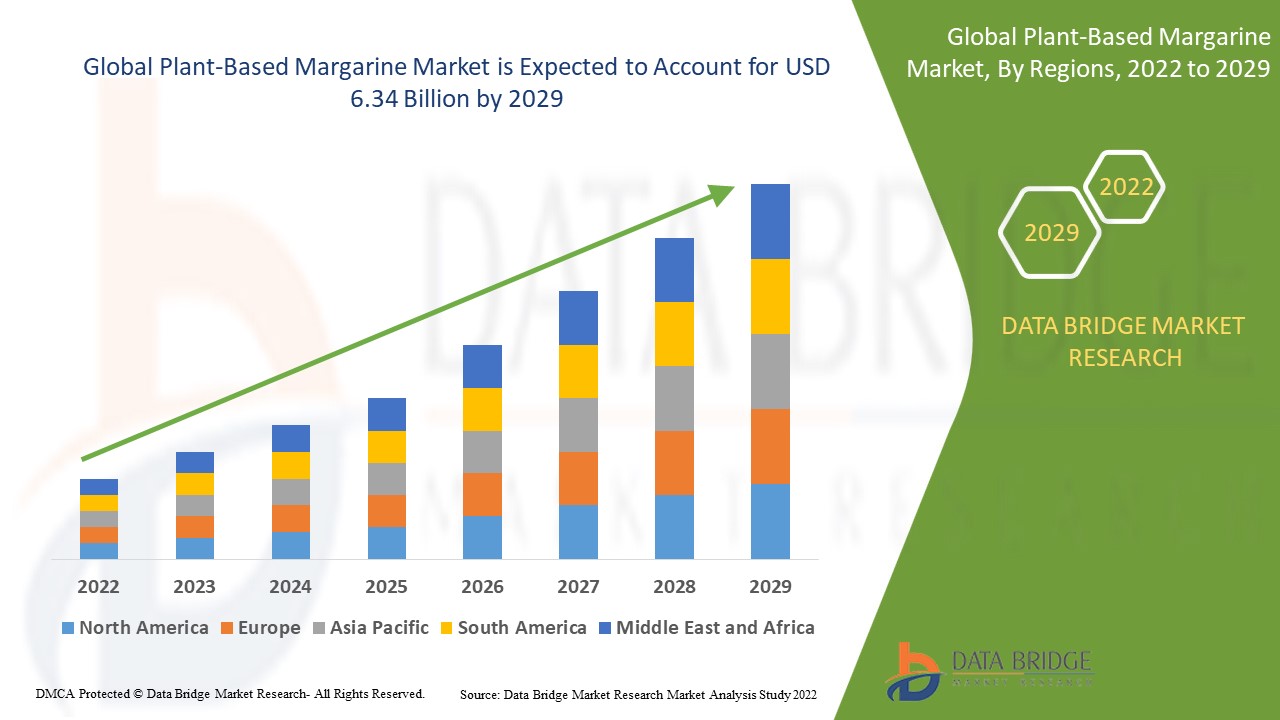
Data Bridge Market Research analyses that the plant-based margarine market was valued at 3.3 billion in 2021 is expected to reach the value of USD 6.34 billion by 2029, at aw CAGR of 8.50% during the forecast period. In addition to the insights on market scenarios such as market value, growth rate, segmentation, geographical coverage, and major players, the market reports curated by the Data Bridge Market Research also include in-depth expert analysis, geographically represented company-wise production and capacity, network layouts of distributors and partners, detailed and updated price trend analysis and deficit analysis of supply chain and demand.
Plant-Based Margarine Market Scope and Segmentation
|
Report Metric |
Details |
|
Forecast Period |
2022 to 2029 |
|
Base Year |
2021 |
|
Historic Years |
2020 (Customizable to 2014 - 2019) |
|
Quantitative Units |
Revenue in USD Billion, Volumes in Units, Pricing in USD |
|
Segments Covered |
Product Type (Hard Margarine, Soft Margarine, Liquid Margarine), Application (Beverages, Convenience Food, Sauces, Dressings and Condiments, Bakery and Confectionery, Dairy Products, Others), Sales Channel (Direct to Customer Channel, Modern Trade Channel (Supermarket/Hypermarket), Convenience Store, Specialty Store, E-Retailers (Third Party Online Channel), Usages (Spreadable, Non-Spreadable), End-User (Commercial, Household) |
|
Countries Covered |
U.S., Canada, Mexico in North America, Germany, Sweden, Poland, Denmark, Italy, U.K., France, Spain, Netherland, Belgium, Switzerland, Turkey, Russia, Rest of Europe in Europe, Japan, China, India, South Korea, New Zealand, Vietnam, Australia, Singapore, Malaysia, Thailand, Indonesia, Philippines, Rest of Asia-Pacific (APAC) in Asia-Pacific (APAC), Brazil, Argentina, Rest of South America as a part of South America, UAE, Saudi Arabia, Oman, Qatar, Kuwait, South Africa, Rest of Middle East and Africa (MEA) as a part of Middle East and Africa (MEA) |
|
Market Players Covered |
Unilever (U.K.), Puratos (Belgium), Wilmar International Ltd (Singapore), Bunge Limited (U.S.), Dairy Crest Limited (U.K.), FUJI OIL HOLDINGS INC. (Japan), Richardson International Limited (Canada), LASENOR EMUL, S.L. (Spain), NMGK Group (Russia), Currimjee Vandemoortele (Belgium), EFKO Group (Austria), Sime Darby Oils Zwijndrecht Refinery B.V. (Netherlands), Muez-Hest India Private Limited. (India), Walter Rau Lebensmittelwerke GmbH (Germany), Conagra Brands, Inc. (U.S.), Silverson (U.S.), Bonanza Megah (Indonesia), Cardowan Creameries Limited (U.K.) |
|
Opportunities |
|
Market Definition
Margarine is a non-dairy substitute for butter that has a similar appearance, consistency, flavour, and nutritional value. It is made by combining various refined vegetable oils, such as corn, palm, canola, and soybean. Margarine is a good source of essential fat-soluble nutrients that help keep blood cholesterol levels low and reduce the risk of cardiovascular disease. It is widely available in a variety of forms, including sticks, cubes, tubs, liquid, spray, and blocks. Margarine is widely used in bakeries, confectioneries, and home cooking.
Plant-Based Margarine Market Dynamics
Drivers
- Rising consumer health concerns about the negative impact of saturated fats
Rising consumer health concerns about the negative impact of saturated fats have resulted in a shift from butter to plant-based margarine. Furthermore, the high prevalence of lactose intolerance disorders and growing awareness of margarine's dairy-free content drive product demand. In line with this, the growing popularity of vegan trends and changing consumer dietary habits are driving the plant-based margarine market.
- Growing consumer awareness of clean-label and sustainable products
Growing consumer awareness of clean-label and sustainable products has resulted in the development of non-GMO, allergen-free, and naturally-sourced margarine. Several manufacturers are introducing organic and low-calorie margarine variants made from healthier vegetable oils like olive oil, palm oil, corn oil, and so on. This is expected to drive the global margarine market over the forecasted period.
Opportunity
One of the primary reasons is the growing number of consumers who suffer from health issues such as lactose intolerance. This has encouraged them to choose plant-based products such as plant-based margarine. Furthermore, plant-based margarine manufacturers are introducing novel variations in terms of base, type, and flavour. This results in a wide range of product offerings for consumers, which influences their purchasing behaviour. As a result, consumers are gravitating toward plant-based margarine.
Restraints
Lack of awareness about the benefits and availability of products, as well as their negative impact on the human body, are acting as market restraints for the growth of the plant-based margarine market during the forecast period.
This plant-based margarine market report provides details of new recent developments, trade regulations, import-export analysis, production analysis, value chain optimization, market share, impact of domestic and localized market players, analyses opportunities in terms of emerging revenue pockets, changes in market regulations, strategic market growth analysis, market size, category market growths, application niches and dominance, product approvals, product launches, geographic expansions, technological innovations in the market. To gain more info on the plant-based margarine market contact Data Bridge Market Research for an Analyst Brief, our team will help you take an informed market decision to achieve market growth.
Impact and Current Market Scenario of Raw Material Shortage and Shipping Delays
Data Bridge Market Research offers a high-level analysis of the market and delivers information by keeping in account the impact and current market environment of raw material shortage and shipping delays. This translates into assessing strategic possibilities, creating effective action plans, and assisting businesses in making important decisions.
Apart from the standard report, we also offer in-depth analysis of the procurement level from forecasted shipping delays, distributor mapping by region, commodity analysis, production analysis, price mapping trends, sourcing, category performance analysis, supply chain risk management solutions, advanced benchmarking, and other services for procurement and strategic support.
COVID-19 Impact on Plant-Based Margarine Market
The corona virus has spread throughout the world, and most countries are implementing lockdown measures to control the virus's spread in order to protect public health. Except for the food and medical sectors, all business and production activities have been completely halted, resulting in an economic crisis in the country. Manufacturing and production functions have been halted, slowing the business, and inactive trade and transportation have completely disrupted the supply chain, causing companies to face significant losses in the near future.
Expected Impact of Economic Slowdown on the Pricing and Availability of Products
When economic activity slows, industries begin to suffer. The forecasted effects of the economic downturn on the pricing and accessibility of the products are taken into account in the market insight reports and intelligence services provided by DBMR. With this, our clients can typically keep one step ahead of their competitors, project their sales and revenue, and estimate their profit and loss expenditures.
Global Plant-Based Margarine Market Scope
The plant-based margarine market is segmented on the basis of product type, application, sales channel, usages, and end-user. The growth amongst these segments will help you analyze meagre growth segments in the industries and provide the users with a valuable market overview and market insights to help them make strategic decisions for identifying core market applications.
Product type
- Hard Margarine
- Soft Margarine
- Liquid Margarine
Application
- Beverages
- Convenience Food
- Sauces
- Dressings and Condiments
- Bakery and Confectionery
- Dairy Products
- Others
Sales channel
- Direct to Customer Channel
- Modern Trade Channel (Supermarket/Hypermarket)
- Convenience Store
- Specialty Store
- E-Retailers (Third Party Online Channel)
Usages
- Spreadable
- Non-Spreadable
End use
- Commercial
- Households
Plant-Based Margarine Market Regional Analysis/Insights
The plant-based margarine market is analysed and market size insights and trends are provided by country, product type, application, sales channel, usages, and end-user as referenced above.
The countries covered in the plant-based margarine market report are U.S., Canada, Mexico in North America, Germany, Sweden, Poland, Denmark, Italy, U.K., France, Spain, Netherland, Belgium, Switzerland, Turkey, Russia, Rest of Europe in Europe, Japan, China, India, South Korea, New Zealand, Vietnam, Australia, Singapore, Malaysia, Thailand, Indonesia, Philippines, Rest of Asia-Pacific (APAC) in Asia-Pacific (APAC), Brazil, Argentina, Rest of South America as a part of South America, UAE, Saudi Arabia, Oman, Qatar, Kuwait, South Africa, Rest of Middle East and Africa (MEA) as a part of Middle East and Africa (MEA).
North America dominates the plant-based margarine market due to rising consumer preferences for natural as well as flavoured plant-based margarine.
Asia-Pacific is expected to grow from 2022 to 2029 due to the region's improved distribution channels.
The country section of the report also provides individual market impacting factors and changes in market regulation that impact the current and future trends of the market. Data points like down-stream and upstream value chain analysis, technical trends and porter's five forces analysis, case studies are some of the pointers used to forecast the market scenario for individual countries. Also, the presence and availability of global brands and their challenges faced due to large or scarce competition from local and domestic brands, impact of domestic tariffs and trade routes are considered while providing forecast analysis of the country data.
Competitive Landscape and Plant-Based Margarine Market Share Analysis
The plant-based margarine market competitive landscape provides details by competitor. Details included are company overview, company financials, revenue generated, market potential, investment in research and development, new market initiatives, global presence, production sites and facilities, production capacities, company strengths and weaknesses, product launch, product width and breadth, application dominance. The above data points provided are only related to the companies' focus related to plant-based margarine market.
Some of the major players operating in the plant-based margarine market are:
- Unilever (U.K.)
- Puratos (Belgium)
- Wilmar International Ltd (Singapore)
- Bunge Limited (U.S.)
- Dairy Crest Limited (U.K.)
- FUJI OIL HOLDINGS INC. (Japan)
- Richardson International Limited (Canada)
- LASENOR EMUL, S.L. (Spain)
- NMGK Group (Russia)
- Currimjee Vandemoortele (Belgium)
- EFKO Group (Austria)
- Sime Darby Oils Zwijndrecht Refinery B.V. (Netherlands)
- Muez-Hest India Private Limited. (India)
- Walter Rau Lebensmittelwerke GmbH (Germany)
- Conagra Brands, Inc. (U.S.)
- Silverson (U.S.)
- Bonanza Megah (Indonesia)
- Cardowan Creameries Limited (U.K.)
SKU-
세계 최초의 시장 정보 클라우드 보고서에 온라인으로 접속하세요

- 대화형 데이터 분석 대시보드
- 높은 성장 잠재력 기회를 위한 회사 분석 대시보드
- 사용자 정의 및 질의를 위한 리서치 분석가 액세스
- 대화형 대시보드를 통한 경쟁자 분석
- 최신 뉴스, 업데이트 및 추세 분석
- 포괄적인 경쟁자 추적을 위한 벤치마크 분석의 힘 활용
연구 방법론
데이터 수집 및 기준 연도 분석은 대규모 샘플 크기의 데이터 수집 모듈을 사용하여 수행됩니다. 이 단계에는 다양한 소스와 전략을 통해 시장 정보 또는 관련 데이터를 얻는 것이 포함됩니다. 여기에는 과거에 수집한 모든 데이터를 미리 검토하고 계획하는 것이 포함됩니다. 또한 다양한 정보 소스에서 발견되는 정보 불일치를 검토하는 것도 포함됩니다. 시장 데이터는 시장 통계 및 일관된 모델을 사용하여 분석하고 추정합니다. 또한 시장 점유율 분석 및 주요 추세 분석은 시장 보고서의 주요 성공 요인입니다. 자세한 내용은 분석가에게 전화를 요청하거나 문의 사항을 드롭하세요.
DBMR 연구팀에서 사용하는 주요 연구 방법론은 데이터 마이닝, 시장에 대한 데이터 변수의 영향 분석 및 주요(산업 전문가) 검증을 포함하는 데이터 삼각 측량입니다. 데이터 모델에는 공급업체 포지셔닝 그리드, 시장 타임라인 분석, 시장 개요 및 가이드, 회사 포지셔닝 그리드, 특허 분석, 가격 분석, 회사 시장 점유율 분석, 측정 기준, 글로벌 대 지역 및 공급업체 점유율 분석이 포함됩니다. 연구 방법론에 대해 자세히 알아보려면 문의를 통해 업계 전문가에게 문의하세요.
사용자 정의 가능
Data Bridge Market Research는 고급 형성 연구 분야의 선두 주자입니다. 저희는 기존 및 신규 고객에게 목표에 맞는 데이터와 분석을 제공하는 데 자부심을 느낍니다. 보고서는 추가 국가에 대한 시장 이해(국가 목록 요청), 임상 시험 결과 데이터, 문헌 검토, 재생 시장 및 제품 기반 분석을 포함하도록 사용자 정의할 수 있습니다. 기술 기반 분석에서 시장 포트폴리오 전략에 이르기까지 타겟 경쟁업체의 시장 분석을 분석할 수 있습니다. 귀하가 원하는 형식과 데이터 스타일로 필요한 만큼 많은 경쟁자를 추가할 수 있습니다. 저희 분석가 팀은 또한 원시 엑셀 파일 피벗 테이블(팩트북)로 데이터를 제공하거나 보고서에서 사용 가능한 데이터 세트에서 프레젠테이션을 만드는 데 도움을 줄 수 있습니다.











