


What is the Automotive Progressive Wound Spring Market Size and Overview?
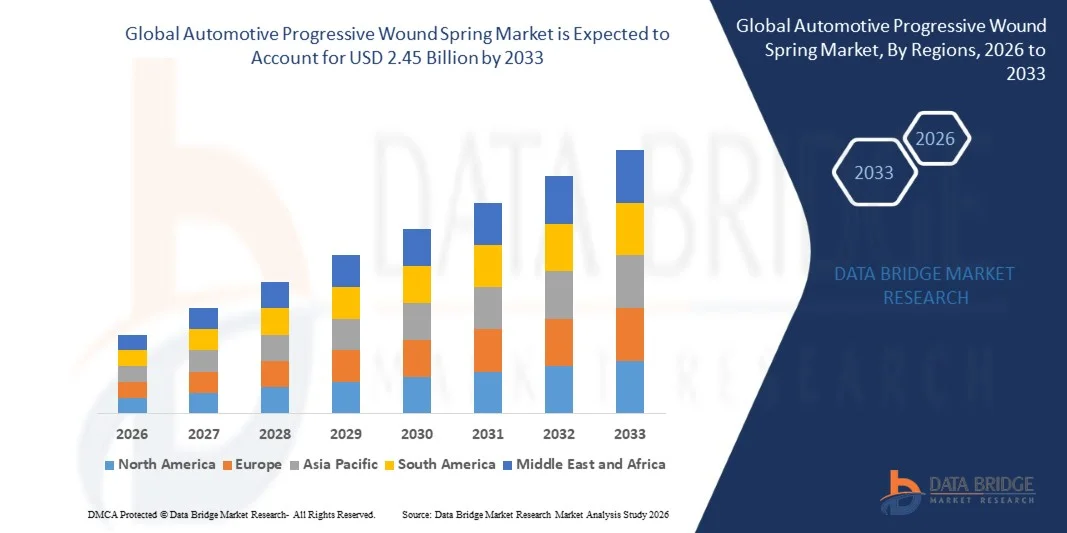
As per Data Bridge Market Research Analysis the Automotive Progressive Wound Spring Market was valued at USD 1.77 Billion in 2025 and is projected to reach USD 2.45 Billion by 2033, growing at a CAGR of 4.70% from 2026 to 2033. The market is experiencing consistent growth driven by increasing vehicle production, rising demand for enhanced ride comfort and suspension performance, and growing adoption of lightweight automotive components. Expanding production of electric vehicles and advancements in high-strength materials and spring manufacturing technologies are further supporting market expansion across major automotive regions.
The increasing focus on vehicle safety, fuel efficiency, and driving comfort, combined with stringent emission regulations, is encouraging automakers to adopt advanced suspension systems equipped with progressive wound springs. These springs provide improved load distribution, enhanced durability, and superior handling characteristics across varying driving conditions. Growing integration of lightweight and high-performance suspension components in passenger vehicles, commercial vehicles, and electric vehicles is further supporting long-term market growth.
Key Market Trends & Insights
- Asia-Pacific dominated the Automotive Progressive Wound Spring Market with the largest revenue share of 35.91% in 2025, supported by strong automotive production capacity, expanding vehicle ownership, and the presence of major component manufacturers across the region
- The four wheeler segment led the market with a 64.2% share in 2025, driven by high production volumes of passenger cars and increasing incorporation of advanced suspension systems
- North America is expected to be the fastest-growing region at a CAGR of 5.5% from 2026 to 2033, fueled by increasing production of SUVs, pickup trucks, and electric vehicles requiring advanced suspension systems
- Heavy vehicles are the fastest-growing application type, projected to register a CAGR of 8.9% from 2026 to 2033, supported by increasing demand for commercial trucks, buses, and construction vehicles across developing economies
- The cold cooling segment dominated the process method category with a 61.4% revenue share in 2025, led by its ability to deliver precise dimensional accuracy and superior surface finish for automotive springs
- Below 4 inch accounted for 58.7% of the market in 2025, preferred by its extensive use in passenger cars and compact vehicle suspension systems requiring lightweight and space-efficient components
- The hot cooling segment is the fastest-growing application category, with a CAGR of 8.3% from 2026 to 2033, driven by increasing demand for heavy-duty and high-strength springs used in commercial and premium vehicles
Market Size & Forecast
- Global Market Value (2025): USD 1.77 Billion
- Expected Market Value (2033): USD 2.45 Billion
- Forecast CAGR (2026–2033): 4.70%
- Leading Region in 2025: Asia-Pacific
- Fastest Growing Region: North America
Report Scope and Automotive Progressive Wound Spring Market Segmentation
|
Attributes |
Automotive Progressive Wound Spring Key Market Insights |
|
Segments Covered |
|
|
Countries Covered |
North America · U.S. · Canada · Mexico Europe · Germany · France · U.K. · Netherlands · Switzerland · Belgium · Russia · Italy · Spain · Turkey · Rest of Europe Asia-Pacific · China · Japan · India · South Korea · Singapore · Malaysia · Australia · Thailand · Indonesia · Philippines · Rest of Asia-Pacific Middle East and Africa · Saudi Arabia · U.A.E. · South Africa · Egypt · Israel · Rest of Middle East and Africa South America · Brazil · Argentina · Rest of South America |
|
Key Market Players |
· Sogefi SpA (Italy) · MW Industries (MWI) (U.S.) · Fuda Group (USA) Corporation (U.S.) · GKN Automotive Limited (U.K.) · NHK of America Suspension Components, Inc. (U.S.) · Muhr und Bender KG (Germany) · Betts Spring (U.S.) · Hendrickson USA, L.L.C. (U.S.) · Draco Spring Mfg. Co. (U.S.) · UNI AUTO PARTS MANUFACTURE CO., LTD. (Taiwan) · MITSUBISHI STEEL MFG. CO., LTD. (Japan) · Kilen Springs (Sweden) · Lesjöfors Automotive (Sweden) · Clifford Springs Ltd (U.K.) · Jamna Auto Industries Ltd. (India) |
|
Market Opportunities |
· Development of Advanced Composite Progressive Wound Springs for EVs · Expansion of Smart Suspension Systems with Integrated Sensor Technologies · Growing Demand for High-Performance Springs in Autonomous and Premium Vehicles |
|
Value Added Data Infosets |
In addition to the market insights such as market value, growth rate, market segments, geographical coverage, market players, and market scenario, the market report curated by the Data Bridge Market Research team includes in-depth expert analysis, import/export analysis, pricing analysis, production consumption analysis, and pestle analysis. |
What is the Key Trend in the Automotive Progressive Wound Spring Market?
Trend: Rising Adoption of Lightweight Suspension Components in Electric Vehicles
Automotive manufacturers are increasingly adopting lightweight suspension components to improve vehicle efficiency, extend battery range, and enhance ride comfort in electric vehicles. Progressive wound springs are gaining wider acceptance owing to their ability to provide variable stiffness and superior load distribution while reducing overall vehicle weight. Advancements in composite materials and high-strength alloys are further supporting the development of next-generation suspension systems for passenger cars and commercial vehicles. The rapid growth of electric mobility across Asia-Pacific, Europe, and North America is accelerating demand for innovative spring technologies.
Companies such as Tenneco introduced a lightweight progressive wound spring for electric vehicles in 2024 featuring an advanced composite core that reduced weight by nearly 20% compared with conventional steel springs, highlighting the growing industry focus on lightweight suspension solutions.
Automotive Progressive Wound Spring Market Dynamics
Key Market Driver: Increasing Demand for Enhanced Ride Comfort and Vehicle Performance
Growing consumer preference for improved driving comfort, vehicle stability, and enhanced handling characteristics is significantly driving demand for automotive progressive wound springs. These springs provide better load management and adaptive suspension performance across varying road conditions, making them increasingly important for modern passenger vehicles and SUVs. Rising production of premium vehicles and electric vehicles equipped with advanced suspension systems is further supporting market expansion. According to the International Organization of Motor Vehicle Manufacturers (OICA), global vehicle production exceeded 93 million units in 2024, creating substantial demand for high-performance suspension components.
Major manufacturers such as Mercedes-Benz, BMW, and Toyota are increasingly incorporating advanced suspension technologies into their vehicle platforms to improve ride quality and overall driving performance.
Key Restraint/Challenge: Volatility in Raw Material Prices and Supply Chain Disruptions
A major challenge in the Automotive Progressive Wound Spring market is the fluctuation in prices of steel and specialty alloys used in spring manufacturing. Rising costs of raw materials and disruptions in global supply chains are increasing production expenses and affecting profit margins for component manufacturers. Geopolitical tensions, transportation bottlenecks, and fluctuations in energy prices are further impacting the availability of critical materials. These factors are creating uncertainty in procurement and increasing overall manufacturing complexity for automotive spring suppliers.
The supply chain disruptions experienced by the automotive industry during 2024, particularly affecting steel availability across Europe and Asia, highlighted the vulnerability of component manufacturers to raw material price fluctuations and logistics challenges.
Key Market Opportunity: Development of Advanced Composite Progressive Wound Springs for EVs
The growing shift toward electric mobility is creating significant opportunities for the development of advanced composite progressive wound springs capable of reducing vehicle weight and improving energy efficiency. Composite materials offer enhanced fatigue resistance, corrosion protection, and durability compared with conventional steel springs, making them highly suitable for electric and premium vehicles. Increasing investments in advanced materials and additive manufacturing technologies are improving product performance and enabling customized spring designs. The expansion of electric vehicle production worldwide is expected to further strengthen demand for innovative suspension solutions.
Companies such as Hyundai announced investments in 2025 in a dedicated manufacturing facility utilizing additive manufacturing technologies for advanced progressive wound springs, while Bosch introduced initiatives to integrate smart sensor technologies into suspension components, supporting the evolution of intelligent and lightweight spring systems for next-generation vehicles.
How is the Automotive Progressive Wound Spring Market Segmented?
The automotive progressive wound spring market is segmented on the basis of diameter, process method, application, and end user.
- By Diameter
On the basis of diameter, the Automotive Progressive Wound Spring Market is segmented into Below 4 Inch and Above 4 Inch. The Below 4 Inch segment dominated the market with the largest share of 58.7% in 2025, driven by its extensive use in passenger cars and compact vehicle suspension systems requiring lightweight and space-efficient components. These springs offer enhanced load distribution and improved ride comfort, making them suitable for modern automotive platforms. Increasing production of fuel-efficient vehicles and growing demand for compact suspension assemblies continue to support segment growth. Their cost-effectiveness and compatibility with high-volume manufacturing processes further strengthen market dominance. Continuous adoption across mid-sized and entry-level vehicles reinforces the segment’s leading position.
The Above 4 Inch segment is projected to register the fastest growth at a CAGR of 7.8% from 2026 to 2033, driven by rising demand for high-load bearing suspension systems in SUVs, electric vehicles, and commercial vehicles. Larger diameter springs provide superior durability and stability under varying road conditions. Increasing vehicle weight owing to battery packs and advanced safety systems is creating strong demand for robust spring configurations. Advancements in material engineering are improving performance and reducing fatigue failure. Expanding production of premium vehicles and heavy-duty applications is accelerating segment expansion.
- By Process Method
On the basis of process method, the Automotive Progressive Wound Spring Market is segmented into Hot Cooling and Cold Cooling. The Cold Cooling segment dominated the market with a share of 61.4% in 2025, supported by its ability to deliver precise dimensional accuracy and superior surface finish for automotive springs. The process is widely adopted for manufacturing springs used in passenger vehicles due to its efficiency and lower production costs. Growing demand for lightweight and high-performance suspension components is further supporting segment growth. Cold cooling methods also enable large-scale production with consistent quality standards. Increasing emphasis on vehicle comfort and handling characteristics strengthens the segment’s market position.
The Hot Cooling segment is projected to register the fastest growth at a CAGR of 8.3% from 2026 to 2033, driven by increasing demand for heavy-duty and high-strength springs used in commercial and premium vehicles. Hot cooling processes enhance material toughness and fatigue resistance, making them suitable for applications involving higher loads. Rising production of electric trucks and utility vehicles is generating demand for advanced spring technologies. Technological improvements in heat treatment and metallurgical processes are improving product performance and durability. Growing investments in specialized automotive components are contributing to rapid segment expansion.
- By Application
On the basis of application, the Automotive Progressive Wound Spring Market is segmented into Two Wheeler, Four Wheeler, and Heavy Vehicles. The Four Wheeler segment dominated the market with the largest share of 64.2% in 2025, driven by high production volumes of passenger cars and increasing incorporation of advanced suspension systems. Progressive wound springs are extensively utilized to improve ride quality, stability, and shock absorption in vehicles. Growing consumer preference for enhanced driving comfort and vehicle safety continues to support demand. Expansion of electric and hybrid vehicle production is further increasing the requirement for optimized suspension components. Strong presence of global automobile manufacturers reinforces the segment’s dominant position.
The Heavy Vehicles segment is projected to register the fastest growth at a CAGR of 8.9% from 2026 to 2033, driven by increasing demand for commercial trucks, buses, and construction vehicles across developing economies. Heavy vehicles require durable suspension systems capable of handling greater loads and challenging operating conditions. Rising infrastructure development and expansion of logistics activities are supporting vehicle fleet growth. Advancements in high-strength alloy springs are improving performance and operational lifespan. Increasing adoption of electric commercial vehicles is further accelerating demand for progressive wound spring solutions.
- By End User
On the basis of end user, the Automotive Progressive Wound Spring Market is segmented into Automotive OEM and Automotive Aftermarket. The Automotive OEM segment dominated the market with a share of 43.6% in 2025, supported by growing vehicle production and rising integration of customized suspension components during manufacturing. OEMs focus on delivering improved vehicle comfort, handling, and safety through advanced spring technologies. Increasing investments in electric and premium vehicles are creating sustained demand for high-quality progressive wound springs. Strong collaborations between vehicle manufacturers and component suppliers are enhancing product innovation. Continuous expansion of automotive production facilities across Asia-Pacific further strengthens segment dominance.
The Automotive Aftermarket segment is projected to register the fastest growth at a CAGR of 8.1% from 2026 to 2033, driven by increasing vehicle parc and rising replacement demand for suspension components. Growing consumer awareness regarding vehicle maintenance and performance enhancement is supporting aftermarket sales. Expansion of e-commerce platforms and organized distribution networks is improving product accessibility. Demand for performance upgrades and customized suspension systems is gaining traction among vehicle owners. Increasing average vehicle age across major markets is contributing to strong growth prospects for the segment.
Which Region Holds the Largest Share of the Automotive Progressive Wound Spring Market?
Asia-Pacific dominated the automotive progressive wound spring market and accounted for the largest revenue share of 35.91% in 2025, supported by strong automotive production capacity, expanding vehicle ownership, and the presence of major component manufacturers across the region. Growing demand for passenger vehicles, commercial vehicles, and electric vehicles is increasing the adoption of advanced suspension components. The region benefits from cost-effective manufacturing capabilities, robust supply chains, and rising investments in automotive technologies. Increasing emphasis on ride comfort, vehicle stability, and lightweight components is further accelerating regional market expansion.
China Automotive Progressive Wound Spring Market Insight
China held the largest share in the Asia-Pacific Automotive Progressive Wound Spring market in 2025, supported by its extensive automobile production base and strong presence of domestic and international component suppliers. The country benefits from a highly developed manufacturing ecosystem that enables large-scale production of suspension systems and spring components. Rising production of electric vehicles and premium passenger cars is further supporting demand for progressive wound springs. In addition, continuous investments in automotive innovation and expanding exports are reinforcing China's leadership in the regional market.
India Automotive Progressive Wound Spring Market Insight
India is witnessing the fastest growth in the Asia-Pacific region, driven by rising vehicle production, increasing demand for two-wheelers and passenger cars, and expanding automotive component manufacturing activities. Growing adoption of electric vehicles and increasing consumer preference for enhanced ride quality are supporting market expansion. The country is also benefiting from favorable government initiatives promoting domestic manufacturing and automotive investments. In addition, rising disposable income and expanding automotive aftermarket activities are accelerating long-term growth.
Europe Automotive Progressive Wound Spring Market Insight
The Europe Automotive Progressive Wound Spring market is expanding steadily, supported by strong demand for premium vehicles, increasing adoption of advanced suspension technologies, and the presence of established automotive manufacturers. Growing focus on vehicle safety, performance, and passenger comfort is driving the use of high-performance spring systems. Increasing production of hybrid and electric vehicles is further contributing to market development. In addition, technological advancements in lightweight materials and precision engineering are supporting regional expansion.
Germany Automotive Progressive Wound Spring Market Insight
Germany accounted for the largest share in the Europe Automotive Progressive Wound Spring market in 2025, driven by its strong automotive manufacturing industry and extensive production of luxury and performance vehicles. The country has a well-established supplier network that supports the development of advanced suspension technologies. Rising demand for fuel-efficient and electric vehicles is further strengthening the need for lightweight spring components. In addition, continuous investments in automotive engineering and innovation are reinforcing Germany’s leading position in the regional market.
U.K. Automotive Progressive Wound Spring Market Insight
The U.K. market is supported by increasing demand for premium vehicles and growing investments in electric mobility technologies. Rising focus on vehicle comfort and advanced suspension systems is driving the adoption of progressive wound springs across various vehicle categories. The country is also witnessing growing automotive aftermarket activities owing to the increasing average age of vehicles. In addition, expansion of automotive research and development activities is supporting market growth.
North America Automotive Progressive Wound Spring Market Insight
North America is projected to grow at the fastest CAGR of 8.7% from 2026 to 2033, driven by increasing production of SUVs, pickup trucks, and electric vehicles requiring advanced suspension systems. Rising demand for improved ride quality, vehicle durability, and performance is significantly supporting market expansion across the region. Strong investments in automotive electrification and lightweight vehicle technologies are further accelerating adoption. In addition, increasing replacement demand from the aftermarket sector is boosting regional market growth.
U.S. Automotive Progressive Wound Spring Market Insight
The U.S. accounted for the largest share in the North America Automotive Progressive Wound Spring market in 2025, supported by strong demand from passenger vehicles, commercial vehicles, and electric vehicle manufacturers. The country benefits from extensive utilization of advanced suspension technologies aimed at improving vehicle performance and driving comfort. Growing production of electric pickup trucks and premium SUVs is further strengthening market demand. In addition, increasing investments in automotive innovation and strong aftermarket distribution networks are reinforcing the U.S. leadership position in the regional market.
Which are the Top Companies in Automotive Progressive Wound Spring Market?
The automotive progressive wound spring industry is primarily led by well-established companies, including:
- Sogefi SpA (Italy)
- MW Industries (MWI) (U.S.)
- Fuda Group (USA) Corporation (U.S.)
- GKN Automotive Limited (U.K.)
- NHK of America Suspension Components, Inc. (U.S.)
- Muhr und Bender KG (Germany)
- Betts Spring (U.S.)
- Hendrickson USA, L.L.C. (U.S.)
- Draco Spring Mfg. Co. (U.S.)
- UNI AUTO PARTS MANUFACTURE CO., LTD. (Taiwan)
- MITSUBISHI STEEL MFG. CO., LTD. (Japan)
- Kilen Springs (Sweden)
- Lesjöfors Automotive (Sweden)
- Clifford Springs Ltd (U.K.)
- Jamna Auto Industries Ltd. (India)
What are Latest Developments in Automotive Progressive Wound Spring Market?
- In 2025, Bosch announced a new initiative to integrate IoT sensors within progressive wound springs for real-time health monitoring. The development is aimed at enabling predictive maintenance capabilities that can reduce downtime and warranty costs for OEMs and fleet operators. The embedded sensors monitor spring load, fatigue levels, and environmental conditions while transmitting data to vehicle management systems. This initiative reflects the growing trend toward connected vehicle ecosystems and highlights Bosch’s focus on intelligent, data-driven suspension technologies that improve reliability and safety
- In 2025, Hyundai invested in a new manufacturing facility dedicated to producing advanced progressive wound springs using additive manufacturing technologies. The facility is intended to shorten production lead times and support rapid prototyping of customized spring designs for emerging vehicle platforms. The investment demonstrates the increasing importance of flexible manufacturing in meeting the fast-paced development requirements of electric and autonomous vehicles. It also signifies a move toward localized and agile supply chains to address geopolitical uncertainties and raw material cost fluctuations
- In 2024, Tenneco introduced a lightweight and high-performance progressive wound spring developed specifically for electric vehicles. The product incorporates an advanced composite core that lowers weight by nearly 20% compared with conventional steel springs. This innovation highlights the industry's transition toward electrification, where lighter suspension components are essential for compensating battery weight and improving vehicle efficiency. The launch also reinforces Tenneco’s commitment to adopting advanced materials in line with OEM electrification strategies
- In 2024, Moog formed a strategic partnership with a leading materials science company to develop shape-memory alloy springs for autonomous vehicle applications. The collaboration focuses on creating springs capable of automatically adjusting stiffness according to changing load and road conditions, thereby enhancing ride quality and handling performance. The partnership reflects the increasing significance of adaptive suspension systems for autonomous mobility. It also positions Moog at the forefront of smart suspension innovation
- In 2024, a startup focused on high-performance composite springs secured USD 50 million in Series B funding to expand production capacity and strengthen its presence in the aftermarket segment. Its proprietary composite winding technology provides substantial weight reduction and improved fatigue resistance, making it attractive for premium vehicles and motorsport applications. The funding demonstrates strong investor confidence in the potential of advanced composite materials within the suspension market. Rising demand for lightweight and durable components in electric and high-performance vehicles continues to support such investments

- Interactive Data Analysis Dashboard
- Company Analysis Dashboard for high growth potential opportunities
- Research Analyst Access for customization & queries
- Competitor Analysis with Interactive dashboard
- Latest News, Updates & Trend analysis
- Harness the Power of Benchmark Analysis for Comprehensive Competitor Tracking
Data collection and base year analysis are done using data collection modules with large sample sizes. The stage includes obtaining market information or related data through various sources and strategies. It includes examining and planning all the data acquired from the past in advance. It likewise envelops the examination of information inconsistencies seen across different information sources. The market data is analysed and estimated using market statistical and coherent models. Also, market share analysis and key trend analysis are the major success factors in the market report. To know more, please request an analyst call or drop down your inquiry.
The key research methodology used by DBMR research team is data triangulation which involves data mining, analysis of the impact of data variables on the market and primary (industry expert) validation. Data models include Vendor Positioning Grid, Market Time Line Analysis, Market Overview and Guide, Company Positioning Grid, Patent Analysis, Pricing Analysis, Company Market Share Analysis, Standards of Measurement, Global versus Regional and Vendor Share Analysis. To know more about the research methodology, drop in an inquiry to speak to our industry experts.
Data Bridge Market Research is a leader in advanced formative research. We take pride in servicing our existing and new customers with data and analysis that match and suits their goal. The report can be customized to include price trend analysis of target brands understanding the market for additional countries (ask for the list of countries), clinical trial results data, literature review, refurbished market and product base analysis. Market analysis of target competitors can be analyzed from technology-based analysis to market portfolio strategies. We can add as many competitors that you require data about in the format and data style you are looking for. Our team of analysts can also provide you data in crude raw excel files pivot tables (Fact book) or can assist you in creating presentations from the data sets available in the report.













