


Baking Enzymes in Bread Application Market Size
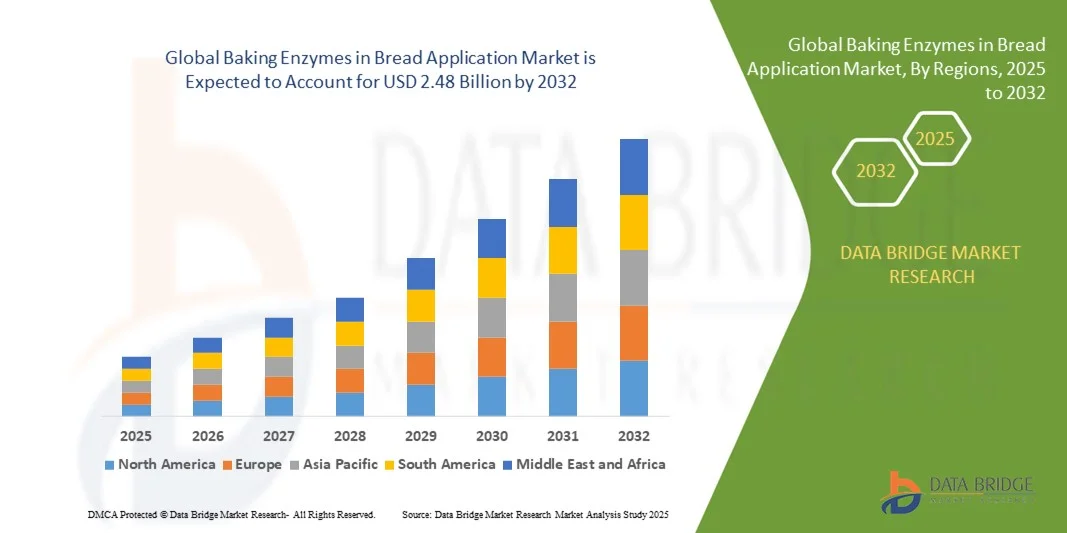
- The global baking enzymes in bread application market size was valued at USD 1.62 billion in 2024 and is expected to reach USD 2.48 billion by 2032, at a CAGR of 5.50% during the forecast period
- The market growth is largely fuelled by the increasing demand for high-quality, fresh, and extended-shelf-life bakery products across both developed and emerging economies
- Rising adoption of enzymes to improve dough stability, texture, and flavor while reducing chemical additives is further driving market expansion
Baking Enzymes in Bread Application Market Analysis
- The market is witnessing steady growth due to technological advancements in enzyme formulation and increasing preference for clean-label and natural ingredients in bakery products
- Key manufacturers are focusing on developing enzyme blends tailored for specific bread types to enhance processing efficiency and product consistency across industrial and artisanal baking segments
- Europe dominated the baking enzymes in bread application market with the largest revenue share of 37.45% in 2024, driven by the strong presence of established bakery manufacturers and high consumer demand for clean-label and premium bakery products
- Asia-Pacific region is expected to witness the highest growth rate in the global baking enzymes in bread application market, driven by changing dietary habits, rising disposable incomes, and growing consumption of packaged bakery products across emerging economies
- The carbohydrase segment held the largest market revenue share in 2024, primarily due to its widespread use in enhancing dough fermentation, improving bread texture, and extending shelf life. Carbohydrases, such as amylases and xylanases, play a key role in breaking down starches and releasing fermentable sugars, which help improve crumb softness and loaf volume in various bread formulations
Report Scope and Baking Enzymes in Bread Application Market Segmentation
|
Attributes |
Baking Enzymes in Bread Application Key Market Insights |
|
Segments Covered |
|
|
Countries Covered |
North America
Europe
Asia-Pacific
Middle East and Africa
South America
|
|
Key Market Players |
• AB Enzymes (Germany) |
|
Market Opportunities |
• Rising Adoption Of Clean-Label And Natural Baking Ingredients |
|
Value Added Data Infosets |
In addition to the insights on market scenarios such as market value, growth rate, segmentation, geographical coverage, and major players, the market reports curated by the Data Bridge Market Research also include in-depth expert analysis, pricing analysis, brand share analysis, consumer survey, demography analysis, supply chain analysis, value chain analysis, raw material/consumables overview, vendor selection criteria, PESTLE Analysis, Porter Analysis, and regulatory framework. |
Baking Enzymes in Bread Application Market Trends
Growing Utilization of Enzyme Blends to Improve Bread Quality and Shelf Life
• The increasing use of multi-enzyme blends is transforming the bread-making process by enhancing dough stability, texture, and volume. These enzyme combinations, such as amylases, xylanases, and lipases, optimize fermentation and gluten development, resulting in improved bread softness and extended freshness. The trend is driven by growing consumer demand for high-quality bakery products with consistent texture and taste, as well as large-scale bakeries seeking to improve operational efficiency and reduce waste during production. Manufacturers are also using enzyme blends to standardize flour performance across different grain qualities and environmental conditions, improving output reliability
• The demand for clean-label and additive-free bakery products is pushing manufacturers to replace chemical improvers with natural enzyme-based alternatives. Enzymes offer a sustainable and label-friendly solution while maintaining dough elasticity and quality. This shift aligns with evolving consumer preferences toward healthier and transparent ingredient lists, especially in premium and artisanal bread segments. The transition is further supported by tightening regulatory frameworks in Europe and North America that restrict chemical additives, making enzymes a preferred natural alternative. The move also allows bakeries to strengthen brand reputation by highlighting natural processing methods on product packaging
• Continuous innovations in enzyme formulation are allowing better control over baking parameters, reducing dependence on additives and enhancing process efficiency. Manufacturers are developing tailored enzyme solutions to address specific flour variations and regional baking practices, improving yield and consistency across production lines. Advanced biotechnology has enabled the creation of enzymes with higher thermal and pH stability, offering consistent results even under variable production environments. These innovations are particularly vital for industrial bakeries operating under high-volume, continuous production systems that demand uniform performance and minimal downtime
• For instance, in 2023, several European bakery ingredient companies introduced advanced enzyme blends that improve dough tolerance and reduce staling rates, helping industrial bakeries achieve extended product shelf life without compromising quality or flavor. These enzyme systems also allowed bakers to eliminate emulsifiers and reduce dependency on chemical softeners, supporting the industry’s sustainability goals. Moreover, the integration of digital baking solutions with enzyme formulations enables better process monitoring and quality control, contributing to reduced ingredient wastage and improved energy efficiency
• While enzyme-based formulations are driving significant quality improvements, cost-effectiveness and stability under varying baking conditions remain key focus areas. Ongoing R&D and close collaboration between enzyme producers and bakeries are expected to accelerate adoption in both industrial and artisanal bread production. Developing enzymes that perform efficiently under diverse humidity, temperature, and flour conditions is a priority for global manufacturers. In addition, partnerships between enzyme suppliers and bakery chains are fostering product innovation pipelines, ensuring better adaptation to evolving consumer expectations for clean-label, fresh, and consistent baked products
Baking Enzymes in Bread Application Market Dynamics
Driver
Rising Demand for Natural and Clean-Label Bakery Products
• The global shift toward natural and additive-free bakery goods is driving the adoption of enzyme-based formulations as safe and sustainable alternatives to synthetic dough conditioners. Enzymes enhance bread quality while reducing the need for chemical emulsifiers and preservatives, meeting both consumer expectations and regulatory standards for clean-label products. As consumers increasingly scrutinize ingredient transparency, bakeries are leveraging enzyme solutions to differentiate themselves in a competitive market. This growing trend is also supported by the rising popularity of artisanal and organic bakery products, where natural ingredient integrity is a key selling factor
• Growing awareness about health and wellness is encouraging manufacturers to use natural processing aids that improve dough handling and texture without artificial ingredients. Enzymes provide functional advantages such as improved crumb softness, better gas retention, and longer shelf life, enabling bakeries to produce cleaner and healthier bread varieties. These advantages also contribute to reducing food waste by maintaining freshness over longer periods, which aligns with sustainability goals. The versatility of enzyme formulations allows bakers to cater to a wide range of consumer preferences, including gluten-free, vegan, and reduced-calorie bread types
• Increasing penetration of clean-label bakery products across retail and foodservice sectors is fostering innovation among enzyme suppliers. Product launches featuring non-GMO, allergen-free, and plant-derived enzymes are catering to diverse consumer preferences and dietary needs. Large bakery manufacturers are investing in reformulation efforts to meet regional labeling standards while maintaining cost efficiency and product quality. The introduction of customized enzyme solutions for whole grain, multigrain, and specialty bread further expands product portfolios and strengthens market competitiveness
• For instance, in 2023, a leading North American bakery brand reformulated its entire product line using enzyme-based dough improvers, successfully eliminating chemical additives and achieving better texture stability during storage and transport. This transition not only improved product shelf life but also aligned with corporate sustainability and health-driven branding strategies. The company’s success has inspired several mid-sized bakeries to pursue similar clean-label transformations using enzyme-based technologies
• The rising consumer inclination toward transparency and natural ingredients is expected to strengthen the position of enzyme-based baking solutions in the global market, promoting long-term growth and product diversification. Enzyme suppliers are expanding partnerships with retail chains to co-develop new product ranges that meet regulatory and consumer standards. In addition, the ongoing integration of artificial intelligence (AI) and enzyme optimization technologies is expected to revolutionize formulation design, leading to greater precision and performance consistency in bread production
Restraint/Challenge
High Production Costs and Temperature Sensitivity of Enzymes
• The relatively high cost of enzyme production, driven by complex fermentation and purification processes, poses a major challenge for large-scale commercial adoption. Smaller bakeries often face budget constraints, limiting the use of specialized enzymes despite their performance benefits in bread-making. In addition, fluctuating raw material costs and supply chain disruptions can increase enzyme pricing, affecting market stability. Manufacturers are investing in biotechnological advancements to improve yield efficiency and lower production costs, but economic scalability remains an ongoing concern
• Enzymes are highly sensitive to temperature and pH fluctuations, which can affect their activity and stability during baking operations. Maintaining optimal processing conditions requires precise control systems and specialized knowledge, which may not be readily available in all baking environments. Inconsistent baking environments can lead to underperformance or enzyme denaturation, resulting in irregular dough behavior and inconsistent bread quality. To address these challenges, manufacturers are focusing on developing next-generation enzyme systems with enhanced resistance to extreme conditions
• Limited awareness regarding enzyme functionality among traditional bakers and regional producers can hinder adoption. The need for technical expertise and standardized formulations often creates barriers in emerging markets where conventional baking practices dominate. Small and medium enterprises (SMEs) in these regions often lack access to training and technical guidance on enzyme applications, leading to inconsistent use or underutilization of the technology. Strengthening industry collaborations and knowledge-sharing platforms can play a key role in increasing market penetration
• For instance, in 2023, bakery manufacturers in Southeast Asia reported challenges in maintaining enzyme efficiency due to fluctuating production conditions, leading to inconsistent dough performance and product texture. These issues prompted regional bakery associations to initiate partnerships with enzyme suppliers to provide training and technical workshops. Such initiatives have proven effective in improving enzyme handling practices and driving gradual adoption across local bakeries
• Addressing these challenges requires continued advancements in enzyme stabilization technology, scalable production processes, and targeted education initiatives to ensure broader and more efficient market adoption across both industrial and artisanal baking sectors. The development of cost-effective, shelf-stable enzyme formulations can help reduce logistical constraints and enhance accessibility in developing regions. Furthermore, increased investment in localized production facilities will reduce dependency on imports and strengthen supply chain resilience across the global bakery enzyme market
Baking Enzymes in Bread Application Market Scope
The market is segmented on the basis of type, distribution channel, and form.
- By Type
On the basis of type, the global baking enzymes in bread application market is segmented into carbohydrase, protease, lipase, and others. The carbohydrase segment held the largest market revenue share in 2024, primarily due to its widespread use in enhancing dough fermentation, improving bread texture, and extending shelf life. Carbohydrases, such as amylases and xylanases, play a key role in breaking down starches and releasing fermentable sugars, which help improve crumb softness and loaf volume in various bread formulations.
The lipase segment is expected to witness the fastest growth rate from 2025 to 2032, driven by its ability to improve dough handling, enhance crumb structure, and replace traditional emulsifiers. Lipases are increasingly used in clean-label bread applications due to their natural functionality, contributing to improved mouthfeel and extended product freshness without the need for synthetic additives.
- By Distribution Channel
On the basis of distribution channel, the global baking enzymes in bread application market is segmented into hypermarkets/supermarkets, B2B, e-commerce, specialty retail, and others. The B2B segment dominated the market in 2024, supported by strong demand from industrial bakeries and food manufacturers seeking high-performance enzyme formulations for large-scale production. These buyers prefer direct procurement from enzyme producers or distributors to ensure product consistency, technical support, and customized solutions for specific baking needs.
The e-commerce segment is expected to witness the fastest growth rate from 2025 to 2032, fuelled by increasing online availability of bakery ingredients and growing adoption of digital sales channels by enzyme suppliers. Online platforms enable small bakeries and artisanal producers to access specialized enzyme blends conveniently, supporting market expansion across emerging regions and niche bakery segments.
- By Form
On the basis of form, the global baking enzymes in bread application market is segmented into powder and liquid. The powder segment accounted for the largest market share in 2024, owing to its longer shelf life, ease of storage, and superior stability during transportation and formulation. Powdered enzymes are preferred by industrial users for their consistent performance, simplified dosage control, and compatibility with dry baking mixes and pre-mixes.
The liquid segment is expected to witness the fastest growth rate from 2025 to 2032, driven by its better dispersion, ease of integration into automated mixing systems, and superior solubility during processing. Liquid enzyme formulations are gaining traction among commercial bakeries for their efficiency in continuous production lines and ability to deliver uniform results in high-moisture doughs.
Baking Enzymes in Bread Application Market Regional Analysis
- Europe dominated the baking enzymes in bread application market with the largest revenue share of 37.45% in 2024, driven by the strong presence of established bakery manufacturers and high consumer demand for clean-label and premium bakery products
- Consumers in the region increasingly prefer bakery goods with improved texture, freshness, and natural ingredients, prompting producers to integrate enzyme-based solutions to enhance bread quality and extend shelf life
- This widespread adoption is further supported by stringent food regulations promoting natural processing aids, a growing trend toward artisanal bread, and the rising focus on sustainable and efficient baking practices across the region
Germany Baking Enzymes in Bread Application Market Insight
The Germany baking enzymes in bread application market is expected to witness the fastest growth rate from 2025 to 2032, driven by technological advancements in enzyme production and increasing interest in clean-label bakery ingredients. German manufacturers are focusing on optimizing baking efficiency through targeted enzyme applications that improve dough handling and product uniformity. The growing popularity of organic and sustainable bakery goods is also reinforcing the use of natural enzyme solutions.
U.K. Baking Enzymes in Bread Application Market Insight
The U.K. baking enzymes in bread application market is projected to experience notable growth from 2025 to 2032, supported by a rising preference for fresh and healthy bakery products. The country’s evolving retail bakery landscape and expanding artisanal bread segment are driving the need for enzyme-based performance enhancers. In addition, ongoing product innovations aimed at improving texture, volume, and shelf life are boosting enzyme utilization among large-scale and independent bakeries alike.
Asia-Pacific Baking Enzymes in Bread Application Market Insight
The Asia-Pacific baking enzymes in bread application market is expected to witness the fastest growth rate from 2025 to 2032, driven by rapid urbanization, growing disposable incomes, and an expanding bakery industry in countries such as China, Japan, and India. The rising consumption of Western-style bakery products and the increasing shift toward industrial baking are promoting enzyme adoption. Furthermore, growing awareness of clean-label solutions and efficiency benefits is accelerating market expansion across both developing and developed markets.
China Baking Enzymes in Bread Application Market Insight
The China baking enzymes in bread application market accounted for the largest market revenue share in Asia-Pacific in 2024, attributed to the nation’s strong bakery production base and evolving consumer preferences toward soft-textured, longer-lasting bread products. Domestic enzyme producers are expanding their capabilities to supply cost-effective and high-performance enzyme blends, catering to both industrial and retail bakery sectors. The country’s growing focus on food quality and technological innovation continues to propel enzyme-based product adoption.
Japan Baking Enzymes in Bread Application Market Insight
The Japan baking enzymes in bread application market is expected to witness significant growth from 2025 to 2032, driven by the country’s advanced baking technology and strong consumer preference for high-quality, soft-textured bread. Japanese bakeries are increasingly adopting multi-enzyme formulations to improve dough elasticity, shelf life, and product uniformity. The integration of clean-label and natural enzyme solutions is also gaining traction as consumers prioritize health, freshness, and ingredient transparency in bakery products.
North America Baking Enzymes in Bread Application Market Insight
The North America baking enzymes in bread application market is expected to witness significant growth from 2025 to 2032, supported by high consumption of packaged bakery goods and continuous innovation in enzyme-based baking solutions. The region’s well-established food processing industry and increasing demand for natural, non-chemical improvers are key growth drivers. Moreover, the adoption of advanced baking enzymes to enhance production efficiency and reduce waste is strengthening the market’s presence across commercial bakeries and foodservice sectors.
U.S. Baking Enzymes in Bread Application Market Insight
The U.S. baking enzymes in bread application market is expected to witness significant growth from 2025 to 2032, driven by a growing preference for clean-label and premium bread products. Major bakery producers are focusing on enzyme blends that improve dough handling, softness, and freshness without synthetic additives. Furthermore, strong R&D initiatives and collaborations between enzyme manufacturers and large-scale bakeries are fostering innovation, expanding the use of natural enzymes across industrial and retail bakery applications.
Baking Enzymes in Bread Application Market Share
The Baking Enzymes in Bread Application industry is primarily led by well-established companies, including:
• AB Enzymes (Germany)
• Advanced Enzyme Technologies (India)
• DSM (Netherlands)
• Novozymes (Denmark)
• Maps Enzymes Ltd (India)
• SternEnzym GmbH & Co. KG (Germany)
• Amano Enzyme Inc. (Japan)
• DuPont (U.S.)
• PURATOS (Belgium)
• Caldic B.V. (Netherlands)
• BDF Natural Ingredients SL (Spain)
• Dyadic International Inc. (U.S.)
• Kerry Inc. (Ireland)
• Lallemand Inc. (Canada)
• BASF SE (Germany)
• Aum Enzymes (India)
• Engrain (U.S.)
• LEVEKING (China)
• VEMO 99 (Bulgaria)
• MirPain Food Ingredients (Turkey)
• Jiangsu Boli Bioproducts Co., Ltd. (China)

- Interactive Data Analysis Dashboard
- Company Analysis Dashboard for high growth potential opportunities
- Research Analyst Access for customization & queries
- Competitor Analysis with Interactive dashboard
- Latest News, Updates & Trend analysis
- Harness the Power of Benchmark Analysis for Comprehensive Competitor Tracking
Global Baking Enzymes In Bread Application Market, Supply Chain Analysis and Ecosystem Framework
To support market growth and help clients navigate the impact of geopolitical shifts, DBMR has integrated in-depth supply chain analysis into its Global Baking Enzymes In Bread Application Market research reports. This addition empowers clients to respond effectively to global changes affecting their industries. The supply chain analysis section includes detailed insights such as Global Baking Enzymes In Bread Application Market consumption and production by country, price trend analysis, the impact of tariffs and geopolitical developments, and import and export trends by country and HSN code. It also highlights major suppliers with data on production capacity and company profiles, as well as key importers and exporters. In addition to research, DBMR offers specialized supply chain consulting services backed by over a decade of experience, providing solutions like supplier discovery, supplier risk assessment, price trend analysis, impact evaluation of inflation and trade route changes, and comprehensive market trend analysis.
Data collection and base year analysis are done using data collection modules with large sample sizes. The stage includes obtaining market information or related data through various sources and strategies. It includes examining and planning all the data acquired from the past in advance. It likewise envelops the examination of information inconsistencies seen across different information sources. The market data is analysed and estimated using market statistical and coherent models. Also, market share analysis and key trend analysis are the major success factors in the market report. To know more, please request an analyst call or drop down your inquiry.
The key research methodology used by DBMR research team is data triangulation which involves data mining, analysis of the impact of data variables on the market and primary (industry expert) validation. Data models include Vendor Positioning Grid, Market Time Line Analysis, Market Overview and Guide, Company Positioning Grid, Patent Analysis, Pricing Analysis, Company Market Share Analysis, Standards of Measurement, Global versus Regional and Vendor Share Analysis. To know more about the research methodology, drop in an inquiry to speak to our industry experts.
Data Bridge Market Research is a leader in advanced formative research. We take pride in servicing our existing and new customers with data and analysis that match and suits their goal. The report can be customized to include price trend analysis of target brands understanding the market for additional countries (ask for the list of countries), clinical trial results data, literature review, refurbished market and product base analysis. Market analysis of target competitors can be analyzed from technology-based analysis to market portfolio strategies. We can add as many competitors that you require data about in the format and data style you are looking for. Our team of analysts can also provide you data in crude raw excel files pivot tables (Fact book) or can assist you in creating presentations from the data sets available in the report.













