


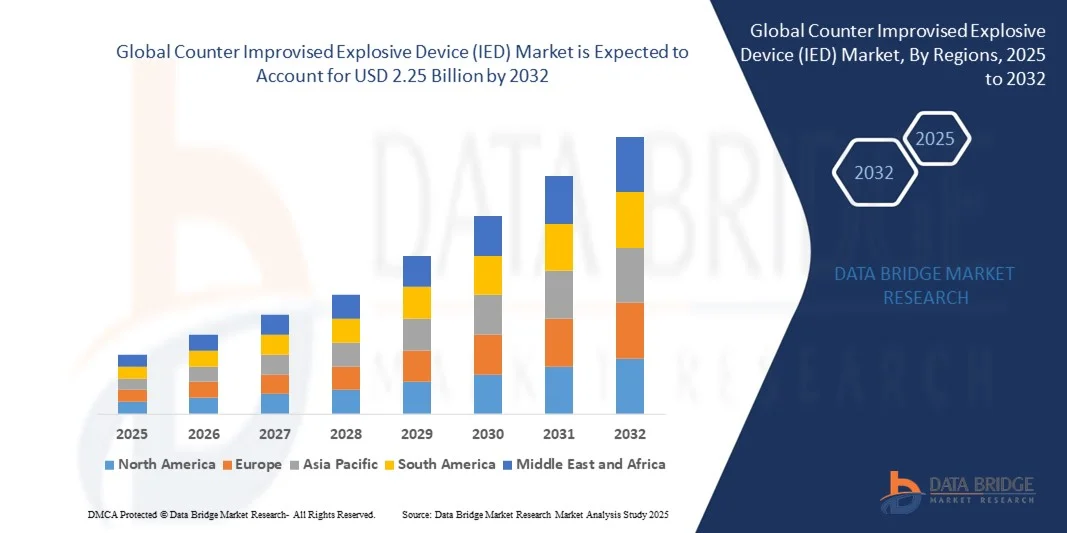
Counter Improvised Explosive Device (IED) Market Size
- The global counter improvised explosive device (IED) market size was valued at USD 1.64 billion in 2024 and is expected to reach USD 2.25 billion by 2032, at a CAGR of 4.05% during the forecast period
- The market growth is largely fueled by the increasing adoption of advanced detection and neutralization technologies, along with continuous innovations in electronic warfare and robotic systems, leading to enhanced protection against explosive threats in both military and homeland security operations
- Furthermore, rising security concerns, geopolitical tensions, and the need to safeguard personnel, infrastructure, and critical assets are driving investments in comprehensive Counter-IED solutions. These converging factors are accelerating the deployment of advanced systems, thereby significantly boosting the market's growth
Counter Improvised Explosive Device (IED) Market Analysis
- Counter IED solutions include detection systems, electronic warfare devices, robotic neutralization tools, and multi-sensor platforms designed to identify and mitigate explosive threats. These systems are increasingly integrated into vehicle-mounted, handheld, airborne, and fixed-site deployments to provide rapid response and operational safety
- The escalating demand for Counter IED solutions is primarily fueled by frequent global security incidents, modernization of military capabilities, and the growing emphasis on automated and AI-enabled threat mitigation technologies, which enhance both efficiency and reliability in detecting and neutralizing IEDs
- North America dominated the counter improvised explosive device (IED) market with a share of 50.3% in 2024, due to heightened security concerns, substantial defense budgets, and the growing need for advanced threat detection and neutralization technologies
- Asia-Pacific is expected to be the fastest growing region in the counter improvised explosive device (IED) market during the forecast period due to rising geopolitical tensions, increased defense expenditure, and technological adoption in countries such as India, Japan, and Australia
- Detection segment dominated the market with a market share of 58.5% in 2024, due to the critical need to identify explosives before they can cause harm. Detection systems leverage advanced sensors, imaging technologies, and AI-powered analytics to locate IEDs in diverse environments, ensuring proactive threat mitigation. Military and homeland security agencies prioritize detection solutions due to their ability to prevent casualties and protect high-value assets. Continuous technological advancements, such as real-time data processing and multi-sensor integration, further strengthen the adoption of detection systems. The segment’s robust demand is reinforced by rising global security concerns and frequent deployment in conflict-prone regions
Report Scope and Counter Improvised Explosive Device (IED) Market Segmentation
|
Attributes |
Counter Improvised Explosive Device (IED) Key Market Insights |
|
Segments Covered |
|
|
Countries Covered |
North America
Europe
Asia-Pacific
Middle East and Africa
South America
|
|
Key Market Players |
|
|
Market Opportunities |
|
|
Value Added Data Infosets |
In addition to the market insights such as market value, growth rate, market segments, geographical coverage, market players, and market scenario, the market report curated by the Data Bridge Market Research team includes in-depth expert analysis, import/export analysis, pricing analysis, production consumption analysis, and pestle analysis. |
Counter Improvised Explosive Device (IED) Market Trends
Rising Adoption of AI-Enabled and Robotic Counter-IED Solutions
- The adoption of AI-enabled and robotic solutions in counter-IED operations is rapidly growing as defense forces worldwide seek advanced methods to reduce human risk while improving detection and neutralization efficiency. These technologies allow for enhanced data processing, real-time surveillance, and autonomous handling of dangerous explosives, marking a transformative step in modern defense strategies
- For instance, Northrop Grumman has been developing autonomous robotic systems integrated with AI algorithms to perform high-precision counter-IED tasks. Their deployment in military operations showcases how AI and robotics are being used to minimize soldier exposure while improving mission effectiveness in conflict zones
- Robotic counter-IED systems provide adaptability in environments where manual handling is unsafe or impractical. AI integration further supports predictive threat detection, enabling soldiers to anticipate potential IED threats before they materialize, thereby enhancing operational safety and preparedness
- The increasing use of unmanned ground vehicles (UGVs) and drones for counter-IED missions is expanding the effectiveness of military forces. By combining machine vision with AI analytics, these machines can detect subtle anomalies, manage remote neutralization, and reduce reliance on manpower in highly volatile situations
- Such advancements are also shaping multinational defense collaborations, as allied nations are investing in AI-enabled counter-IED programs to share intelligence and leverage integrated robotic fleets. These cooperative efforts strengthen collective security frameworks against evolving explosive threats
- In conclusion, the rising adoption of AI and robotic technologies within counter-IED strategies is significantly redefining military responses. This trend is expected to set the benchmark for future defense modernization, ensuring greater safety, precision, and efficiency in explosive threat mitigation
Counter Improvised Explosive Device (IED) Market Dynamics
Driver
Increasing Global Security Concerns and Defense Modernization Programs
- The growing global security threat from insurgencies and asymmetric warfare is a primary driver of the counter-IED market. Defense organizations are under rising pressure to adopt advanced technologies to effectively detect, neutralize, and prevent improvised explosive devices in both domestic and international operations
- For instance, BAE Systems has secured contracts to provide counter-IED solutions integrated into armored vehicles for NATO forces, highlighting how modernization programs directly influence the growth of this market across regions engaged in counter-terrorism efforts
- The shift in modern conflict toward unconventional warfare has elevated the threat of IEDs, making it necessary for defense agencies to invest in specialized systems. This escalation is driving long-term procurement plans for counter-IED equipment as part of broader modernization strategies
- Governments are also allocating greater defense budgets toward advanced bomb disposal equipment, training, and intelligence infrastructure. This prioritization ensures counter-IED technologies remain essential components of national and international defense preparedness
- Altogether, the rising global security concerns and the emphasis on fleet and system modernization are amplifying adoption rates. The combination of evolving threats and the need for technologically advanced solutions ensures sustained demand for counter-IED systems worldwide
Restraint/Challenge
High Cost of Advanced Systems
- The high cost of advanced counter-IED technologies presents a major challenge for widespread adoption. Sophisticated systems that integrate AI, robotics, and advanced detection sensors require significant financial investment, which may not be feasible for nations with limited defense budgets
- For instance, contract programs involving advanced robotic counter-IED vehicles from companies such as QinetiQ often involve multimillion-dollar investments. This underscores how expensive system procurement and maintenance can strain budgets of smaller military forces and limit broad accessibility
- Beyond procurement, lifecycle costs such as maintenance, software upgrades, spare parts, and operator training add to the financial burden. These recurring costs create barriers for nations trying to establish sustainable counter-IED programs over the long term
- High costs also slow down adoption in peacekeeping and humanitarian operations, where funding sources are limited. The inability to deploy advanced systems in these scenarios can result in higher risks for personnel operating in volatile environments
- In conclusion, while advanced counter-IED systems provide unparalleled safety and effectiveness, their high cost remains a serious limitation for many defense agencies. Greater cost-optimization strategies, international funding collaborations, and modular system designs will be essential to overcome this restraint and enhance global adoption
Counter Improvised Explosive Device (IED) Market Scope
The market is segmented on the basis of capability, deployment, and end-user.
- By Capability
On the basis of capability, the Counter IED market is segmented into detection and countermeasure. The detection segment dominated the largest market revenue share of 58.5% in 2024, driven by the critical need to identify explosives before they can cause harm. Detection systems leverage advanced sensors, imaging technologies, and AI-powered analytics to locate IEDs in diverse environments, ensuring proactive threat mitigation. Military and homeland security agencies prioritize detection solutions due to their ability to prevent casualties and protect high-value assets. Continuous technological advancements, such as real-time data processing and multi-sensor integration, further strengthen the adoption of detection systems. The segment’s robust demand is reinforced by rising global security concerns and frequent deployment in conflict-prone regions.
The countermeasure segment is anticipated to witness the fastest growth rate from 2025 to 2032, fueled by increasing adoption of neutralization technologies that safely disable IEDs once detected. Countermeasure solutions include blast containment systems, robotic disarmament units, and electronic jamming devices that reduce risk to personnel. The rising focus on automated and remote-controlled countermeasure technologies enhances operational safety while minimizing human exposure to threats. Growing investments in research and development and the need for integrated, rapid-response solutions across military and security operations are driving market expansion in this segment.
- By Deployment
On the basis of deployment, the Counter IED market is segmented into vehicle-mounted, ship-mounted, airborne, handheld, and others. The vehicle-mounted segment dominated the largest market revenue share in 2024, attributed to its extensive use in convoy protection and patrol operations. Vehicle-mounted systems provide continuous monitoring, rapid detection, and immediate countermeasure deployment while ensuring mobility across high-risk areas. These systems are increasingly integrated with advanced sensors and autonomous technologies, enhancing situational awareness for military and security forces. The versatility and ruggedness of vehicle-mounted solutions make them essential for on-ground operations in conflict zones and urban environments.
The handheld segment is expected to witness the fastest CAGR from 2025 to 2032, driven by its portability, ease of use, and effectiveness in localized operations. Handheld devices allow personnel to perform precise detection and disarmament tasks in confined spaces or complex terrains. Their growing popularity is further supported by innovations in miniaturized sensors, wireless connectivity, and real-time data analytics. Rising demand from specialized military units and homeland security agencies for rapid-deployment, user-friendly solutions is propelling the adoption of handheld Counter IED systems.
- By End User
On the basis of end user, the Counter IED market is segmented into military and homeland security. The military segment dominated the largest market revenue share in 2024, owing to extensive deployment in active conflict zones, peacekeeping missions, and border security operations. Military forces prioritize highly reliable, integrated systems capable of detecting and neutralizing explosives to safeguard personnel and critical assets. The segment benefits from significant government funding, ongoing modernization programs, and the continuous advancement of multi-capability solutions that combine detection and countermeasure technologies.
The homeland security segment is anticipated to witness the fastest growth rate from 2025 to 2032, driven by increasing concerns over urban terrorism, public safety, and critical infrastructure protection. Homeland security agencies are investing in advanced portable, vehicle-mounted, and aerial detection systems to prevent IED-related attacks in cities, transportation hubs, and large public events. Rising public-private collaborations and the development of smart surveillance networks further enhance the deployment of Counter IED solutions in civilian contexts.
Counter Improvised Explosive Device (IED) Market Regional Analysis
- North America dominated the counter improvised explosive device (IED) market with the largest revenue share of 50.3% in 2024, driven by heightened security concerns, substantial defense budgets, and the growing need for advanced threat detection and neutralization technologies
- Military and homeland security agencies in the region prioritize state-of-the-art IED detection and countermeasure solutions to protect personnel, critical infrastructure, and high-value assets
- This widespread adoption is further supported by technologically advanced defense systems, strong R&D investments, and government-led initiatives to modernize explosive ordnance disposal capabilities, establishing North America as a leading market for Counter IED solutions
U.S. Counter IED Market Insight
The U.S. Counter IED market captured the largest revenue share in North America in 2024, fueled by the rapid deployment of advanced detection and countermeasure systems across military operations and homeland security applications. The U.S. continues to prioritize the development of portable, vehicle-mounted, and airborne solutions to enhance operational readiness and reduce personnel risk. Increased funding for counterterrorism initiatives, integration of AI-enabled detection systems, and the adoption of unmanned platforms for IED neutralization are key factors driving the market. Furthermore, collaboration between government agencies and private defense contractors is accelerating innovation and deployment of comprehensive Counter IED solutions.
Europe Counter IED Market Insight
The Europe Counter IED market is projected to grow at a substantial CAGR during the forecast period, supported by rising defense modernization programs, stringent security regulations, and the increasing threat of terrorist activities. European countries are investing in advanced detection and neutralization technologies for both military and urban security operations. The market growth is bolstered by the integration of portable, vehicle-mounted, and robotic systems in defense and law enforcement units. In addition, European governments are encouraging research and development in automated and multi-capability solutions to enhance national security and emergency response capabilities.
U.K. Counter IED Market Insight
The U.K. Counter IED market is anticipated to grow at a notable CAGR during the forecast period, driven by heightened concerns over domestic terrorism, public safety, and critical infrastructure protection. Both military and homeland security agencies are adopting advanced detection and neutralization technologies to mitigate IED threats. The U.K.’s strong defense infrastructure, emphasis on innovation, and government funding programs are expected to stimulate the deployment of handheld, vehicle-mounted, and airborne systems across defense and civilian applications.
Germany Counter IED Market Insight
The Germany Counter IED market is expected to expand at a significant CAGR during the forecast period, fueled by increasing awareness of security threats, defense modernization programs, and the adoption of technologically advanced IED detection and neutralization solutions. Germany’s well-developed defense infrastructure and emphasis on research-driven innovation encourage the integration of multi-capability systems, particularly in military, border security, and law enforcement applications. The demand for secure, reliable, and automated Counter IED solutions is rising, aligning with Germany’s national security priorities.
Asia-Pacific Counter IED Market Insight
The Asia-Pacific Counter IED market is poised to grow at the fastest CAGR during the forecast period of 2025 to 2032, driven by rising geopolitical tensions, increased defense expenditure, and technological adoption in countries such as India, Japan, and Australia. Growing concerns over regional terrorism and insurgency have fueled investments in advanced IED detection and neutralization systems. Furthermore, governments are supporting initiatives to enhance homeland security infrastructure and deploy state-of-the-art portable, vehicle-mounted, and airborne solutions. Rising domestic manufacturing capabilities and collaborations with global defense technology providers are also contributing to the rapid expansion of the market.
Japan Counter IED Market Insight
The Japan Counter IED market is gaining momentum due to regional security concerns, increased military modernization, and the demand for advanced, automated threat mitigation technologies. Japan focuses on integrating detection and countermeasure systems into both military and homeland security operations to enhance public safety and operational efficiency. The adoption of robotic, handheld, and vehicle-mounted solutions is rising, along with the integration of AI and sensor-based detection technologies, fueling market growth.
China Counter IED Market Insight
The China Counter IED market accounted for the largest market revenue share in Asia-Pacific in 2024, attributed to the country’s expanding defense modernization programs, increasing security investments, and regional strategic priorities. China is rapidly deploying advanced detection and neutralization systems across military and homeland security applications. Government initiatives to strengthen urban security, combined with domestic manufacturing of cost-effective IED solutions, are propelling market growth. The focus on AI-enabled detection, unmanned platforms, and multi-capability solutions further positions China as the leading market in the region.
Counter Improvised Explosive Device (IED) Market Share
The counter improvised explosive device (IED) industry is primarily led by well-established companies, including:
- Lockheed Martin Corporation (U.S.)
- Raytheon Technologies Corporation (U.S.)
- MBDA Inc. (U.S.)
- General Dynamics Corporation (U.S.)
- BAE Systems (U.S.)
- Boeing (U.S.)
- L3Harris Technologies, Inc. (U.S.)
- Thales Group (France)
- Textron Inc. (U.S.)
- Rheinmetall AG (Germany)
- Alliant Techsystems (U.S.)
- Israel Aerospace Industries (IAI) (Israel)
- Denel Dynamics (South Africa)
- Northrop Grumman (U.S.)
- Saab AB (Sweden)
- Airbus S.A.S. (France)
- Aselsan (Turkey)
- Rafael Advanced Defense Systems Ltd. (Israel)
- Diehl Stiftung & Co. KG (Germany)
- Leonardo (Italy)
Latest Developments in Global Counter Improvised Explosive Device (IED) Market
- In August 2025, NATO's Counter-Improvised Explosive Devices Centre of Excellence (C-IED COE) convened its annual Counter-IED conference in Málaga, Spain, bringing together military personnel, law enforcement, intelligence agencies, academia, and defense industry experts. This event highlighted advanced counter-IED strategies, including the development of modular armor to protect tactical vehicles from explosively formed IED attacks. The conference strengthened collaborative efforts to enhance multi-domain resilience against IED threats, fostering innovation and international cooperation within the market
- In June 2025, the NATO Istanbul Cooperation Initiative Regional Centre (NIRC) in Kuwait City hosted a Mobile Training Team from Allied Joint Force Command Naples to deliver NATO’s Counter-IED expertise to military personnel from Kuwait, Qatar, Oman, and Saudi Arabia. This initiative expanded regional capabilities, promoting knowledge transfer and operational readiness, which is expected to drive the adoption of advanced Counter-IED technologies across the Middle East
- In February 2025, Northrop Grumman was awarded a $123.2 million contract by the U.S. Navy to provide engineering and sustainment support for the Joint Counter Radio-Controlled Improvised Explosive Device Electronic Warfare (JCREW) Increment One Block One system. This contract ensures continuous technological upgrades and operational readiness, reinforcing the system’s critical role in protecting personnel and assets from IED threats and boosting market demand for advanced electronic warfare solutions
- In January 2024, the U.S. Navy announced plans to integrate artificial intelligence into the JCREW Increment One Block One system, developed by Northrop Grumman, to counter IEDs and drones. This enhancement improves detection speed, accuracy, and autonomous threat response, increasing system effectiveness and strengthening market growth by enabling next-generation electronic countermeasure solutions for the U.S. and allied forces
- In June 2020, Sierra Nevada Corporation (SNC) received a production contract with multiple delivery orders to procure, deliver, and support the Degraded Visual Environment Pilotage System (DVEPS) on U.S. Special Operations Command and select U.S. Army aircraft. The deployment of DVEPS enhanced operational capability in low-visibility conditions, demonstrating the market’s growing focus on integrated technologies that improve safety and effectiveness in Counter-IED operations

- Interactive Data Analysis Dashboard
- Company Analysis Dashboard for high growth potential opportunities
- Research Analyst Access for customization & queries
- Competitor Analysis with Interactive dashboard
- Latest News, Updates & Trend analysis
- Harness the Power of Benchmark Analysis for Comprehensive Competitor Tracking
Data collection and base year analysis are done using data collection modules with large sample sizes. The stage includes obtaining market information or related data through various sources and strategies. It includes examining and planning all the data acquired from the past in advance. It likewise envelops the examination of information inconsistencies seen across different information sources. The market data is analysed and estimated using market statistical and coherent models. Also, market share analysis and key trend analysis are the major success factors in the market report. To know more, please request an analyst call or drop down your inquiry.
The key research methodology used by DBMR research team is data triangulation which involves data mining, analysis of the impact of data variables on the market and primary (industry expert) validation. Data models include Vendor Positioning Grid, Market Time Line Analysis, Market Overview and Guide, Company Positioning Grid, Patent Analysis, Pricing Analysis, Company Market Share Analysis, Standards of Measurement, Global versus Regional and Vendor Share Analysis. To know more about the research methodology, drop in an inquiry to speak to our industry experts.
Data Bridge Market Research is a leader in advanced formative research. We take pride in servicing our existing and new customers with data and analysis that match and suits their goal. The report can be customized to include price trend analysis of target brands understanding the market for additional countries (ask for the list of countries), clinical trial results data, literature review, refurbished market and product base analysis. Market analysis of target competitors can be analyzed from technology-based analysis to market portfolio strategies. We can add as many competitors that you require data about in the format and data style you are looking for. Our team of analysts can also provide you data in crude raw excel files pivot tables (Fact book) or can assist you in creating presentations from the data sets available in the report.













