


Gold Nanoparticles Market Size
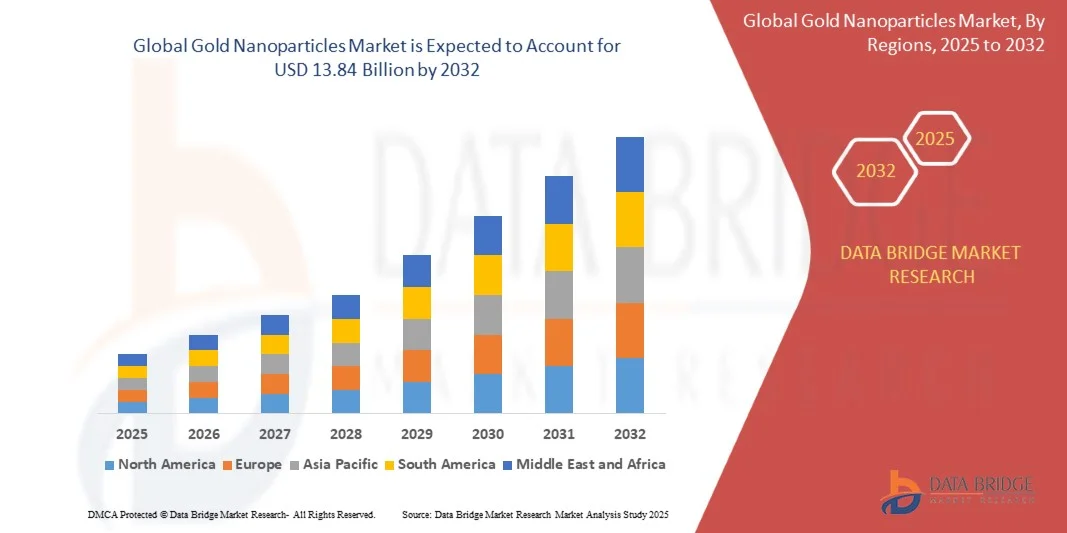
- The Gold Nanoparticles Market size was valued at USD 5.90 billion in 2024 and is projected to reach USD 13.84 billion by 2032, growing at a CAGR of 11.25% during the forecast period.
- The market expansion is primarily driven by the rising adoption of gold nanoparticles in medical diagnostics, targeted drug delivery, imaging, and electronics, owing to their exceptional optical and chemical properties.
- Moreover, increasing investments in nanotechnology research, coupled with growing applications in cancer therapy, biosensing, and precision medicine, are fueling demand. These advancements, along with expanding use in catalysis and photovoltaic systems, are propelling the Gold Nanoparticles Market’s rapid growth.
Gold Nanoparticles Market Analysis
- Gold nanoparticles, known for their exceptional optical, electronic, and chemical properties, are increasingly vital components across industries such as healthcare, electronics, catalysis, and biotechnology, due to their versatility, stability, and effectiveness in enhancing product performance.
- The escalating demand for gold nanoparticles is primarily fueled by advancements in nanotechnology, increasing use in medical diagnostics and targeted drug delivery, and growing applications in imaging and photothermal therapy.
- North America dominated the Gold Nanoparticles Market with the largest revenue share of 38.5% in 2024, driven by strong research and development activities, expanding healthcare infrastructure, and significant investments in nanomedicine and electronics sectors.
- Europe is expected to be the fastest-growing region in the Gold Nanoparticles Market during the forecast period due to rising demand for innovative healthcare solutions, growing focus on sustainable nanomaterials, and increasing adoption in pharmaceutical and diagnostic applications.
- The water soluble segment dominated the market with the largest revenue share of 46.5% in 2024, due to its extensive use in biomedical research, drug delivery systems, diagnostics, and biosensing applications
Report Scope and Gold Nanoparticles Market Segmentation
|
Attributes |
Gold Nanoparticles Key Market Insights |
|
Segments Covered |
|
|
Countries Covered |
North America
Europe
Asia-Pacific
Middle East and Africa
South America
|
|
Key Market Players |
|
|
Market Opportunities |
|
|
Value Added Data Infosets |
In addition to the insights on market scenarios such as market value, growth rate, segmentation, geographical coverage, and major players, the market reports curated by the Data Bridge Market Research also include import export analysis, production capacity overview, production consumption analysis, price trend analysis, climate change scenario, supply chain analysis, value chain analysis, raw material/consumables overview, vendor selection criteria, PESTLE Analysis, Porter Analysis, and regulatory framework. |
Gold Nanoparticles Market Trends
“Growing Integration with Advanced and Sustainable Nanotechnology Solutions”
- A significant and accelerating trend in the Gold Nanoparticles Market is the increasing integration of advanced and sustainable nanotechnology solutions across industries such as healthcare, electronics, energy, and environmental applications. This shift is driven by the growing demand for eco-efficient, high-performance materials that minimize waste and enhance process sustainability.
- For instance, leading manufacturers and research institutions are investing in green synthesis methods for gold nanoparticles, utilizing plant extracts, microorganisms, and biodegradable polymers to reduce the use of toxic chemicals and energy-intensive processes. These approaches align with global sustainability and carbon-reduction objectives.
- The development of bio-based and water-dispersible gold nanoparticle formulations is expanding rapidly, offering safer and more environmentally friendly alternatives for use in biomedical imaging, targeted drug delivery, and diagnostic assays. This enhances product safety while maintaining high precision and performance standards.
- Furthermore, innovations in surface functionalization and nanostructure design are enabling gold nanoparticles to deliver improved biocompatibility, enhanced catalytic efficiency, and reduced environmental impact, addressing the rising demand for green nanomaterials in industrial and medical applications.
- This growing emphasis on sustainable nanotechnology is fostering collaboration between material scientists, pharmaceutical companies, and environmental researchers to accelerate breakthroughs that support circular economy goals and resource-efficient production.
- The demand for sustainably produced gold nanoparticles is expected to surge globally, particularly in medical diagnostics, electronics, and renewable energy sectors, as industries and consumers increasingly prioritize environmentally responsible and high-performance nanomaterials.
Gold Nanoparticles Market Dynamics
Driver
“Growing Demand Driven by Technological Innovation and Biomedical Applications”
- The increasing global focus on advanced healthcare solutions and nanotechnology-driven innovation is a major factor driving the rising demand in the Gold Nanoparticles Market. Industries across healthcare, electronics, and energy are increasingly leveraging gold nanoparticles for their unique optical, electronic, and biocompatible properties.
- For instance, in March 2024, Cytodiagnostics Inc. announced the expansion of its gold nanoparticle production facilities in North America to meet the growing need for high-purity nanoparticles used in diagnostics and targeted drug delivery systems. Such developments underscore the increasing role of nanotechnology in precision medicine and sustainable innovation.
- As technological advancement becomes a key differentiator, gold nanoparticles synthesized through green and environmentally friendly methods—using plant extracts or biological agents—are gaining traction for their reduced toxicity and environmental impact.
- Furthermore, governments and research institutions worldwide are promoting nanotechnology through funding initiatives and sustainability-driven research programs, encouraging the development of safer, bio-compatible nanomaterials.
- Applications in industries such as medical diagnostics (for biosensing and imaging), electronics (in conductive inks and sensors), and catalysis (for energy-efficient reactions) are expanding rapidly. Demand is particularly strong in emerging economies, where healthcare investments and nanotechnology research capabilities are growing.
Restraint/Challenge
“High Production Costs and Raw Material Supply Constraints”
- The high cost of raw materials and complex synthesis processes pose significant challenges to the large-scale production and affordability of gold nanoparticles. The price of gold, a critical input, is subject to global market fluctuations driven by geopolitical instability, mining output, and macroeconomic conditions.
- For instance, volatility in gold prices during periods of economic uncertainty can substantially impact production costs, limiting adoption in cost-sensitive applications such as consumer electronics or bulk medical supplies.
- Additionally, ensuring the consistent quality and stability of nanoparticles during large-scale production remains a key technical challenge, often requiring advanced equipment and costly purification processes.
- While there is rising interest in sustainable and green synthesis routes, the perception that environmentally friendly production methods are less efficient or more expensive can hinder market expansion in certain sectors.
- Overcoming these challenges will require strategic investments in process optimization, alternative synthesis methods using renewable reducing agents, and collaborations between industry and academia to improve scalability and cost-effectiveness. Enhanced recycling of gold and technological innovations in nanomanufacturing will be crucial to ensuring long-term sustainability and affordability.
Gold Nanoparticles Market Scope
The gold nanoparticles market is segmented on the basis of type, application and end users.
- By Type
On the basis of type, the Gold Nanoparticles Market is segmented into water soluble, oil soluble, and combined capability. The water soluble segment dominated the market with the largest revenue share of 46.5% in 2024, due to its extensive use in biomedical research, drug delivery systems, diagnostics, and biosensing applications. These nanoparticles are highly favored for their excellent biocompatibility, easy surface functionalization, and stable dispersion in aqueous systems, making them essential for laboratory research and clinical applications.
The oil soluble segment is expected to register the fastest growth rate from 2025 to 2032, driven by increasing industrial and electronic applications where interaction with hydrophobic materials is critical, such as in catalysis, nanocoatings, and advanced material fabrication. The combined capability type, which offers dual solubility in both aqueous and organic phases, is gaining traction for multifunctional applications, including hybrid imaging probes and theranostic systems, bridging versatility across life sciences and industrial use cases.
- By Application
On the basis of application, the Gold Nanoparticles Market is segmented into life sciences, imaging, targeted drug delivery, sensors, proton therapy, in-vitro diagnostics, probes, catalysis, industrial, and others. The life sciences segment dominated with a market share of 33.7% in 2024, driven by the increasing use of gold nanoparticles in molecular diagnostics, therapeutic delivery, and biomedical imaging. Their unique optical, electronic, and chemical properties, combined with low toxicity, make them ideal for bio-conjugation and disease detection, particularly in oncology and personalized medicine.
The targeted drug delivery segment is anticipated to witness the fastest growth during the forecast period, propelled by the rising demand for precision medicine, cancer therapeutics, and nanoparticle-enabled drug carriers that minimize systemic toxicity. Other applications such as sensors, in-vitro diagnostics, and catalysis are also growing, supported by advances in nanotechnology and the need for high-performance, point-of-care, and industrial solutions.
- By End Users
On the basis of end users, the Gold Nanoparticles Market is segmented into healthcare, electronics, chemicals, and others. The healthcare segment held the largest market share of 54.8% in 2024, primarily due to the growing adoption of gold nanoparticles in disease diagnosis, imaging, and targeted drug delivery systems. Increasing prevalence of chronic illnesses, such as cancer and cardiovascular diseases, is driving investments in nanoparticle-enabled medical technologies.
The electronics segment is expected to witness the fastest growth rate from 2025 to 2032, fueled by the rising use of gold nanoparticles in conductive inks, nano-sensors, flexible electronics, and advanced circuit fabrication. Gold nanoparticles’ exceptional electrical conductivity, stability, and resistance to oxidation make them ideal for miniaturized, high-performance components. The chemicals segment also remains significant, particularly in catalysis, material science, and specialty chemical manufacturing, where gold nanoparticles enhance reaction rates, selectivity, and product quality.
Gold Nanoparticles Market Regional Analysis
- North America dominated the Gold Nanoparticles Market with the largest revenue share of 38.5% in 2024, driven by strong research and development activities, expanding healthcare and electronics sectors, and increasing adoption of nanotechnology in biomedical and diagnostic applications.
- Industries and consumers in the region are increasingly focusing on advanced and sustainable nanomaterials, with gold nanoparticles being preferred for their high biocompatibility, efficiency in drug delivery, and superior performance in imaging and sensing technologies.
- This strong market position is further supported by significant government and private investments in nanotechnology research, well-established pharmaceutical and biotechnology industries, and the presence of leading market players. Additionally, rising demand from end-use sectors such as healthcare, electronics, and catalysis continues to establish North America as the central hub for gold nanoparticle innovation and commercialization.
U.S. Gold Nanoparticles Market Insight
The U.S. gold nanoparticles market captured the largest revenue share of 78% in 2024 within North America, driven by strong demand in medical diagnostics, drug delivery, and imaging applications. The widespread adoption of nanotechnology in healthcare and electronics is fueling market growth. Increasing investments by pharmaceutical companies and research institutions in nanomedicine, along with the development of advanced therapeutic and diagnostic tools, are key growth contributors. Moreover, the integration of gold nanoparticles in biosensors, photothermal therapy, and cancer treatment applications is significantly enhancing the market’s expansion.
Europe Gold Nanoparticles Market Insight
The Europe gold nanoparticles market is projected to expand at a substantial CAGR during the forecast period, primarily driven by growing research in nanomedicine and rising demand from the pharmaceutical and biotechnology sectors. The region’s strong regulatory framework promoting sustainable and safe nanomaterials is supporting adoption across healthcare, electronics, and catalysis industries. Increasing collaborations between universities, research organizations, and private companies are further accelerating product innovation. Additionally, the development of gold nanoparticle-based imaging and diagnostic technologies is propelling market growth across Europe.
U.K. Gold Nanoparticles Market Insight
The U.K. gold nanoparticles market is anticipated to grow at a noteworthy CAGR over the forecast period, supported by a robust healthcare infrastructure and significant government investment in nanotechnology research. The rising application of gold nanoparticles in biosensing, drug delivery, and cancer treatment is fueling adoption. Growing awareness of early disease detection and advancements in precision medicine are further enhancing market growth. Additionally, the U.K.’s strong academic and research institutions are fostering innovations that improve nanoparticle efficiency and scalability.
Germany Gold Nanoparticles Market Insight
The Germany gold nanoparticles market is expected to expand at a considerable CAGR during the forecast period, fueled by the country’s focus on technological innovation, healthcare excellence, and sustainable nanomaterials. Germany’s advanced manufacturing and R&D capabilities support the integration of gold nanoparticles in electronics, catalysis, and medical applications. Increasing investments in green nanotechnology and precision healthcare solutions are driving demand. The use of gold nanoparticles in diagnostic imaging and targeted therapies is rapidly gaining traction, aligning with Germany’s emphasis on advanced healthcare solutions.
Asia-Pacific Gold Nanoparticles Market Insight
The Asia-Pacific gold nanoparticles market is poised to grow at the fastest CAGR of 13.5% during the forecast period of 2025 to 2032, driven by rapid urbanization, expanding healthcare infrastructure, and increasing investments in nanotechnology research. Countries such as China, Japan, and India are emerging as major hubs for gold nanoparticle production and application in medical, electronic, and energy sectors. Government support for advanced materials and biotechnology innovation is further boosting the market. The affordability and scalability of production in the region are expanding access to high-quality nanomaterials across industries.
Japan Gold Nanoparticles Market Insight
The Japan gold nanoparticles market is gaining momentum due to the nation’s technological sophistication, emphasis on innovation, and growing adoption of nanomaterials in healthcare and electronics. The use of gold nanoparticles in imaging, biosensors, and drug delivery systems is rapidly increasing. Japan’s strong focus on R&D, coupled with collaborations between academia and industry, is driving advancements in nanoparticle synthesis and application. Furthermore, demand for biocompatible, high-performance materials in medical diagnostics and treatment continues to accelerate market growth.
China Gold Nanoparticles Market Insight
The China gold nanoparticles market accounted for the largest market revenue share in Asia Pacific in 2024, attributed to rapid industrialization, technological innovation, and extensive applications across healthcare and electronics. China’s strong manufacturing base and significant investments in nanotechnology research are driving large-scale production and adoption. The growing demand for gold nanoparticles in biosensing, medical imaging, and catalytic applications, combined with government initiatives supporting advanced material development, is strengthening China’s position as a global leader in gold nanoparticle production and innovation.
Gold Nanoparticles Market Share
The Gold Nanoparticles industry is primarily led by well-established companies, including:
- Cytodiagnostics Inc. (Canada)
- NanoComposix, Inc. (U.S.)
- BBI Solutions OEM Ltd. (U.K.)
- Tanaka Holdings Co., Ltd. (Japan)
- Metalor Technologies SA (Switzerland)
- Expedeon Ltd. (U.K.)
- Avantor, Inc. (U.S.)
- Sigma‑Aldrich Corporation (U.S.)
- Cline Scientific AB (Sweden)
- Meliorum Technologies, Inc. (U.S.)
- Strem Chemicals, Inc. (U.S.)
- Solaris Nanosciences, Inc. (U.S.)
- Prolume Ltd. (U.K.)
- NanoHybrids Inc. (U.S.)
- NanoSeeds India Pvt. Ltd. (India)
What are the Recent Developments in Gold Nanoparticles Market?
- In April 2023, Cytodiagnostics Inc., a global leader in gold nanoparticle synthesis and characterization, expanded its manufacturing facility in Canada to increase production capacity for high-purity gold nanoparticles. This strategic move is aimed at meeting the rising demand from biomedical, diagnostic, and electronic applications worldwide. The expansion underscores Cytodiagnostics’ commitment to innovation, quality, and maintaining its competitive edge in the Gold Nanoparticles Market.
- In March 2023, nanoComposix, Inc., a leading U.S.-based nanomaterials company, launched a new line of functionalized gold nanoparticles for drug delivery and diagnostic applications. These nanoparticles offer enhanced biocompatibility and precision targeting, aligning with growing demand for advanced nanomedicine solutions. The initiative highlights nanoComposix’s focus on product innovation and its strategic role in driving adoption of gold nanoparticle technologies across healthcare and research sectors.
- In March 2023, BBI Solutions OEM Ltd., a prominent UK-based provider of nanomaterials and bioscience solutions, unveiled a new R&D center in Germany dedicated to developing customized gold nanoparticle formulations for biomedical and industrial applications. The facility aims to accelerate product innovation and foster collaboration with European clients seeking high-performance, safe, and sustainable nanoparticle solutions. This investment reflects BBI Solutions’ commitment to expanding its global footprint and supporting cutting-edge nanotechnology initiatives.
- In February 2023, Strem Chemicals, Inc., a U.S.-based specialty chemical supplier, introduced a new portfolio of gold nanoparticles for catalysis and research applications. These nanoparticles provide improved stability and reproducibility, meeting the growing requirements of pharmaceutical, electronics, and energy industries. The launch strengthens Strem’s position as a key supplier of high-quality, application-ready nanomaterials in the global market.
- In January 2023, Tanaka Holdings Co., Ltd., a Japan-based global precious metals producer, announced a strategic partnership with a leading Chinese research institute to ensure sustainable and scalable production of gold nanoparticles for biomedical and electronic applications. The partnership includes investments in advanced synthesis technologies and process optimization programs, aimed at enhancing efficiency and reducing environmental impact. This initiative reaffirms Tanaka’s commitment to responsible manufacturing and reinforces its leadership in the global gold nanoparticles industry.

- Interactive Data Analysis Dashboard
- Company Analysis Dashboard for high growth potential opportunities
- Research Analyst Access for customization & queries
- Competitor Analysis with Interactive dashboard
- Latest News, Updates & Trend analysis
- Harness the Power of Benchmark Analysis for Comprehensive Competitor Tracking
Global Gold Nanoparticles Market, Supply Chain Analysis and Ecosystem Framework
To support market growth and help clients navigate the impact of geopolitical shifts, DBMR has integrated in-depth supply chain analysis into its Global Gold Nanoparticles Market research reports. This addition empowers clients to respond effectively to global changes affecting their industries. The supply chain analysis section includes detailed insights such as Global Gold Nanoparticles Market consumption and production by country, price trend analysis, the impact of tariffs and geopolitical developments, and import and export trends by country and HSN code. It also highlights major suppliers with data on production capacity and company profiles, as well as key importers and exporters. In addition to research, DBMR offers specialized supply chain consulting services backed by over a decade of experience, providing solutions like supplier discovery, supplier risk assessment, price trend analysis, impact evaluation of inflation and trade route changes, and comprehensive market trend analysis.
Data collection and base year analysis are done using data collection modules with large sample sizes. The stage includes obtaining market information or related data through various sources and strategies. It includes examining and planning all the data acquired from the past in advance. It likewise envelops the examination of information inconsistencies seen across different information sources. The market data is analysed and estimated using market statistical and coherent models. Also, market share analysis and key trend analysis are the major success factors in the market report. To know more, please request an analyst call or drop down your inquiry.
The key research methodology used by DBMR research team is data triangulation which involves data mining, analysis of the impact of data variables on the market and primary (industry expert) validation. Data models include Vendor Positioning Grid, Market Time Line Analysis, Market Overview and Guide, Company Positioning Grid, Patent Analysis, Pricing Analysis, Company Market Share Analysis, Standards of Measurement, Global versus Regional and Vendor Share Analysis. To know more about the research methodology, drop in an inquiry to speak to our industry experts.
Data Bridge Market Research is a leader in advanced formative research. We take pride in servicing our existing and new customers with data and analysis that match and suits their goal. The report can be customized to include price trend analysis of target brands understanding the market for additional countries (ask for the list of countries), clinical trial results data, literature review, refurbished market and product base analysis. Market analysis of target competitors can be analyzed from technology-based analysis to market portfolio strategies. We can add as many competitors that you require data about in the format and data style you are looking for. Our team of analysts can also provide you data in crude raw excel files pivot tables (Fact book) or can assist you in creating presentations from the data sets available in the report.













