


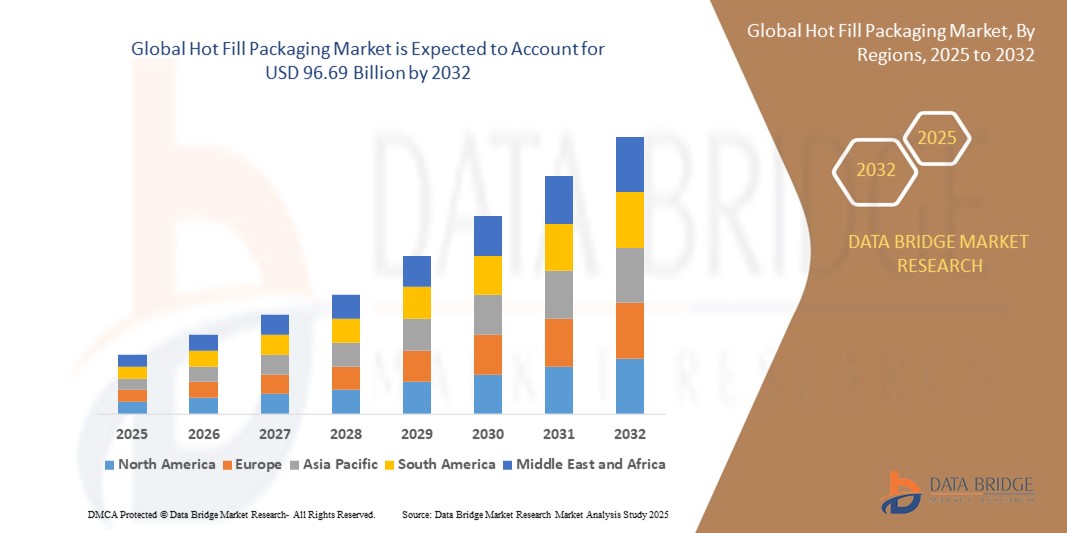
Hot Fill Packaging Market Size
- The global hot fill packaging market size was valued at USD 69.04 billion in 2024 and is expected to reach USD 96.68 billion by 2032, at a CAGR of 4.30% during the forecast period
- The market growth is primarily driven by the increasing demand for convenient, shelf-stable food and beverage products, coupled with advancements in packaging technologies that enhance product safety and shelf life
- Rising consumer preference for ready-to-drink beverages, sauces, and other perishable products requiring hot fill processes is further propelling market expansion, particularly in the food and beverage sector
Hot Fill Packaging Market Analysis
- Hot fill packaging, a process involving filling containers with hot liquid products to ensure sterility and extended shelf life, is a critical solution for the food and beverage industry, offering durability, safety, and sustainability
- The growing demand for hot fill packaging is fueled by the rise in consumption of ready-to-drink beverages, increasing awareness of food safety, and the need for cost-effective packaging solutions that maintain product quality
- Asia-Pacific dominated the hot fill packaging market with the largest revenue share of 42.5% in 2024, driven by rapid urbanization, a booming food and beverage industry, and high demand for packaged goods in countries such as China and India
- North America is expected to be the fastest-growing region during the forecast period, attributed to increasing consumer demand for convenience foods, technological advancements in packaging, and a strong presence of key industry players
- The bottles segment dominated the largest market revenue share of 32.7% in 2024, driven by their widespread use for hot-filled beverages such as fruit juices, flavored water, and ready-to-drink beverages due to their robust design and ability to withstand high temperatures.
Report Scope and Hot Fill Packaging Market Segmentation
|
Attributes |
Hot Fill Packaging Key Market Insights |
|
Segments Covered |
|
|
Countries Covered |
North America
Europe
Asia-Pacific
Middle East and Africa
South America
|
|
Key Market Players |
|
|
Market Opportunities |
|
|
Value Added Data Infosets |
In addition to the insights on market scenarios such as market value, growth rate, segmentation, geographical coverage, and major players, the market reports curated by the Data Bridge Market Research also include import export analysis, production capacity overview, production consumption analysis, price trend analysis, climate change scenario, supply chain analysis, value chain analysis, raw material/consumables overview, vendor selection criteria, PESTLE Analysis, Porter Analysis, and regulatory framework. |
Hot Fill Packaging Market Trends
“Increasing Adoption of Sustainable and Recyclable Materials”
- The global hot fill packaging market is experiencing a significant trend toward the adoption of sustainable and recyclable materials, driven by consumer demand and regulatory pressures for eco-friendly packaging solutions
- Technologies such as lightweight polyethylene terephthalate (PET) and polypropylene (PP) are being prioritized for their recyclability and ability to withstand high temperatures without compromising product integrity
- Companies are innovating with biodegradable and bio-based plastics to reduce environmental impact, aligning with global sustainability goals and circular economy initiatives
- For instances, in April 2024, Amcor introduced a one-liter PET bottle made from 100% post-consumer recycled (PCR) content for carbonated soft drinks, supporting sustainability goals and meeting consumer demand for greener packaging
- This trend enhances the appeal of hot fill packaging for environmentally conscious consumers and strengthens brand reputation in competitive markets
Hot Fill Packaging Market Dynamics
Driver
“Rising Demand for Convenience Foods and Beverages”
- The increasing consumer preference for convenience foods, ready-to-eat meals, and beverages, such as sauces, fruit juices, vegetable juices, and ready-to-drink (RTD) beverages, is a major driver for the global hot fill packaging market
- Hot fill packaging extends shelf life without preservatives, meeting consumer demand for natural and preservative-free products, particularly in applications such as jams, mayonnaise, and nectars
- Government regulations promoting food safety and quality, especially in the Asia-Pacific region, which dominates the market, are encouraging the adoption of hot fill packaging solutions
- Advancements in 5G and IoT technologies are enabling faster and more reliable data transmission for automated hot fill packaging systems, enhancing efficiency for end-users such as dairy and soup manufacturers
- Manufacturers are increasingly offering hot fill packaging solutions, such as bottles and jars, as standard or customizable options to cater to diverse consumer needs across offline and online distribution channels
Restraint/Challenge
“High Initial Costs and Regulatory Compliance Issues”
- The high initial investment required for hot fill packaging equipment, such as manual and automatic machines, and the integration of advanced materials such as PET and PP, poses a significant barrier, particularly for small-scale manufacturers in emerging market
- The complexity and cost of retrofitting existing production lines to accommodate hot fill packaging processes can deter adoption, especially for products such as sauces, spreads, and flavored water
- Regulatory compliance issues, including varying standards for food safety and packaging across countries, create challenges for manufacturers operating globally, particularly in ensuring compliance for primary, secondary, and tertiary packaging layer
- The need for robust supply chains to support the production and distribution of packaging formats, such as pouches, cans, and caps and closures, further complicates market expansion, especially in regions with underdeveloped infrastructure
- These factors may limit market growth, particularly in cost-sensitive markets or regions with stringent regulatory frameworks
Hot Fill Packaging market Scope
The market is segmented on the basis of product type, material type, packaging layer, capacity, machine type, end-user, and distribution channel.
- By Product Type
On the basis of product type, the global hot fill packaging market is segmented into bottles, jars, containers, pouches, cans, caps and closures, and others. The bottles segment dominated the largest market revenue share of 32.7% in 2024, driven by their widespread use for hot-filled beverages such as fruit juices, flavored water, and ready-to-drink beverages due to their robust design and ability to withstand high temperatures.
The Pouches segment is expected to witness the fastest growth rate, primarily driven by their increasing adoption for single-serving hot-filled products such as sauces, soups, and baby food, offering convenience, reduced material usage, and extended shelf life.
- By Material Type
On the basis of material type, the global hot fill packaging market is segmented into polyethylene terephthalate (PET), glass, polypropylene, polyethylene, and others. The polyethylene terephthalate (PET) segment is expected to hold the largest market revenue share, primarily due to its excellent barrier properties, lightweight nature, and cost-effectiveness, making it a preferred choice for hot-filled beverages and food products.
The glass segment is anticipated to witness significant growth, driven by its premium appeal, inert nature, and recyclability, particularly for high-end hot-filled products where product integrity and shelf life are crucial.
- By Packaging Layer
On the basis of packaging layer, the global hot fill packaging market is segmented into primary, secondary, and tertiary. The primary packaging layer segment is expected to hold the largest market revenue share, as it directly contains the hot-filled product and plays a crucial role in maintaining product freshness, safety, and extending shelf life.
The secondary packaging layer is anticipated to experience robust growth, driven by its importance in protecting primary packaging during transit and storage, as well as providing branding and promotional opportunities.
- By Capacity
On the basis of capacity, the global hot fill packaging market is segmented into up to 12 Oz, 13 Oz-32 Oz, 33 Oz-64 Oz, and above 64 Oz. The 13 Oz-32 Oz segment is expected to hold the largest market revenue share, aligning with popular beverage and food portion sizes, offering a balance between consumer convenience and product volume.
The above 64 Oz segment is expected to witness significant growth, driven by the increasing demand for bulk hot-filled products in institutional and food service sectors, as well as for multi-serving household products.
- By Machine Type
On the basis of machine type, the global hot fill packaging market is segmented into manual and automatic. The automatic segment is expected to hold the largest market revenue share, primarily due to the high volume production requirements of hot fill packaging, where automated systems offer efficiency, precision, and reduced labor costs.
The manual segment is anticipated to witness growth in niche markets or for smaller-scale operations where flexibility and lower initial investment are prioritized.
- By End-User
On the basis of end-user, the global hot fill packaging market is segmented into sauces and spreads, fruit juices, vegetable juices, jams, mayonnaise, flavored water, ready to drink beverages, soups, dairy, nectars, and others. The fruit Juices segment is expected to hold the largest market revenue share, driven by the widespread consumption of fruit juices globally and the need for hot fill packaging to preserve freshness and extend shelf life without refrigeration.
The ready to drink beverages segment is anticipated to witness rapid growth, fueled by changing consumer lifestyles and the increasing demand for convenient and healthy beverage options that can be hot-filled to ensure product safety and longevity.
- By Distribution Channel
On the basis of distribution channel, the global hot fill packaging market is segmented into offline and online. The offline segment is expected to hold the largest market revenue share, as traditional retail channels such as supermarkets, hypermarkets, and convenience stores remain the primary points of sale for hot-filled packaged products.
The online segment is anticipated to witness significant growth, driven by the increasing penetration of e-commerce and the convenience it offers consumers for purchasing a wide range of packaged food and beverage products.
Hot Fill Packaging Market Regional Analysis
- Asia-Pacific dominated the hot fill packaging market with the largest revenue share of 42.5% in 2024, driven by rapid urbanization, a booming food and beverage industry, and high demand for packaged goods in countries such as China and India
- Consumers prioritize hot fill packaging for extending shelf life, ensuring product safety, and maintaining quality without preservatives, particularly in regions with high consumption of beverages and processed foods
- Growth is supported by advancements in packaging technology, including lightweight PET and recyclable materials, alongside rising adoption in both OEM and aftermarket segments
U.S. Hot Fill Packaging Market Insight
The U.S. hot fill packaging market is expected to witness significant growth, fueled by strong demand for ready-to-drink beverages and sauces in the aftermarket. Growing consumer awareness of sustainability and food safety benefits drives market expansion. The trend toward eco-friendly packaging and increasing regulations promoting recyclable materials further boost the market. Manufacturers’ integration of hot fill technology in production lines complements aftermarket sales, creating a diverse product ecosystem.
Europe Hot Fill Packaging Market Insight
The Europe hot fill packaging market is expected to witness significant growth, supported by regulatory emphasis on food safety and sustainability. Consumers seek packaging that preserves product freshness while offering convenience. The growth is prominent in both new production lines and retrofit projects, with countries such as Germany and France showing significant uptake due to rising environmental concerns and demand for healthy food options.
U.K. Hot Fill Packaging Market Insight
The U.K. market for hot fill packaging is expected to witness rapid growth, driven by demand for convenient food and beverage solutions in urban and suburban settings. Increased interest in sustainable packaging and rising awareness of preservative-free products encourage adoption. Evolving food safety regulations influence consumer choices, balancing packaging functionality with compliance.
Germany Hot Fill Packaging Market Insight
Germany is expected to witness rapid growth in hot fill packaging, attributed to its advanced food and beverage manufacturing sector and high consumer focus on product quality and sustainability. German consumers prefer technologically advanced packaging that ensures product safety and reduces environmental impact. The integration of these solutions in premium products and aftermarket options supports sustained market growth.
Asia-Pacific Hot Fill Packaging Market Insight
The Asia-Pacific region dominates the global hot fill packaging market, driven by expanding food and beverage production and rising disposable incomes in countries such as China, India, and Japan. Increasing awareness of product safety, convenience, and sustainability boosts demand. Government initiatives promoting eco-friendly packaging and food safety further encourage the use of advanced hot fill solutions.
Japan Hot Fill Packaging Market Insight
Japan’s hot fill packaging market is expected to witness rapid growth due to strong consumer preference for high-quality, technologically advanced packaging that enhances product safety and convenience. The presence of major food and beverage manufacturers and integration of hot fill technology in production accelerate market penetration. Rising interest in sustainable aftermarket solutions also contributes to growth.
China Hot Fill Packaging Market Insight
China holds the largest share of the Asia-Pacific hot fill packaging market, propelled by rapid urbanization, rising food and beverage consumption, and increasing demand for shelf-stable solutions. The country’s growing middle class and focus on convenience support the adoption of advanced hot fill packaging. Strong domestic manufacturing capabilities and competitive pricing enhance market accessibility.
Hot Fill Packaging Market Share
The hot fill packaging industry is primarily led by well-established companies, including:
- United States Plastic Corp (U.S.)
- Berry Global Inc. (U.S.)
- Imperial Packaging (U.S.)
- DS Smith (U.K.)
- SAMKIN INDUSTRIES (India)
- Smurfit Kappa (Ireland)
- RESILUX NV (Belgium)
- MJS Packaging (U.S.)
- Gualapack S.p.A. (Italy)
- Hetzner Online GmbH (Germany)
- Kaufman Container (U.S.)
- Pipeline Packaging (U.S.)
- Amcor plc (Australia)
- Graham Packaging Company (U.S.)
- Borealis AG (Austria)
What are the Recent Developments in Global Hot Fill Packaging Market?
- In February 2024, Dohler announced the expansion of its Cartersville, Georgia production plant to spur additional development. This project aims to double the capacity and include cutting-edge production lines for Syrups, Compounds, Liquid Flavors, and Extractions, showing the company's dedication to the Americas. It expands the company's hot fill bottling capacity and boosts flavor creation capability
- In October 2023, Sidel Group acquired PET Engineering, strengthening its packaging solutions portfolio across water, soft drinks, liquid dairy products, and beer. This strategic move enhances Sidel’s expertise in hot-fill packaging, expanding its capabilities in container design, qualification, and blowing processes. PET Engineering, known for its innovative packaging designs, brings award-winning expertise to Sidel, reinforcing its commitment to sustainable and efficient packaging solutions
- In August 2023, Amcor acquired Phoenix Flexibles, expanding its capacity in the Indian market. Phoenix Flexibles, located in Gujarat, India, generates approximately USD 20 million per year from the sale of flexible packaging for food, home care, and personal care applications. The acquisition also adds advanced film technology, enabling local production of a broader range of more sustainable packaging solutions, and brings capabilities allowing Amcor to expand its product offering in attractive high-value segments
- In February 2023, Sealed Air (SEE) completed its acquisition of Liquibox for on a cash and debt-free basis. This strategic move unites two leaders in flexible packaging, accelerating the growth of SEE’s CRYOVAC® brand Fluids & Liquids business. Liquibox, known for its Bag-in-Box sustainable packaging solutions, serves fresh food, beverage, consumer goods, and industrial markets. The acquisition enhances SEE’s automation and sustainability efforts, reinforcing its commitment to innovative packaging technologies
- In September 2021, UFlex, Hoffer Plastics, and Mespack partnered to develop a sustainable solution for hot-fill pouch recycling. Their mono-polymer structure enables 100% recyclability, addressing challenges in packaging waste management. The turnkey solution integrates recyclable spout caps and laminate materials, ensuring efficient processing within existing PP recycling streams. This innovation supports eco-conscious brands in achieving sustainability goals while maintaining product integrity

- Interactive Data Analysis Dashboard
- Company Analysis Dashboard for high growth potential opportunities
- Research Analyst Access for customization & queries
- Competitor Analysis with Interactive dashboard
- Latest News, Updates & Trend analysis
- Harness the Power of Benchmark Analysis for Comprehensive Competitor Tracking
Table of Content
1 INTRODUCTION
1.1 OBJECTIVES OF THE STUDY
1.2 MARKET DEFINITION
1.3 OVERVIEW OF GLOBAL HOT FILL PACKAGING MARKET
1.4 CURRENCY AND PRICING
1.5 LIMITATION
1.6 MARKETS COVERED
2 MARKET SEGMENTATION
2.1 KEY TAKEAWAYS
2.2 ARRIVING AT THE GLOBAL HOT FILL PACKAGING MARKET SIZE
2.3 VENDOR POSITIONING GRID
2.4 MARKETS COVERED
2.5 GEOGRAPHIC SCOPE
2.6 YEARS CONSIDERED FOR THE STUDY
2.7 RESEARCH METHODOLOGY
2.8 TECHNOLOGY LIFE LINE CURVE
2.9 MULTIVARIATE MODELLING
2.1 PRIMARY INTERVIEWS WITH KEY OPINION LEADERS
2.11 DBMR MARKET POSITION GRID
2.12 MARKET APPLICATION COVERAGE GRID
2.13 DBMR MARKET CHALLENGE MATRIX
2.14 IMPORT AND EXPORT DATA
2.15 SECONDARY SOURCES
2.16 GLOBAL HOT FILL PACKAGING MARKET: RESEARCH SNAPSHOT
2.17 ASSUMPTIONS
3 MARKET OVERVIEW
3.1 DRIVERS
3.2 RESTRAINTS
3.3 OPPORTUNITIES
3.4 CHALLENGES
4 EXECUTIVE SUMMARY
5 PREMIUM INSIGHTS
6 PREMIUM INSIGHTS
6.1 CONSUMER BUYING BEHAVIOUR
6.2 FACTORS AFFECTING BUYING DECISION
6.3 PRODUCT ADOPTION SCENARIO
6.4 PORTER’S FIVE FORCES
6.5 REGULATION COVERAGE
6.6 RAW MATERIAL SOURCING ANALYSIS
6.7 IMPORT EXPORT SCENARIO
6.8 TECHNICAL CONSIDERATIONS WHILE DESIGNING A BOTTLE FOR HOT FILL PACKAGING
6.9 PHYSICAL PROPERTIES OF PET BOTTLES THAT ARE REQUIRED FOR HOT FILL PACKAGING
6.1 CHANGES IN PHYSICAL PROPERTIES OF PET BOTTLE WHEN BLENDED/NOT BLENDED WITH OTHER RESINS
6.11 FUTURE PROSPECTS OF HOT FILL PACKAGING V/S ASEPTIC PACKAGING
6.12 POLYETHYLENE FURONATE (PEF) FOR HOT FILL PACKAGING
7 PRODUCTION CAPACITY OUTLOOK
8 PRICE INDEX
9 BRAND OUTLOOK
9.1 BRAND COMPARATIVE ANALYSIS
9.2 PRODUCT VS BRAND OVERVIEW
10 IMPACT OF ECONOMIC SLOWDOWN
10.1 IMPACT ON PRICES
10.2 IMPACT ON SUPPLY CHAIN
10.3 IMPACT ON SHIPMENT
10.4 IMPACT ON DEMAND
10.5 IMPACT ON STRATEGIC DECISIONS
11 SUPPLY CHAIN ANALYSIS
11.1 OVERVIEW
11.2 LOGISTIC COST SCENARIO
11.3 IMPORTANCE OF LOGISTICS SERVICE PROVIDERS
12 GLOBAL HOT FILL PACKAGING MARKET, BY PRODUCT TYPE , 2022-2031 (USD MILLION) (MILLION UNITS)
12.1 OVERVIEW
12.2 BOTTLES
12.2.1 BY PLASTIC TYPE
12.2.1.1. PET
12.2.1.2. HDPE
12.2.1.3. LDPE
12.2.1.4. POLYPROPYLENE (PP)
12.2.1.5. OTHERS
12.3 JARS
12.4 CONTAINERS
12.5 POUCHES
12.6 CANS
12.7 CAPS & CLOSURES
12.8 OTHERS
13 GLOBAL HOT FILL PACKAGING MARKET, BY MATERIAL TYPE, 2022-2031 (USD MILLION)
13.1 OVERVIEW
13.2 POLYETHYLENE TEREPHTHALATE (PET)
13.3 GLASS
13.4 POLYPROPYLENE
13.5 OTHERS
14 GLOBAL HOT FILL PACKAGING MARKET,BY PACKAGING LAYER, 2022-2031 (USD MILLION)
14.1 OVERVIEW
14.2 PRIMARY
14.3 SECONDARY
14.4 TERTIARY
15 GLOBAL HOT FILL PACKAGING MARKET,BY CAPACITY, 2022-2031 (USD MILLION)
15.1 OVERVIEW
15.2 UP TO 12 OZ
15.3 13 OZ - 32 OZ
15.4 33 OZ – 64 OZ
15.5 ABOVE 64 OZ
16 GLOBAL HOT FILL PACKAGING MARKET,BY MACHINE TYPE, 2022-2031 (USD MILLION)
16.1 OVERVIEW
16.2 MANUAL
16.3 AUTOMATIC
17 GLOBAL HOT FILL PACKAGING MARKET, BY END-USE, 2022-2031 (USD MILLION)
17.1 OVERVIEW
17.2 BEVERAGES
17.2.1 BEVERAGES, BY CATEGORY
17.2.1.1. JUICES
17.2.1.2. SPORTS DRINKS
17.2.1.3. TEAS
17.2.1.4. FLAVORED WATERS
17.2.1.5. OTHERS
17.2.2 BEVERAGES, BY PRODUCT TYPE
17.2.2.1. BOTTLES
17.2.2.1.1. JARS
17.2.2.1.2. CONTAINERS
17.2.2.1.3. POUCHES
17.2.2.1.4. CANS
17.2.2.1.5. CAPS & CLOSURES
17.2.2.1.6. OTHERS
17.3 SAUCES, DRESSINGS AND CONDIMENTS
17.3.1 SAUCES, DRESSINGS, AND CONDIMENTS, BY CATEGORY
17.3.1.1. SAUCES
17.3.1.2. JAMS
17.3.1.3. JELLIES
17.3.1.4. MAYONNAISE
17.3.1.5. OTHERS
17.3.2 SAUCES, DRESSINGS, AND CONDIMENTS, BY PRODUCT TYPE
17.3.2.1. BOTTLES
17.3.2.2. JARS
17.3.2.3. CONTAINERS
17.3.2.4. POUCHES
17.3.2.5. CANS
17.3.2.6. CAPS & CLOSURES
17.3.2.7. OTHERS
17.4 LIQUID FOOD PRODUCTS
17.4.1 LIQUID FOOD PRODUCTS, BY CATEGORY
17.4.2 SOUPS
17.4.3 BROTHS
17.4.4 READY-TO-EAT MEALS
17.4.4.1. LIQUID FOOD PRODUCTS, BY PRODUCT TYPE
17.4.4.1.1. BOTTLES
17.4.4.1.2. JARS
17.4.4.1.3. CONTAINERS
17.4.4.1.4. POUCHES
17.4.4.1.5. CANS
17.4.4.1.6. CAPS & CLOSURES
17.4.4.1.7. OTHERS
17.5 OTHERS
17.5.1 OTHERS, BY PRODUCT TYPE
17.5.1.1. BOTTLES
17.5.1.2. JARS
17.5.1.3. CONTAINERS
17.5.1.4. POUCHES
17.5.1.5. CANS
17.5.1.6. CAPS & CLOSURES
17.5.1.7. OTHERS
18 GLOBAL HOT FILL PACKAGING MARKET, BY GEOGRAPHY, 2022-2031 (USD MILLION)
18.1 GLOBAL HOT FILL PACKAGING MARKET, (ALL SEGMENTATION PROVIDED ABOVE IS REPRESENTED IN THIS CHAPTER BY COUNTRY)
18.2 NORTH AMERICA
18.2.1 U.S.
18.2.2 CANADA
18.2.3 MEXICO
18.3 EUROPE
18.3.1 GERMANY
18.3.2 U.K.
18.3.3 ITALY
18.3.4 FRANCE
18.3.5 SPAIN
18.3.6 RUSSIA
18.3.7 SWITZERLAND
18.3.8 TURKEY
18.3.9 BELGIUM
18.3.10 NETHERLANDS
18.3.11 LUXEMBURG
18.3.12 REST OF EUROPE
18.4 ASIA-PACIFIC
18.4.1 JAPAN
18.4.2 CHINA
18.4.3 SOUTH KOREA
18.4.4 INDIA
18.4.5 SINGAPORE
18.4.6 THAILAND
18.4.7 INDONESIA
18.4.8 MALAYSIA
18.4.9 PHILIPPINES
18.4.10 AUSTRALIA & NEW ZEALAND
18.4.11 REST OF ASIA-PACIFIC
18.5 SOUTH AMERICA
18.5.1 BRAZIL
18.5.2 ARGENTINA
18.5.3 REST OF SOUTH AMERICA
18.6 MIDDLE EAST AND AFRICA
18.6.1 SOUTH AFRICA
18.6.2 EGYPT
18.6.3 SAUDI ARABIA
18.6.4 UNITED ARAB EMIRATES
18.6.5 ISRAEL
18.6.6 REST OF MIDDLE EAST AND AFRICA
19 GLOBAL HOT FILL PACKAGING MARKET, COMPANY LANDSCAPE
19.1 COMPANY SHARE ANALYSIS: GLOBAL
19.2 COMPANY SHARE ANALYSIS: NORTH AMERICA
19.3 COMPANY SHARE ANALYSIS: EUROPE
19.4 COMPANY SHARE ANALYSIS: ASIA-PACIFIC
19.5 MERGERS AND ACQUISITIONS
19.6 NEW PRODUCT DEVELOPMENT AND APPROVALS
19.7 EXPANSIONS
19.8 PARTNERSHIP AND OTHER STRATEGIC DEVELOPMENTS
20 SWOT AND DATA BRIDGE MARKET RESEARCH ANALYSIS
21 GLOBAL HOT FILL PACKAGING MARKET- COMPANY PROFILES
21.1 AMCOR PLC
21.1.1 COMPANY SNAPSHOT
21.1.2 REVENUE ANALYSIS
21.1.3 PRODUCT PORTFOLIO
21.1.4 RECENT UPDATES
21.2 SIDEL
21.2.1 COMPANY SNAPSHOT
21.2.2 REVENUE ANALYSIS
21.2.3 PRODUCT PORTFOLIO
21.2.4 RECENT UPDATES
21.3 GRAHAM PACKAGING COMPANY
21.3.1 COMPANY SNAPSHOT
21.3.2 REVENUE ANALYSIS
21.3.3 PRODUCT PORTFOLIO
21.3.4 RECENT UPDATES
21.4 BERRY GLOBAL
21.4.1 COMPANY SNAPSHOT
21.4.2 REVENUE ANALYSIS
21.4.3 PRODUCT PORTFOLIO
21.4.4 RECENT UPDATES
21.5 IMPERIAL PACKAGING
21.5.1 COMPANY SNAPSHOT
21.5.2 REVENUE ANALYSIS
21.5.3 PRODUCT PORTFOLIO
21.5.4 RECENT UPDATES
21.6 DS SMITH
21.6.1 COMPANY SNAPSHOT
21.6.2 REVENUE ANALYSIS
21.6.3 PRODUCT PORTFOLIO
21.6.4 RECENT UPDATES
21.7 RPC GROUP
21.7.1 COMPANY SNAPSHOT
21.7.2 REVENUE ANALYSIS
21.7.3 PRODUCT PORTFOLIO
21.7.4 RECENT UPDATES
21.8 SMURFIT KAPPA
21.8.1 COMPANY SNAPSHOT
21.8.2 REVENUE ANALYSIS
21.8.3 PRODUCT PORTFOLIO
21.8.4 RECENT UPDATES
21.9 KLÖCKNER PENTAPLAST
21.9.1 COMPANY SNAPSHOT
21.9.2 REVENUE ANALYSIS
21.9.3 PRODUCT PORTFOLIO
21.9.4 RECENT UPDATES
21.1 KAUFMAN CONTAINER
21.10.1 COMPANY SNAPSHOT
21.10.2 REVENUE ANALYSIS
21.10.3 PRODUCT PORTFOLIO
21.10.4 RECENT UPDATES
21.11 AISAPACK SA
21.11.1 COMPANY SNAPSHOT
21.11.2 REVENUE ANALYSIS
21.11.3 PRODUCT PORTFOLIO
21.11.4 RECENT UPDATES
21.12 SAN MIGUEL YAMAMURA PACKAGING CORPORATION (SMYPC)
21.12.1 COMPANY SNAPSHOT
21.12.2 REVENUE ANALYSIS
21.12.3 PRODUCT PORTFOLIO
21.12.4 RECENT UPDATES
21.13 BOREALISAG
21.13.1 COMPANY SNAPSHOT
21.13.2 REVENUE ANALYSIS
21.13.3 PRODUCT PORTFOLIO
21.13.4 RECENT UPDATES
21.14 RESILUX NV
21.14.1 COMPANY SNAPSHOT
21.14.2 REVENUE ANALYSIS
21.14.3 PRODUCT PORTFOLIO
21.14.4 RECENT UPDATES
21.15 MJS PACKAGING
21.15.1 COMPANY SNAPSHOT
21.15.2 REVENUE ANALYSIS
21.15.3 PRODUCT PORTFOLIO
21.15.4 RECENT UPDATES
21.16 GUALA PACK S.P.A
21.16.1 COMPANY SNAPSHOT
21.16.2 REVENUE ANALYSIS
21.16.3 PRODUCT PORTFOLIO
21.16.4 RECENT UPDATES
21.17 LOG PLASTIC PRODUCTS COMPANY LTD.
21.17.1 COMPANY SNAPSHOT
21.17.2 REVENUE ANALYSIS
21.17.3 PRODUCT PORTFOLIO
21.17.4 RECENT UPDATES
21.18 PIPELINE PACKAGING
21.18.1 COMPANY SNAPSHOT
21.18.2 REVENUE ANALYSIS
21.18.3 PRODUCT PORTFOLIO
21.18.4 RECENT UPDATES
21.19 PRETIUM PACKAGING
21.2 NOVOLEX
21.20.1 COMPANY SNAPSHOT
21.20.2 REVENUE ANALYSIS
21.20.3 PRODUCT PORTFOLIO
21.20.4 RECENT UPDATES
21.21 CROWN
21.21.1 COMPANY SNAPSHOT
21.21.2 REVENUE ANALYSIS
21.21.3 PRODUCT PORTFOLIO
21.21.4 RECENT UPDATES
NOTE: THE COMPANIES PROFILED IS NOT EXHAUSTIVE LIST AND IS AS PER OUR PREVIOUS CLIENT REQUIREMENT. WE PROFILE MORE THAN 100 COMPANIES IN OUR STUDY AND HENCE THE LIST OF COMPANIES CAN BE MODIFIED OR REPLACED ON REQUEST
22 RELATED REPORTS
23 QUESTIONNAIRE
24 CONCLUSION
25 ABOUT DATA BRIDGE MARKET RESEARCH

Global Hot Fill Packaging Market, Supply Chain Analysis and Ecosystem Framework
To support market growth and help clients navigate the impact of geopolitical shifts, DBMR has integrated in-depth supply chain analysis into its Global Hot Fill Packaging Market research reports. This addition empowers clients to respond effectively to global changes affecting their industries. The supply chain analysis section includes detailed insights such as Global Hot Fill Packaging Market consumption and production by country, price trend analysis, the impact of tariffs and geopolitical developments, and import and export trends by country and HSN code. It also highlights major suppliers with data on production capacity and company profiles, as well as key importers and exporters. In addition to research, DBMR offers specialized supply chain consulting services backed by over a decade of experience, providing solutions like supplier discovery, supplier risk assessment, price trend analysis, impact evaluation of inflation and trade route changes, and comprehensive market trend analysis.
Data collection and base year analysis are done using data collection modules with large sample sizes. The stage includes obtaining market information or related data through various sources and strategies. It includes examining and planning all the data acquired from the past in advance. It likewise envelops the examination of information inconsistencies seen across different information sources. The market data is analysed and estimated using market statistical and coherent models. Also, market share analysis and key trend analysis are the major success factors in the market report. To know more, please request an analyst call or drop down your inquiry.
The key research methodology used by DBMR research team is data triangulation which involves data mining, analysis of the impact of data variables on the market and primary (industry expert) validation. Data models include Vendor Positioning Grid, Market Time Line Analysis, Market Overview and Guide, Company Positioning Grid, Patent Analysis, Pricing Analysis, Company Market Share Analysis, Standards of Measurement, Global versus Regional and Vendor Share Analysis. To know more about the research methodology, drop in an inquiry to speak to our industry experts.
Data Bridge Market Research is a leader in advanced formative research. We take pride in servicing our existing and new customers with data and analysis that match and suits their goal. The report can be customized to include price trend analysis of target brands understanding the market for additional countries (ask for the list of countries), clinical trial results data, literature review, refurbished market and product base analysis. Market analysis of target competitors can be analyzed from technology-based analysis to market portfolio strategies. We can add as many competitors that you require data about in the format and data style you are looking for. Our team of analysts can also provide you data in crude raw excel files pivot tables (Fact book) or can assist you in creating presentations from the data sets available in the report.













