


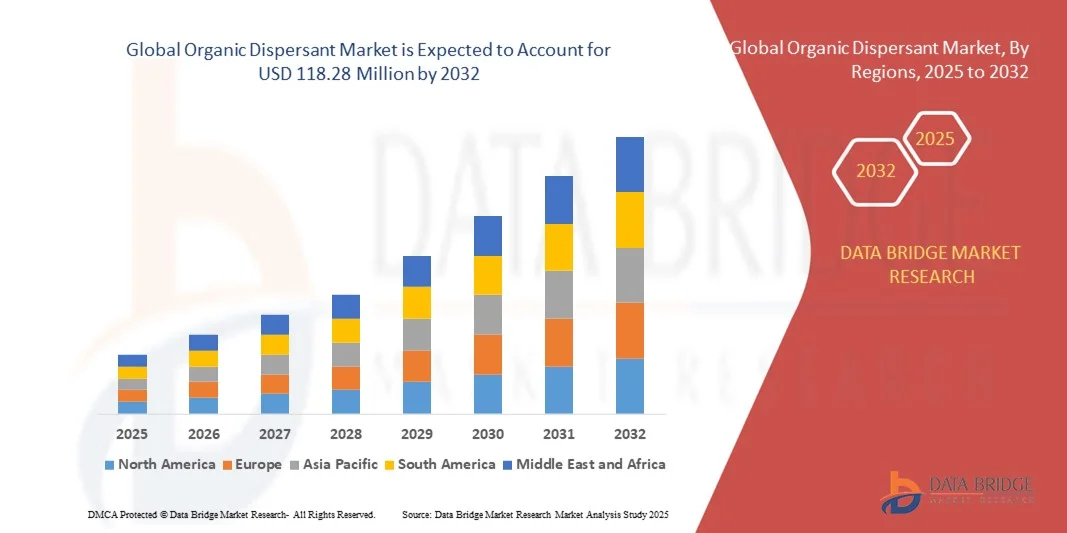
What is the Global Organic Dispersant Market Size and Growth Rate?
- The global organic dispersant market size was valued at USD 75.91 million in 2024 and is expected to reach USD 118.28 million by 2032, at a CAGR of 5.70% during the forecast period
- Increasing number of infrastructure activities across the globe, increasing use of organic pigment in the packaging industry for increasing the aesthetics of packaging, growing demand for products from both existing and emerging end-user industries, rising demand of the product which will improve stability and behaviour are some of the major as well as important factors which will such asly to accelerate the growth of the organic dispersant market
What are the Major Takeaways of Organic Dispersant Market?
- Growth of the various end use industries along with infrastructure modernization which will further contribute by generating immense opportunities that will led to the growth of the organic dispersant market in the above mentioned projected timeframe
- Volatility in the prices of raw material along with lack of industry innovations in developing economies which will likely to act as market restraints factor for the growth of the organic dispersant in the above mentioned projected timeframe
- Asia-Pacific dominated the organic dispersant market with the largest revenue share of 42.01% in 2024, driven by rapid industrialization, increasing urbanization, and strong demand from end-use industries such as construction, automotive, and oil & gas
- The North America organic dispersant market is expected to grow at the fastest CAGR of 8.23% during 2025–2032, driven by technological advancements, increased awareness of high-performance dispersants, and strong demand from end-use industries such as oil & gas, automotive, and coatings
- The Polymer segment dominated the market with the largest revenue share of 45.6% in 2024, owing to its excellent dispersing efficiency, thermal stability, and compatibility with a wide range of industrial formulations
Report Scope and Organic Dispersant Market Segmentation
|
Attributes |
Organic Dispersant Key Market Insights |
|
Segments Covered |
|
|
Countries Covered |
North America
Europe
Asia-Pacific
Middle East and Africa
South America
|
|
Key Market Players |
|
|
Market Opportunities |
|
|
Value Added Data Infosets |
In addition to the insights on market scenarios such as market value, growth rate, segmentation, geographical coverage, and major players, the market reports curated by the Data Bridge Market Research also include in-depth expert analysis, pricing analysis, brand share analysis, consumer survey, demography analysis, supply chain analysis, value chain analysis, raw material/consumables overview, vendor selection criteria, PESTLE Analysis, Porter Analysis, and regulatory framework. |
What is the Key Trend in the Organic Dispersant Market?
Rising Demand for Sustainable and High-Performance Additives
- A major and accelerating trend in the global Organic Dispersant market is the growing adoption of environmentally friendly and high-performance dispersants in industrial and lubricant applications. Manufacturers are focusing on bio-based or low-VOC (volatile organic compounds) formulations that reduce environmental impact while maintaining superior dispersing efficiency
- For instance, leading lubricant producers are incorporating phosphate-free and polymer-based organic dispersants in engine oils to improve sludge control and deposit prevention, offering enhanced engine performance and longer service intervals. Similarly, specialty chemical companies are developing dispersants optimized for fuel, coatings, and agrochemical formulations, aligning with stricter environmental regulations
- Advanced molecular engineering of organic dispersants enables improved solubility, thermal stability, and compatibility with a wide range of base oils and solvents, enhancing product reliability and performance in harsh operating conditions. This trend allows formulators to achieve better product consistency and longer shelf life
- The integration of sustainable raw materials with high-efficiency chemical structures supports the development of multifunctional dispersants capable of reducing friction, controlling deposits, and maintaining system cleanliness, particularly in automotive and industrial lubrication applications
- Companies such as BASF, Lubrizol, and Clariant are actively investing in eco-friendly, high-performance dispersants, reflecting the industry shift toward sustainability while meeting growing industrial performance requirements
- The demand for organic dispersants that combine efficiency with environmental compliance is rapidly increasing across automotive, industrial, and specialty chemical sectors, driven by regulatory pressures, rising consumer awareness, and the need for reliable performance in complex formulations
What are the Key Drivers of Organic Dispersant Market?
- The increasing demand for high-performance lubricants, fuels, and industrial fluids is a major driver for the growth of the Organic Dispersant market. The rising need for engine cleanliness, deposit control, and longer maintenance intervals in automotive and industrial equipment is fueling adoption
- For instance, in 2024, Lubrizol Corporation launched next-generation organic dispersants for engine oils, designed to reduce sludge formation and improve oxidation stability, demonstrating how technological innovation is driving market expansion
- Growing environmental regulations and government initiatives to reduce emissions are compelling manufacturers to adopt eco-friendly and biodegradable dispersants, boosting market growth
- Increasing industrialization, automotive production, and demand for high-performance fuels are further driving the requirement for specialized dispersants that ensure equipment efficiency, longevity, and operational reliability
- The versatility of organic dispersants in applications such as lubricants, fuel additives, paints, and agrochemicals, along with their role in enhancing performance and reducing environmental impact, is a critical factor supporting widespread adoption
- In addition, the trend towards sustainable product formulations and demand for premium chemical solutions in emerging markets is expected to further propel the organic dispersant market in the forecast period
Which Factor is Challenging the Growth of the Organic Dispersant Market?
- Raw material volatility and environmental compliance challenges pose a significant constraint on the market. Fluctuating costs of feedstocks such as petrochemicals and bio-based oils can impact product pricing and profit margins
- For instance, rising crude oil prices in 2024 led to higher production costs for petroleum-based dispersants, prompting manufacturers to explore alternative raw materials
- Strict regulatory frameworks regarding VOC limits, biodegradability, and toxicity require continuous R&D investments to ensure compliance, increasing development costs for organic dispersant producers
- Furthermore, competition from inorganic and conventional dispersants that are often cheaper can restrain market penetration, especially in price-sensitive industrial segments
- Overcoming these challenges through innovation in sustainable raw materials, cost optimization, and regulatory-compliant formulations is essential for the continued growth and widespread adoption of organic dispersants across global markets
How is the Organic Dispersant Market Segmented?
The market is segmented on the basis of type, product, end-use, and application.
- By Type
On the basis of type, the organic dispersant market is segmented into Oligomer, Polymer, and Polyelectrolyte. The Polymer segment dominated the market with the largest revenue share of 45.6% in 2024, owing to its excellent dispersing efficiency, thermal stability, and compatibility with a wide range of industrial formulations. Polymers are widely used in lubricants, fuels, paints, and agrochemical formulations due to their ability to prevent deposits, reduce sludge formation, and improve product performance under high-temperature conditions.
The Polyelectrolyte segment is anticipated to witness the fastest CAGR of 22.4% from 2025 to 2032, driven by increasing adoption in water treatment, oilfield, and specialty chemical applications. Polyelectrolytes are favored for their strong charge density, high solubility, and superior interaction with suspended particles, making them highly effective in dispersing, flocculation, and stabilization processes. The ongoing demand for eco-friendly, high-performance dispersants further fuels the growth of this segment.
- By Product
On the basis of product, the organic dispersant market is segmented into Azo Pigments, Phthalocyanine Pigments, HPPs, and Others. The Azo Pigments segment held the largest market revenue share of 42.8% in 2024, supported by its widespread application in coatings, inks, and plastics due to excellent color strength, brightness, and versatility. HPPs and phthalocyanine pigments are also gaining traction in high-performance industrial coatings and specialty applications due to their thermal and chemical stability.
The HPPs segment is expected to register the fastest CAGR of 20.9% from 2025 to 2032, driven by increasing demand for high-performance pigments that provide superior durability, resistance to UV degradation, and enhanced aesthetic appeal in automotive, construction, and decorative coatings. Growing end-user focus on long-lasting, premium-quality products is expected to boost the adoption of these specialized dispersants globally.
- By End Use
On the basis of end-use, the organic dispersant market is segmented into Construction, Pulp and Paper, Oil and Gas, Agricultural, Detergents, Pharmaceutical, and Other End-User Industries. The Oil and Gas segment dominated the market with the largest revenue share of 38.7% in 2024, driven by the rising demand for high-performance fuel and lubricant additives to improve engine efficiency and reduce deposits.
The Agricultural segment is projected to witness the fastest CAGR of 23.1% from 2025 to 2032, owing to increased adoption of dispersants in fertilizers, herbicides, and pesticide formulations to ensure uniform distribution, stability, and effectiveness of agrochemical products. Rapid industrialization, rising energy consumption, and a growing focus on enhanced product performance across industries are further driving the use of organic dispersants in multiple end-use sectors.
- By Application
On the basis of application, the organic dispersant market is segmented into Decorative, Industrial, Can and Coil Coatings, Industrial Maintenance, Furniture and Flooring, Marine Coatings, Automotive OEM, and Printing and Packaging. The Decorative segment accounted for the largest market revenue share of 40.3% in 2024, driven by the booming construction and interior design industries and increasing demand for high-quality paints and coatings with superior dispersion and color stability.
The Automotive OEM segment is expected to register the fastest CAGR of 21.5% from 2025 to 2032, attributed to the growing production of automobiles, rising quality standards for coatings, and the need for corrosion-resistant and long-lasting finishes. Growing emphasis on sustainable coatings, enhanced durability, and improved aesthetic appeal is expected to continue driving adoption across both industrial and decorative applications.
Which Region Holds the Largest Share of the Organic Dispersant Market?
- Asia-Pacific dominated the organic dispersant market with the largest revenue share of 42.01% in 2024, driven by rapid industrialization, increasing urbanization, and strong demand from end-use industries such as construction, automotive, and oil & gas
- Consumers and industrial users in the region value high-performance dispersants for improved efficiency, product stability, and enhanced application performance in paints, coatings, lubricants, and agrochemical formulations
- This widespread adoption is further supported by the presence of major chemical manufacturing hubs in China, India, and Japan, availability of cost-effective production, and government initiatives promoting industrial growth and smart manufacturing, making Asia-Pacific the key revenue contributor in the global market
China Organic Dispersant Market Insight
The China organic dispersant market captured the largest revenue share in Asia-Pacific in 2024, driven by the country’s expanding manufacturing base, strong demand in automotive, construction, and industrial coatings, and increasing adoption of high-performance dispersants in specialty applications. Rising urbanization, a growing middle class, and supportive government policies for chemical production further strengthen market growth. In addition, the availability of affordable, locally manufactured dispersant solutions is helping companies penetrate wider industrial and decorative applications.
Japan Organic Dispersant Market Insight
The Japan organic dispersant market is witnessing significant momentum due to the country’s high-tech manufacturing culture, rising industrial automation, and demand for high-quality, efficient dispersants in paints, coatings, and lubricant applications. Japan’s emphasis on eco-friendly and high-performance chemical solutions drives adoption in industrial, automotive, and specialty coatings sectors. Furthermore, the integration of advanced formulations for long-lasting durability and performance supports the market’s steady growth.
Which Region is the Fastest Growing Region in the Organic Dispersant Market?
The North America organic dispersant market is expected to grow at the fastest CAGR of 8.23% during 2025–2032, driven by technological advancements, increased awareness of high-performance dispersants, and strong demand from end-use industries such as oil & gas, automotive, and coatings. The U.S. and Canada are witnessing growing adoption of advanced chemical formulations in industrial and construction applications, supported by rising infrastructure investments and regulatory focus on sustainable and efficient chemical products.
U.S. Organic Dispersant Market Insight
The U.S. organic dispersant market captured the largest revenue share of 81% in North America in 2024, fueled by the adoption of high-performance dispersants in paints, coatings, lubricants, and specialty chemical applications. Increasing demand for eco-friendly and efficient dispersant solutions, along with robust industrial growth and innovation in chemical manufacturing, is propelling market expansion. In addition, the U.S. focus on R&D and advanced formulation technologies ensures steady demand for premium-quality dispersants across multiple industrial and decorative applications.
Which are the Top Companies in Organic Dispersant Market?
The organic dispersant industry is primarily led by well-established companies, including:
- Clariant (Switzerland)
- BASF SE (Germany)
- Evonik Industries AG (Germany)
- The Lubrizol Corporation (U.S.)
- The Dow Chemical Company (U.S.)
- Harmony Additive Pvt. Ltd. (India)
- Arkema (France)
- Ashland (U.S.)
- ALTANA AG (Germany)
- Cera Chem Pvt Ltd (India)
- DIC Corporation (Japan)
- Ferro Corporation (U.S.)
- DCL Corporation (U.S.)
- TOYOCOLOR CO., LTD. (Japan)
- Heubach GmbH (Germany)
- Trust Chem Europe BV (Netherlands)
- PALMER HOLLAND (U.S.)
- BlenTex Industries, LLC (U.S.)
- Ques Industries, Inc. (U.S.)
What are the Recent Developments in Global Organic Dispersant Market?
- In October 2021, Clariant AG launched a new dispersing agent product line, Licosperse, offering an eco-friendlier pigment preparation for polish applications, which can be easily incorporated into base media to ensure consistent color production, reinforcing Clariant’s commitment to sustainable and high-performance solutions
- In September 2021, BASF and Sanyo Chemical signed a Memorandum of Understanding for a strategic collaboration on polyurethane dispersions (PUDs) development, aiming to jointly create and produce innovative products with strong sustainability contributions, highlighting the focus on advancing eco-conscious chemical technologies
- In July 2021, Altana introduced two new wetting and dispersing additives in the DisperByk range, namely, DisperBYK-2018 & 2019, which provide high viscosity reduction, Newtonian flow behavior, outstanding pigment stability, and excellent optical properties, strengthening Altana’s portfolio of high-performance pigment solutions
- In May 2021, Clariant AG launched the Hostatint AU dispersing agent product line, an aqueous pigment dispersing agent that expands the color options for exterior and interior architectural coatings, enabling manufacturers in North and South America to offer the most extensive color palette possible, enhancing Clariant’s market reach

- Interactive Data Analysis Dashboard
- Company Analysis Dashboard for high growth potential opportunities
- Research Analyst Access for customization & queries
- Competitor Analysis with Interactive dashboard
- Latest News, Updates & Trend analysis
- Harness the Power of Benchmark Analysis for Comprehensive Competitor Tracking
Global Organic Dispersant Market, Supply Chain Analysis and Ecosystem Framework
To support market growth and help clients navigate the impact of geopolitical shifts, DBMR has integrated in-depth supply chain analysis into its Global Organic Dispersant Market research reports. This addition empowers clients to respond effectively to global changes affecting their industries. The supply chain analysis section includes detailed insights such as Global Organic Dispersant Market consumption and production by country, price trend analysis, the impact of tariffs and geopolitical developments, and import and export trends by country and HSN code. It also highlights major suppliers with data on production capacity and company profiles, as well as key importers and exporters. In addition to research, DBMR offers specialized supply chain consulting services backed by over a decade of experience, providing solutions like supplier discovery, supplier risk assessment, price trend analysis, impact evaluation of inflation and trade route changes, and comprehensive market trend analysis.
Data collection and base year analysis are done using data collection modules with large sample sizes. The stage includes obtaining market information or related data through various sources and strategies. It includes examining and planning all the data acquired from the past in advance. It likewise envelops the examination of information inconsistencies seen across different information sources. The market data is analysed and estimated using market statistical and coherent models. Also, market share analysis and key trend analysis are the major success factors in the market report. To know more, please request an analyst call or drop down your inquiry.
The key research methodology used by DBMR research team is data triangulation which involves data mining, analysis of the impact of data variables on the market and primary (industry expert) validation. Data models include Vendor Positioning Grid, Market Time Line Analysis, Market Overview and Guide, Company Positioning Grid, Patent Analysis, Pricing Analysis, Company Market Share Analysis, Standards of Measurement, Global versus Regional and Vendor Share Analysis. To know more about the research methodology, drop in an inquiry to speak to our industry experts.
Data Bridge Market Research is a leader in advanced formative research. We take pride in servicing our existing and new customers with data and analysis that match and suits their goal. The report can be customized to include price trend analysis of target brands understanding the market for additional countries (ask for the list of countries), clinical trial results data, literature review, refurbished market and product base analysis. Market analysis of target competitors can be analyzed from technology-based analysis to market portfolio strategies. We can add as many competitors that you require data about in the format and data style you are looking for. Our team of analysts can also provide you data in crude raw excel files pivot tables (Fact book) or can assist you in creating presentations from the data sets available in the report.













