


What is the Pediatric Medical Device Market Size and Growth Rate?
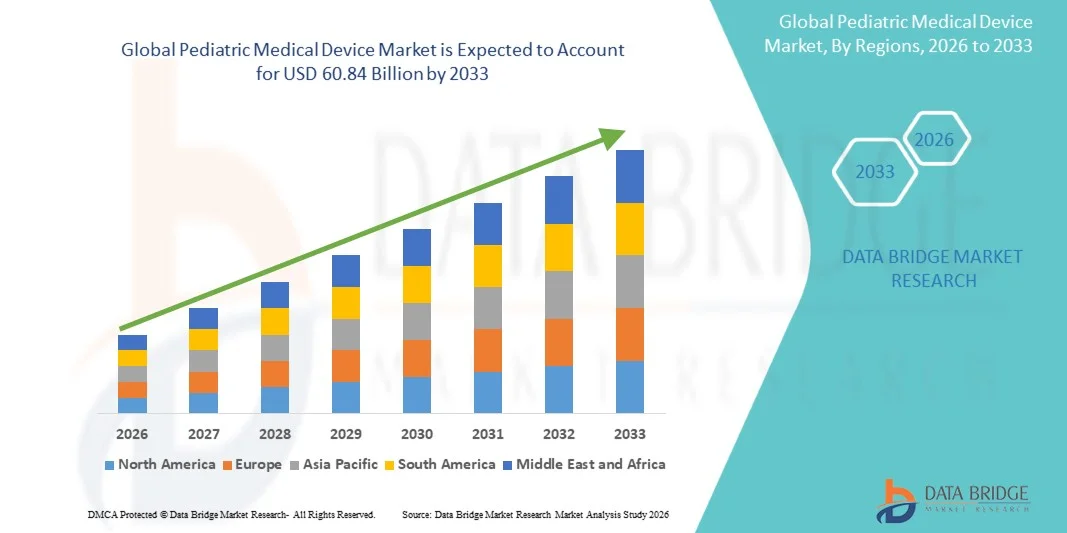
- As per Data Bridge Market Research Analysis the global pediatric medical device market size was valued at USD 33.74 billion in 2025 and is expected to reach USD 60.84 billion by 2033, at a CAGR of 7.65% during the forecast period
- The Pediatric Medical Device market growth is largely driven by continuous technological advancements and increasing adoption of innovative medical devices designed specifically for pediatric care, supporting improved diagnosis, monitoring, and treatment outcomes across neonatal, infant, and pediatric populations. Growing digitalization in healthcare, including the integration of connected and smart medical devices, is enhancing clinical efficiency and enabling more precise, age-appropriate care in hospitals and specialized pediatric clinics
- Rising demand for safe, user-friendly, and minimally invasive pediatric medical devices is further accelerating market growth, as healthcare providers and parents prioritize patient safety, comfort, and ease of use. Increasing awareness of early disease detection, higher incidence of pediatric chronic and congenital conditions, and expanding investments in pediatric healthcare infrastructure are establishing advanced pediatric medical devices as essential components of modern child healthcare systems, thereby significantly boosting the overall market expansion
Market Size & Forecast
- Global Market Value (2025): USD 33.74 billion
- Expected Market Value (2033): USD 60.84 billion
- Forecast CAGR (2026–2033): 7.65%
What are the Major Takeaways of Pediatric Medical Device Market?
- Smart pediatric medical devices, offering specialized diagnostic, monitoring, and therapeutic functionalities for neonates, infants, and children, are increasingly vital components of modern healthcare systems due to their enhanced safety, accuracy, and patient-specific design
- The escalating demand for pediatric medical devices is primarily fueled by rising awareness of early disease detection, increasing prevalence of pediatric chronic and congenital conditions, and a growing emphasis on minimally invasive and connected healthcare solutions
- North America dominated the pediatric medical device market with the largest revenue share of 38.7% in 2025, supported by advanced healthcare infrastructure, high adoption of pediatric-specific medical devices, and a strong presence of key industry players. The U.S. experienced substantial growth in pediatric medical device deployment across hospitals, specialty clinics, and homecare settings, driven by innovations in neonatal monitoring systems, pediatric imaging, and smart connected devices
- Asia-Pacific is expected to be the fastest-growing region in the pediatric medical device market during the forecast period, with a projected CAGR of 8.1%, driven by increasing urbanization, rising disposable incomes, expansion of pediatric healthcare facilities, and growing adoption of advanced diagnostic and monitoring devices in countries such as China, India, and Japan
- The cardiology devices segment dominated the largest market revenue share of 28.5% in 2025, driven by the rising prevalence of congenital heart defects, pediatric arrhythmias, and other cardiovascular disorders in children
Report Scope and Pediatric Medical Device Market Segmentation
|
Attributes |
Pediatric Medical Device Key Market Insights |
|
Segments Covered |
|
|
Countries Covered |
North America
Europe
Asia-Pacific
Middle East and Africa
South America
|
|
Key Market Players |
|
|
Market Opportunities |
|
|
Value Added Data Infosets |
In addition to the insights on market scenarios such as market value, growth rate, segmentation, geographical coverage, and major players, the market reports curated by the Data Bridge Market Research also include in-depth expert analysis, patient epidemiology, pipeline analysis, pricing analysis, and regulatory framework. |
What is the Key Trend in the Pediatric Medical Device Market?
Rising Adoption of Minimally Invasive and Point-of-Care Pediatric Devices
- A major and accelerating trend in the global pediatric medical device market is the increasing adoption of minimally invasive devices and point-of-care diagnostic tools. These devices are helping clinicians provide faster, safer, and less invasive care, which is especially crucial in pediatric populations
- For instance, handheld ultrasound systems designed specifically for neonates and children are being increasingly used in hospitals and clinics across Europe and North America to support bedside assessments, reducing the need for large imaging equipment
- Portable infusion pumps and wearable monitoring devices are gaining popularity in home-based pediatric care, enabling continuous monitoring of vital signs, glucose levels, and cardiac function without prolonged hospital stays
- Furthermore, advancements in 3D printing and customized pediatric implants, such as cranial plates or orthopedic supports, are allowing hospitals to provide patient-specific solutions, improving treatment outcomes and recovery times
- The trend also includes increased integration of remote patient monitoring technologies, where clinicians can track pediatric patients’ health data in real-time, enabling timely interventions and reducing hospital readmissions
- Overall, these trends are making pediatric healthcare more efficient, accessible, and tailored to the unique physiological needs of children
Pediatric Medical Device Market Dynamics
Driver
Rising Prevalence of Chronic Diseases and Increased Pediatric Healthcare Spending
- The global pediatric medical device market is strongly driven by the growing prevalence of chronic conditions in children, such as congenital heart disease, diabetes, respiratory disorders, and neurological diseases, which demand specialized monitoring and treatment devices
- For instance, in February 2023, Medtronic launched a pediatric continuous glucose monitoring system designed for children with type 1 diabetes, reflecting the increasing demand for child-specific chronic care solutions
- Increasing healthcare expenditure by governments and private institutions across North America, Europe, and Asia-Pacific is boosting the adoption of advanced pediatric devices. Countries like Germany and the U.S. are investing heavily in pediatric hospital infrastructure and specialized care units
- The rising focus on preventative healthcare and early diagnosis is encouraging parents and caregivers to adopt pediatric medical devices that allow continuous monitoring at home or in outpatient settings
- Furthermore, technological innovations, including smaller, user-friendly, and accurate monitoring devices, are driving higher acceptance among clinicians and caregivers. For instance, portable neonatal ventilators and compact cardiac monitors are now increasingly being used in smaller hospitals and clinics
- The increasing number of hospital births and improved neonatal care programs globally are also contributing to market growth, as hospitals require devices tailored to vulnerable infant populations
Restraint/Challenge
High Costs, Regulatory Complexity, and Safety Concerns”
- Despite strong market growth, the pediatric medical device sector faces challenges due to the high cost of devices
- Pediatric devices often require specialized design, testing, and safety validation, which increases production costs and limits affordability, especially in developing countries
- For instance, advanced MRI-compatible monitoring devices for neonates or pediatric-specific surgical instruments can cost several times more than standard devices, creating barriers for smaller hospitals or clinics
- Stringent regulatory requirements are another major challenge. Pediatric devices must undergo extensive clinical trials, safety testing, and country-specific regulatory approvals, which can delay product launches. For example, approvals from the U.S. FDA and European CE marking for pediatric devices often require additional pediatric studies, prolonging time-to-market
- Ensuring safety and reliability is critical, given the vulnerability of pediatric patients, and any device recalls or malfunctions can significantly impact market perception and adoption rates
- In addition, a shortage of trained healthcare professionals to operate complex pediatric devices in certain regions, particularly in emerging markets, can further limit device utilization
- Addressing these restraints requires cost-effective manufacturing, robust regulatory strategies, training programs for healthcare staff, and development of universally safe, user-friendly pediatric devices
How is the Pediatric Medical Device Market Segmented?
The market is segmented on the basis of product and end user.
• By Product
On the basis of product, the Global Pediatric Medical Device market is segmented into cardiology devices, in vitro diagnostic (IVD) devices, diagnostic imaging devices, telemedicine, anesthesia and respiratory care devices, neonatal ICU devices, monitoring devices, and others. The cardiology devices segment dominated the largest market revenue share of 28.5% in 2025, driven by the rising prevalence of congenital heart defects, pediatric arrhythmias, and other cardiovascular disorders in children. Hospitals and specialty pediatric clinics increasingly rely on advanced cardiac monitoring and interventional devices to manage complex conditions. Growing awareness of early diagnosis and preventive care fuels demand for pediatric pacemakers, stents, and echocardiography systems. Technological advancements such as miniaturization of devices and improved non-invasive monitoring enhance adoption. Integration with digital health platforms allows real-time patient monitoring. Strong reimbursement policies for pediatric cardiac care further boost market penetration. High demand in North America and Europe, combined with increasing public-private healthcare initiatives, strengthens market dominance. Continuous innovation in cardiac surgery devices supports procedural efficiency. Long-term outcomes in pediatric cardiac interventions further drive utilization. Multi-specialty hospitals prefer advanced cardiology devices for comprehensive pediatric care. Training programs and skilled workforce availability reinforce adoption. These factors collectively maintain dominance of cardiology devices in the global pediatric medical device market.
The neonatal ICU devices segment is expected to witness the fastest CAGR of 16.8% from 2026 to 2033, fueled by rising neonatal mortality awareness, premature births, and demand for advanced intensive care units for infants. Devices such as incubators, phototherapy units, and neonatal ventilators are critical for survival in NICUs. Increasing adoption in emerging markets with expanding healthcare infrastructure drives growth. Technological improvements such as smart incubators with AI monitoring and remote access features enhance care quality. Government and NGO initiatives targeting infant health further support market expansion. Hospitals and specialized pediatric centers prioritize investment in NICU devices. Integration with hospital monitoring systems allows real-time vital tracking. Rising demand for portable NICU solutions in rural areas contributes to market growth. Increasing training programs for neonatal care specialists facilitate adoption. Enhanced reliability, safety features, and compliance with international standards strengthen market acceptance. Collaborative partnerships with device manufacturers improve distribution channels. These factors collectively contribute to the rapid growth of neonatal ICU devices in the pediatric medical device market.
• By End User
On the basis of end user, the Global Pediatric Medical Device market is segmented into hospitals, pediatric clinics, ambulatory surgery centers, research and academic institutes, and others. The hospitals segment dominated the largest market revenue share of 52.7% in 2025, driven by high patient volumes, availability of advanced pediatric care infrastructure, and multi-specialty services. Hospitals provide comprehensive care across cardiology, neonatology, and intensive care, creating consistent demand for pediatric devices. Large tertiary hospitals adopt state-of-the-art diagnostic imaging, monitoring, and intervention equipment. Hospitals also benefit from strong reimbursement frameworks for pediatric treatments. High capital investment capabilities allow procurement of sophisticated devices. Integration with digital patient management systems improves operational efficiency. Hospitals frequently serve as referral centers for pediatric care. Continuous innovation in device technology supports procedural outcomes. Hospitals play a critical role in clinical trials and device evaluation. Partnerships with medical device manufacturers ensure timely equipment updates. These factors collectively reinforce the dominance of hospitals in pediatric device utilization.
The pediatric clinics segment is expected to witness the fastest CAGR of 14.9% from 2026 to 2033, driven by the growing number of outpatient pediatric specialty centers and increased focus on preventive care. Clinics are adopting devices for diagnostics, telemedicine, and monitoring to offer early intervention services. Rising parental awareness of routine screenings and pediatric wellness programs supports market expansion. Telemedicine adoption enables remote monitoring and virtual consultations. Clinics benefit from compact, cost-effective, and portable pediatric devices. Integration with electronic health records ensures seamless data management. Rising investments in pediatric specialty care by private entities fuel growth. Expansion in suburban and semi-urban areas enhances clinic adoption. Increased demand for point-of-care diagnostics and monitoring devices contributes to market growth. Partnerships with medical device providers improve access to advanced solutions. Emerging markets present untapped opportunities for pediatric clinic expansion. These factors collectively drive the rapid growth of pediatric clinics as a key end-user segment.
Which Region Holds the Largest Share of the Pediatric Medical Device Market?
- North America dominated the pediatric medical device market with the largest revenue share of 38.7% in 2025, supported by advanced healthcare infrastructure, high adoption of pediatric-specific medical devices, and a strong presence of key industry players
- The market growth is driven by increasing deployment of connected devices, smart home integration, and adoption of neonatal monitoring systems, pediatric imaging, and homecare solutions. Consumers and healthcare providers value convenience, advanced features, and seamless integration with other healthcare technologies
- High disposable incomes, a technologically inclined population, and robust healthcare initiatives further accelerate adoption across both residential and commercial settings
U.S. Pediatric Medical Device Market Insight
The U.S. pediatric medical device market captured the largest revenue share in 2025 within North America, fueled by rapid uptake of connected pediatric devices and the expanding trend of homecare and smart healthcare solutions. Hospitals and specialty clinics are increasingly adopting smart monitoring systems, pediatric imaging devices, and remote patient monitoring technologies. Consumers are prioritizing secure, user-friendly, and technologically advanced solutions for children’s healthcare. The integration of devices with platforms such as Alexa, Google Assistant, and Apple HomeKit further supports market expansion. Increasing awareness of early disease detection and homecare monitoring continues to drive demand for innovative pediatric devices.
Europe Pediatric Medical Device Market Insight
The Europe pediatric medical device market is projected to expand at a substantial CAGR throughout the forecast period, driven by stringent safety regulations, growing urbanization, and rising adoption of connected healthcare devices. Consumers value the convenience, energy efficiency, and enhanced security offered by advanced pediatric devices. The market is witnessing significant growth across residential, hospital, and multi-family healthcare applications, with smart devices increasingly incorporated into new installations and upgrades.
U.K. Pediatric Medical Device Market Insight
The U.K. pediatric medical device market is anticipated to grow at a noteworthy CAGR during the forecast period, supported by the increasing trend of home healthcare, demand for convenient monitoring, and concerns regarding safety. Rising adoption of keyless entry solutions, connected devices, and home monitoring systems in residential and clinical settings is driving market expansion. The country’s robust retail and e-commerce infrastructure also aids in widespread distribution of pediatric devices.
Germany Pediatric Medical Device Market Insight
The Germany pediatric medical device market is expected to expand at a considerable CAGR during the forecast period, fueled by awareness of digital healthcare, demand for eco-conscious and technologically advanced devices, and integration with hospital and homecare systems. The country’s emphasis on innovation, security, and sustainability is promoting adoption, particularly in residential and clinical settings.
Asia-Pacific Pediatric Medical Device Market Insight
The Asia-Pacific pediatric medical device market is poised to grow at the fastest CAGR of 8.1% during the forecast period, driven by increasing urbanization, rising disposable incomes, expansion of pediatric hospitals and clinics, and growing adoption of advanced diagnostic and monitoring devices in countries such as China, India, and Japan. Government initiatives promoting digital healthcare and smart healthcare solutions further accelerate adoption. Affordability and increased accessibility of advanced pediatric devices across urban and semi-urban regions are expanding the market.
Japan Pediatric Medical Device Market Insight
The Japan pediatric medical device market is gaining momentum due to high-tech culture, rapid urbanization, and rising demand for convenience and secure healthcare solutions. Adoption of connected pediatric devices in hospitals and homecare, integration with smart home systems, and increasing aging population are fueling growth. Healthcare providers and consumers value devices that are user-friendly, safe, and compatible with IoT-enabled monitoring platforms.
China Pediatric Medical Device Market Insight
The China pediatric medical device market accounted for the largest revenue share in Asia-Pacific in 2025, supported by rapid expansion of pediatric healthcare infrastructure, increasing prevalence of pediatric diseases, and high adoption of AI-enabled and smart diagnostic devices in hospitals and clinics. Government investment, urbanization, and strong domestic manufacturing capabilities are driving market leadership. Smart and connected pediatric devices are increasingly deployed across residential, hospital, and rental healthcare settings.
India Pediatric Medical Device Market Insight
India is expected to be the fastest-growing country in the Asia-Pacific Pediatric Medical Device market, with a projected CAGR of 8.6% during the forecast period. Growth is driven by rising healthcare expenditure, expansion of pediatric clinics and hospitals, improving access to advanced monitoring and diagnostic technologies, and government initiatives to strengthen pediatric healthcare infrastructure. Growing awareness of early disease diagnosis and cost-effective smart healthcare solutions is further accelerating market adoption.
Which are the Top Companies in Pediatric Medical Device Market?
The Pediatric Medical Device industry is primarily led by well-established companies, including:
- Medtronic (U.S.)
- GE Healthcare (U.S.)
- Siemens Healthineers (Germany)
- Philips Healthcare (Netherlands)
- Fresenius Medical Care (Germany)
- Becton Dickinson (U.S.)
- Terumo Corporation (Japan)
- Hill-Rom Holdings (U.S.)
- Humana (U.S.)
- Drägerwerk (Germany)
- Edwards Lifesciences (U.S.)
- Mindray (China)
- CareFusion (U.S.)
- MicroPort (China)
- Nihon Kohden (Japan)
- Canon Medical Systems (Japan)
- Abbott Laboratories (U.S.)
- Invacare Corporation (U.S.)
- Tyco Healthcare (U.S.)
- ResMed (U.S.)
What are Latest Developments in Pediatric Medical Device Market?
- In June 2025, SoundHealth, a pediatric wearable tech company, received FDA approval for the SONU Band, the first AI‑enabled wearable device for moderate‑to‑severe nasal congestion in children aged 12 and older, designed to improve respiratory assessment and patient comfort in pediatric clinical care
- In April 2025, Children’s National Hospital signed a collaboration agreement with Compremium AG to co‑develop non‑invasive pediatric diagnostic devices, focusing on advanced technologies to improve early detection and monitoring of pediatric conditions, strengthening innovation pipelines for pediatric healthcare
- In April 2025, AngelEye Health unveiled an acceleration of its NICU technology platform integrating artificial intelligence (AI) and computer vision into neonatal intensive care unit (NICU) and pediatric unit settings, aimed at enhancing monitoring and outcomes for critically ill infants
- In March 2025, OrthoPediatrics Corp., a company focused on pediatric orthopedic solutions, entered a strategic partnership with the Crossroads Pediatric Device Consortium (CPDC) to support the development and commercialization of innovative pediatric medical devices that address unmet clinical needs in children’s orthopedics

- Interactive Data Analysis Dashboard
- Company Analysis Dashboard for high growth potential opportunities
- Research Analyst Access for customization & queries
- Competitor Analysis with Interactive dashboard
- Latest News, Updates & Trend analysis
- Harness the Power of Benchmark Analysis for Comprehensive Competitor Tracking
Data collection and base year analysis are done using data collection modules with large sample sizes. The stage includes obtaining market information or related data through various sources and strategies. It includes examining and planning all the data acquired from the past in advance. It likewise envelops the examination of information inconsistencies seen across different information sources. The market data is analysed and estimated using market statistical and coherent models. Also, market share analysis and key trend analysis are the major success factors in the market report. To know more, please request an analyst call or drop down your inquiry.
The key research methodology used by DBMR research team is data triangulation which involves data mining, analysis of the impact of data variables on the market and primary (industry expert) validation. Data models include Vendor Positioning Grid, Market Time Line Analysis, Market Overview and Guide, Company Positioning Grid, Patent Analysis, Pricing Analysis, Company Market Share Analysis, Standards of Measurement, Global versus Regional and Vendor Share Analysis. To know more about the research methodology, drop in an inquiry to speak to our industry experts.
Data Bridge Market Research is a leader in advanced formative research. We take pride in servicing our existing and new customers with data and analysis that match and suits their goal. The report can be customized to include price trend analysis of target brands understanding the market for additional countries (ask for the list of countries), clinical trial results data, literature review, refurbished market and product base analysis. Market analysis of target competitors can be analyzed from technology-based analysis to market portfolio strategies. We can add as many competitors that you require data about in the format and data style you are looking for. Our team of analysts can also provide you data in crude raw excel files pivot tables (Fact book) or can assist you in creating presentations from the data sets available in the report.













