


Global Soft Drink Packaging Market Size
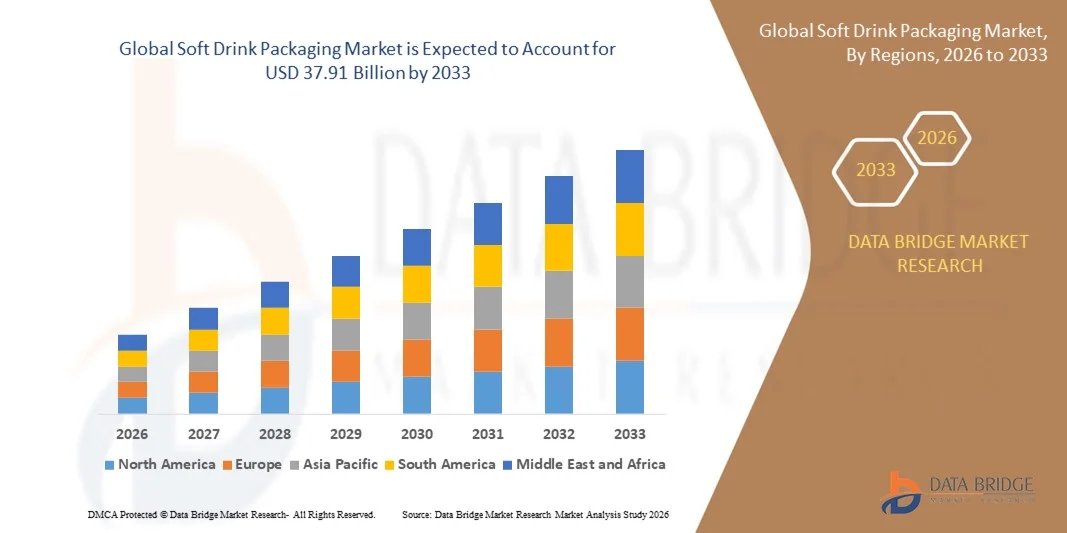
- The global Soft Drink Packaging Market size was valued at USD 26.86 billion in 2025 and is expected to reach USD 37.91 billion by 2033, at a CAGR of 4.40% during the forecast period.
- The market growth is largely driven by increasing demand for sustainable, innovative, and convenient packaging solutions, coupled with advancements in packaging technology and automation.
- Furthermore, rising consumer preference for environmentally friendly materials, along with the expansion of the global beverage industry and retail distribution channels, is encouraging manufacturers to adopt modern packaging solutions. These factors are collectively propelling the market, thereby significantly boosting industry growth.
Global Soft Drink Packaging Market Analysis
- Soft drink packaging, encompassing bottles, cans, cartons, and other containers, is increasingly essential for preserving product quality, extending shelf life, and enhancing brand appeal in both retail and commercial markets due to innovations in materials, design, and sustainability.
- The rising demand for advanced soft drink packaging is primarily fueled by growing consumer preference for convenient, safe, and visually appealing packaging, alongside increasing production automation and adoption of eco-friendly materials.
- Asia-Pacific dominated the Global Soft Drink Packaging Market with the largest revenue share of 32.5% in 2025, driven by high consumer spending, mature retail infrastructure, and strong presence of leading beverage and packaging companies, with the U.S. witnessing significant adoption of premium and sustainable packaging formats, propelled by innovations in lightweight, recyclable, and smart packaging solutions.
- North America is expected to be the fastest-growing region in the Global Soft Drink Packaging Market during the forecast period due to rapid urbanization, expanding beverage consumption, and rising disposable incomes across countries like China and India.
- The plastic segment dominated the market with the largest revenue share of 46.5% in 2025, driven by its lightweight, cost-effectiveness, and versatility across beverage types.
Report Scope and Global Soft Drink Packaging Market Segmentation
|
Attributes |
Soft Drink Packaging Key Market Insights |
|
Segments Covered |
|
|
Countries Covered |
North America
Europe
Asia-Pacific
Middle East and Africa
South America
|
|
Key Market Players |
• Tetra Pak (Sweden) |
|
Market Opportunities |
|
|
Value Added Data Infosets |
In addition to the insights on market scenarios such as market value, growth rate, segmentation, geographical coverage, and major players, the market reports curated by the Data Bridge Market Research also include import export analysis, production capacity overview, production consumption analysis, price trend analysis, climate change scenario, supply chain analysis, value chain analysis, raw material/consumables overview, vendor selection criteria, PESTLE Analysis, Porter Analysis, and regulatory framework. |
Global Soft Drink Packaging Market Trends
Enhanced Convenience Through Smart and Sustainable Packaging
- A significant and accelerating trend in the global Soft Drink Packaging Market is the growing adoption of smart, sustainable, and intelligent packaging solutions that improve consumer convenience, product safety, and brand engagement.
- For instance, Coca-Cola’s “PlantBottle” packaging combines recyclable PET materials with a sleek design, offering eco-friendly convenience to consumers while maintaining product integrity. Similarly, Tetra Pak’s digitally-enabled cartons provide easy-to-open and resealable solutions for on-the-go consumption.
- Smart packaging innovations enable features such as freshness indicators, QR codes for product information, and interactive designs that engage consumers digitally. For example, some Ball Corporation aluminum cans feature NFC-enabled labels that allow users to access promotions, verify authenticity, or track recycling instructions.
- The integration of intelligent packaging with digital platforms facilitates centralized consumer engagement, allowing brands to connect directly with customers, share product information, and encourage sustainable behaviors through a single interface.
- This trend towards more convenient, interactive, and sustainable packaging is fundamentally reshaping consumer expectations in the beverage industry. Consequently, companies such as Amcor and Crown Holdings are developing recyclable, lightweight, and digitally-enabled packaging solutions to meet evolving market demands.
- The demand for packaging solutions that combine convenience, sustainability, and digital interactivity is growing rapidly across both developed and emerging markets, as consumers increasingly prioritize eco-friendly, user-friendly, and engaging beverage experiences.
Global Soft Drink Packaging Market Dynamics
Driver
Growing Need Due to Rising Consumer Demand and Sustainability Trends
- The increasing consumer focus on convenience, product safety, and environmental sustainability, coupled with the expanding global beverage industry, is a significant driver for the heightened demand for advanced soft drink packaging solutions.
- For instance, in 2025, Coca-Cola introduced new recyclable and lightweight PET bottles in several markets to reduce carbon footprint while enhancing user convenience. Such initiatives by key players are expected to drive market growth during the forecast period.
- As consumers become more conscious of packaging waste and product quality, innovative solutions such as resealable cartons, biodegradable bottles, and smart freshness indicators provide compelling advantages over traditional packaging formats.
- Furthermore, the growing popularity of on-the-go consumption and the expansion of modern retail and e-commerce channels are making convenient and durable packaging an essential component of the beverage supply chain.
- Features such as easy-to-open designs, portion-controlled containers, and recyclable materials are key factors propelling the adoption of advanced packaging in both developed and emerging markets. The trend towards premiumization and branded packaging further contributes to market growth.
Restraint/Challenge
Concerns Regarding Sustainability Costs and Regulatory Compliance
- The higher costs associated with sustainable and technologically advanced packaging solutions pose a significant challenge to broader market adoption. Eco-friendly materials, lightweight bottles, and smart packaging often come with increased production and material costs, which can affect pricing and margins.
- For instance, small and medium-sized beverage producers may be hesitant to adopt premium packaging solutions due to the higher capital expenditure compared to conventional packaging materials such as standard PET or glass bottles.
- Addressing these cost concerns through innovations in material efficiency, scalable manufacturing processes, and government incentives for sustainable practices is crucial for encouraging adoption. Companies such as Tetra Pak and Amcor emphasize cost-effective sustainable packaging solutions while meeting regulatory requirements.
- Additionally, compliance with varying international packaging and environmental regulations, including recycling mandates and material standards, can complicate operations for global beverage companies.
- Overcoming these challenges through cost optimization, consumer education on the benefits of sustainable packaging, and development of more affordable eco-friendly solutions will be vital for sustained growth in the soft drink packaging market.
Global Soft Drink Packaging Market Scope
The soft drink packaging market is segmented on the basis of material, packaging type and application.
- By Material
On the basis of material, the Global Soft Drink Packaging Market is segmented into glass, plastic, metal, and paperboard. The plastic segment dominated the market with the largest revenue share of 46.5% in 2025, driven by its lightweight, cost-effectiveness, and versatility across beverage types. Plastic packaging offers durability, ease of transport, and compatibility with various sealing and labeling techniques, making it highly favored by beverage manufacturers. Additionally, innovations in recyclable and biodegradable plastics are further enhancing consumer acceptance and regulatory compliance.
The metal segment is expected to witness the fastest CAGR of 18.9% from 2026 to 2033, fueled by the rising demand for aluminum cans in carbonated soft drinks and energy beverages. Metal packaging is valued for its recyclability, premium look, and ability to preserve taste and carbonation, positioning it as a preferred choice for brands targeting eco-conscious and convenience-oriented consumers.
- By Packaging Type
On the basis of packaging type, the Global Soft Drink Packaging Market is segmented into boxes, bottles, cartons, and cans. The bottle segment held the largest market revenue share of 44.2% in 2025, primarily driven by its convenience, portability, and strong consumer preference for on-the-go consumption. Bottles, particularly plastic and glass varieties, allow for innovative shapes, labeling, and resealable designs, enhancing brand visibility and user experience.
The carton segment is anticipated to witness the fastest CAGR of 19.3% from 2026 to 2033, propelled by the increasing adoption of aseptic cartons for juices, functional drinks, and dairy-based soft beverages. Cartons provide extended shelf life, lightweight logistics advantages, and environmentally sustainable options, aligning with both manufacturer cost-efficiency and consumer demand for eco-friendly packaging solutions.
- By Application
On the basis of application, the Global Soft Drink Packaging Market is segmented into carbonated soft drinks, functional drinks, juices, and others. The carbonated soft drinks segment dominated the market with a revenue share of 42.8% in 2025, driven by the enduring global popularity of sodas and fizzy beverages. Packaging solutions for carbonated drinks require high durability and airtight sealing, making bottles and cans particularly effective in maintaining carbonation and freshness.
The functional drinks segment is expected to witness the fastest CAGR of 20.5% from 2026 to 2033, fueled by the rising consumer focus on health, wellness, and fortified beverages. Packaging for functional drinks emphasizes convenience, portion control, and eco-friendly materials, with innovative labeling and interactive designs increasingly employed to educate and engage health-conscious consumers.
Global Soft Drink Packaging Market Regional Analysis
- Asia-Pacific dominated the Global Soft Drink Packaging Market with the largest revenue share of 32.5% in 2025, driven by the well-established beverage industry, high consumer purchasing power, and a strong focus on product quality and sustainability.
- Consumers in the region increasingly demand convenient, durable, and environmentally friendly packaging solutions, such as resealable bottles, aluminum cans, and recyclable cartons, to suit their on-the-go lifestyles and eco-conscious preferences.
- This widespread adoption is further supported by advanced manufacturing infrastructure, robust retail and e-commerce channels, and the presence of leading beverage and packaging companies, establishing North America as a key market for innovative and premium soft drink packaging solutions across both carbonated and functional beverages.
U.S. Soft Drink Packaging Market Insight
The U.S. soft drink packaging market captured the largest revenue share of 81% in 2025 within North America, driven by a mature beverage industry, high consumer demand for convenience, and strong adoption of sustainable packaging solutions. Consumers increasingly prefer resealable bottles, aluminum cans, and eco-friendly cartons that maintain freshness while supporting on-the-go lifestyles. The robust retail infrastructure, e-commerce expansion, and the presence of leading beverage and packaging companies further propel market growth. Moreover, innovations in smart packaging, lightweight materials, and recycling initiatives are contributing to increased adoption across carbonated soft drinks, functional beverages, and juices.
Europe Soft Drink Packaging Market Insight
The Europe soft drink packaging market is projected to expand at a substantial CAGR during the forecast period, primarily fueled by stringent environmental regulations, rising consumer awareness of sustainability, and demand for innovative packaging. Increasing urbanization and growth in modern retail channels are encouraging manufacturers to adopt eco-friendly, convenient, and premium packaging solutions. European consumers also prioritize design, brand visibility, and portion-controlled packaging, driving adoption in residential, commercial, and on-the-go consumption segments.
U.K. Soft Drink Packaging Market Insight
The U.K. soft drink packaging market is anticipated to grow at a noteworthy CAGR during the forecast period, driven by the growing trend of health-conscious and eco-friendly consumption. Rising demand for convenient, portable packaging formats such as bottles and cartons, along with an emphasis on recyclable and sustainable materials, is stimulating market growth. The U.K.’s developed retail and e-commerce infrastructure, combined with consumer preference for innovative and premium packaging, continues to drive adoption across carbonated, functional, and juice beverages.
Germany Soft Drink Packaging Market Insight
The Germany soft drink packaging market is expected to expand at a considerable CAGR during the forecast period, fueled by strong regulatory frameworks on sustainability, high consumer awareness, and demand for innovative, durable packaging solutions. German consumers favor eco-friendly and premium packaging formats, including aluminum cans, glass bottles, and cartons with enhanced usability features. The country’s advanced manufacturing capabilities, focus on innovation, and emphasis on environmentally responsible practices further support market growth in both residential consumption and commercial applications.
Asia-Pacific Soft Drink Packaging Market Insight
The Asia-Pacific soft drink packaging market is poised to grow at the fastest CAGR of 24% during the forecast period of 2026 to 2033, driven by rapid urbanization, rising disposable incomes, and increasing beverage consumption in countries such as China, India, and Japan. The region’s growing preference for convenient, portable, and sustainable packaging solutions, combined with the expansion of modern retail and e-commerce channels, is accelerating adoption. Additionally, APAC serves as a manufacturing hub for packaging materials and machinery, improving accessibility and affordability of advanced packaging solutions across beverage categories.
Japan Soft Drink Packaging Market Insight
The Japan soft drink packaging market is gaining momentum due to high consumer focus on convenience, product safety, and environmental sustainability. Japanese consumers increasingly prefer resealable bottles, cartons, and recyclable cans that align with on-the-go lifestyles and eco-conscious preferences. The country’s advanced manufacturing infrastructure, coupled with a high rate of innovation in smart and functional packaging, is boosting adoption across carbonated drinks, juices, and functional beverages. Moreover, trends in portion-controlled packaging and interactive labeling are driving growth in both residential and commercial segments.
China Soft Drink Packaging Market Insight
The China soft drink packaging market accounted for the largest market revenue share in Asia-Pacific in 2025, driven by rapid urbanization, an expanding middle class, and increasing consumption of both carbonated and functional beverages. Consumers are showing growing preference for convenient, durable, and environmentally friendly packaging, including recyclable bottles, cans, and cartons. Government initiatives promoting sustainability, along with strong domestic manufacturing capabilities and cost-effective packaging solutions, are key factors propelling market growth. The rise of modern retail and e-commerce channels further supports the adoption of innovative and premium packaging formats across diverse beverage categories.
Global Soft Drink Packaging Market Share
The Soft Drink Packaging industry is primarily led by well-established companies, including:
• Tetra Pak (Sweden)
• Crown Holdings (U.S.)
• Amcor (Australia)
• Ball Corporation (U.S.)
• Ardagh Group (Luxembourg)
• Can-Pack (Poland)
• Sealed Air Corporation (U.S.)
• O-I Glass, Inc. (U.S.)
• Plastipak Holdings, Inc. (U.S.)
• WestRock (U.S.)
• Smurfit Kappa Group (Ireland)
• Sidel (France)
• ALPLA (Austria)
• Constantia Flexibles (Austria)
• Encocorp Packaging (U.S.)
• CMP Packaging (U.K.)
• PepsiCo (U.S.)
• Coca-Cola Company (U.S.)
• Kingfa Science & Technology (China)
• Krones AG (Germany)
What are the Recent Developments in Global Soft Drink Packaging Market?
- In April 2024, Tetra Pak, a global leader in food and beverage packaging, launched a strategic initiative in South Africa aimed at promoting sustainable, eco-friendly packaging solutions for soft drinks. The initiative focuses on enhancing recyclability and reducing carbon footprint in both residential and commercial beverage segments, underscoring Tetra Pak’s commitment to innovation and sustainability in the global soft drink packaging market. By leveraging its global expertise and advanced packaging technologies, the company is addressing regional challenges while reinforcing its market leadership.
- In March 2024, Amcor introduced its next-generation lightweight PET bottle specifically designed for functional drinks and juices. This innovative packaging solution improves portability, durability, and recyclability, catering to growing consumer demand for convenient and eco-friendly packaging. The development highlights Amcor’s commitment to sustainability and its focus on meeting evolving market trends in beverage packaging.
- In March 2024, Crown Holdings successfully deployed a large-scale aluminum can production facility in Bengaluru, India, aimed at supporting the growing carbonated soft drink and energy drink markets. The project emphasizes Crown’s dedication to providing durable, recyclable, and high-quality packaging solutions, supporting the rapid growth of beverage consumption in urban centers.
- In February 2024, Ball Corporation announced a strategic partnership with a leading juice manufacturer in the U.S. to develop an innovative smart aluminum can with interactive QR code labeling. This collaboration is designed to enhance consumer engagement, improve traceability, and support sustainability goals. The initiative underscores Ball Corporation’s commitment to innovation and operational excellence in beverage packaging.
- In January 2024, Ardagh Group unveiled its new eco-friendly glass bottle line at the Beverage Packaging Expo 2024. The bottles feature lightweight construction, improved durability, and premium design aesthetics for carbonated and functional beverages. This launch highlights Ardagh Group’s focus on integrating advanced technology with sustainable practices to deliver convenient, high-quality packaging solutions to the global soft drink market.

- Interactive Data Analysis Dashboard
- Company Analysis Dashboard for high growth potential opportunities
- Research Analyst Access for customization & queries
- Competitor Analysis with Interactive dashboard
- Latest News, Updates & Trend analysis
- Harness the Power of Benchmark Analysis for Comprehensive Competitor Tracking
Global Soft Drink Packaging Market, Supply Chain Analysis and Ecosystem Framework
To support market growth and help clients navigate the impact of geopolitical shifts, DBMR has integrated in-depth supply chain analysis into its Global Soft Drink Packaging Market research reports. This addition empowers clients to respond effectively to global changes affecting their industries. The supply chain analysis section includes detailed insights such as Global Soft Drink Packaging Market consumption and production by country, price trend analysis, the impact of tariffs and geopolitical developments, and import and export trends by country and HSN code. It also highlights major suppliers with data on production capacity and company profiles, as well as key importers and exporters. In addition to research, DBMR offers specialized supply chain consulting services backed by over a decade of experience, providing solutions like supplier discovery, supplier risk assessment, price trend analysis, impact evaluation of inflation and trade route changes, and comprehensive market trend analysis.
Data collection and base year analysis are done using data collection modules with large sample sizes. The stage includes obtaining market information or related data through various sources and strategies. It includes examining and planning all the data acquired from the past in advance. It likewise envelops the examination of information inconsistencies seen across different information sources. The market data is analysed and estimated using market statistical and coherent models. Also, market share analysis and key trend analysis are the major success factors in the market report. To know more, please request an analyst call or drop down your inquiry.
The key research methodology used by DBMR research team is data triangulation which involves data mining, analysis of the impact of data variables on the market and primary (industry expert) validation. Data models include Vendor Positioning Grid, Market Time Line Analysis, Market Overview and Guide, Company Positioning Grid, Patent Analysis, Pricing Analysis, Company Market Share Analysis, Standards of Measurement, Global versus Regional and Vendor Share Analysis. To know more about the research methodology, drop in an inquiry to speak to our industry experts.
Data Bridge Market Research is a leader in advanced formative research. We take pride in servicing our existing and new customers with data and analysis that match and suits their goal. The report can be customized to include price trend analysis of target brands understanding the market for additional countries (ask for the list of countries), clinical trial results data, literature review, refurbished market and product base analysis. Market analysis of target competitors can be analyzed from technology-based analysis to market portfolio strategies. We can add as many competitors that you require data about in the format and data style you are looking for. Our team of analysts can also provide you data in crude raw excel files pivot tables (Fact book) or can assist you in creating presentations from the data sets available in the report.













