


Software Testing Services Market Overview
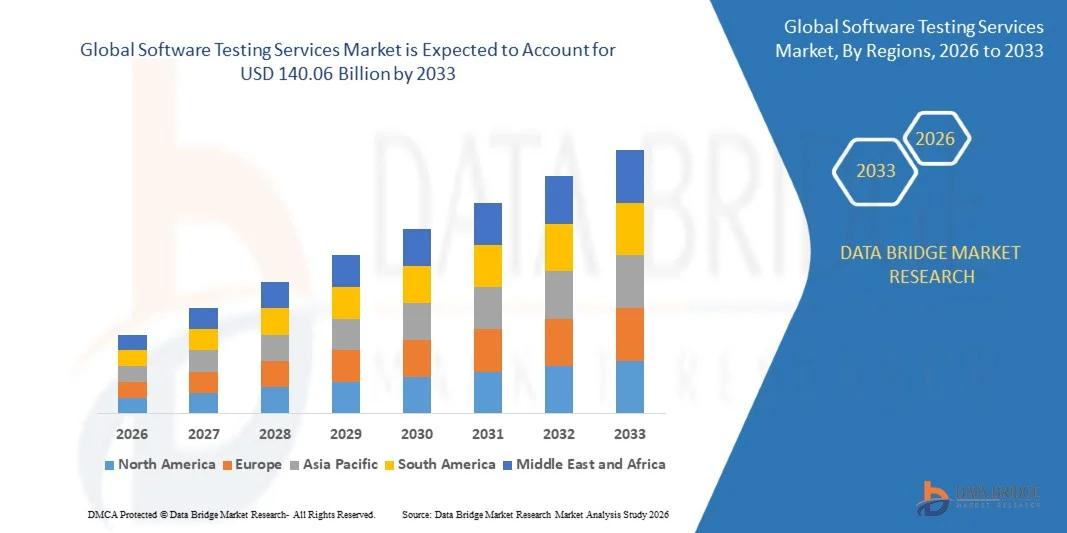
The Software Testing Services Market was valued at USD 48.93 billion in 2025 and is projected to reach USD 140.06 billion by 2033, growing at a CAGR of 14.05% from 2026 to 2033. The market is experiencing rapid growth driven by increasing adoption of cloud computing, rising complexity of enterprise software systems, and growing demand for high-quality digital experiences across banking, healthcare, retail, telecommunications, and manufacturing industries. Expansion of DevOps practices, AI-driven testing platforms, and continuous software delivery models is further accelerating demand for advanced software testing and quality assurance services globally.
The increasing dependence on digital infrastructure and mission-critical applications, combined with rising cybersecurity concerns and stricter compliance requirements, is compelling enterprises and technology providers to invest heavily in automated and continuous software testing solutions. Functional testing, security testing, performance testing, and API testing services are increasingly replacing traditional manual quality assurance processes in many industries because of their ability to improve software reliability, reduce deployment risks, and accelerate product release cycles. In addition, rapid growth of mobile applications, IoT ecosystems, AI-powered enterprise platforms, and cloud-native software architectures is expanding the need for scalable and intelligent software testing services capable of supporting complex multi-platform environments and real-time application performance validation.
Key Market Trends & Insights
- North America dominated the software testing services market with the largest revenue share of approximately 39.8% in 2025, supported by strong enterprise IT spending, widespread adoption of cloud computing, and the presence of leading technology and software service providers. The region benefits from advanced digital infrastructure, early adoption of AI-based testing tools, and high demand for secure, scalable, and high-performance software applications across banking, healthcare, and retail sectors.
- Asia-Pacific is expected to be the fastest-growing region, recording a CAGR of approximately 16.2% from 2026 to 2033. Growth is driven by rapid digitalization, expansion of IT outsourcing services, increasing cloud adoption, and strong growth in fintech, e-commerce, and telecommunications industries across countries such as India, China, and Japan. Rising investments in software development and cost-efficient testing services are also supporting regional market expansion.
- The Functional Testing segment held the largest market revenue share of approximately 58.7% in 2025 driven by its extensive adoption across enterprise applications, banking systems, cloud platforms, and mobile applications to validate software functionality, user workflows, and business process accuracy. Functional testing services are widely preferred because of their ability to ensure application reliability, reduce operational errors, and improve customer experience across complex digital ecosystems.
- The Non-Functional Testing segment is projected to register the fastest growth at a CAGR of 15.6% from 2026 to 2033, driven by increasing demand for cybersecurity validation, performance optimization, usability testing, and scalability assessment across AI-driven applications and cloud-native enterprise systems. Rising cybersecurity threats, growing API integration complexity, and expansion of real-time digital platforms are accelerating adoption of advanced non-functional testing services globally.
- The Application Testing segment held the largest market revenue share of approximately 67.9% in 2025 driven by increasing deployment of mobile applications, cloud-based enterprise software, SaaS platforms, and digital banking systems requiring continuous validation and performance monitoring. Enterprises are increasingly utilizing automated application testing platforms, For instance AI-enabled regression and API testing systems, to accelerate software release cycles and improve operational efficiency across multi-platform environments.
- The Product Testing segment is projected to register the fastest growth at a CAGR of 14.9% from 2026 to 2033, driven by increasing development of connected devices, embedded systems, AI-powered enterprise products, and IoT-enabled industrial platforms requiring comprehensive validation and interoperability testing. Growing adoption of autonomous technologies, smart consumer electronics, and digital healthcare devices is accelerating demand for advanced product testing services across global technology markets.
- The Banking, Financial Services, and Insurance segment held the largest market revenue share of approximately 24.8% in 2025 driven by increasing digital banking adoption, rising cybersecurity risks, and growing deployment of cloud-native financial applications and payment platforms. Financial institutions are increasingly investing in automated software testing services, For instance fraud detection validation and transaction performance testing systems, to improve operational security and ensure regulatory compliance across digital financial ecosystems.
- The Lifesciences and Healthcare segment is projected to register the fastest growth at a CAGR of 16.1% from 2026 to 2033, driven by increasing adoption of digital healthcare infrastructure, telemedicine platforms, AI-powered diagnostics systems, and electronic health record applications. Rising regulatory compliance requirements, expansion of connected medical devices, and increasing cybersecurity focus across healthcare IT infrastructure are accelerating demand for advanced software testing and validation services globally.
Market Size & Forecast
- Global Market Value (2025): USD 48.93 Billion
- Expected Market Value (2033): USD 140.06 Billion
- Forecast CAGR (2026–2033): 14.05%
- Leading Region in 2025: North America
- Fastest Growing Region: Asia-Pacific
Report Scope and Software Testing Services Market Segmentation
|
Attributes |
Software Testing Services Key Market Insights |
|
Segments Covered |
· By Type of Testing: Functional Testing and Non-Functional Testing · By Product: Application Testing and Product Testing · By End-Users: Banking, Financial Services, and Insurance, IT and Telecom, Lifesciences and Healthcare, Manufacturing, Energy and Utilities, Retail, Consumer Goods, and Logistics, and Others |
|
Countries Covered |
North America · U.S. · Canada · Mexico Europe · Germany · France · U.K. · Netherlands · Switzerland · Belgium · Russia · Italy · Spain · Turkey · Rest of Europe Asia-Pacific · China · Japan · India · South Korea · Singapore · Malaysia · Australia · Thailand · Indonesia · Philippines · Rest of Asia-Pacific Middle East and Africa · Saudi Arabia · U.A.E. · South Africa · Egypt · Israel · Rest of Middle East and Africa South America · Brazil · Argentina · Rest of South America |
|
Key Market Players |
• Wipro Limited (India) |
|
Market Opportunities |
|
|
Value Added Data Infosets |
In addition to the market insights such as market value, growth rate, market segments, geographical coverage, market players, and market scenario, the market report curated by the Data Bridge Market Research team includes in-depth expert analysis, import/export analysis, pricing analysis, production consumption analysis, and pestle analysis. |
Software Testing Services Market Trends
Trend: Rapid Adoption Of AI-Driven Test Automation And Continuous Quality Engineering Solutions
Increasing demand for faster software delivery, scalable application performance, and high-quality digital user experiences across banking, healthcare, retail, telecommunications, and enterprise IT sectors. Conventional manual testing methods require longer execution cycles, higher operational costs, and extensive human intervention, encouraging enterprises to adopt AI-driven automation and continuous testing solutions with improved speed, accuracy, and operational efficiency.
In modern enterprise environments, organizations are increasingly integrating AI-powered software testing platforms, For instance autonomous testing tools for application performance monitoring and defect prediction, to improve software reliability and reduce deployment failures across cloud-native and mobile applications. In digital commerce and financial systems, automated testing frameworks are being used to validate high-volume transactions, APIs, and cybersecurity controls while improving overall application stability and reducing downtime risks.
The rapid expansion of cloud computing, SaaS platforms, and AI-driven enterprise applications is also increasing demand for continuous testing systems capable of supporting agile development and DevOps environments. In addition, automotive, healthcare, and aerospace sectors continue to rely on advanced software validation services, such as real-time embedded system testing and cybersecurity testing platforms, because of their importance in ensuring operational safety and regulatory compliance. Growing industry validation through enterprise AI testing deployments in 2025 integrating self-healing automated testing frameworks demonstrated reductions of nearly 35–45% in software regression testing time during continuous release cycles.
Software Testing Services Market Dynamics
Key Market Driver: Rising Adoption Of Digital Transformation And Agile Development Practices
Industries worldwide are facing increasing pressure to accelerate digital transformation, improve software quality, and reduce application deployment timelines while maintaining operational reliability and cybersecurity standards. Rapid growth of cloud-native applications, mobile platforms, and enterprise automation systems is creating strong demand for software testing services capable of ensuring stable and secure digital infrastructure across complex IT environments.
Industries such as banking, healthcare, retail, and telecommunications are increasingly deploying automated testing solutions to improve application performance, identify vulnerabilities, and accelerate product delivery cycles. Large technology companies are actively integrating AI-driven software testing services, For instance automated API validation and continuous integration testing frameworks, to support high-frequency software releases and reduce operational disruptions.
Similarly, financial institutions and cloud service providers are exploring intelligent testing platforms to manage rising transaction volumes and cybersecurity risks associated with AI-driven digital infrastructure. Real-world enterprise deployments in the U.S. and India during 2024 integrating AI-enabled test automation systems into large-scale DevOps operations demonstrated reductions of around 30–40% in defect resolution time and software deployment delays.
Key Restraint/Challenge: High Implementation Complexity And Shortage Of Skilled Testing Professionals
Advanced software testing environments often require substantial investment in automation infrastructure, cloud-based testing platforms, cybersecurity validation tools, and AI-enabled analytics systems, creating operational and financial challenges for small and medium-sized enterprises. Complex enterprise software architectures involving multi-cloud infrastructure, APIs, IoT ecosystems, and real-time applications further increase implementation and integration complexity.
In addition, shortage of skilled testing professionals with expertise in AI-driven automation, cybersecurity testing, performance engineering, and DevOps environments limits operational scalability for software testing service providers. Rapidly evolving programming frameworks and application architectures also require continuous workforce training and technology upgrades, increasing operational management costs for enterprises and outsourced testing vendors.
Commercial IT benchmarking studies indicate that enterprises implementing large-scale automated testing infrastructure, For instance AI-enabled continuous testing systems, experienced integration and workforce adaptation costs increasing project expenditures by around 18–25% during initial deployment phases in 2024.
Key Market Opportunity: Expansion Of Cloud-Native Applications And AI-Powered Enterprise Platforms
Modern enterprises, digital banking systems, e-commerce platforms, and AI-driven business applications increasingly require scalable, secure, and high-performance software testing environments capable of supporting continuous deployment and real-time operational monitoring. Conventional testing frameworks are often unable to efficiently support rapidly changing application environments, creating demand for intelligent testing platforms with automation, predictive analytics, and self-healing capabilities.
Technology companies and enterprise software providers are increasingly exploring advanced software testing solutions, For instance AI-powered test orchestration platforms and cloud-based continuous quality engineering systems, to improve application reliability, accelerate release cycles, and reduce operational downtime. In consumer-facing digital platforms, rising demand for seamless mobile experiences and real-time transaction processing is accelerating adoption of automated functional and performance testing systems for smartphones, payment gateways, and SaaS applications.
In addition, advancements in generative AI, machine learning analytics, and low-code automation frameworks are improving testing efficiency, opening opportunities across healthcare IT, autonomous mobility systems, fintech infrastructure, and AI-powered enterprise software markets in North America and Asia-Pacific. Enterprise AI testing programs conducted in 2025 across the U.S., Germany, and Singapore reported productivity improvements of around 25–38% after integrating predictive defect analytics and autonomous regression testing systems into enterprise software development pipelines.
Software Testing Services Market Scope
The market is segmented on the basis of type of testing, product, and end-users.
- By Type of Testing
On the basis of type of testing, the Software Testing Services Market is segmented into Functional Testing and Non-Functional Testing. The Functional Testing segment held the largest market revenue share of approximately 58.7% in 2025 driven by its extensive adoption across enterprise applications, banking systems, cloud platforms, and mobile applications to validate software functionality, user workflows, and business process accuracy. Functional testing services are widely preferred because of their ability to ensure application reliability, reduce operational errors, and improve customer experience across complex digital ecosystems.
The Non-Functional Testing segment is projected to register the fastest growth at a CAGR of 15.6% from 2026 to 2033, driven by increasing demand for cybersecurity validation, performance optimization, usability testing, and scalability assessment across AI-driven applications and cloud-native enterprise systems. Rising cybersecurity threats, growing API integration complexity, and expansion of real-time digital platforms are accelerating adoption of advanced non-functional testing services globally.
- By Product
On the basis of product, the Software Testing Services Market is segmented into Application Testing and Product Testing. The Application Testing segment held the largest market revenue share of approximately 67.9% in 2025 driven by increasing deployment of mobile applications, cloud-based enterprise software, SaaS platforms, and digital banking systems requiring continuous validation and performance monitoring. Enterprises are increasingly utilizing automated application testing platforms, For instance AI-enabled regression and API testing systems, to accelerate software release cycles and improve operational efficiency across multi-platform environments.
The Product Testing segment is projected to register the fastest growth at a CAGR of 14.9% from 2026 to 2033, driven by increasing development of connected devices, embedded systems, AI-powered enterprise products, and IoT-enabled industrial platforms requiring comprehensive validation and interoperability testing. Growing adoption of autonomous technologies, smart consumer electronics, and digital healthcare devices is accelerating demand for advanced product testing services across global technology markets.
- By End-Users
On the basis of end-users, the Software Testing Services Market is segmented into Banking, Financial Services, and Insurance, IT and Telecom, Lifesciences and Healthcare, Manufacturing, Energy and Utilities, Retail, Consumer Goods, and Logistics, and Others. The Banking, Financial Services, and Insurance segment held the largest market revenue share of approximately 24.8% in 2025 driven by increasing digital banking adoption, rising cybersecurity risks, and growing deployment of cloud-native financial applications and payment platforms. Financial institutions are increasingly investing in automated software testing services, For instance fraud detection validation and transaction performance testing systems, to improve operational security and ensure regulatory compliance across digital financial ecosystems.
The Lifesciences and Healthcare segment is projected to register the fastest growth at a CAGR of 16.1% from 2026 to 2033, driven by increasing adoption of digital healthcare infrastructure, telemedicine platforms, AI-powered diagnostics systems, and electronic health record applications. Rising regulatory compliance requirements, expansion of connected medical devices, and increasing cybersecurity focus across healthcare IT infrastructure are accelerating demand for advanced software testing and validation services globally.
Software Testing Services Market Regional Analysis
North America Software Testing Services Market Insight
North America dominated the software testing services market with the largest revenue share of approximately 39.8% in 2025, supported by rapid adoption of cloud computing, strong presence of global technology companies, and increasing investments in AI-driven software development and cybersecurity infrastructure. Enterprises in the region highly prioritize software quality, application security, and continuous deployment efficiency, encouraging widespread adoption of automated testing platforms and DevOps-integrated quality assurance solutions. This strong market expansion is further supported by advanced digital infrastructure, high enterprise IT spending, and growing demand for reliable digital customer experiences across banking, healthcare, retail, and telecommunications sectors.
U.S. Software Testing Services Market Insight
The U.S. software testing services market captured the largest revenue share in 2025 within North America, fueled by rapid expansion of cloud-native enterprise applications and increasing deployment of AI-powered digital platforms across industries. Enterprises are increasingly prioritizing software reliability, cybersecurity validation, and faster product release cycles through adoption of automated testing services and continuous integration frameworks. The growing preference for DevOps practices, combined with strong demand for API testing, performance engineering, and cloud application validation services, further propels the market. Moreover, increasing integration of AI-driven testing automation and predictive analytics platforms across enterprise software ecosystems is significantly contributing to market expansion throughout the country.
Europe Software Testing Services Market Insight
The Europe software testing services market is expected to witness the fastest growth rate from 2026 to 2033, primarily driven by stringent cybersecurity regulations and increasing demand for secure digital infrastructure across financial services, healthcare, and industrial automation sectors. The increase in enterprise digital transformation initiatives, coupled with rising cloud adoption and AI integration, is fostering demand for advanced software validation and quality assurance services across Europe. European enterprises are also attracted to the operational efficiency and regulatory compliance benefits offered by AI-enabled software testing platforms. The region is experiencing significant growth across banking, automotive software, telecommunications, and public sector digitalization projects, with automated testing services increasingly integrated into enterprise DevOps and cloud modernization strategies.
U.K. Software Testing Services Market Insight
The U.K. software testing services market is expected to witness the fastest growth rate from 2026 to 2033, driven by rising investments in fintech infrastructure, cloud-native enterprise software, and cybersecurity compliance frameworks. In addition, increasing demand for digital banking platforms, e-commerce systems, and AI-powered business applications is encouraging enterprises to adopt automated software testing and continuous quality engineering solutions. The U.K.’s strong technology ecosystem, alongside expansion of SaaS adoption and enterprise cloud migration initiatives, is expected to continue stimulating market growth.
Germany Software Testing Services Market Insight
The Germany software testing services market is expected to witness the fastest growth rate from 2026 to 2033, fueled by increasing industrial automation and rising deployment of connected manufacturing and automotive software systems. Germany’s advanced enterprise IT infrastructure, combined with its emphasis on cybersecurity, operational precision, and Industry 4.0 transformation, promotes adoption of advanced software testing and validation services across industrial and commercial sectors. The integration of AI-powered testing automation platforms with enterprise ERP systems, automotive software infrastructure, and smart factory applications is also becoming increasingly prevalent, with strong preference for secure and compliance-focused testing environments aligning with local industry requirements.
Asia-Pacific Software Testing Services Market Insight
The Asia-Pacific software testing services market is expected to witness the fastest growth rate from 2026 to 2033, supported by rapid digitalization, expansion of IT outsourcing operations, and increasing enterprise cloud adoption across countries such as China, India, Japan, and South Korea. The region’s growing focus on software quality assurance, supported by rising investments in AI, fintech, e-commerce, and telecommunications infrastructure, is driving demand for advanced software testing services across commercial and industrial sectors. Furthermore, as Asia-Pacific emerges as a global hub for software development and technology services, the affordability and accessibility of automated testing platforms and outsourced quality assurance solutions are expanding to a wider enterprise customer base.
Japan Software Testing Services Market Insight
The Japan software testing services market is expected to witness the fastest growth rate from 2026 to 2033 due to the country’s advanced digital infrastructure, increasing enterprise automation, and strong focus on cybersecurity and software reliability. The Japanese market places significant emphasis on operational precision and system stability, and adoption of software testing services is driven by increasing deployment of AI-powered enterprise platforms and connected industrial systems. The integration of automated testing frameworks with robotics, automotive software, and smart manufacturing infrastructure is fueling growth. Moreover, Japan’s aging workforce and increasing dependence on digital public services are further supporting demand for intelligent and highly reliable software validation solutions across enterprise and government sectors.
China Software Testing Services Market Insight
The China software testing services market accounted for the largest market revenue share in Asia-Pacific in 2025, attributed to the country’s rapid digital transformation, expanding cloud computing infrastructure, and high-volume enterprise software development activities. China stands as one of the largest markets for AI-powered digital applications and enterprise cloud platforms, with software testing services becoming increasingly important across fintech, telecommunications, e-commerce, and industrial automation sectors. The push toward smart manufacturing infrastructure and AI-enabled enterprise systems, alongside strong domestic technology capabilities and large-scale software outsourcing operations, are key factors propelling the market in China.
Software Testing Services Market Share
The Software Testing Services industry is primarily led by well-established companies, including:
• Wipro Limited (India)
• Cigniti Technologies Limited (India)
• Accenture (Ireland)
• Atos SE (France)
• Capgemini (France)
• Cognizant (U.S.)
• HCL Technologies Limited (India)
• IBM (U.S.)
• Tata Consultancy Services Limited (India)
• TestingXperts (U.S.)
• Codoid (India)
• Oxagile (U.S.)
• QA Mentor - Software Testing Company (U.S.)
• TestFort (U.S.)
• Testbytes (India)
• BugRaptors (India)
• a1qa software testing company (U.S.)
• Kualitatem (U.S.)
• Infosys Limited (India)
• DXC Technology Company (U.S.)
• Hexaware Technologies Limited (India)
Latest Developments in Software Testing Services Market
- In October, 2024, Tata Consultancy Services (TCS) launched a new suite of cloud-based software testing services designed for small and medium enterprises, enabling scalable, cost-effective, and automated quality assurance capabilities. This development is expected to enhance accessibility of advanced testing tools for SMEs, improve deployment efficiency, and accelerate digital transformation across smaller organizations while strengthening TCS’s presence in the cloud testing services market.
- In September, 2024, Cognizant (U.S.) completed the acquisition of a leading software testing company to expand its quality assurance and testing service portfolio across multiple industry verticals. This acquisition is likely to strengthen Cognizant’s capabilities in advanced testing methodologies, enhance its automation and AI-driven testing offerings, and improve overall service delivery efficiency. It is also expected to support deeper market penetration in high-growth sectors such as banking, healthcare, and enterprise IT services.
- In August, 2024, Accenture (Ireland) announced a strategic partnership with a leading AI firm to develop next-generation software testing solutions powered by machine learning and predictive analytics. This initiative is expected to enhance Accenture’s AI-driven testing capabilities, improve defect prediction accuracy, and reduce software development lifecycle timelines. The collaboration is likely to strengthen its competitive position in intelligent testing services and influence broader industry adoption of AI-enabled quality assurance solutions.

- Interactive Data Analysis Dashboard
- Company Analysis Dashboard for high growth potential opportunities
- Research Analyst Access for customization & queries
- Competitor Analysis with Interactive dashboard
- Latest News, Updates & Trend analysis
- Harness the Power of Benchmark Analysis for Comprehensive Competitor Tracking
Data collection and base year analysis are done using data collection modules with large sample sizes. The stage includes obtaining market information or related data through various sources and strategies. It includes examining and planning all the data acquired from the past in advance. It likewise envelops the examination of information inconsistencies seen across different information sources. The market data is analysed and estimated using market statistical and coherent models. Also, market share analysis and key trend analysis are the major success factors in the market report. To know more, please request an analyst call or drop down your inquiry.
The key research methodology used by DBMR research team is data triangulation which involves data mining, analysis of the impact of data variables on the market and primary (industry expert) validation. Data models include Vendor Positioning Grid, Market Time Line Analysis, Market Overview and Guide, Company Positioning Grid, Patent Analysis, Pricing Analysis, Company Market Share Analysis, Standards of Measurement, Global versus Regional and Vendor Share Analysis. To know more about the research methodology, drop in an inquiry to speak to our industry experts.
Data Bridge Market Research is a leader in advanced formative research. We take pride in servicing our existing and new customers with data and analysis that match and suits their goal. The report can be customized to include price trend analysis of target brands understanding the market for additional countries (ask for the list of countries), clinical trial results data, literature review, refurbished market and product base analysis. Market analysis of target competitors can be analyzed from technology-based analysis to market portfolio strategies. We can add as many competitors that you require data about in the format and data style you are looking for. Our team of analysts can also provide you data in crude raw excel files pivot tables (Fact book) or can assist you in creating presentations from the data sets available in the report.













