


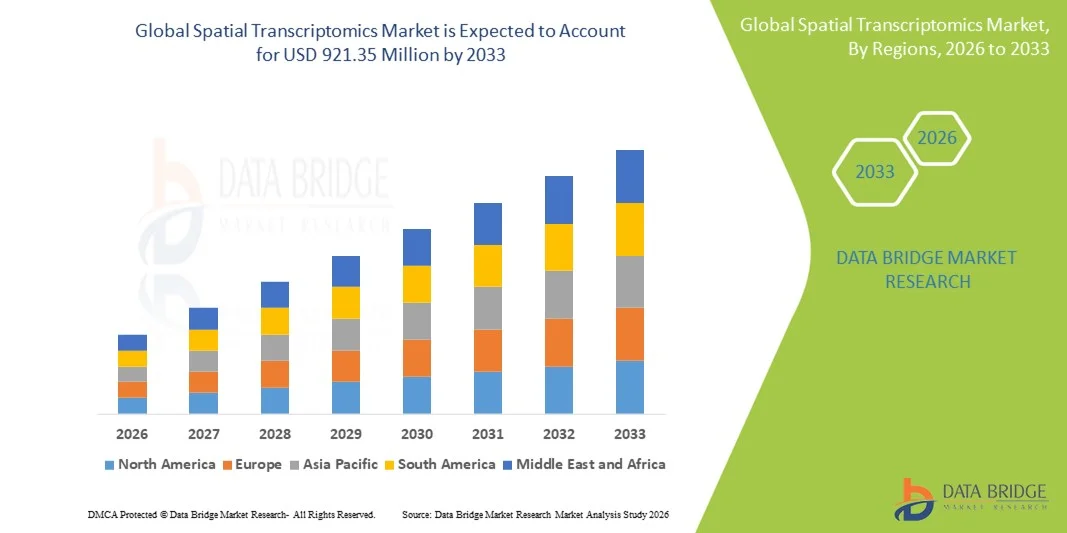
Spatial Transcriptomics Market Size
- The global spatial transcriptomics market size was valued at USD 449.04 million in 2025 and is expected to reach USD 921.35 million by 2033, at a CAGR of 9.40% during the forecast period
- The market growth is largely fueled by the increasing adoption of spatial-omics technologies in research and drug development, growing prevalence of genetic and chronic diseases, and continuous advancements in high-throughput sequencing, imaging, and bioinformatics tools, enabling detailed spatial gene expression analysis in tissues
- Furthermore, rising demand for precision medicine and targeted therapies, especially in oncology, neuroscience, and immunology, is driving the uptake of spatial transcriptomics in both academic and clinical research settings, facilitating better understanding of tissue heterogeneity, microenvironment, and disease pathology
Spatial Transcriptomics Market Analysis
- Spatial transcriptomics, enabling high-resolution mapping of gene expression within tissue samples, is increasingly becoming a critical tool in modern biomedical research and drug discovery across both academic and clinical settings due to its ability to provide spatial context to molecular data, enhancing understanding of tissue heterogeneity and disease mechanisms
- The escalating demand for spatial transcriptomics is primarily fueled by the growing adoption of high-throughput sequencing and imaging technologies, increasing focus on precision medicine, and rising investments in genomics and biotechnology research
- North America dominated the spatial transcriptomics market with the largest revenue share of 42.5% in 2025, characterized by strong presence of leading technology providers, high research and development spending, and a robust infrastructure for genomics research, with the U.S. experiencing substantial growth in spatial transcriptomics applications, particularly in oncology and neuroscience, driven by innovations from both established biotech companies and startups focusing on multi-omics integration and AI-driven bioinformatics
- Asia-Pacific is expected to be the fastest growing region in the spatial transcriptomics market during the forecast period due to increasing research funding, expanding biotech and academic research centers, and rising collaborations with global genomics companies
- Sequencing Technologies segment dominated the market with a share of 48.3% in 2025, driven by its high throughput, scalability, and ability to provide comprehensive gene expression profiling across complex tissue architectures
Report Scope and Spatial Transcriptomics Market Segmentation
|
Attributes |
Spatial Transcriptomics Key Market Insights |
|
Segments Covered |
|
|
Countries Covered |
North America
Europe
Asia-Pacific
Middle East and Africa
South America
|
|
Key Market Players |
|
|
Market Opportunities |
|
|
Value Added Data Infosets |
In addition to the insights on market scenarios such as market value, growth rate, segmentation, geographical coverage, and major players, the market reports curated by the Data Bridge Market Research also include in-depth expert analysis, patient epidemiology, pipeline analysis, pricing analysis, and regulatory framework |
Spatial Transcriptomics Market Trends
Integration with AI and Multi-Omics Analytics
- A significant and accelerating trend in the global spatial transcriptomics market is the integration of artificial intelligence (AI) and multi-omics analytics platforms, enhancing the ability to interpret complex spatial gene expression data with greater accuracy and efficiency
- For instance, 10x Genomics’ Visium platform now incorporates AI-based image analysis to map tissue morphology alongside gene expression, enabling more precise spatial insights
- AI integration enables predictive modeling of tissue heterogeneity and identification of novel biomarkers, while multi-omics approaches provide comprehensive views of disease mechanisms, facilitating deeper insights into cellular interactions and microenvironments
- The integration with bioinformatics pipelines allows researchers to seamlessly combine spatial transcriptomics data with proteomics, metabolomics, and genomics datasets, creating a holistic view of biological systems
- This trend towards intelligent, data-driven, and integrative spatial profiling is fundamentally enhancing research capabilities, with companies such as NanoString developing AI-enabled platforms that support automated tissue segmentation and high-resolution gene mapping
- The demand for platforms that offer seamless AI and multi-omics integration is growing rapidly across academic, clinical, and pharmaceutical research sectors, as precision medicine and targeted therapy development increasingly rely on these technologies
- Spatial transcriptomics is increasingly being applied in large-scale clinical trials to understand patient stratification and treatment response, providing actionable insights for therapeutic development
- Collaborations between biotech firms and academic institutions to develop standardized workflows and reference atlases are accelerating the adoption of spatial transcriptomics across diverse research areas
Spatial Transcriptomics Market Dynamics
Driver
Rising Demand for Precision Medicine and Disease Mapping
- The growing need for precision medicine, targeted therapies, and detailed tissue mapping is a significant driver of the spatial transcriptomics market
- For instance, researchers at Memorial Sloan Kettering Cancer Center adopted spatial transcriptomics to map tumor microenvironments, advancing personalized oncology approaches
- As the prevalence of cancer, neurological disorders, and autoimmune diseases increases, spatial transcriptomics provides critical insights into tissue heterogeneity, aiding drug discovery and therapeutic development
- Furthermore, government initiatives and funding for genomics research are increasing the adoption of spatial transcriptomics in both clinical and academic settings
- The ability to analyze gene expression in its native spatial context allows researchers to better understand disease mechanisms, accelerate biomarker discovery, and support precision therapy development, driving market growth
- Integration of spatial transcriptomics with single-cell sequencing technologies is enabling deeper cellular resolution studies, boosting the market’s research applications
- The growing demand from pharmaceutical companies to reduce drug development timelines and improve clinical trial outcomes is increasing adoption of spatial transcriptomics platforms
Restraint/Challenge
High Cost and Data Complexity
- The high cost of spatial transcriptomics platforms and the complexity of data analysis pose significant challenges to broader market adoption
- For instance, implementing 10x Genomics Visium or NanoString GeoMx platforms requires substantial investment in instrumentation, reagents, and computational infrastructure
- Handling and interpreting large-scale spatial transcriptomics datasets demand advanced bioinformatics expertise, which may not be readily available in all research setting
- Furthermore, standardization of protocols and reproducibility of results across laboratories remain challenging, limiting adoption in smaller research facilities
- Overcoming these challenges through cost reduction, simplified workflows, cloud-based analytics, and training programs will be vital for wider adoption and sustained market growth
- Limited awareness and understanding of spatial transcriptomics among smaller research institutions and emerging markets can slow adoption rates
- Dependence on high-quality tissue samples and strict experimental conditions may constrain widespread application, especially in clinical environments with limited sample availability
Spatial Transcriptomics Market Scope
The market is segmented on the basis of technology, product and services, application, and end user.
- By Technology
On the basis of technology, the spatial transcriptomics market is segmented into Immunohistochemistry (IHC), In Situ Hybridization, sequencing technologies, microscopy-based rna imaging, and others. The sequencing technologies segment dominated the market with the largest revenue share of 48.3% in 2025, driven by its high throughput, scalability, and ability to provide comprehensive gene expression profiling across complex tissue architectures. Sequencing-based platforms, such as 10x Genomics Visium, enable researchers to capture transcriptomic data with spatial context, facilitating advanced studies in oncology, neuroscience, and immunology. The reliability, reproducibility, and integration with bioinformatics pipelines further reinforce its dominance. Researchers also value sequencing technologies for enabling multi-sample comparisons and large-scale studies across clinical and academic settings. These platforms support integration with AI and machine learning, improving data interpretation and accelerating biomarker discovery. High adoption in pharmaceutical R&D and translational research further contributes to its leading market position.
The microscopy-based RNA imaging segment is anticipated to witness the fastest growth rate of 22.1% from 2026 to 2033, fueled by advancements in super-resolution imaging and single-molecule RNA visualization techniques. These methods provide high spatial resolution, enabling visualization of individual transcripts within cells and tissues. The ability to combine imaging with multi-omics approaches and AI-based image analysis drives adoption in precision medicine and pathology research. Rising demand for spatial resolution at the cellular and subcellular level across academic, pharmaceutical, and biotechnology sectors supports rapid market growth. Innovations improving imaging speed and throughput, along with decreasing costs, are accelerating uptake of microscopy-based approaches.
- By Product and Services
On the basis of product and services, the spatial transcriptomics market is segmented into consumables, instruments, software, and services. The consumables segment dominated the market with the largest share of 45.7% in 2025, due to recurring demand for reagents, probes, slides, and sequencing kits required for spatial transcriptomics experiments. Consumables are essential for consistent experimental quality and reproducibility, making them a major revenue driver. High adoption in large-scale research projects and pharmaceutical R&D pipelines contributes to sustained demand. Companies offering proprietary consumables with optimized workflows, such as NanoString and 10x Genomics, further reinforce market dominance. Consumables also benefit from ongoing technological advancements that increase sensitivity, throughput, and compatibility across platforms.
The software segment is expected to witness the fastest CAGR of 24.5% from 2026 to 2033, driven by increasing demand for advanced data analysis and visualization tools. Spatial transcriptomics generates massive datasets, requiring specialized software for integration, interpretation, and multi-omics analysis. AI-driven analytics, cloud-based platforms, and user-friendly interfaces enhance accessibility and adoption in both academic and commercial research. Integration of software with instruments and services supports end-to-end workflow solutions, contributing to rapid market growth.
- By Application
On the basis of application, the spatial transcriptomics market is segmented into translational research, drug discovery and development, and others. The translational research segment dominated the market with the largest share of 50.2% in 2025, due to the high relevance of spatial transcriptomics in bridging laboratory findings with clinical applications. Researchers use these technologies to study tissue heterogeneity, tumor microenvironments, and cellular interactions, providing actionable insights for precision medicine. Strong adoption in academic and government research institutions supports market dominance. Collaborative projects between biotech companies and academic labs further reinforce its leading position. High demand in disease mapping, biomarker discovery, and understanding therapeutic responses drives revenue growth in translational research.
The drug discovery and development segment is expected to witness the fastest CAGR of 23.7% from 2026 to 2033, fueled by pharmaceutical companies leveraging spatial transcriptomics to accelerate target identification, biomarker discovery, and preclinical testing. Integration with high-throughput sequencing, AI analytics, and multi-omics approaches enables more efficient and precise drug development pipelines. The increasing focus on oncology, immunology, and neuroscience therapies drives adoption. Cost-effective workflows and faster turnaround times further boost segment growth. Strong partnerships between technology providers and pharmaceutical companies are catalyzing rapid uptake in this application area.
- By End User
On the basis of end user, the spatial transcriptomics market is segmented into government institutes and academic centers, contract research organizations (CROs), and pharmaceutical and biotechnology companies. The government institutes and academic centers segment dominated the market with the largest share of 47.5% in 2025, driven by heavy investments in genomics research and growing adoption of advanced spatial transcriptomics platforms. High prevalence of disease-focused research programs and precision medicine initiatives supports strong utilization. Availability of skilled researchers and advanced laboratory infrastructure in developed regions further enhances adoption. Academic collaborations with biotech firms also reinforce market dominance. These institutions frequently lead in method development and validation studies, sustaining high demand for spatial transcriptomics solutions.
The pharmaceutical and biotechnology companies segment is expected to witness the fastest CAGR of 25.2% from 2026 to 2033, due to increasing use of spatial transcriptomics for drug discovery, biomarker identification, and clinical trial support. Companies are leveraging high-resolution spatial data to optimize therapeutic targets, enhance patient stratification, and reduce development timelines. Integration with AI, multi-omics, and automation technologies is accelerating adoption. Partnerships with technology providers ensure access to advanced platforms and consumables, driving rapid segment growth. Strong emphasis on precision medicine and personalized therapies is a key factor propelling market expansion in this end-user category.
Spatial Transcriptomics Market Regional Analysis
- North America dominated the spatial transcriptomics market with the largest revenue share of 42.5% in 2025, characterized by strong presence of leading technology providers, high research and development spending, and a robust infrastructure for genomics research
- Researchers and institutions in the region highly value the ability of spatial transcriptomics to map tissue heterogeneity, analyze complex disease mechanisms, and accelerate precision medicine and drug development efforts
- This widespread adoption is further supported by government funding, robust academic and pharmaceutical collaborations, and a well-established ecosystem of biotech startups and established companies, positioning North America as the key hub for spatial transcriptomics research and applications
U.S. Spatial Transcriptomics Market Insight
The U.S. spatial transcriptomics market captured the largest revenue share of 45% in 2025 within North America, driven by substantial investments in genomics research, advanced laboratory infrastructure, and the presence of leading technology providers. Researchers and pharmaceutical companies increasingly leverage spatial transcriptomics to study tissue heterogeneity, tumor microenvironments, and disease mechanisms. The growing adoption of AI-based analytics and multi-omics integration further propels the market. Moreover, government funding initiatives and collaborations between academic institutions and biotech firms are significantly contributing to the expansion of spatial transcriptomics applications across research and clinical settings.
Europe Spatial Transcriptomics Market Insight
The Europe spatial transcriptomics market is projected to expand at a substantial CAGR throughout the forecast period, primarily driven by increasing research funding, stringent regulatory standards for biomedical research, and growing adoption in academic and clinical institutions. The rising prevalence of chronic diseases, combined with the demand for high-resolution tissue mapping, is fostering the adoption of spatial transcriptomics. European researchers are also leveraging these technologies for precision medicine, oncology, and neuroscience studies. The region is witnessing significant growth across academic, pharmaceutical, and contract research applications.
U.K. Spatial Transcriptomics Market Insight
The U.K. spatial transcriptomics market is anticipated to grow at a noteworthy CAGR during the forecast period, fueled by rising government and private research funding, the expansion of genomics and biotechnology centers, and growing awareness of spatial transcriptomics’ value in disease research. In addition, the demand for high-resolution tissue profiling in translational research and drug development is encouraging adoption in both academic and commercial settings. The U.K.’s robust research infrastructure and strong collaborations between universities and biotech companies continue to stimulate market growth.
Germany Spatial Transcriptomics Market Insight
The Germany spatial transcriptomics market is expected to expand at a considerable CAGR during the forecast period, driven by increasing awareness of advanced genomics technologies, strong research infrastructure, and government initiatives promoting innovation in biomedical research. Germany’s emphasis on precision medicine and high-quality clinical research promotes the adoption of spatial transcriptomics in both academic and pharmaceutical settings. Integration with AI, multi-omics analysis, and bioinformatics platforms is becoming increasingly prevalent, meeting local research demands for accurate, high-resolution gene expression mapping.
Asia-Pacific Spatial Transcriptomics Market Insight
The Asia-Pacific spatial transcriptomics market is poised to grow at the fastest CAGR of 23% during the forecast period of 2026 to 2033, driven by rising research funding, expanding biotech and academic research centers, and increasing collaborations with global genomics technology providers. Countries such as China, Japan, and India are witnessing rapid adoption due to increasing focus on precision medicine, disease mapping, and drug discovery applications. Furthermore, government initiatives supporting life sciences research and affordable technology access are expanding spatial transcriptomics adoption across the region.
Japan Spatial Transcriptomics Market Insight
The Japan spatial transcriptomics market is gaining momentum due to the country’s strong research ecosystem, emphasis on precision medicine, and increasing investment in genomics and biomedical technologies. Japanese researchers prioritize tissue-level gene expression analysis for oncology, neuroscience, and immunology applications. Integration with AI-based analytics, high-resolution imaging, and multi-omics approaches is fueling market growth. Moreover, collaborations between pharmaceutical companies and academic institutions support development of targeted therapies and translational research projects.
India Spatial Transcriptomics Market Insight
The India spatial transcriptomics market accounted for the largest market revenue share in Asia Pacific in 2025, attributed to expanding life sciences research, increasing government and private funding, and rapid growth of biotechnology and academic research centers. India is emerging as a key hub for genomics research, and spatial transcriptomics is being increasingly adopted in translational research, drug discovery, and clinical studies. Government initiatives supporting precision medicine and access to cost-effective technologies, alongside collaborations with global genomics companies, are key factors driving market growth.
Spatial Transcriptomics Market Share
The Spatial Transcriptomics industry is primarily led by well-established companies, including:
- 10x Genomics, Inc. (U.S.)
- Illumina, Inc. (U.S.)
- Vizgen, Inc. (U.S.)
- Bio‑Techne Corporation (U.S.)
- Akoya Biosciences, Inc. (U.S.)
- Bruker Corporation (U.S.)
- Standard BioTools, Inc. (U.S.)
- Bio‑Rad Laboratories, Inc. (U.S.)
- PerkinElmer (U.S.)
- Thermo Fisher Scientific, Inc. (U.S.)
- Resolve Biosciences GmbH (Germany)
- Ultivue, Inc. (U.S.)
- Molecular Instruments, Inc. (U.S.)
- Natera, Inc. (U.S.)
- Dovetail Genomics (U.S.)
- Rebus Biosystems, Inc. (U.S.)
- S2 Genomics, Inc. (U.S.)
- Lunaphore Technologies SA (Switzerland)
- VisioPharm A/S (Denmark)
- Miltenyi Biotec (Germany)
What are the Recent Developments in Global Spatial Transcriptomics Market?
- In November 2025, Vizgen declared it would present new spatial multi‑omics data at the Society for Immunotherapy of Cancer 40th Annual Meeting (SITC 2025), combining MERFISH 2.0 transcript data with protein data from multiplex immunofluorescence (InSituPlex) on sequential tissue sections demonstrating the real‑world application of spatial transcriptomics + proteomics for in situ tumor‑immune microenvironment profiling, critical for immuno-oncology and translational research
- In April 2025, Vizgen, Inc. announced global commercial availability of its enhanced chemistry MERFISH 2.0 along with expanded spatial‑proteomics panel offerings, enabling deeper, more precise spatial transcriptomics and proteomics analyses bridging foundational research and translational/clinical applications such as Antibody‑Drug Conjugate (ADC) development
- In February 2025, Illumina, Inc. unveiled a new spatial transcriptomics technology program delivering unbiased whole‑transcriptome profiling with cellular resolution and high sensitivity. The new solution promises large‑scale tissue coverage and higher throughput, enabling researchers to map complex tissues and cell interactions at unprecedented scale
- In September 2024, Vizgen shipped the first worldwide units of its next‑generation imaging platform MERSCOPE Ultra which triples the imaging area per slide (3 cm²) over its predecessor and offers flexible flow‑cell sizes for reagent optimization. This milestone expands spatial genomics access to leading research centres globally, accelerating adoption in complex tissue studies and high‑throughput spatial experiments
- In March 2024, 10x Genomics commercially launched its Visium HD Spatial Gene Expression Assay offering whole‑transcriptome spatial gene expression profiling at single‑cell–scale resolution for FFPE tissue sections. This launch significantly improved resolution and sensitivity for spatial transcriptomics in archived human/mouse tissue samples, expanding the usability of ST in clinical and retrospective studies

- Interactive Data Analysis Dashboard
- Company Analysis Dashboard for high growth potential opportunities
- Research Analyst Access for customization & queries
- Competitor Analysis with Interactive dashboard
- Latest News, Updates & Trend analysis
- Harness the Power of Benchmark Analysis for Comprehensive Competitor Tracking
Data collection and base year analysis are done using data collection modules with large sample sizes. The stage includes obtaining market information or related data through various sources and strategies. It includes examining and planning all the data acquired from the past in advance. It likewise envelops the examination of information inconsistencies seen across different information sources. The market data is analysed and estimated using market statistical and coherent models. Also, market share analysis and key trend analysis are the major success factors in the market report. To know more, please request an analyst call or drop down your inquiry.
The key research methodology used by DBMR research team is data triangulation which involves data mining, analysis of the impact of data variables on the market and primary (industry expert) validation. Data models include Vendor Positioning Grid, Market Time Line Analysis, Market Overview and Guide, Company Positioning Grid, Patent Analysis, Pricing Analysis, Company Market Share Analysis, Standards of Measurement, Global versus Regional and Vendor Share Analysis. To know more about the research methodology, drop in an inquiry to speak to our industry experts.
Data Bridge Market Research is a leader in advanced formative research. We take pride in servicing our existing and new customers with data and analysis that match and suits their goal. The report can be customized to include price trend analysis of target brands understanding the market for additional countries (ask for the list of countries), clinical trial results data, literature review, refurbished market and product base analysis. Market analysis of target competitors can be analyzed from technology-based analysis to market portfolio strategies. We can add as many competitors that you require data about in the format and data style you are looking for. Our team of analysts can also provide you data in crude raw excel files pivot tables (Fact book) or can assist you in creating presentations from the data sets available in the report.













