


Synthetic Drugs Market Size
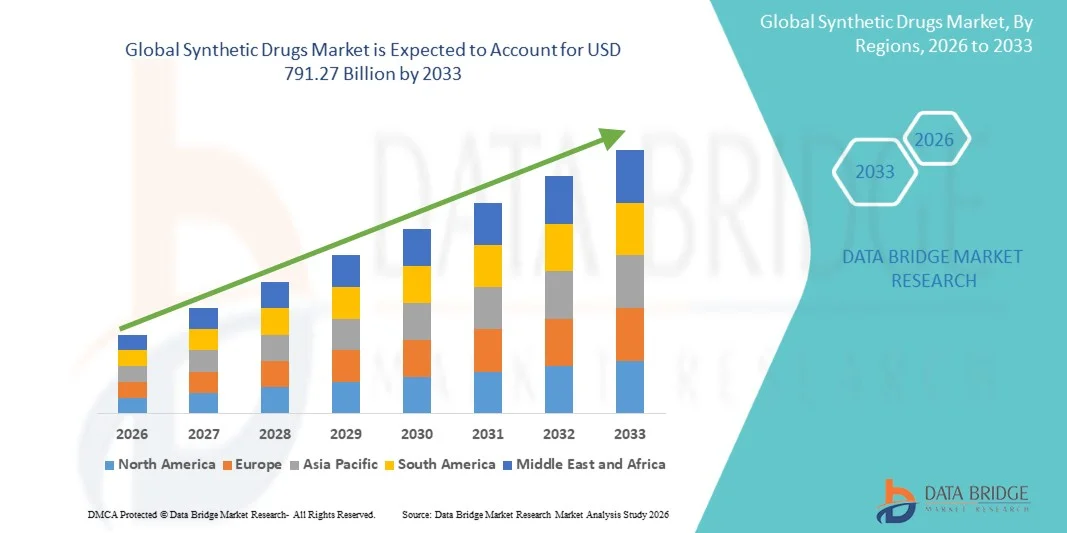
- The global Synthetic Drugs market size was valued at USD 427.50 billion in 2025and is expected to reach USD 791.27 billion by 2033, at a CAGR of 8.00% during the forecast period
- The market growth is largely fueled by the increasing prevalence of chronic and complex diseases requiring advanced pharmaceutical interventions, along with rapid expansion in drug discovery technologies and chemical synthesis capabilities, leading to higher development and utilization of synthetic drug compounds across global healthcare systems
- Furthermore, rising demand for cost-effective, scalable, and fast-acting therapeutic solutions, coupled with advancements in medicinal chemistry, high-throughput screening, and pharmaceutical manufacturing technologies, is establishing synthetic drugs as a critical component of modern treatment approaches. These converging factors are accelerating the uptake of Synthetic Drugs solutions, thereby significantly boosting the industry's growth
Synthetic Drugs Market Analysis
- Synthetic drugs, which are chemically manufactured pharmaceutical compounds designed to mimic or enhance biological activity for therapeutic purposes, are increasingly vital in modern healthcare systems due to their role in treating a wide range of acute and chronic diseases with improved efficacy, stability, and scalable production capabilities
- The escalating demand for synthetic drugs is primarily fueled by the rising burden of chronic diseases, increasing need for cost-effective treatment options, and continuous advancements in pharmaceutical R&D and chemical synthesis technologies, which enable faster drug development and wider therapeutic applications
- North America dominated the synthetic drugs market with the largest revenue share of 38.6% in 2025, driven by strong pharmaceutical R&D infrastructure, high drug consumption rates, and the presence of major global pharmaceutical companies, with the U.S. accounting for the majority of innovative drug development and commercial distribution
- Asia-Pacific is expected to be the fastest growing region in the Synthetic Drugs market during the forecast period due to expanding pharmaceutical manufacturing capabilities, increasing healthcare expenditure, rising patient population, and strong growth of generic drug production in countries such as India and China
- The oral segment dominated the largest market revenue share of 61.3% in 2025, driven by ease of consumption, wide availability in tablet or capsule form, and high user preference in non-clinical settings
Report Scope and Synthetic Drugs Market Segmentation
|
Attributes |
Synthetic Drugs Key Market Insights |
|
Segments Covered |
|
|
Countries Covered |
North America · U.S. · Canada · Mexico Europe · Germany · France · U.K. · Netherlands · Switzerland · Belgium · Russia · Italy · Spain · Turkey · Rest of Europe Asia-Pacific · China · Japan · India · South Korea · Singapore · Malaysia · Australia · Thailand · Indonesia · Philippines · Rest of Asia-Pacific Middle East and Africa · Saudi Arabia · U.A.E. · South Africa · Egypt · Israel · Rest of Middle East and Africa South America · Brazil · Argentina · Rest of South America |
|
Key Market Players |
· Pfizer Inc. (U.S.) · Johnson & Johnson (U.S.) · Merck & Co., Inc. (U.S.) · Novartis AG (Switzerland) · Sanofi (France) · GlaxoSmithKline plc (U.K.) · AstraZeneca plc (U.K.) · Teva Pharmaceutical Industries Ltd. (Israel) · Sun Pharmaceutical Industries Ltd. (India) · Dr. Reddy’s Laboratories Ltd. (India) · Cipla Limited (India · Lupin Limited (India) · Aurobindo Pharma Limited (India) · Zydus Lifesciences Limited (India) · Hikma Pharmaceuticals PLC (U.K.) · Apotex Inc. (Canada) · Amneal Pharmaceuticals LLC (U.S.) · Alkem Laboratories Ltd. (India) · Torrent Pharmaceuticals Ltd. (India) |
|
Market Opportunities |
· Rising Demand for Advanced Pain Management and Neurological Treatments · Expansion of Pharmaceutical R&D and Generic Drug Manufacturing |
|
Value Added Data Infosets |
In addition to the insights on market scenarios such as market value, growth rate, segmentation, geographical coverage, and major players, the market reports curated by the Data Bridge Market Research also include in-depth expert analysis, patient epidemiology, pipeline analysis, pricing analysis, and regulatory framework. |
Synthetic Drugs Market Trends
“Expansion of Forensic Detection Technologies and Regulatory Surveillance Systems”
- A significant and accelerating trend in the global Synthetic Drugs market is the increasing focus on advanced forensic detection methods and strengthened regulatory surveillance to combat the rapid emergence of new psychoactive substances (NPS)
- For instance, governments and regulatory agencies are increasingly deploying advanced toxicology screening methods, mass spectrometry techniques, and real-time drug monitoring systems to identify and classify newly emerging synthetic compounds more efficiently
- The growing sophistication of synthetic drug formulations is driving continuous upgrades in analytical laboratory capabilities, enabling faster identification of chemical variants and analogs in illicit drug markets
- Furthermore, international organizations such as United Nations Office on Drugs and Crime are actively tracking global patterns of synthetic drug production and distribution, supporting cross-border cooperation in drug control efforts
- The rising prevalence of new psychoactive substances (NPS), including synthetic cannabinoids, synthetic opioids, and stimulant analogs, is increasing the need for rapid regulatory scheduling and public health response mechanisms
- This trend toward enhanced detection, classification, and regulatory enforcement is reshaping global drug control frameworks and improving early warning systems for emerging synthetic substances
- The demand for advanced forensic and analytical solutions is growing across law enforcement agencies, public health institutions, and regulatory bodies as synthetic drug complexity continues to evolve
Synthetic Drugs Market Dynamics
Driver
“Rising Incidence of New Psychoactive Substances and Expanding Illicit Drug Networks”
- The increasing emergence and global spread of new psychoactive substances (NPS) is a major driver of activity in the Synthetic Drugs market landscape
- For instance, synthetic drugs are often chemically modified to mimic controlled substances while avoiding existing drug regulations, leading to continuous evolution in their chemical structures and rapid market proliferation
- The rising demand for low-cost, easily accessible psychoactive substances is contributing to the expansion of synthetic drug consumption in certain regions
- Furthermore, the globalization of illicit drug trafficking networks and the increasing availability of precursor chemicals are facilitating the rapid production and distribution of synthetic drugs across international markets
- Strengthened law enforcement efforts and international cooperation are also indirectly driving market dynamics by accelerating identification and classification of new synthetic compounds, thereby influencing regulatory scheduling and enforcement priorities
Restraint/Challenge
“Strict Regulatory Controls and Public Health Risks Associated with Synthetic Substances”
- Strict global regulatory frameworks and enforcement actions targeting synthetic drugs pose a major challenge to the expansion of this market segment
- For instance, governments across multiple regions are continuously updating controlled substance lists and implementing emergency bans on newly identified synthetic compounds to limit their distribution and misuse
- The unpredictable toxicity, high addiction potential, and severe health risks associated with synthetic drugs create significant public health concerns, leading to increased regulatory scrutiny and enforcement measures
- In addition, rapid structural modification of synthetic compounds makes it difficult for regulatory agencies and forensic laboratories to keep pace with emerging variants, creating enforcement and classification challenges
- The growing public awareness of health risks and the expansion of harm-reduction programs are also reducing demand in certain user segments, further limiting market expansion potential
- Overcoming these challenges requires stronger international coordination, improved real-time monitoring systems, and continued investment in forensic science and public health response infrastructure to address the evolving synthetic drug landscape
Synthetic Drugs Market Scope
The market is segmented on the basis of type, indication, route of administration, end-users, and distribution channel.
- By Type
On the basis of type, the Synthetic Drugs market is segmented into herbal highs, synthetic cannabinoids, research chemicals, and drug analogues. The synthetic cannabinoids segment dominated the largest market revenue share of 42.6% in 2025, driven by increasing availability of lab-manufactured cannabinoid compounds that mimic the effects of natural cannabis. These substances are widely used due to their potent psychoactive properties and evolving chemical formulations that enhance market penetration. The segment is further supported by growing recreational misuse trends and continuous chemical innovation that helps bypass regulatory restrictions. Rising online availability through illicit digital platforms is also contributing to strong demand. In addition, lower production costs compared to natural alternatives are boosting adoption. Increasing awareness among regulatory authorities is leading to tighter monitoring, but demand remains high in several regions. The segment is also influenced by shifting consumer preferences toward synthetic alternatives. Furthermore, rapid emergence of new analogues is sustaining market expansion. Overall, synthetic cannabinoids continue to dominate due to accessibility and evolving product diversity.
The research chemicals and drug analogues segment is expected to witness the fastest CAGR of 10.8% from 2026 to 2033, driven by increasing experimentation in chemical modification and rising demand for novel psychoactive substances. These compounds are often developed for research purposes but are increasingly misused due to their psychoactive effects. The segment benefits from rapid innovation in chemical synthesis and limited initial regulatory classification. Growing online distribution networks are significantly contributing to accessibility. Increasing awareness among users seeking new psychoactive experiences is further driving demand. Regulatory gaps in emerging markets are also supporting short-term growth. The segment is influenced by continuous introduction of new molecular structures. Law enforcement agencies are increasingly focusing on monitoring these substances. Despite restrictions, demand continues due to novelty and potency. Furthermore, evolving chemical research activities are expected to sustain high growth momentum during the forecast period.
- By Indication
On the basis of indication, the Synthetic Drugs market is segmented into neurological disorder management, nausea, pain management, and others. The pain management segment accounted for the largest market revenue share of 39.4% in 2025, driven by the increasing misuse of synthetic drugs for analgesic and sedative effects. These substances are often used for self-medication or recreational pain relief, particularly in regions with limited access to regulated pharmaceuticals. The segment benefits from rising prevalence of chronic pain conditions globally. Increasing opioid restrictions in some markets are also indirectly boosting synthetic alternatives usage. Easy availability through illicit channels further supports demand. The segment is influenced by growing self-medication trends and lack of awareness regarding risks. Rising incidence of injury-related pain conditions is also contributing to usage. In addition, synthetic compounds are often cheaper alternatives to prescription painkillers. Regulatory challenges in controlling synthetic variants are supporting market persistence. Furthermore, demand remains strong due to fast-acting effects in illicit usage contexts.
The neurological disorder management segment is expected to witness the fastest CAGR of 11.2% from 2026 to 2033, driven by increasing experimental use of synthetic compounds affecting neurological pathways. These substances interact with brain receptors, leading to altered cognitive and sensory responses. The segment is influenced by rising interest in psychoactive experimentation among users. Growing availability of novel synthetic compounds is further driving adoption. Increasing research into brain receptor interactions is also contributing to market expansion. The segment benefits from rapid chemical innovation and evolving drug formulations. Online distribution channels are significantly enhancing accessibility. Rising mental health challenges are indirectly influencing misuse patterns. Regulatory agencies are increasingly tracking neurological impact of synthetic substances. Furthermore, continuous emergence of new psychoactive molecules is expected to sustain strong growth during the forecast period.
- By Route of Administration
On the basis of route of administration, the Synthetic Drugs market is segmented into oral, intravenous, and others. The oral segment dominated the largest market revenue share of 61.3% in 2025, driven by ease of consumption, wide availability in tablet or capsule form, and high user preference in non-clinical settings. Oral synthetic drugs are commonly used due to convenience and discreet administration. The segment benefits from widespread illicit distribution through online and street markets. Increasing production of synthetic pills and capsules is further driving demand. Oral intake is preferred due to slower onset and prolonged psychoactive effects. The segment is also influenced by lower production costs and easier packaging. Growing misuse among younger populations is contributing to market expansion. Regulatory enforcement is challenging due to mass production and distribution. In addition, oral formulations are widely circulated across multiple illicit networks. Furthermore, strong global availability continues to sustain segment dominance.
The intravenous segment is expected to witness the fastest CAGR of 9.7% from 2026 to 2033, driven by increasing misuse of high-potency synthetic compounds in medical and non-medical settings. Intravenous administration leads to rapid onset of effects, making it highly sought after in certain user groups. The segment is influenced by rising availability of injectable synthetic analogues in illicit markets. Increasing cases of drug dependency are also contributing to growth. The segment benefits from evolving chemical formulations designed for stronger effects. However, it is associated with higher health risks, leading to regulatory concerns. Law enforcement agencies are focusing on reducing injectable drug circulation. Rising emergency healthcare cases related to drug misuse are also being reported. Despite risks, demand persists in specific high-risk user populations. Furthermore, continuous emergence of potent synthetic formulations is expected to drive segment growth.
- By End-Users
On the basis of end-users, the Synthetic Drugs market is segmented into clinic, hospital, and others. The hospital segment accounted for the largest market revenue share of 54.1% in 2025, driven by the increasing number of emergency admissions related to synthetic drug intoxication and overdose cases. Hospitals serve as primary treatment centers for managing acute toxicity and adverse drug reactions. The segment benefits from availability of advanced emergency care infrastructure and trained medical professionals. Rising incidence of substance abuse disorders is significantly contributing to hospital visits. Increasing government focus on drug abuse treatment programs is also supporting segment growth. Hospitals play a key role in detoxification and rehabilitation support. Growing awareness regarding drug-related health risks is driving admissions. The segment is further supported by expanding healthcare infrastructure globally. Increasing collaboration between public health agencies and hospitals is improving treatment outcomes. Furthermore, rising substance misuse cases are expected to sustain hospital dominance during the forecast period.
The clinic segment is expected to witness the fastest CAGR of 10.5% from 2026 to 2033, driven by increasing demand for outpatient treatment and addiction counseling services. Clinics provide accessible and cost-effective care for individuals dealing with synthetic drug dependence. The segment benefits from growing awareness of substance abuse treatment programs. Increasing availability of specialized addiction clinics is supporting market growth. Clinics offer personalized rehabilitation and therapy services. Rising government initiatives for mental health and addiction treatment are further contributing to expansion. Telemedicine-based counseling services are also improving accessibility. Growing social acceptance of addiction treatment is encouraging more individuals to seek help. In addition, private clinics are expanding rapidly in urban areas. Furthermore, increasing focus on early intervention is expected to drive strong segment growth during the forecast period.
- By Distribution Channel
On the basis of distribution channel, the Synthetic Drugs market is segmented into hospital pharmacy, retail pharmacy, and online pharmacy. The retail pharmacy segment dominated the largest market revenue share of 47.9% in 2025, driven by high accessibility and widespread availability of pharmaceutical products through established retail networks. Retail pharmacies play a major role in dispensing controlled medications and supporting outpatient care. The segment benefits from strong distribution infrastructure and consumer convenience. Increasing prescription volumes for various therapeutic indications are supporting demand. Retail pharmacies are widely accessible across urban and semi-urban regions. The segment is also influenced by growing healthcare awareness among patients. Expansion of pharmacy chains is further strengthening market presence. In addition, regulatory frameworks ensure controlled dispensing of medications. Rising healthcare utilization is also contributing to segment growth. Furthermore, strong supply chain networks are expected to sustain segment dominance during the forecast period.
The online pharmacy segment is expected to witness the fastest CAGR of 13.4% from 2026 to 2033, driven by rapid digitalization of healthcare services and increasing consumer preference for home delivery of medications. Online pharmacies offer convenience, privacy, and easy access to a wide range of drugs. The segment benefits from rising internet penetration and smartphone usage globally. Increasing adoption of e-prescriptions is significantly supporting growth. The COVID-19 pandemic accelerated online pharmacy usage, creating long-term behavioral shifts. Pharmaceutical companies are partnering with digital platforms to expand reach. Online services also offer subscription-based medication delivery systems. Growing demand for contactless healthcare solutions is further driving adoption. Regulatory support for digital health ecosystems is improving market structure. Furthermore, increasing consumer preference for convenience is expected to drive strong segment expansion during the forecast period.
Synthetic Drugs Market Regional Analysis
- North America dominated the synthetic drugs market with the largest revenue share of 38.6% in 2025, driven by strong pharmaceutical R&D infrastructure, high drug consumption rates, and the presence of major global pharmaceutical companies. The region benefits from advanced drug discovery capabilities, robust clinical research ecosystems, and high adoption of innovative therapeutic drugs across multiple disease areas
- The increasing prevalence of chronic diseases, growing demand for advanced therapeutic treatments, and strong focus on pharmaceutical innovation are key factors driving the expansion of the synthetic drugs market in the region. In addition, well-established regulatory frameworks and high investment in drug development activities continue to support market growth
- Furthermore, the presence of leading pharmaceutical manufacturers, strong commercialization capabilities, and continuous advancements in synthetic drug formulations are reinforcing North America’s dominant position in the global Synthetic Drugs market
U.S. Synthetic Drugs Market Insight
The U.S. synthetic drugs market captured the largest revenue share within North America in 2025, accounting for the majority of regional demand, driven by strong pharmaceutical innovation, high drug consumption rates, and extensive R&D investments. The country plays a leading role in global drug development, with significant contributions from major pharmaceutical companies and research institutions. Additionally, increasing demand for advanced therapeutic drugs, growing prevalence of chronic diseases, and strong distribution networks continue to propel the Synthetic Drugs market in the U.S.
Europe Synthetic Drugs Market Insight
The Europe synthetic drugs market is projected to expand at a substantial CAGR throughout the forecast period, supported by strong pharmaceutical manufacturing capabilities, increasing healthcare expenditure, and rising demand for innovative therapeutic drugs. The region’s well-established regulatory framework and strong focus on drug safety and efficacy are encouraging the development and adoption of synthetic pharmaceuticals. Furthermore, growing investments in pharmaceutical research and expanding access to advanced treatments are contributing significantly to market growth across Europe.
U.K. Synthetic Drugs Market Insight
The U.K. synthetic drugs market is anticipated to grow at a noteworthy CAGR during the forecast period due to strong pharmaceutical research activities, increasing prevalence of chronic diseases, and rising demand for innovative medicines. The country’s robust healthcare system, coupled with strong academic–industry collaborations in drug development, is supporting market growth. Additionally, increasing investment in life sciences and expanding access to advanced therapies are further driving the synthetic drugs market in the U.K.
Germany Synthetic Drugs Market Insight
The Germany synthetic drugs market is expected to expand at a considerable CAGR during the forecast period, fueled by strong pharmaceutical manufacturing base, high R&D expenditure, and increasing demand for advanced therapeutic drugs. Germany’s emphasis on innovation, precision medicine, and high-quality drug production is supporting the growth of synthetic pharmaceuticals. Moreover, increasing clinical research activities and strong presence of global pharmaceutical companies are contributing positively to market expansion in the country.
Asia-Pacific Synthetic Drugs Market Insight
The Asia-Pacific synthetic drugs market is expected to witness the fastest CAGR during the forecast period due to expanding pharmaceutical manufacturing capabilities, increasing healthcare expenditure, rising patient population, and strong growth of generic drug production in countries such as India and China. Rapid industrialization, improving healthcare infrastructure, and growing access to affordable medicines are significantly driving market expansion in the region. Furthermore, increasing investments in pharmaceutical production and government support for domestic drug manufacturing are accelerating growth across Asia-Pacific.
Japan Synthetic Drugs Market Insight
The Japan synthetic drugs market is gaining momentum due to the country’s advanced pharmaceutical industry, aging population, and increasing demand for innovative therapeutic treatments. Strong focus on research and development, coupled with high adoption of advanced drug formulations, is driving market growth. Additionally, Japan’s well-established healthcare system and increasing need for chronic disease management therapies are contributing to the expansion of the synthetic drugs market in the country.
China Synthetic Drugs Market Insight
The China synthetic drugs market accounted for the largest market revenue share in Asia-Pacific in 2025, attributed to rapid pharmaceutical industry expansion, rising healthcare demand, and strong government support for drug manufacturing. Increasing prevalence of chronic diseases, growing investments in pharmaceutical R&D, and expansion of domestic drug production capabilities are key factors driving market growth. Additionally, China’s large patient population and strong presence of generic drug manufacturers are significantly contributing to the growth of the Synthetic Drugs market.
Synthetic Drugs Market Share
The Synthetic Drugs industry is primarily led by well-established companies, including:
- Pfizer Inc. (U.S.)
- Johnson & Johnson (U.S.)
- Merck & Co., Inc. (U.S.)
- Novartis AG (Switzerland)
- Sanofi (France)
- GlaxoSmithKline plc (U.K.)
- AstraZeneca plc (U.K.)
- Teva Pharmaceutical Industries Ltd. (Israel)
- Sun Pharmaceutical Industries Ltd. (India)
- Reddy’s Laboratories Ltd. (India)
- Cipla Limited (India
- Lupin Limited (India)
- Aurobindo Pharma Limited (India)
- Zydus Lifesciences Limited (India)
- Hikma Pharmaceuticals PLC (U.K.)
- Apotex Inc. (Canada)
- Amneal Pharmaceuticals LLC (U.S.)
- Alkem Laboratories Ltd. (India)
- Torrent Pharmaceuticals Ltd. (India)
Latest Developments in Global Synthetic Drugs Market
- In June 2021, the United Nations Office on Drugs and Crime (UNODC) released its World Drug Report 2021, highlighting a major structural shift in global drug markets toward synthetic drugs, driven by low production cost, ease of trafficking, and difficulty in detection. The report emphasized methamphetamine as the most dominant illegally manufactured synthetic drug globally, marking a long-term expansion of synthetic drug economies worldwide
- In June 2023, UNODC’s World Drug Report 2023 confirmed that synthetic drug markets were expanding rapidly, with amphetamine-type stimulants (ATS) such as methamphetamine and amphetamine continuing to dominate global synthetic drug production. The report highlighted that synthetic drugs are increasingly preferred by traffickers due to low production costs and reduced risk of detection compared to plant-based drugs
- In June 2023, UNODC reported that global seizures of amphetamine-type stimulants reached record highs in 2023, accounting for nearly half of all synthetic drug seizures globally. Synthetic opioids such as fentanyl were identified as the second-largest segment, reinforcing the rapid diversification of synthetic drug categories
- In April 2024, UNODC Early Warning Advisory reported that 31 new psychoactive substances (NPS) were identified for the first time in 2023, including a rising proportion of synthetic opioids (nitazenes) and synthetic stimulants. This marked a significant shift in the composition of synthetic drug supply, with opioids emerging as a rapidly growing segment of new synthetic substances
- In October 2024, UNODC data showed that a total of 1,250 unique NPS had been reported globally, with stimulants representing 35%, synthetic cannabinoids 32%, and synthetic opioids 12% of the total market. This confirmed the increasing diversification and complexity of the global synthetic drug ecosystem
- In June 2025, UNODC reported that synthetic drug markets continue expanding globally, driven by low operational costs and reduced detection risks. Amphetamine-type stimulants (including methamphetamine and captagon) remained dominant, with seizures reaching record levels in 2024–2025, confirming sustained growth of synthetic drug trafficking network
- In June 2025, UNODC further confirmed that synthetic opioids such as fentanyl and nitazenes are increasingly present in global drug markets, with nitazenes emerging as highly potent substitutes contributing to rising overdose deaths in Europe and North America. This marked a significant escalation in the synthetic opioid crisis

- Interactive Data Analysis Dashboard
- Company Analysis Dashboard for high growth potential opportunities
- Research Analyst Access for customization & queries
- Competitor Analysis with Interactive dashboard
- Latest News, Updates & Trend analysis
- Harness the Power of Benchmark Analysis for Comprehensive Competitor Tracking
Data collection and base year analysis are done using data collection modules with large sample sizes. The stage includes obtaining market information or related data through various sources and strategies. It includes examining and planning all the data acquired from the past in advance. It likewise envelops the examination of information inconsistencies seen across different information sources. The market data is analysed and estimated using market statistical and coherent models. Also, market share analysis and key trend analysis are the major success factors in the market report. To know more, please request an analyst call or drop down your inquiry.
The key research methodology used by DBMR research team is data triangulation which involves data mining, analysis of the impact of data variables on the market and primary (industry expert) validation. Data models include Vendor Positioning Grid, Market Time Line Analysis, Market Overview and Guide, Company Positioning Grid, Patent Analysis, Pricing Analysis, Company Market Share Analysis, Standards of Measurement, Global versus Regional and Vendor Share Analysis. To know more about the research methodology, drop in an inquiry to speak to our industry experts.
Data Bridge Market Research is a leader in advanced formative research. We take pride in servicing our existing and new customers with data and analysis that match and suits their goal. The report can be customized to include price trend analysis of target brands understanding the market for additional countries (ask for the list of countries), clinical trial results data, literature review, refurbished market and product base analysis. Market analysis of target competitors can be analyzed from technology-based analysis to market portfolio strategies. We can add as many competitors that you require data about in the format and data style you are looking for. Our team of analysts can also provide you data in crude raw excel files pivot tables (Fact book) or can assist you in creating presentations from the data sets available in the report.












