
The global dairy herd management market comprises integrated technologies, solutions, and services designed to optimize the productivity, health, welfare, and profitability of dairy livestock across commercial dairy farms worldwide. This market focuses on the systematic monitoring, analysis, and management of dairy herds by leveraging data-driven tools rather than relying solely on traditional, manual herd supervision practices. Dairy herd management solutions enable farmers and dairy operators to improve milk yield and quality, enhance reproductive efficiency, reduce disease incidence, and ensure compliance with animal welfare and food safety standards through precise, real-time decision-making.
The Dairy Herd Management market includes a wide range of hardware, software, and service-based offerings such as animal identification systems, milk yield monitoring equipment, heat and estrus detection tools, activity and health monitoring sensors, feeding and nutrition management systems, herd management software platforms, data analytics, and advisory services. These solutions are deployed across small, medium, and large-scale dairy farms and are applicable to both conventional and technologically advanced farming operations. With the growing global demand for milk and dairy products, increasing farm consolidation, labor shortages, and rising emphasis on sustainable and efficient dairy farming, dairy herd management systems play a critical role in improving operational efficiency, reducing costs, minimizing losses, and supporting long-term herd performance. Consequently, dairy herd management has become a foundational component of the modern global dairy value chain, enabling scalable, technology-driven, and productivity-focused livestock management.
Access Full Report @ https://www.databridgemarketresearch.com/reports/global-dairy-herd-management-market
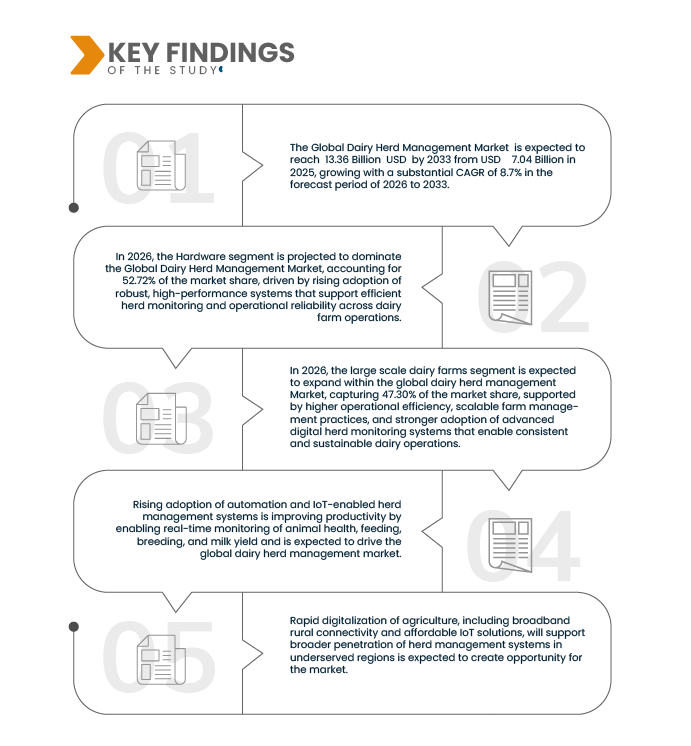
Data Bridge Market Research analyzes that the Global Dairy Herd Management Market size was valued at USD 7.03 billion in 2025 and is expected to reach USD 13.35 billion by 2033, at a CAGR of 8.7% during the forecast period.
Key Findings of the Study
“Rising Preference for Convenient and Ready-To-Use Foods is Driving Market Growth”
In recent years, changing lifestyles and evolving consumer preferences have significantly reshaped global food consumption patterns. With increasing urbanization, dual‑income households, and time‑constrained routines, convenience has become a defining factor influencing what people choose to eat. Ready‑to‑use and easy‑to‑prepare food products, including cheese spreads, fit seamlessly into this trend, as they require minimal preparation and can be incorporated into a variety of quick meals or snacks. Global authorities such as the Food and Agriculture Organization (FAO) have noted that diets are diversifying and that consumers tend to seek foods that simplify meal preparation and fit into faster‑paced daily schedules, a development tied with rising incomes and urban living.
Cheese spreads in particular benefit from this broader shift toward convenience foods. Unlike traditional cheeses that may require slicing, grating, or cooking, cheese spreads are ready to apply straight from the package, enhancing their appeal for busy consumers, families, and foodservice operators alike. They are versatile across applications — from quick breakfast toasts and sandwiches to dips for social gatherings — which further solidifies their position within the convenience segment of the dairy category.
Report Scope and Market Segmentation
|
Report Metric
|
Details
|
|
Forecast Period
|
2026 to 2033
|
|
Base Year
|
2025
|
|
Historic Years
|
2024 (Customizable to 2018-2023)
|
|
Quantitative Units
|
Revenue in USD Billions
|
|
Segments Covered
|
By Product (Hardware, Software, and Services), By Farm Size (Large-Scale Dairy Farms, Medium-Scale Dairy Farms, and Small-Scale Dairy Farms), By Herd Size (Below 100, Between 100 and 1,000, and Above 1,000), By Farm Type (Conventional Dairy Farms, Organic Dairy Farms, and Robotic Dairy Farms), By Interface (Web-Based and App/Software-Based), By Application (Preventative Care, Comfort and Heat Stress Management, Calf Management, Health Management, Feeding Management, Heat Detection, Milk Quality Management, Milk Harvesting, Breeding Management, and Others)
|
|
Countries Covered
|
Asia-Pacific China, Japan, South Korea, Taiwan, India, Vietnam, Singapore, Malaysia, Thailand, Philippines, Indonesia, Australia, New Zealand, Rest of Asia-Pacific.., North America, U.S., Canada, Mexico. , Europe, Germany, France, United Kingdom, Italy, Sweden, Netherlands, Switzerland, Spain, Finland, Norway, Denmark, Turkey, Belgium, Russia, Rest of Europe., South America, Brazil, Argentina, Colombia, Chile, Peru, Venezuela, Ecuador, Uruguay, Paraguay, Bolivia, Rest of South America.. Middle East and Africa U.A.E., Saudi Arabia, Israel, South Africa, Egypt, Qatar, Kuwait, Oman, Bahrain, Rest of Middle East and Africa
|
|
Market Players Covered
|
|
|
Data Points Covered in the Report
|
In addition to the insights on market scenarios such as market value, growth rate, segmentation, geographical coverage, and major players, the market reports curated by the Data Bridge Market Research also include in-depth expert analysis, pricing analysis, brand share analysis, consumer survey, demography analysis, supply chain analysis, value chain analysis, raw material/consumables overview, vendor selection criteria, PESTLE Analysis, Porter Analysis, and regulatory framework.
|
Segment Analysis
The global dairy herd management market is segmented into six notable segments based on the product, farm size, herd size, farm type, interface and application.
- On the basis of product, the Global Dairy Herd Management Market is segmented into hardware, software, and services
In 2026, the hardware segment is expected to dominate the market
In 2026, the hardware segment is expected to dominate the market with 52.72% share due to its critical role in on-farm data collection through sensors, monitoring devices, identification systems, and automation equipment, supported by increasing adoption of precision dairy technologies and the need for real-time herd performance tracking.
- On the basis of farm size, the Global Dairy Herd Management Market is segmented into large-scale dairy farms, medium-scale dairy farms, and small-scale dairy farms
In 2026, the large-scale dairy farms segment is expected to dominate the market
In 2026, the large-scale dairy farms segment is expected to dominate the market with 47.30% share and 9.0% CAGR due to higher herd volumes, greater investment capacity in digital management systems, and strong focus on productivity optimization, cost control, and operational efficiency.
- On the basis of herd size, the Global Dairy Herd Management Market is segmented into below 100, between 100 and 1,000, and above 1,000
In 2026, the between 100 and 1,000 segment is expected to dominate the market
In 2026, the between 100 and 1,000 segment is expected to dominate the market with 42.44% share and 8.7% CAGR due to its balanced scale of operations, growing transition toward semi-automated herd management practices, and increasing need for structured monitoring without full industrial automation.
- On the basis of farm type, the Global Dairy Herd Management Market is segmented into conventional dairy farms, organic dairy farms, and robotic dairy farms
In 2026, the conventional dairy farms segment is expected to dominate the market
In 2026, the conventional dairy farms segment is expected to dominate the market with 50.07% share and 8.4% CAGR due to their widespread presence across both developed and developing regions, established production practices, and gradual integration of herd management technologies into existing farm operations.
- On the basis of interface, the Global Dairy Herd Management Market is segmented into web-based and app/software-based
In 2026, the app/software-based segment is expected to dominate the market
In 2026, the app/software-based segment is expected to dominate the market with 61.82% share and 8.9% CAGR due to increasing smartphone penetration among farmers, ease of real-time access to herd data, remote monitoring capabilities, and improved user convenience for daily farm management activities.
- On the basis of application, the Global Dairy Herd Management Market is segmented into preventative care, comfort and heat stress management, calf management, health management, feeding management, heat detection, milk quality management, milk harvesting, breeding management, and others
In 2026, the health management segment is expected to dominate the market
In 2026, the health management segment is expected to dominate the market with 18.42% share and 9.1% CAGR due to rising focus on early disease detection, reduction in livestock mortality, improved milk yield consistency, and growing emphasis on animal welfare and long-term herd productivity.
Major Players
GEA Group Aktiengesellschaft (Germany), Afimilk Ltd. (Israel), Merck & Co., Inc. (U.S.), Alta Genetics Inc. (Canada), BouMatic (U.S.), Cowmanager (Netherlands), Dairymaster (Ireland), Datamars (Switzerland), DeLaval (Sweden), Delmer Group (U.K.), Fullwood JOZ (Netherlands), Herdlync (Ireland), Herdwatch (Ireland), BoviSync LLC (U.S.), Hokofarm Group (Denmark), Lely (Netherlands), Madero Dairy Systems, Inc. (U.S.), Milkline (Italy), Pru Apps Pvt. Ltd. (India), miRobot (Netherlands), FarmLogics (U.S.), Nedap N.V. (Netherlands), Orchid Farmtech (India), Pearson Milking Technology’s (U.S.), SUM-IT (Netherlands), Triolet (Netherlands), Vansun Technologies Private Limited (India), Dairykhata (India), Milkrite | InterPuls (U.K.), Censortec (Denmark), AgriWebb (Australia), FarmLog, Inc. (U.S.), SEMEX (Canada), Uniform-Agri (Netherlands), Vansun Milking (India)
Market Developments
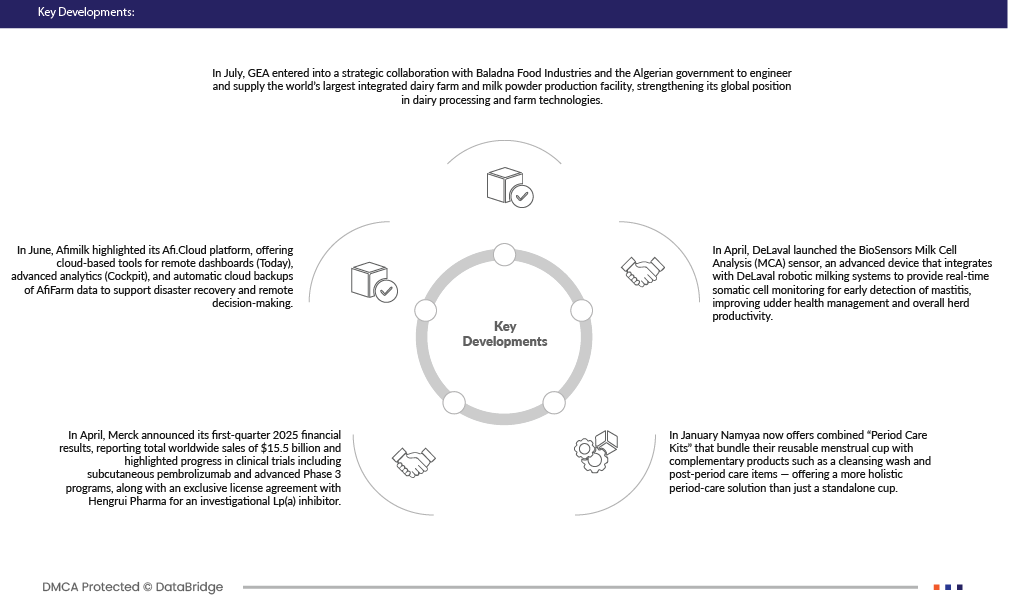
- In July 2025, Merck agreed to acquire Verona Pharma plc for approximately USD 10 Billion, adding its COPD therapy Ohtuvayre to Merck’s cardio‑pulmonary portfolio and expanding its respiratory treatment capabilities
- In July 2025, GEA entered into a strategic collaboration with Baladna Food Industries and the Algerian government to engineer and supply the world’s largest integrated dairy farm and milk powder production facility, strengthening its global position in dairy processing and farm technologies.
- In April 2025, DeLaval launched the BioSensors Milk Cell Analysis (MCA) sensor, an advanced device that integrates with DeLaval robotic milking systems to provide real‑time somatic cell monitoring for early detection of mastitis, improving udder health management and overall herd productivity.
- In January 2021, Namyaa now offers combined “Period Care Kits” that bundle their reusable menstrual cup with complementary products such as a cleansing wash and post-period care items — offering a more holistic period-care solution than just a standalone cup.
- In June 2024, Afimilk highlighted its Afi.Cloud platform, offering cloud‑based tools for remote dashboards (Today), advanced analytics (Cockpit), and automatic cloud backups of AfiFarm data to support disaster recovery and remote decision-making.
As per Data Bridge Market Research analysis:
For more detailed information about the Global Dairy Herd Management Marketreport, click here – https://www.databridgemarketresearch.com/reports/global-dairy-herd-management-market










