Explosive data consumption is one of the strongest drivers of the global dark fiber networks market. With the rapid growth of cloud computing, video streaming, AI/ML workloads, IoT devices, and real-time applications, global data traffic has surged exponentially. Enterprises and service providers now require massive bandwidth, ultra-low latency, and high-capacity connections that traditional lit services often struggle to deliver. Dark fiber enables users to “light” their own fiber infrastructure with advanced optical equipment, allowing them to scale bandwidth freely and handle large data volumes without relying on shared networks. This makes dark fiber highly attractive for data-intensive industries such as hyperscale data centers, telecom operators, financial services, and media companies. Additionally, the shift toward digital transformation, remote work, and cloud-first strategies further amplifies the pressure on network capacity. As applications become more data-intensive, ranging from 4K/8K streaming to AI model training, edge computing, and massive IoT deployments, organizations need dedicated, secure, high performance connectivity. Dark fiber provides the ideal foundation for supporting these growing and fluctuating data demands, delivering superior scalability, future-proof capacity, and operational control. As a result, explosive data growth continues to be a key driver of dark fiber adoption worldwide.
The relentless growth of global data consumption, driven by streaming, cloud computing, AI workloads, IoT, and a rising online population, is creating unprecedented demand for high-capacity, low-latency network infrastructure. Dark fiber offers a scalable, secure, and future-proof solution, enabling enterprises and service providers to meet these escalating bandwidth requirements and support the digital transformation of data intensive industries worldwide.
Access Full Report @ https://www.databridgemarketresearch.com/reports/global-dark-fiber-networks-market
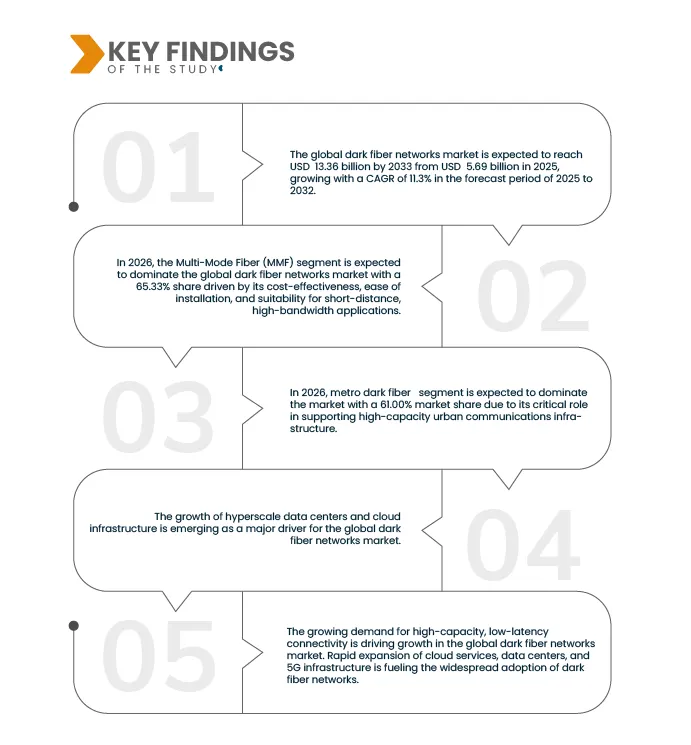
Data Bridge Market Research analyzes that the Global Dark Fiber Networks Market is expected to reach USD 13.36 billion by 2033 from USD 5.69 billion in 2025, growing with a substantial CAGR of 11.3% in the forecast period of 2026 to 2033.
Key Findings of the Study
Increasing Need for Secure and Private Network
Organizations across sectors, including finance, healthcare, and government, are prioritizing protecting sensitive data from cyber threats and unauthorized access. Dark fiber networks enable these entities to establish dedicated infrastructure, ensuring end-to-end control over network traffic and significantly reducing the risk of breaches associated with shared networks. As cybersecurity concerns continue to rise and regulatory requirements around data privacy become stricter, the need for isolated, high-performance networking solutions is fueling the adoption of dark fiber.
Moreover, private dark fiber networks offer unmatched flexibility and scalability, enabling organizations to tailor bandwidth and network performance according to their specific needs without relying on third-party providers. This level of control not only enhances security but also supports critical applications that require low latency and high reliability, such as cloud computing, data centers, and real-time financial transactions. As businesses increasingly prioritize secure, private communication channels to maintain operational integrity and protect sensitive information, demand for dark fiber infrastructure is expected to grow steadily, positioning it as a key driver of market expansion.
The growing emphasis on data security, privacy, and high-performance connectivity across industries is a key driver for the global dark fiber networks market. Organizations are increasingly investing in dedicated, private fiber infrastructure to safeguard sensitive information, ensure reliable performance, and future-proof their networks against emerging cyber threats. As regulatory pressures and cybersecurity concerns continue to rise, the demand for secure, flexible, and scalable dark fiber solutions is expected to accelerate, reinforcing its role as a critical enabler of modern digital infrastructure.
Report Scope and Market Segmentation
|
Report Metric
|
Details
|
|
Forecast Period
|
2026 to 2033
|
|
Base Year
|
2025
|
|
Historic Years
|
2024 (Customizable to 2018-2023)
|
|
Quantitative Units
|
Revenue in USD Billion
|
|
Segments Covered
|
Fiber Type (Multi-Mode Fiber (MMF) and Single-Mode Fiber (SMF)), Network Type (Metro Dark Fiber and Long-Haul Dark Fiber), Material (Glass Fiber and Plastic Optical Fiber (POF)), Application (Backhaul Connectivity, Data Center Interconnect (DCI), Enterprise & Private Networks, Long-Haul Transport, Redundancy & Network Resiliency, and Others), End User (IT & Telecommunications, BFSI, Government & Public Sector, Healthcare, Universities & Research Institutes, Industrial & Manufacturing, Media & Entertainment, Others), Sales Channel (Direct Sales and Indirect Sales)
|
|
Countries Covered
|
U.S., Canada, Mexico. Germany, U.K., France, Italy, Spain, Russia, Poland, Turkey, Netherlands, Belgium, Sweden, Portugal, Switzerland, Finland, Denmark, Norway, Rest of Europe. China, Japan, India, South Korea, Australia, Taiwan, Indonesia, Singapore, Vietnam, Thailand, Malaysia, Philippines, New Zealand, Rest of Asia Pacific. Saudi Arabia, U.A.E., South Africa, Israel, Egypt, Qatar, Kuwait, Oman, Bahrain, Rest of Middle East & Africa. Brazil, Argentina, Rest of South America
|
|
Market Players Covered
|
Lumen Technologies (U.S.), Crown Castle (U.S.), Zayo Group, LLC (U.S.), Colt Technology Services Group Limited (U.K.), Charter Communications (U.S.), Arelion (Sweden), CIRION (U.S.), Cogent Communications (U.S.), DQE Communications (U.S.), euNetworks (U.K.), Eurofiber (Netherlands), Everstream Solutions, LLC (U.S.), EXA Infrastructure (U.K.), Fiber Light, LLC (U.S.), First Light Fiber, Inc (U.S.), Frontier Communications Parent, Inc. (U.S.), Global Connect Group (Sweden), LIGHTPATH (U.S.), LuxConnect (Luxembourg), Lyntia Networks (Spain), PS Lightwave LLC (U.S.), Relined B.V (Netherlands), Retelit S.p.A (Italy), RETN NETWORKS LTD (U.K.), Segra (U.S.), Stealth Communications Services, LLC. (U.S.), Sterlite Power (India), UFINET (Spain), Uniti Corporation (U.S.), Verizon (U.S.)
|
|
Data Points Covered in the Report
|
In addition to the insights on market scenarios such as market value, growth rate, segmentation, geographical coverage, and major players, the market reports curated by the Data Bridge Market Research also include in-depth expert analysis, geographically represented company-wise production and capacity, network layouts of distributors and partners, detailed and updated price trend analysis and deficit analysis of supply chain and demand.
|
Segment Analysis
The global dark fiber networks market is segmented into six notable segments based on fiber type, network type, material, application, end user, and sales channel.
- On the basis of fiber type, the global dark fiber networks market is segmented into Single-Mode Fiber (SMF) and Multi-Mode Fiber (MMF)
In 2026, the Multi-Mode Fiber (MMF) segment is expected to dominate the global dark fiber networks market
In 2026, the Multi-Mode Fiber (MMF) segment is expected to dominate the market with a market share of 65.33% due to its cost-effectiveness, ease of installation, and suitability for short-distance, high-bandwidth applications. MMF supports efficient data transmission for enterprise networks, campus environments, and data centers, making it a preferred choice as organizations expand internal connectivity. Its lower deployment costs further accelerate widespread adoption across diverse industries.
- On the basis of network type, the global dark fiber networks market is segmented into metro dark fiber and long haul dark fiber
In 2026, the metro dark fiber segment is expected to dominate the global dark fiber networks market
In 2026, metro dark fiber segment dominates the market with a market share of 61.00% due to its critical role in supporting high-capacity urban communications infrastructure. Growing data traffic within metropolitan areas, driven by cloud services, 5G deployment, and dense enterprise clusters, fuels demand for scalable, low-latency fiber routes. Metro networks enable flexible bandwidth provisioning, making them ideal for service providers and enterprises seeking robust connectivity.
- On the basis of material, the market is segmented into glass fiber and Plastic Optical Fiber (POF). In 2026, the glass fiber segment is expected to dominate the market with a market share of 64.61%
- On the basis of application, the market is segmented into backhaul connectivity, Data Center Interconnect (DCI), enterprise & private networks, long-haul transport, redundancy & network resiliency and others. In 2026, the backhaul connectivity segment is expected to dominate the market with a market share of 42.23%
- On the basis of end user, the market is segmented into BFSI, IT & telecommunication, government & public sector, healthcare, universities & research institutes, media & entertainment, industrial & manufacturing and others. In 2026, the IT & telecommunication segment is expected to dominate the market with a market share of 49.87%
- On the basis of sales channel, the market is segmented into direct sales and indirect sales. In 2026, the direct sales segment is expected to dominate the market with a market share of 62.63%
Major Players
Data Bridge Market Research Analyses Lumen Technologies (U.S.), Crown Castle (U.S.), Zayo Group, LLC (U.S.), Colt Technology Services Group Limited (U.K.), Charter Communications (U.S.) as the major .players operating in the market
Market Developments
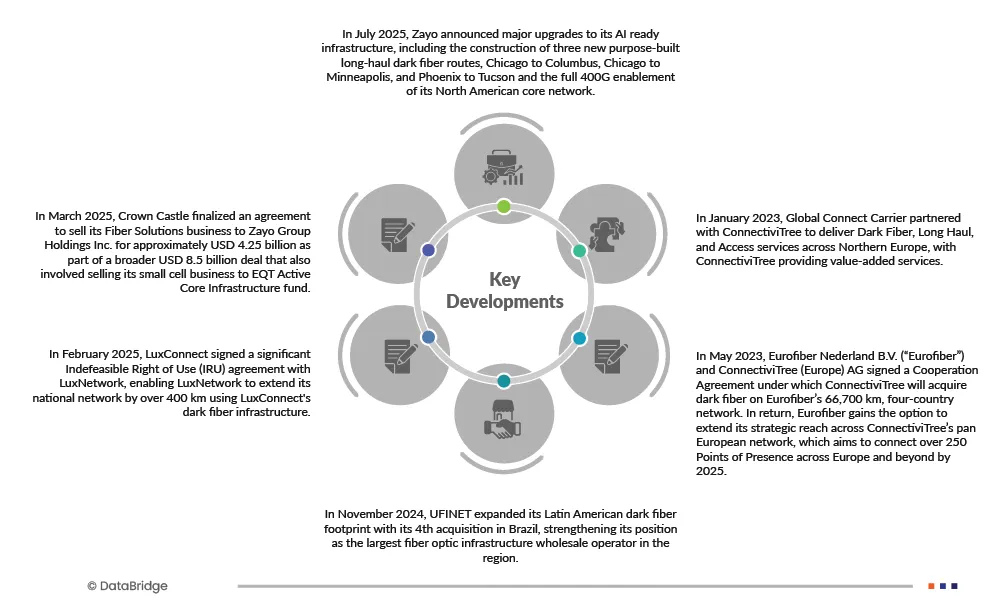
- In July 2025, Lumen Technologies announced it will provide the terrestrial dark fiber backhaul for the JUNO trans-Pacific cable system, linking Japan and the U.S. Lumen’s network connects the JUNO cable at Grover Beach, California, to major PoPs in San Jose and Los Angeles, enabling high-capacity, private network transport into key U.S. cloud hubs and enterprise networks. The partnership supports JUNO’s 350 Tbps capacity across 20 fiber pairs, leveraging SDM technology, and aims to facilitate next-generation AI, data-driven innovation, and seamless trans-Pacific connectivity for global enterprises
- In May 2025, Cirion expanded its network capacity by adding over 1,580 km of long-haul and 447 km of metro fiber routes in Latin America, boosting terrestrial optical network capacity to 668 Tb/s and enhancing data center interconnection and peering capabilities
- In March 2025, Crown Castle finalized an agreement to sell its Fiber Solutions business to Zayo Group Holdings Inc. for approximately USD 4.25 billion as part of a broader USD 8.5 billion deal that also involved selling its small cell business to EQT Active Core Infrastructure fund. This divestiture represents Crown Castle’s strategic refocus on its core tower infrastructure business while enabling Zayo to expand its fiber footprint and enhance connectivity solutions essential for supporting 5G, AI growth, cloud services, and enterprise customers across key U.S. metro areas
- In February 2025, LuxConnect signed a significant Indefeasible Right of Use (IRU) agreement with LuxNetwork, enabling LuxNetwork to extend its national network by over 400 km using LuxConnect's dark fiber infrastructure. This agreement guarantees service for 10 years and supports next-generation connectivity at 400 Gbps, enhancing Luxembourg’s digital infrastructure and European interconnections
- In January 2023, Global Connect Carrier partnered with ConnectiviTree to deliver Dark Fiber, Long Haul, and Access services across Northern Europe, with ConnectiviTree providing value-added services. The collaboration enables multiple-redundant routes, high-security, and low-latency connectivity, while also supporting future data center projects and geographic expansion. This partnership will strengthen Global Connect Carrier’s international network reach and solidify its position as a leading carrier in the Nordics.
Regional Analysis
Geographically, the countries covered in the global dark fiber networks market report are U.S., Canada, Mexico. Germany, U.K., France, Italy, Spain, Russia, Poland, Turkey, Netherlands, Belgium, Sweden, Portugal, Switzerland, Finland, Denmark, Norway, Rest of Europe. China, Japan, India, South Korea, Australia, Taiwan, Indonesia, Singapore, Vietnam, Thailand, Malaysia, Philippines, New Zealand, Rest of Asia Pacific. Saudi Arabia, U.A.E., South Africa, Israel, Egypt, Qatar, Kuwait, Oman, Bahrain, Rest of Middle East & Africa. Brazil, Argentina, Rest of South America.
As per Data Bridge Market Research analysis:
North America is the dominant and fastest growing region in the global dark fiber networks market during the forecast period of 2026 to 2033
The region is expected to maintain its lead due to its highly advanced telecommunications infrastructure, rapid 5G rollout, and the strong presence of major technology companies that rely on high-capacity, low-latency connectivity. North America’s mature data center ecosystem and widespread cloud adoption further accelerate demand for dark fiber. In addition, substantial investments in network modernization, rising internet traffic, and favorable regulatory policies continue to support fiber deployment. Collectively, these factors position North America as the leading and most dynamic market for dark fiber network growth worldwide.
For more detailed information about the global dark fiber networks market report, click here – https://www.databridgemarketresearch.com/reports/global-dark-fiber-networks-market