The increasing complexity of enterprise networking environments has led many organizations to adopt Software-Defined Wide Area Networking (SD-WAN) and WAN-as-a-Service (WANaaS) solutions to improve connectivity across geographically distributed branch locations. Traditional WAN infrastructures that rely heavily on static routing and dedicated MPLS circuits are often costly and difficult to scale, particularly as enterprises expand operations and shift toward cloud-based applications. SD-WAN-enabled WANaaS solutions allow enterprises to centrally manage network policies, dynamically provision connectivity, and intelligently route traffic across multiple links such as broadband, fiber, cellular, or MPLS based on application requirements and network performance. These service-based networking models, typically delivered through Network-as-a-Service (NaaS) platforms, provide organizations with centralized visibility, automated traffic management, integrated security, and faster deployment of branch connectivity. As enterprises increasingly rely on cloud services, remote work environments, and distributed digital operations, SD-WAN and WANaaS are becoming essential components for ensuring scalable, secure, and high-performance enterprise networking across modern branch infrastructures.
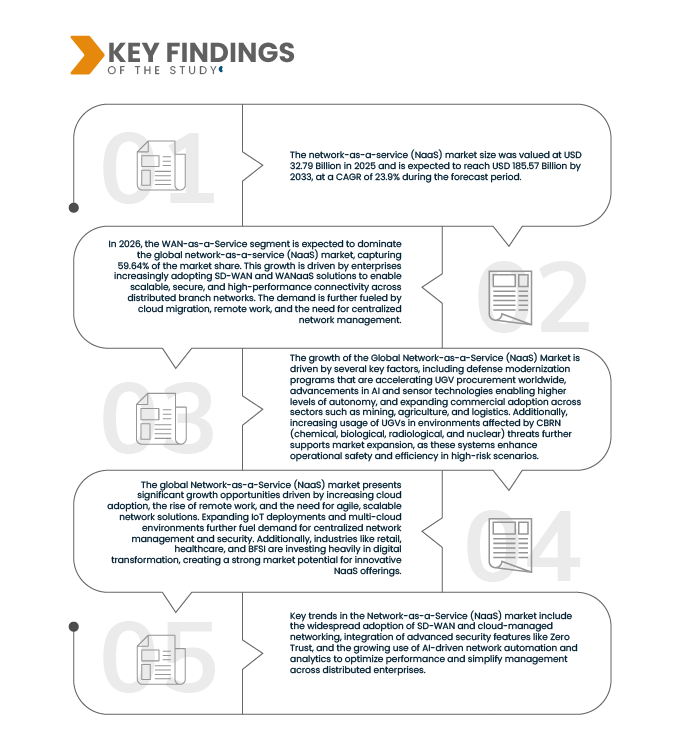
Data Bridge Market Research estimates that the Global Network-as-a-Service (NaaS) Market will grow from USD 32.79 billion in 2025 to USD 185.57 billion by 2033, registering a CAGR of 23.9% over the forecast period.
Key Findings of the Study
Growing Adoption of Sd-Wan A\and Wan-As-A-Service for Enterprise Branch Connectivity Optimization
The growing complexity of enterprise networking has accelerated the adoption of Software-Defined Wide Area Networking (SD-WAN) and WAN-as-a-Service (WANaaS) within the broader Network-as-a-Service (NaaS) market, as organizations seek more scalable, cost-effective, and flexible connectivity solutions. Traditional WANs relying on static routing and MPLS circuits are increasingly being replaced by software-defined architectures that enable centralized control, dynamic traffic management, and application-aware routing across distributed branch locations. SD-WAN-based NaaS solutions allow enterprises to securely connect headquarters, branches, cloud platforms, and remote users while optimizing performance through real-time traffic steering across multiple links such as broadband, fiber, and 5G. These capabilities are particularly critical for industries with large multi-site operations, including retail, banking, healthcare, and telecommunications. Additionally, cloud-based orchestration, integrated security features, and automated provisioning enhance network agility, reduce operational complexity, and support modern digital requirements such as remote work, SaaS adoption, and IoT integration, positioning SD-WAN-enabled WANaaS as a key enabler of next-generation enterprise networking.
Report Scope and Market Segmentation
|
Report Metric
|
Details
|
|
Forecast Period
|
2026 to 2033
|
|
Base Year
|
2025
|
|
Historic Years
|
2024 (Customizable from 2018-2023)
|
|
Quantitative Units
|
Revenue in USD Billion
|
|
Segments Covered
|
By Type (WAN-as-a-Service, LAN-as-a-Service, Security-as-a-Service (SECaaS) and Cloud Network-as-a-Service), By Offering (Service, Software and Hardware), By Application (Network Security and Access Control, Cloud-Based Network Management, Data Center and Branch Connectivity, Wide Area Network (WAN) Optimization, Virtual Private Network (VPN) Services, Unified Communication and Collaboration, IoT and Edge Networking and Others.), By Deployment Mode (Cloud and On-Premise), By End User (IT & Telecom, BFSI, Manufacturing, Healthcare & Life Sciences, Retail & E-Commerce, Government & Public Sector, Education, Energy & Utilities, Transportation & Logistics and Others), By Distribution Channel (Direct Sales and Indirect)
|
|
Market Players Covered
|
VMware (A part of Broadcom) (U.S.), Megaport (Australia), ARYAKA NETWORKS, INC. (U.S.), Akamai Technologies (U.S.), Cloudflare, Inc. (U.S.), Ciena Corporation (U.S.), Lumen Technologies (U.S.), Deutsche Telekom AG (Germany), Telefónica S.A. (Spain), Colt Technology Services Group Limited (U.K.), NTT DOCOMO BUSINESS, Inc. (Japan), Masergy (A part of Comcast Business) (U.S.), Extreme Networks (U.S.), PACKETFABRIC, INC. (U.S.), VERIZON COMMUNICATIONS INC. (U.S.), ERICSSON AB (Sweden), Cisco Systems, Inc. (U.S.), Nokia Corporation (Finland), AT&T Inc. (U.S.), Juniper Networks, Inc. (part of HPE) (U.S.), IBM CORPORATION (U.S.), MICROSOFT AZURE (U.S.), ORACLE (U.S.), BT GROUP (U.K.), Orange Business (France), Google LLC (ALPHABET INC.) (U.S.), Amazon Web Services, Inc. (U.S.), Tata Communications Limited (India).
|
|
Data Points Covered in the Report
|
In addition to the market insights such as market value, growth rate, market segments, geographical coverage, market players, and market scenario, the market report curated by the Data Bridge Market Research team includes in-depth expert analysis, import/export analysis, pricing analysis, production consumption analysis, and pestle analysis.
|
Segment Analysis
Global network-as-a-service (NaaS) market is categorized into six notable segments which are based on type, offering, application, deployment mode, end user, and distribution channel.
On the basis of type, global network-as-a-service (NaaS) market is segmented into WAN-as-a-Service, LAN-as-a-Service, Security-as-a-Service (SECaaS) and Cloud Network-as-a-Service.
In 2026, the Wan-As-A-Service segment is expected to dominate the Global Network-as-a-Service (NaaS) market
In 2026, the WAN-as-a-Service segment is expected to dominate the global network-as-a-service (NaaS) market, capturing 59.64% of the market share. This growth is driven by enterprises increasingly adopting SD-WAN and WANaaS solutions to enable scalable, secure, and high-performance connectivity across distributed branch networks. The demand is further fueled by cloud migration, remote work, and the need for centralized network management.
On the basis of offering, the global Network-as-a-Service (NaaS) market is segmented into Service, Software, Hardware.
In 2026, the Service segment dominates the Network-as-a-Service (NaaS) market
In 2026, the service segment is expected to dominate the global network-as-a-service (NaaS) market, holding a 52.23% share. This is driven by the growing adoption of managed NaaS solutions, which enable enterprises to outsource network management, optimize performance, and ensure security across distributed locations without investing heavily in on-premises hardware or software.
On the basis of application, the global network-as-a-service (NaaS) market is segmented into Network Security and Access Control, Cloud-Based Network Management, Data Center and Branch Connectivity, Wide Area Network (WAN) Optimization, Virtual Private Network (VPN) Services, Unified Communication and Collaboration, IoT and Edge Networking, Others.
In 2026, network security and access control segment dominates the network-as-a-service (NaaS) market
In 2026, the network security and access control segment is expected to dominate the global Network-as-a-Service (NaaS) market, holding a 20.55% share. This growth is driven by increasing enterprise focus on securing distributed networks, protecting cloud workloads, and managing access across multiple branch locations and remote users.
On the basis of deployment mode, the global network-as-a-service (NaaS) market is segmented into Cloud, On Premise.
In 2026, the cloud segment dominates the network-as-a-service (NaaS) market
In 2026, the cloud segment is expected to dominate the global Network-as-a-Service (NaaS) market, holding a 68.50% share. This growth is driven by the increasing adoption of cloud-based networking solutions that offer scalability, centralized management, and cost-efficiency, enabling enterprises to efficiently connect distributed branch offices, cloud applications, and remote users.
On the basis of end user, the global network-as-a-service (NaaS) market is segmented into IT & Telecom, BFSI, Manufacturing, Healthcare & Life Sciences, Retail & E-Commerce, Government & Public Sector, Education, Energy & Utilities, Transportation & Logistics, Others.
In 2026, the IT & telecom segment dominates the network-as-a-service (NaaS) market
In 2026, the IT & telecom segment is expected to dominate the global Network-as-a-Service (NaaS) market, holding a 45.43% share. This is driven by the sector’s high demand for scalable, secure, and high-performance network services to support cloud adoption, remote work, digital transformation initiatives, and distributed enterprise operations.
On the basis of distribution channel, the global Network-as-a-Service (NaaS) market is segmented into direct sales, indirect.
In 2026, the direct sales segment dominates the network-as-a-service (NaaS) market
In 2026, the Direct Sales segment is expected to dominate the global Network-as-a-Service (NaaS) market, holding a 63.84% share. This growth is driven by enterprises preferring direct engagement with NaaS providers to ensure customized solutions, better service-level agreements, and streamlined deployment of secure and scalable network services.
Major Players
"Data Bridge Market Research analyzes major players, including VMware (A part of Broadcom) (U.S.), Megaport (Australia), ARYAKA NETWORKS, INC. (U.S.), Akamai Technologies (U.S.), Cloudflare, Inc. (U.S.), Ciena Corporation (U.S.), Lumen Technologies (U.S.), Deutsche Telekom AG (Germany), Telefónica S.A. (Spain), Colt Technology Services Group Limited (U.K.), NTT DOCOMO BUSINESS, Inc. (Japan), Masergy (A part of Comcast Business) (U.S.), Extreme Networks (U.S.), PACKETFABRIC, INC. (U.S.), VERIZON COMMUNICATIONS INC. (U.S.), ERICSSON AB (Sweden), Cisco Systems, Inc. (U.S.), Nokia Corporation (Finland), AT&T Inc. (U.S.), Juniper Networks, Inc. (part of HPE) (U.S.), IBM CORPORATION (U.S.), MICROSOFT AZURE (U.S.), ORACLE (U.S.), BT GROUP (U.K.), Orange Business (France), Google LLC (ALPHABET INC.) (U.S.), Amazon Web Services, Inc. (U.S.) and Tata Communications Limited (India).
Market Developments
- In November 2025, Cisco has unveiled enhancements to its secure enterprise network architecture to meet the demands of the AI era, introducing innovations like cloud‑managed fabrics, AI‑powered automation, and simplified deployment tools that allow enterprises to provision and secure networks quickly at scale. These updates also embed advanced security and high‑performance connectivity. This strengthens Cisco’s leadership in AI‑ready enterprise networking by enabling faster, more secure deployments and tapping growing demand from organizations modernizing infrastructure for distributed AI applications.
- In October 2024, AT&T has introduced an innovative integrated gateway that combines ultra fast fiber broadband with built in 5G wireless backup in a single device for business customers ordering 1 Gbps or higher, ensuring continuous connectivity even if the primary fiber link experiences an outage. The gateway also supports advanced Wi Fi 6E technology. This product strengthens AT&T’s competitive edge in business connectivity by offering a unified, resilient solution that enhances uptime and reliability for enterprise customers.
- In July 2025, Juniper Networks has officially become part of Hewlett Packard Enterprise following the completion of HPE’s approximately $14 billion acquisition, combining Juniper’s AI-native networking technologies with HPE’s enterprise IT portfolio to deliver a comprehensive cloud-native, AI-driven networking stack. The integration strengthens Juniper’s capabilities in routers, switching, security, and AI-driven network management while expanding its global reach through HPE’s hybrid cloud and edge-to-cloud ecosystem.
- In November 2024, VMware announced advancements in the VMware Cloud Foundation platform, including expanded data services and tools to support faster application development, stronger data governance, and improved operational efficiency. The company also introduced new security and networking capabilities, such as AI-driven threat detection and enhanced load-balancing technologies, to strengthen enterprise cybersecurity and performance.
- In July 2023, VMware announced the launch of a NSX Advanced Threat Prevention (ATP) Point of Presence (PoP) in Sydney, Australia, aimed at strengthening cybersecurity protection for organizations against ransomware and other advanced cyber threats. The new local PoP provides on-shore capabilities to detect and respond to sophisticated attacks in real time, helping reduce the risk of data breaches and speeding up incident response.
As per Data Bridge Market Research analysis:
For more detailed information about Network-as-a-Service (NaaS) Market click here – https://www.databridgemarketresearch.com/reports/global-network-service-market