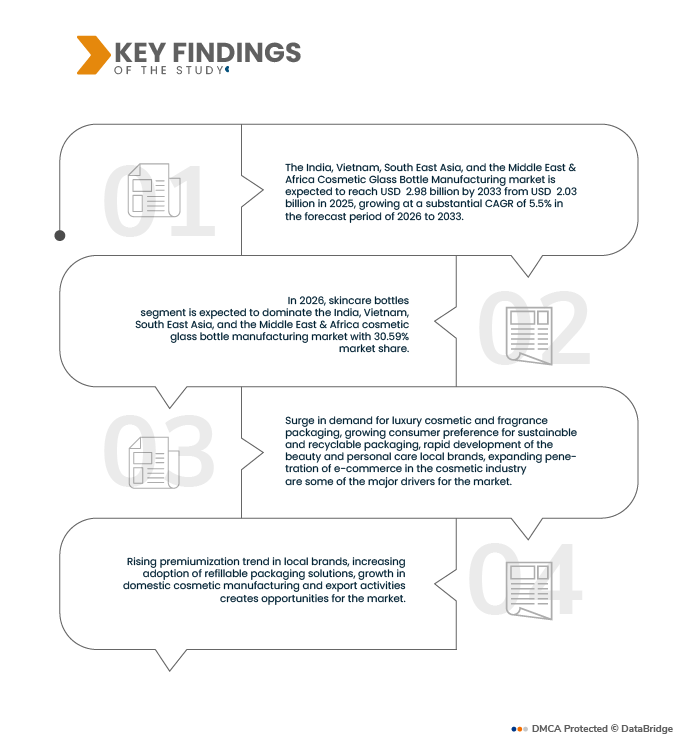
Rising consumption of luxury cosmetics and premium fragrances is significantly driving demand for cosmetic glass bottle manufacturing across India, Vietnam, Southeast Asia, and the Middle East & Africa. Glass packaging is widely preferred by premium beauty brands due to its transparency, durability, chemical stability, and high-end aesthetic appeal, which strengthens brand positioning and product differentiation. Strong fragrance consumption trends, particularly in the UAE, where luxury perfumes dominate sales and retail performance remains robust, are directly increasing demand for decorative, customized, and refillable glass bottles. High consumer spending on premium beauty products and growing urban middle- and high-income populations are further supporting sustained market growth.
Similar momentum is emerging in India and Southeast Asia, where rising disposable incomes and evolving consumer preferences are encouraging cosmetic companies to launch luxury skincare and fragrance products packaged in high-quality glass containers. Packaging innovations such as lightweight bottles, refillable jars, and sustainable glass solutions introduced by manufacturers are also aligning with luxury and environmental trends. Overall, increasing demand for premium beauty products, combined with advancements in aesthetic and eco-friendly packaging, is expected to remain a key growth driver for the cosmetic glass bottle manufacturing market in these emerging regions.
Access Full Report @ https://www.databridgemarketresearch.com/reports/india-vietnam-south-east-asia-middle-east-and-africa-cosmetic-glass-bottle-manufacturing-market
Data Bridge market research analyzes that India, Vietnam, South East Asia, and the Middle East & Africa Cosmetic Glass Bottle Manufacturing Market is expected to reach USD 2.98 billion by 2033 from USD 2.03 billion in 2025, growing with a substantial CAGR of 5.5%in the forecast period of 2026 to 2033.
Key Findings of the Study
RISING PREMIUMIZATION TREND IN LOCAL BRANDS
The increasing premiumization among local beauty and personal care brands is creating strong growth opportunities for the cosmetic glass bottle manufacturing market across India, Vietnam, Southeast Asia, and the Middle East & Africa. Local companies are repositioning their products as high-quality, niche, or luxury offerings to differentiate from mass-market competitors and attract affluent, urban, and aspirational consumers. Glass packaging is widely preferred in this shift due to its clarity, weight, durability, and ability to support decorative finishes such as embossing, metallic coatings, and customized shapes. These features help brands communicate exclusivity, enhance shelf appeal, and strengthen premium brand perception. Rising disposable incomes, increasing skincare awareness, and growing domestic cosmetic production are further encouraging local brands to adopt aesthetically appealing glass bottles and jars.
At the same time, packaging manufacturers are responding to this demand by introducing innovative, sustainable, and customizable premium glass solutions tailored for emerging markets. Launches such as refillable luxury glass collections, decorative limited-edition bottles, and high-clarity containers with recycled content reflect growing collaboration between packaging suppliers and regional beauty brands. In markets like Southeast Asia and the Middle East, where consumers show strong willingness to pay for premium presentation, glass packaging is becoming a key branding tool for boutique cosmetic and fragrance companies. Overall, the premiumization trend among local brands is expected to sustain long-term demand for advanced, visually distinctive, and environmentally responsible cosmetic glass packaging solutions.
Report Scope and Market Segmentation
|
Report Metric
|
Details
|
|
Forecast Period
|
2026 to 2033
|
|
Base Year
|
2025
|
|
Historic Years
|
2024 (Customizable to 2018-2023)
|
|
Quantitative Units
|
Revenue in USD billion
|
|
Segments Covered
|
By Product Type (Skincare Bottles, Perfume Bottles, Cosmetics Bottles, Serum Bottles, Room Freshener Glass Containers, Other Cosmetic Glass Packaging), By Offering (Components, Services), By Shape (Boston Round Bottles, Jar Glass Containers, Square Glass Bottles, Tubular Glass Bottles, Decorated Bottles, Others), By Application (Skincare, Perfume & Fragrance, Cosmetics (Foundation, Makeup Remover, etc.), Hair Care, Room Freshener Glass Containers, Nail Care, Others), By Manufacturing Process (Blow And Blow Process, Press And Blow Process, Tube Forming, Handmade / Artisanal), By Capacity (30 ml To 100 ml, 100 ml To 250 ml, Less Than 30 ml, Above 250 ml), By End User (Cosmetic Brands, Contract Manufacturers, Private Label Manufacturers, Beauty Salons & Spas, Others), By Distribution Channel (Direct Sales, Wholesalers & Distributors, Retail, Online Platforms)
|
|
Countries Covered
|
|
|
Market Players Covered
|
|
|
Data Points Covered in the Report
|
In addition to the market insights such as market value, growth rate, market segments, geographical coverage, market players, and market scenario, the market report curated by the Data Bridge Market Research team includes in-depth expert analysis, import/export analysis, pricing analysis, production consumption analysis, and pestle analysis.
|
Segment Analysis
The India, Vietnam, South East Asia, and the Middle East & Africa Cosmetic Glass Bottle Manufacturing Market is segmented into seven notable segments based on product type, shape, application, manufacturing process, capacity, end user, and distribution channel..
- On the basis of product type, the India, Vietnam, Southeast Asia, and Middle East & Africa Cosmetic Glass Bottle Manufacturing Market is segmented into Skincare Bottles, Perfume Bottles, Cosmetics Bottles, Serum Bottles, Room Freshener Glass Containers, and Other Cosmetic Glass Packaging
In 2026, the Skincare Bottles segment is expected to dominate the market
In 2026, the Skincare Bottles segment is expected to dominate the India, Vietnam, South East Asia, and the Middle East & Africa Cosmetic Glass Bottle Manufacturing market share of 30.59% due to rapid growth of skincare product consumption across emerging beauty markets. Increasing demand for facial serums, creams, lotions, and dermatological skincare solutions has significantly increased the need for high-quality glass packaging. Skincare formulations often require chemically stable and non-reactive packaging, making glass bottles a preferred choice for premium skincare brands and cosmetic manufacturers.
- On the basis of shape, the market is segmented into Boston Round Bottles, Jar Glass Containers, Square Glass Bottles, Tubular Glass Bottles, Decorated Bottles, and Others
In 2026, the Boston Round Bottles segment is expected to dominate the market
In 2026, Boston Round Bottles segment is expected to dominate the India, Vietnam, South East Asia, and the Middle East & Africa Cosmetic Glass Bottle Manufacturing market share of 30.45% due to its versatile design, structural durability, and compatibility with a wide range of cosmetic products including serums, essential oils, lotions, and skincare formulations. Boston round bottles provide excellent product protection, ease of handling, and aesthetic appeal, making them widely adopted by cosmetic brands and contract manufacturers.
- On the basis of application, the market is segmented into Skincare, Perfume & Fragrance, Cosmetics (Foundation, Makeup Remover, etc.), Hair Care, Room Freshener Glass Containers, Nail Care, and Others.
In 2026, the Skincare segment is expected to dominate the market
In 2026, the Skincare segment is anticipated to dominate the India, Vietnam, South East Asia, and the Middle East & Africa Cosmetic Glass Bottle Manufacturing market share of 29.99% due to the strong growth of skincare product demand across India, Southeast Asia, and the Middle East. Rising consumer awareness regarding skincare routines, increasing demand for anti-aging products, and the expansion of premium skincare brands are significantly driving the use of glass bottles for packaging serums, creams, oils, and dermatological products.
- On the basis of manufacturing process, the market is segmented into Blow and Blow Process, Press and Blow Process, Tube Forming, and Handmade / Artisanal
In 2026, the Blow and Blow Process segment is expected to dominate the market
In 2026, the Blow and Blow Process segment is anticipated to dominate the India, Vietnam, South East Asia, and the Middle East & Africa Cosmetic Glass Bottle Manufacturing market share of 44.84% due to its efficiency in producing hollow glass containers such as bottles used in cosmetic packaging. This manufacturing process enables large-scale production with consistent wall thickness, improved structural strength, and high productivity, making it the most widely used technique for cosmetic glass bottle manufacturing.
- On the basis of capacity, the market is segmented into Less than 30 ml, 30 ml to 100 ml, 100 ml to 250 ml, and above 250 ml
In 2026, the 30 ml to 100 ml segment is expected to dominate the market
In 2026, the 30 ml to 100 ml segment is anticipated to dominate the India, Vietnam, South East Asia, and the Middle East & Africa Cosmetic Glass Bottle Manufacturing market share of 38.00% due to its suitability for packaging skincare serums, lotions, oils, and cosmetic treatments that are commonly sold in medium-sized containers. This capacity range offers convenience for consumers while allowing cosmetic brands to package premium products in compact and travel-friendly formats.
- On the basis of end user, the market is segmented into Cosmetic Brands, Contract Manufacturers, Private Label Manufacturers, Beauty Salons & Spas, and Others.
In 2026, the Cosmetic Brands segment is expected to dominate the market
In 2026, the Cosmetic Brands segment is anticipated to dominate the India, Vietnam, South East Asia, and the Middle East & Africa Cosmetic Glass Bottle Manufacturing market share of 31.99% due to major beauty companies increasingly invest in differentiated packaging to strengthen product positioning and brand identity. Cosmetic brands are the primary buyers of glass bottles for packaging skincare, fragrance, and personal care products, contributing significantly to overall demand in the marke.
- On the basis of distribution channel, the market is segmented into Direct Sales, Wholesalers & Distributors, Retail, and Online Platforms
In 2026, the Direct Sales segment is expected to dominate the market
In 2026, the Direct Sales segment is anticipated to dominate the India, Vietnam, South East Asia, and the Middle East & Africa Cosmetic Glass Bottle Manufacturing market share of 41.96% due to cosmetic glass bottle manufacturers frequently supply packaging directly to cosmetic brands and contract manufacturers through long-term supply agreements. Direct sales enable manufacturers to provide customized bottle designs, maintain production consistency, and build strategic partnerships with cosmetic companies requiring large-volume packaging supplies.
Major Players
Gerresheimer AG (Germany), SGD Pharma (France), PGP Glass (India), HINDUSTAN NATIONAL GLASS & INDUSTRIES LTD. (India), HEINZ-GLAS GmbH & Co. KGaA (Germany) among others.
Latest Developments in India, Vietnam, South East Asia, and the Middle East & Africa Cosmetic Glass Bottle Manufacturing Market
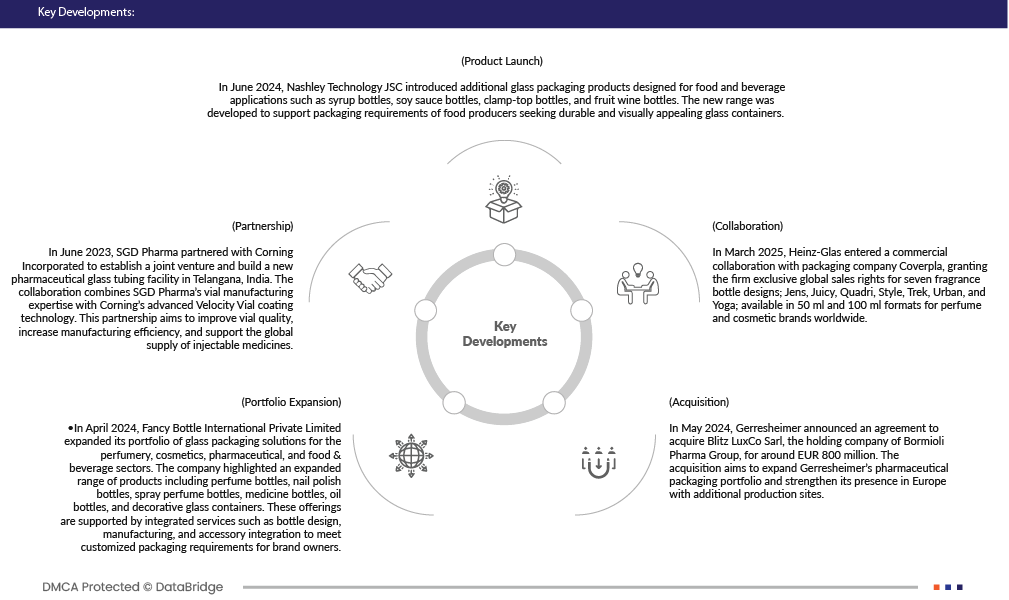
- In January 2025, Gerresheimer introduced its Connected Packaging platform for the beauty industry, which integrates digital technologies such as QR codes and NFC tags into packaging. This innovation turns product packaging into a digital touchpoint that allows brands to interact with customers, provide personalized offers, and gather consumer insights.
- In March 2025, Heinz-Glas entered a commercial collaboration with packaging company Coverpla, granting the firm exclusive global sales rights for seven fragrance bottle designs; Jens, Juicy, Quadri, Style, Trek, Urban, and Yoga; available in 50 ml and 100 ml formats for perfume and cosmetic brands worldwide.
- In June 2023, SGD Pharma partnered with Corning Incorporated to establish a joint venture and build a new pharmaceutical glass tubing facility in Telangana, India. The collaboration combines SGD Pharma’s vial manufacturing expertise with Corning’s advanced Velocity Vial coating technology. This partnership aims to improve vial quality, increase manufacturing efficiency, and support the global supply of injectable medicines.
- In February 2026, HNGIL with the Madhvani Turner Group, is shifting its strategic focus toward premium and health oriented glass packaging, emphasizing high margin segments like food, beverage and pharmaceutical containers to meet rising quality and safety needs. The company highlights glass’s purity and inert properties as key advantages in preserving product taste and consumer trust while leveraging its national manufacturing scale. This strategic pivot supports HNGIL’s product premiumization and positions its glass solutions as a healthier, high quality alternative in growing packaging markets.
- In April 2024, Fancy Bottle International Private Limited expanded its portfolio of glass packaging solutions for the perfumery, cosmetics, pharmaceutical, and food & beverage sectors. The company highlighted an expanded range of products including perfume bottles, nail polish bottles, spray perfume bottles, medicine bottles, oil bottles, and decorative glass containers. These offerings are supported by integrated services such as bottle design, manufacturing, and accessory integration to meet customized packaging requirements for brand owners.
For more detailed information about the India, Vietnam, South East Asia, and the Middle East & Africa Cosmetic Glass Bottle Manufacturing Market report, click here – https://www.databridgemarketresearch.com/reports/india-vietnam-south-east-asia-middle-east-and-africa-cosmetic-glass-bottle-manufacturing-market