The expansion of commercial cut flower export infrastructure has become a key growth driver for the floriculture market across Colombia, Ecuador, Kenya, and major Asia-Pacific producing countries. Investments in modern packhouses, cold storage facilities, cargo terminals, and refrigerated logistics networks are improving the efficiency of flower handling from farms to international markets.
For Instance,
- In May 2026, Colombia's Ministry of Commerce, Industry and Tourism (MinCIT), in collaboration with Asocolflores, continued implementing the Plan Pétalo initiative to strengthen flower export logistics through coordinated airport operations, trade facilitation measures, security enhancements, and supply chain optimization, enabling efficient international shipment of flowers during peak export seasons.
These developments help maintain flower freshness, reduce post-harvest losses, and support year-round exports of premium-quality cut flowers. Improved connectivity between production regions and international airports is further strengthening the competitiveness of exporters in Asia-Pacific, Middle East & Africa, Colombia & Ecuador markets.
For Example
- In February 2024, Colombia's Ministry of Agriculture and Rural Development highlighted that continued government support for export promotion programs, technical assistance, and international market development strengthened the country's floriculture export chain, with flowers accounting for nearly 75% of Colombia's air export cargo, reinforcing the importance of specialized export infrastructure.
Expansion of specialized air cargo services, digital export documentation systems, and quality inspection facilities has reduced transit delays and improved supply chain reliability. Growing investment in production hubs across Southeast Asia and established export centers in Colombia, Ecuador, and Kenya is enabling producers to meet rising international demand while complying with stringent quality and phytosanitary standards. Collectively, these infrastructure advancements and collaborative initiatives are supporting higher export volumes and reinforcing the Asia-Pacific, Middle East & Africa, Colombia & Ecuador position of key flower-producing regions.
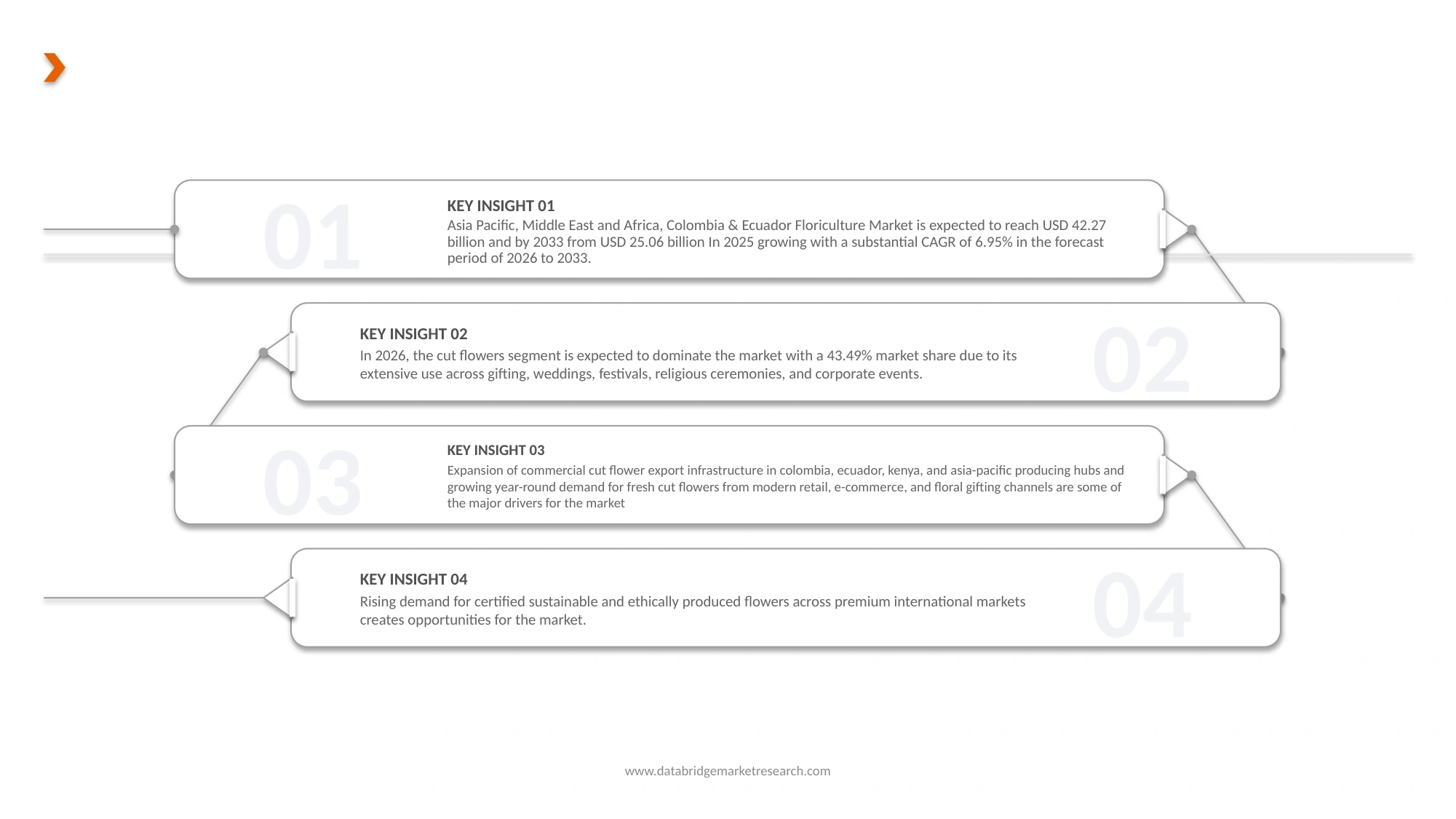
The expansion of commercial cut flower export infrastructure across Colombia, Ecuador, Kenya, and Asia-Pacific producing hubs is strengthening Asia-Pacific, Middle East & Africa, Colombia & Ecuador floriculture supply chains by improving logistics efficiency and product quality. Continued investments in cold chain facilities, air cargo capacity, and export support infrastructure are expected to enhance international competitiveness and sustain long-term market growth.
Access Full Report @ https://www.databridgemarketresearch.com/reports/asia-pacific-middle-east-and-africa-columbia-and-ecuador-floriculture-market
Data Bridge market research analyzes that the Asia-Pacific, Middle East and Africa, Colombia & Ecuador Floriculture Market is expected to reach USD 42.27 billion and by 2033 from USD 25.06 billion In 2025 growing with a substantial CAGR of 6.95% in the forecast period of 2026 to 2033.
Key Findings of the Study
Increasing Adoption of Protected Floriculture Cultivation Using Greenhouses and Precision Irrigation Systems
The increasing adoption of protected floriculture cultivation through greenhouses and precision irrigation systems is transforming flower production across major producing regions. Controlled growing environments enable growers to regulate temperature, humidity, light intensity, and pest exposure, resulting in improved flower quality, higher yields, and year-round cultivation. These technologies are particularly valuable for high-value cut flowers, where consistency in stem length, color, and bloom quality is essential for domestic and export markets. As a result, growers are increasingly investing in modern cultivation systems to enhance productivity and reduce climate-related production risks.
For instance,
- In May 2026, the ICAR-Indian Agricultural Research Institute organized a Rose Stakeholder Meet highlighting advanced greenhouse cultivation, precision irrigation, fertilizer management, and post-harvest technologies to improve productivity, sustainability, and profitability in commercial rose cultivation, encouraging wider adoption of protected floriculture systems.
In parallel, precision irrigation technologies such as drip irrigation, automated fertigation, and sensor-based water management are improving resource efficiency while supporting sustainable floriculture practices. These systems optimize water and nutrient application, reduce input wastage, and improve crop health under varying climatic conditions.
For instance,
- In September 2022, the Food and Agriculture Organization (FAO) emphasized that greenhouse cultivation combined with drip irrigation and precision water management could improve resource-use efficiency, enhance flower quality, and reduce climate-related production risks in commercial floriculture systems.
Additionally, agricultural research organizations such as ICAR have been supporting growers through technical guidance, stakeholder programs, and research-based recommendations to encourage the adoption of greenhouse and precision cultivation methods. Consequently, the widespread adoption of greenhouse cultivation and precision irrigation is strengthening production efficiency, ensuring consistent flower supply, and enhancing the Asia-Pacific, Middle East & Africa, Colombia & Ecuador competitiveness of the floriculture industry.
The increasing adoption of greenhouse cultivation and precision irrigation is enhancing the efficiency, quality, and sustainability of commercial floriculture production. These technologies are enabling growers to achieve higher productivity, optimize resource use, and meet the rising demand for premium flowers in domestic and export markets.
Report Scope and Market Segmentation
|
Report Metric
|
Details
|
|
Forecast Period
|
2025 to 2032
|
|
Base Year
|
2024
|
|
Historic Years
|
2023 (Customizable to 2018-2022)
|
|
Quantitative Units
|
Revenue in USD billion
|
|
Segments Covered
|
By Product Form (Cut Flowers, Potted Flowering Plants, Bedding and Garden Plants, Foliage Plants, Propagation Materials), Flower Type (Rose, Chrysanthemum, Orchid, Lily, Gerbera, Carnation, Tulip, Other Flower Types), Plant Life Cycle (Perennial Plants, Annual Plants, Biennial Plants), End User Application (Personal and Household Use, Religious and Ceremonial Use, Events and Social Functions, Commercial Landscaping, Institutional And Public Spaces), Cultivation Environment (Protected Cultivation, Open Field Cultivation), Distribution Channel (Wholesale Markets & Auctions, Direct Sales, Florists & Specialty Stores, Online Retail, Garden Centers & Nurseries), Buyer Type (Individual Consumers, Commercial Buyers, Institutional Buyers)
|
|
Countries Covered
|
Asia- Pacific
Middle East
Africa
Colombia
Ecuador
|
|
Market Players Covered
|
|
|
Data Points Covered in the Report
|
In addition to the insights on market scenarios such as market value, growth rate, segmentation, geographical coverage, and major players, the market reports curated by the Data Bridge Market Research also include innovation tracker and strategic analysis, technological advancements, climate change scenario, supply chain analysis, value chain analysis, vendor selection criteria, PESTLE Analysis, Porter Analysis, patent analysis, industry eco-system analysis, raw material coverage, tariffs and their impact on market, regulation coverage, consumer buying behavior, brand outlook, cost analysis breakdown, and regulatory framework.
|
Segment Analysis
Asia Pacific, Middle East and Africa, Colombia & Ecuador Floriculture market is categorized into seven notable segments which are based on product form, flower type, plant life cycle, end user application, cultivation environment, distribution channel, and buyer type.
- On the basis of product form, the Asia-Pacific, Middle East & Africa, Colombia & Ecuador floriculture market is segmented into cut flowers, potted flowering plants, bedding and garden plants, foliage plants, and propagation materials.
In 2026, the cut flowers segment is expected to dominate the market
In 2026, the cut flowers segment is expected to dominate the market with a 43.49% market share due to its extensive use across gifting, weddings, festivals, hospitality, religious ceremonies, and corporate events. Their strong consumer appeal, wide variety of flower choices, established cold-chain logistics, and high demand from florists, supermarkets, and export markets contribute to greater commercial value and continuous purchasing throughout the year, making cut flowers the leading product form in the regional floriculture market
- On the basis of flower type, the Asia-Pacific, Middle East & Africa, Colombia & Ecuador floriculture market is segmented into rose, chrysanthemum, orchid, lily, gerbera, carnation, tulip, and other flower types.
In 2026, the rose segment is expected to dominate the market
In 2026, the rose segment is expected to dominate the market with a 30.32% market share due to its universal acceptance for gifting, celebrations, weddings, hospitality decoration, and premium floral arrangements. Roses are cultivated extensively across major producing countries, offer numerous color and variety options, possess strong export demand, and maintain consistent consumer preference, supporting their position as the largest flower type across domestic and international floriculture markets.
- On the basis of plant life cycle, the Asia-Pacific, Middle East & Africa, Colombia & Ecuador floriculture market is segmented into perennial plants, annual plants, and biennial plants.
In 2026, the perennial plants segment is expected to dominate the market
In 2026, the perennial plants segment is expected to dominate the market with a 75.76% market share due to their long productive lifespan, repeated flowering cycles, and extensive commercial cultivation for both cut flower production and ornamental landscaping. Perennial flowers provide higher economic returns over multiple growing seasons, reduce replanting requirements, and include several high-value species such as roses, orchids, lilies, and carnations that experience sustained market demand throughout the region.
- On the basis of end-use application, the Asia-Pacific, Middle East & Africa, Colombia & Ecuador floriculture market is segmented into personal and household use, religious and ceremonial use, events and social functions, commercial landscaping, and institutional and public spaces.
In 2026, the personal and household use segment is expected to dominate the market
In 2026, the personal and household use segment is expected to dominate the market with a 32.97% market sharedue to increasing consumer spending on home decoration, indoor plants, gifting, festive celebrations, and everyday ornamental purchases. Growing urbanization, rising disposable incomes, expanding online flower delivery services, and greater awareness of the aesthetic and wellness benefits of ornamental plants continue to strengthen household demand across the covered regions.
- On the basis of cultivation environment, the Asia-Pacific, Middle East & Africa, Colombia & Ecuador floriculture market is segmented into protected cultivation and open field cultivation.
In 2026, the protected cultivation segment is expected to dominate the market
In 2026, the protected cultivation segment is expected to dominate the market with a 71.72% market share due to its ability to provide controlled growing conditions that improve flower quality, increase yields, extend production seasons, and reduce weather-related risks. Greenhouses and shade-net structures enable the cultivation of premium flowers with uniform quality, supporting export standards and consistent year-round supply for domestic and international markets.
- On the basis of distribution channel, the Asia-Pacific, Middle East & Africa, Colombia & Ecuador floriculture market is segmented into wholesale markets & auctions, direct sales, florists & specialty stores, online retail, and garden centers & nurseries.
In 2026, the wholesale markets & auctions segment is expected to dominate the market
In 2026, the wholesale markets & auctions segment is expected to dominate the market with a 41.14% market share due to their role as the primary trading platform connecting growers, exporters, distributors, and commercial buyers. These channels facilitate large-volume transactions, efficient price discovery, standardized quality grading, and rapid product distribution, making them the preferred sales route for commercial floriculture businesses across regional and export markets.
- On the basis of buyer type, the Asia-Pacific, Middle East & Africa, Colombia & Ecuador floriculture market is segmented into individual consumers, commercial buyers, and institutional buyers.
In 2026, the individual consumers segment is expected to dominate the market
In 2026, the individual consumers segment is expected to dominate the market with a 41.57% market share due to strong demand for flowers and ornamental plants for gifting, home decoration, festivals, personal celebrations, and everyday aesthetic purposes. Rising household spending, improved retail accessibility, expanding e-commerce platforms, and increasing interest in gardening and indoor greenery continue to support higher purchasing volumes from individual consumers than other buyer categories.
Major Players
TAKII & CO., LTD. (Kyoto, Japan), Dümmen Orange (De Lier, Netherlands), Ball Horticultural Company (West Chicago, Illinois, USA), Black Tulip Group (Hillegom, Netherlands), Sunshine Bouquet (Singapore) among others.
Latest Developments in Floriculture market
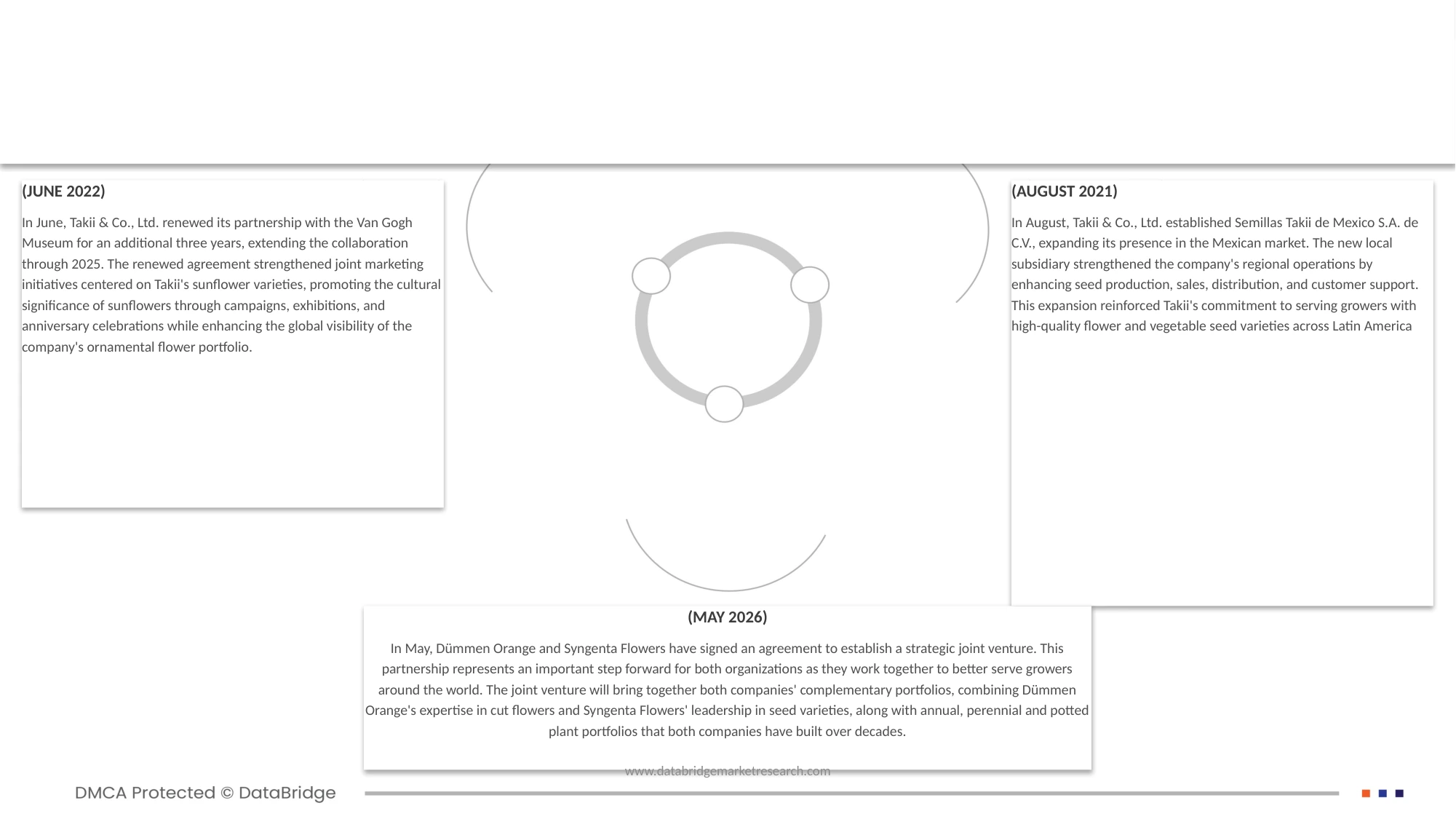
- In June 2022, Takii & Co., Ltd. renewed its partnership with the Van Gogh Museum for an additional three years, extending the collaboration through 2025. The renewed agreement strengthened joint marketing initiatives centered on Takii’s sunflower varieties, promoting the cultural significance of sunflowers through campaigns, exhibitions, and anniversary celebrations while enhancing the Asia-Pacific, Middle East & Africa, Colombia & Ecuador visibility of the company’s ornamental flower portfolio.
- In May 2026, Dümmen Orange and Syngenta Flowers have signed an agreement to establish a strategic joint venture. This partnership represents an important step forward for both organizations as they work together to better serve growers around the world. The joint venture will bring together both companies’ complementary portfolios, combining Dümmen Orange’s expertise in cut flowers and Syngenta Flowers’ leadership in seed varieties, along with annual, perennial and potted plant portfolios that both companies have built over decades.
- In September 2024, Dümmen Orange, in collaboration with the Naturalis Biodiversity Center, has won the Plantum Sustainability Award 2024 for developing a method to test and breed plants for insect-friendliness.
- In April 2026, agricultural innovator Pairwise has announced a landmark licensing agreement with Ball Horticultural Company to apply its Fulcrum CRISPR genome editing platform to the ornamental plant market. This partnership marks the first time the Fulcrum technology will be utilized outside of food and staple crops, granting Ball access to precision breeding tools for more than 40 ornamental species, including roses, petunias, and hydrangeas.
- In June 2024, Black Tulip Flowers Group received the Platinum Award at IFTEX 2024 (International Flower Trade Exhibition) held in Nairobi, Kenya. The recognition highlighted the company’s capabilities in fresh cut flower production, international flower sourcing, and floral distribution. Through its expanding flower production and supply network, Black Tulip Group continued strengthening its position as a major player in the Asia-Pacific, Middle East & Africa, Colombia & Ecuador floriculture industry, supporting the availability of premium cut flowers across Middle Eastern and international markets.
As per Data Bridge Market Research analysis:
Geographically, the countries covered in the floriculture market report are China, India, Japan, Indonesia, South Korea, Thailand, Vietnam, Australia, Malaysia, Philippines, Taiwan, Singapore, New Zealand, Rest of Asia-Pacific, Saudi Arabia, UAE, Israel, Qatar, Kuwait, Oman, Bahrain, Rest of Middle East, Kenya, Ethiopia, South Africa, Nigeria, Egypt, Uganda, Tanzania, Algeria, Zimbabwe, Rwanda, Rest of Africa, Colombia, and Ecuador.
China is the dominating country in Asia-Pacific, Middle East & Africa, Colombia & Ecuador Floriculture market
China is expected to dominate the Asia-Pacific, Middle East & Africa, Colombia & Ecuador Floriculture Market in 2026 due to its extensive floriculture production base, large domestic consumer market, and strong cultivation infrastructure. The country benefits from advanced greenhouse cultivation, expanding urban landscaping projects, rising demand for ornamental plants and cut flowers, and well-developed wholesale and e-commerce distribution networks. Government support for modern horticulture and increasing exports further strengthen China's leading position in the regional floriculture market.
India is expected to be the fastest growing region in Asia-Pacific, Middle East & Africa, Colombia & Ecuador Floriculture market
India is expected to be the fastest-growing market in the Asia-Pacific, Middle East & Africa, Colombia & Ecuador Floriculture Market during the forecast period due to rising disposable incomes, increasing demand for fresh flowers in weddings, festivals, and religious ceremonies, and rapid expansion of organized floriculture. Government initiatives promoting horticulture, growing adoption of protected cultivation, increasing exports of cut flowers, and the rapid growth of online flower delivery platforms are further accelerating market growth across the country.
For more detailed information about the Asia-Pacific, Middle East & Africa, Colombia & Ecuador Floriculture market report, click here – https://www.databridgemarketresearch.com/reports/asia-pacific-middle-east-and-africa-columbia-and-ecuador-floriculture-market