



Global Processed Meat Market, By Product Type (BeefPork, Goat, Lamb, Chicken, Turkey, Duck, Fish), Type (Fresh Processed Meat, Frozen Meat, Chilled Meat, Canned Meat, Dried / Semi Dried Meat, Fermented Meat, Others), Category (Cured, Uncured), Nature (Conventional, Organic), Packaging Type (Trays, Pouches, Boxes, Cannisters, Others), Packaging Material (Plastic, Glass, Paper / Cardboard, Metal, Others), End-User (Food Service Sector, Household), Distribution Channel (Store-based Retailers, Non-Store Based Retailers), Country (U.S., Canada, Mexico, Germany, France, U.K., Italy, Spain, Russia, Turkey, Belgium, Netherlands, Switzerland, Austria, Russia, Denmark, Sweden, Poland, Turkey and Rest of Europe, Japan, China, South Korea, India, Australia, Thailand, Singapore, New Zealand, Vietnam, Malaysia, Indonesia, Philippines, and Rest of Asia-Pacific, South Africa, Saudi Arabia, U.A.E., Qatar, Kuwait, Oman and Rest of the Middle East and Africa) Industry Trends and Forecast to 2029.
Market Analysis and Insights : Global Processed Meat Market
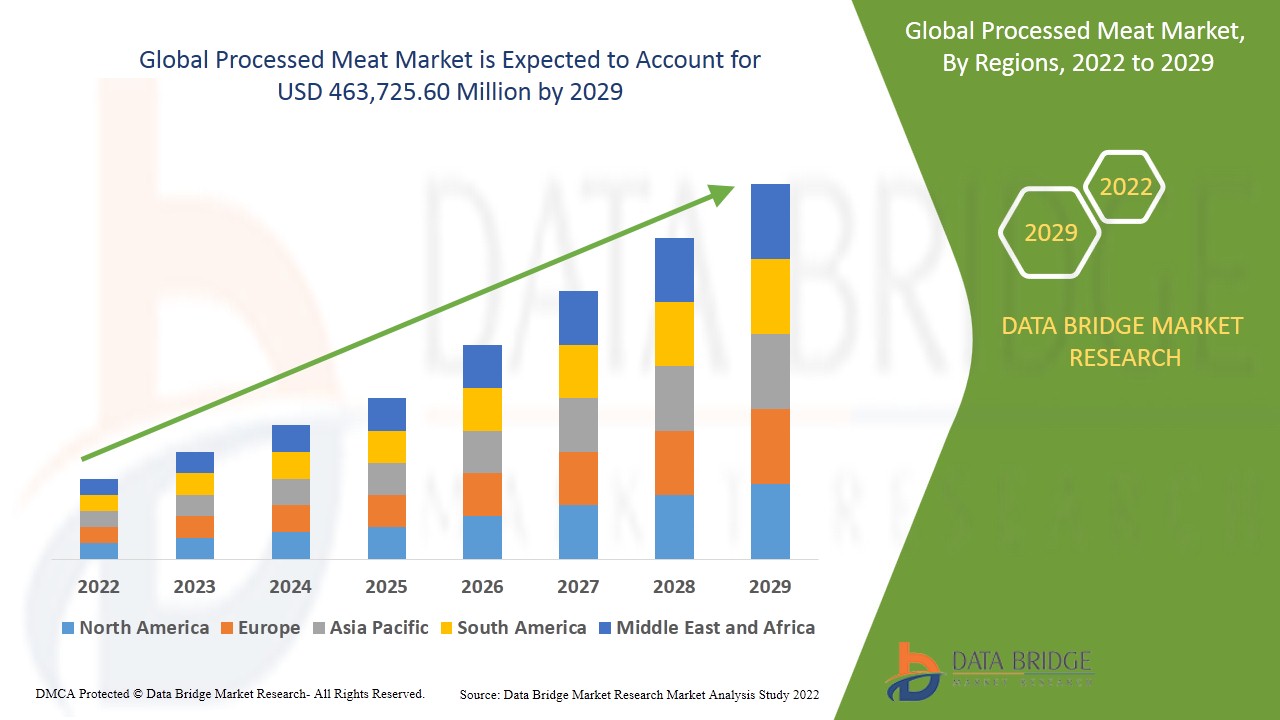
The global processed meat market is expected to grow in the forecast period of 2022 to 2029. Data Bridge Market Research analyses that the market is growing with a CAGR of 5.4% in the forecast period of 2022 to 2029 and is expected to reach USD 463,725.60 million by 2029. Increased demand for processed meat in the food and pharmaceutical industries may drive growth in the global processed meat market.
Processed meat can be defined as meat supplemented with several additives and preservatives such as acidifiers, minerals, salts, and various other seasoning and flavoring agents. The meat is primarily processed to enhance its quality, prevent degeneration, and add flavors to its original composition. It can be red meat or white meat from swine, poultry, cattle, or sea animal meat.
Meat such as beef, pork, turkey, chicken, and lamb are commonly used to produce processed meat. Various processed meat products include pepperoni, jerky, hot dogs, and sausages. Certain preservatives are added to the meat to prevent bacteria and other organisms from spoiling.
Major factors that are expected to boost the growth of the global processed meat market in the forecast period are the increase in disposable income. Moreover, the decrease in the time taken to cook meat at home because of the hectic lifestyle is estimated further to supplement the growth of the global processed meat market.
- On the other hand, the rise in the incidences of obesity because of the high consumption of processed meat-based products is projected to impede the growth of the global processed meat market in the timeline period. In addition, growing fast food and restaurant chains can further provide potential opportunities for the growth of the processed meat market in the coming years. However, the stringent government regulations might further challenge the growth of the global processed meat market.
The global processed meat market report provides details of market share, new developments, and product pipeline analysis, the impact of domestic and localized market players, analyses opportunities in terms of emerging revenue pockets, changes in market regulations, product approvals, strategic decisions, product launches, geographic expansions, and technological innovations in the market. To understand the analysis and the global processed meat market scenario, contact Data Bridge Market Research for an Analyst Brief; our team will help you create a revenue impact solution to achieve your desired goal.
Global Processed Meat Market Scope and Market Size
The global processed meat market is segmented into eight notable segments based on type, product type, category, nature, packaging type, packaging material, end-user and distribution channel. The growth among segments helps you analyze niche pockets of growth and strategies to approach the market and determine your core application areas and the difference in your target markets.
- On the basis of processing type, the global processed meat market is segmented into fresh processed meat, frozen meat, chilled meat, canned meat, dried/semi dried meat, fermented meat, and others. In 2022, the fresh processed meat segment is expected to dominate the market due to rising consumer preference for fresh processed meat as it contains high nutrition, such as large amounts of L-carnitine and a high amount of protein, minerals, vitamins, iron, and antioxidants.
- On the basis of product type, the global processed meat market is segmented into beef, pork, goat, lamb, chicken, turkey, duck, and fish. In 2022, the chicken segment is expected to dominate the market due to the increasing import and export of poultry meat.
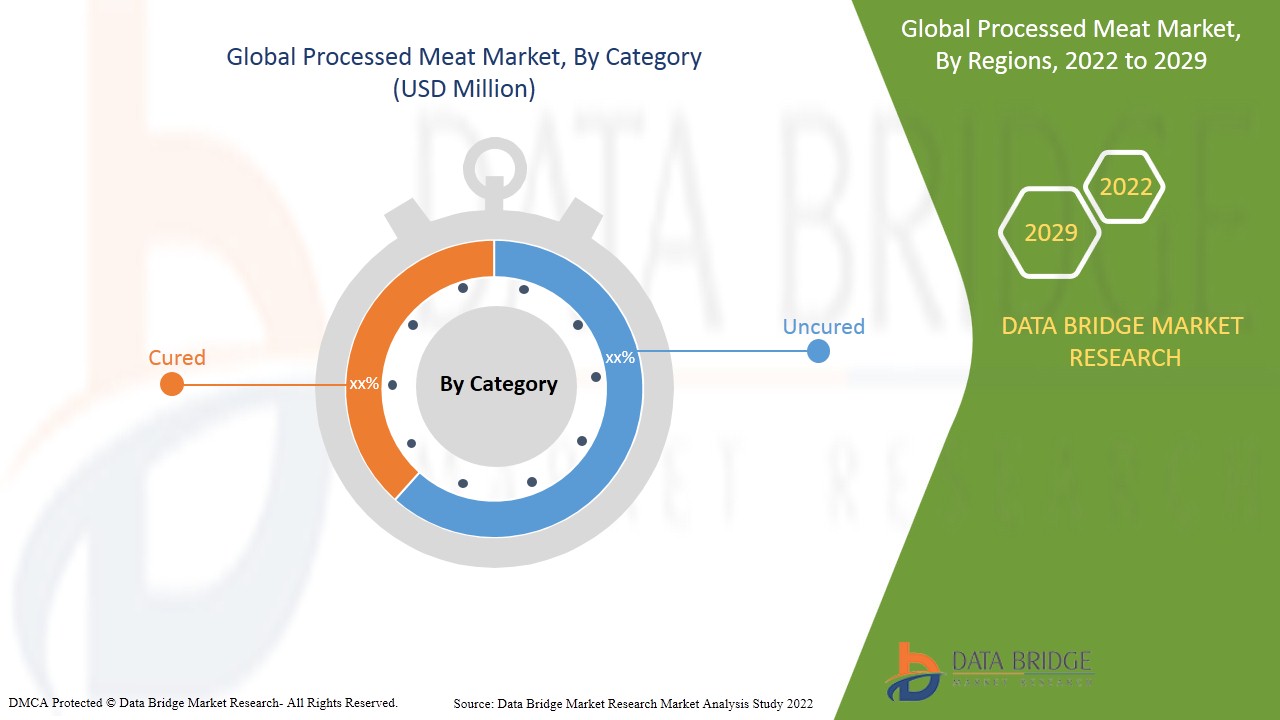
- On the basis of category, the global processed meat market is segmented into cured and uncured. In 2022, the cured segment is expected to dominate the market due to the longer shelf life of cured meat compared to uncured meat.
- On the basis of nature, the global processed meat market is segmented into organic and conventional. In 2022, the conventional segment is expected to dominate the market due to lower costs of inorganic meat when compared to organic meat.
- On the basis of packaging type, the global processed meat market is segmented into trays, pouches, boxes, cannisters and others. In 2022, pouches segment is expected to dominate the market due to the malleability and low weight of pouches.
- On the basis of packaging material, the global processed meat market is segmented into plastic, glass, paper/cardboard, metal, and others. In 2022, the plastic segment is expected to dominate the market due to the lightweight and easy-to-handle nature of plastic packages.
- On the basis of end-user, the processed meat market is segmented into household and food service sector. In 2022, the food service sector segment is expected to dominate the processed meat market due to the rapid expansion of fast-food chains such as KFC, McDonald's, Subway, Burger King, Taco Bell, and others.
- On the basis of distribution channel, the global processed meat market is segmented into store based retailers and non-store based retailers. In 2022, the store based retailers segment is expected to dominate the market due to the availability of trained company representatives in supermarkets and hypermarkets.
Global Processed Meat Market Country Level Analysis
The global processed meat market is segmented into eight notable segments based on type, product type, category, nature, packaging type, packaging material, end-user and distribution channel.
The countries covered in the global processed meat market report are the U.S., Canada, Mexico, Germany, France, U.K., Italy, Spain, Russia, Turkey, Belgium, Netherlands, Switzerland, Austria, Russia, Denmark, Sweden, Poland, Turkey and Rest of Europe, Japan, China, South Korea, India, Australia, Thailand, Singapore, New Zealand, Vietnam, Malaysia, Indonesia, Philippines, and Rest of Asia-Pacific, South Africa, Saudi Arabia, U.A.E., Qatar, Kuwait, Oman and Rest of the Middle East and Africa.
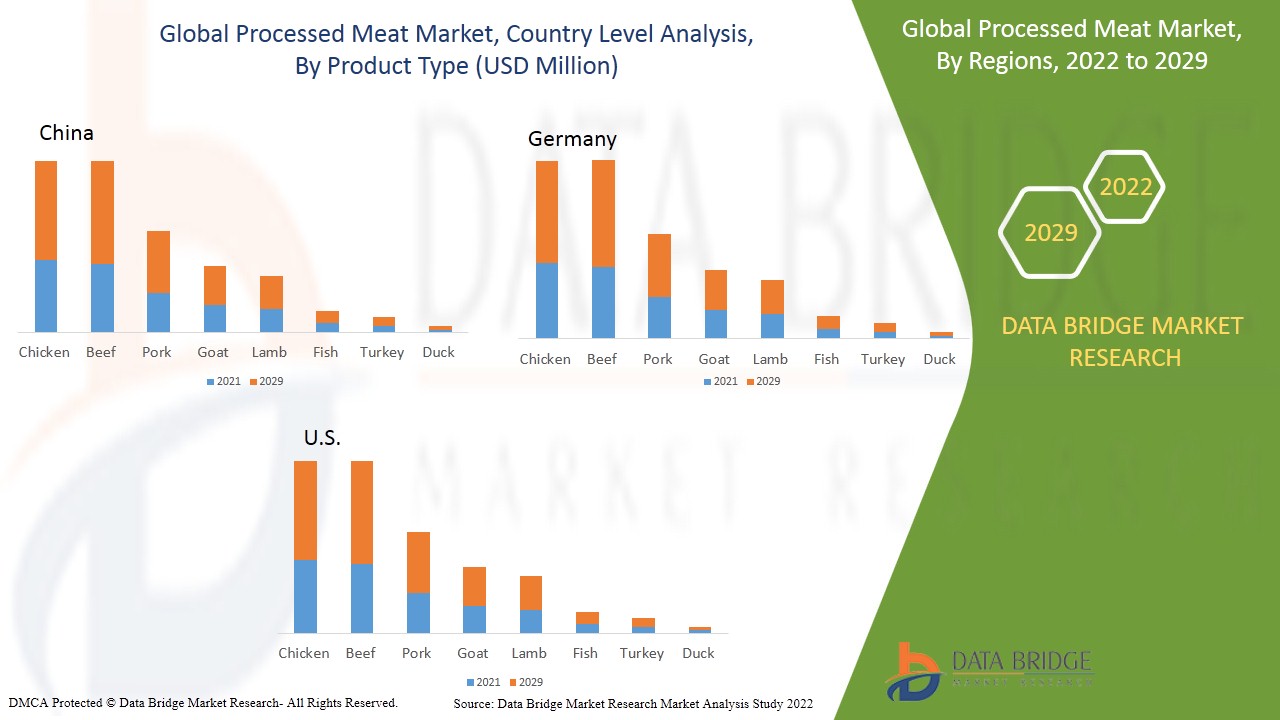
The processing type segment in the Asia-Pacific region is expected to grow with the highest growth rate in the forecast period of 2022 to 2029 because of growth in investments and collaborations in the meat processing business. The product type segment in China is projected to dominate the Asia-Pacific market owing to the growing popularity of canned and frozen meat food. Germany is expected to lead the growth of the European market, and the product type segment is anticipated to dominate in this country due to the growing urbanization and increased adoption of a healthy lifestyle. The U.S. is expected to lead the growth of the North American market, and the product type segment may dominate in this country due to growing fast food and restaurant chains.
The country section of the report also provides individual market impacting factors and changes in market regulation that impact the current and future trends of the market. Data points such as new sales, replacement sales, country demographics, regulatory acts, and import-export tariffs are some of the major pointers used to forecast the market scenario for individual countries. Also, the presence and availability of global brands and their challenges faced due to large or scarce competition from local and domestic brands, the impact of sales channels are considered while providing forecast analysis of the country data.
Growing Strategic Activities by Major Market Players to Enhance the Awareness for Processed Meat is Boosting the Market Growth of Global Processed Meat Market
The global processed meat market also provides you with a detailed market analysis for every country's growth in a particular market. Additionally, it provides detailed information regarding the market players’ strategy and their geographical presence. The data is available for the historical period 2011 to 2020.
Competitive Landscape and Global Processed Meat Market Share Analysis
The global processed meat market competitive landscape provides details by the competitor. Details included are company overview, company financials, revenue generated, market potential, investment in research and development, new market initiatives, production sites and facilities, company strengths and weaknesses, product launch, product trials pipelines, product approvals, patents, product width, and breadth, application dominance, technology lifeline curve. The above data points are only related to the company’s focus on the global processed meat market.
Some of the major players operating in the global processed meat market are Cargill, Incorporated, JBS Foods, Tyson Foods, Inc., Smithfield Foods, Inc, Hormel Foods Corporation, Groupe Bigard, NH Foods Ltd., Louis Dreyfus Company, Tönnies Group, Koch Foods., Gausepohl Fleisch Deutschland GmbH, HKScan, Gruppo Veronesi, TERRENA, Müller Gruppe, OSI Group, Charoen Pokphand Foods PCL., Perdue Farms Inc., Sanderson Farms, Incorporated., National Beef Packing Company L.L.C., Westfleisch SCE mbH, Marfrig, Vion Food Group, Danish Crown A.M.B.A, The Kraft Heinz Company, among others.
DBMR analysts understand competitive strengths and provide competitive analysis for each competitor separately.
Many product launches are also initiated by companies worldwide, which accelerates the global processed meat market.
For instance,
- In January 2021, Danish Crown's Swedish company KLS Ugglarps acquired Ingemar Johansson. This acquisition helped the company strengthen its position within sausages and other processed products on the Swedish market
- In January 2021, Vion Food Group announced that it would acquire Adriaens, a beef producer based in Zottegem, Belgium, as Vion Food Group aims to expand its position in the country. With this acquisition, the company will establish a strong supply chain that guarantees quality and transparency in the beef market
Collaboration, product launch, business expansion, award and recognition, joint ventures, and other strategies by the market player enhance the company's footprints in the global processed meat market, which also benefits the organization’s profit growth.
SKU-
Obtenha acesso online ao relatório sobre a primeira nuvem de inteligência de mercado do mundo

- Painel interativo de análise de dados
- Painel de análise da empresa para oportunidades de elevado potencial de crescimento
- Acesso de analista de pesquisa para personalização e customização. consultas
- Análise da concorrência com painel interativo
- Últimas notícias, atualizações e atualizações Análise de tendências
- Aproveite o poder da análise de benchmark para um rastreio abrangente da concorrência
Índice
1 INTRODUÇÃO
1.1 OBJETIVOS DO ESTUDO
1.2 DEFINIÇÃO DE MERCADO
1.3 VISÃO GERAL DO MERCADO GLOBAL DE CARNES PROCESSADAS
1.4 LIMITAÇÕES
1,5 MERCADOS COBERTOS
2 SEGMENTAÇÃO DE MERCADO
2.1 MERCADOS COBERTOS
2.2 ÂMBITO GEOGRÁFICO
2,3 ANOS CONSIDERADOS PARA O ESTUDO
2.4 MOEDA E PREÇOS
2.5 MODELO DE VALIDAÇÃO DE DADOS TRIPÉ DBMR
2.6 MODELAGEM MULTIVARIADA
2.7 CURVA DE VIDA DO PRODUTO
2.8 ENTREVISTAS PRINCIPAIS COM PRINCIPAIS LÍDERES DE OPINIÃO
2.9 GRADE DE POSIÇÃO DE MERCADO DBMR
2.1 ANÁLISE DA PARTICIPAÇÃO DO FORNECEDOR (VOLUME%)
2.11 FONTES SECUNDÁRIAS
2.12 PREMISSAS
3 RESUMO EXECUTIVO
4 INSIGHTS PREMIUM
4.1 ANÁLISE COMPETITIVA DA MARCA
4.2 MERCADO GLOBAL DE CARNES PROCESSADAS - TENDÊNCIAS DA INDÚSTRIA E PERSPECTIVA FUTURA
4.2.1 CRESCENTE UTILIZAÇÃO DE NOVAS TECNOLOGIAS NO PROCESSAMENTO DE CARNES
4.2.2 COLABORAÇÕES E PARCERIAS CRESCENTES
4.2.3 CONSUMIDOR OPTA POR PRODUTOS DE CARNE SAUDÁVEIS COM REDUÇÃO DE NÍVEL DE GORDURA, COLESTEROL,
5 MERCADO GLOBAL DE CARNES PROCESSADAS: QUADRO REGULAMENTAR
6 VISÃO GERAL DO MERCADO
6.1 MOTORISTAS
6.1.1 CRESCIMENTO DE INVESTIMENTOS E COLABORAÇÕES NO NEGÓCIO DE PROCESSAMENTO DE CARNES
6.1.2 PREFERÊNCIA POR PROTEÍNAS DE ORIGEM ANIMAL EM RELAÇÃO ÀS PROTEÍNAS DE ORIGEM VEGETAL
6.1.3 URBANIZAÇÃO CRESCENTE E ADOÇÃO AUMENTADA DE ESTILOS DE VIDA SAUDÁVEIS
6.1.4 CRESCENTE POPULARIDADE DE ALIMENTOS DE CARNE ENLATADA E CONGELADA
6.2 RESTRIÇÕES
6.2.1 ALTO CUSTO DE INVESTIMENTO NO NEGÓCIO AVÍCOLA
6.2.2 AUMENTO DA POPULAÇÃO VEGANA E AUMENTO DA DEMANDA POR ALTERNATIVAS À CARNE
6.3 OPORTUNIDADES
6.3.1 CRESCIMENTO DAS REDES DE FAST FOOD E RESTAURANTES
6.3.2 AUMENTO DA AUTOMAÇÃO NA INDÚSTRIA DE PROCESSAMENTO DE CARNES
6.3.3 CRESCENTE PREFERÊNCIA POR CARNE ORGÂNICA
6.4 DESAFIOS
6.4.1 REGULAMENTOS GOVERNAMENTAIS RIGOROSOS
6.4.2 PERTURBAÇÃO NA CADEIA DE SUPRIMENTOS DEVIDO À PANDEMIA DE COVID-19
7 IMPACTO DA COVID-19 NO MERCADO GLOBAL DE CARNES PROCESSADAS
7.1 CONSEQUÊNCIAS DA COVID-19 E INICIATIVAS GOVERNAMENTAIS PARA IMPULSIONAR O MERCADO GLOBAL DE CARNES PROCESSADAS
7.2 DECISÕES ESTRATÉGICAS PARA FABRICANTES APÓS A COVID-19 PARA GANHAR PARTICIPAÇÃO COMPETITIVA NO MERCADO
7.3 IMPACTO NO PREÇO
7.4 IMPACTO NA DEMANDA
7.5 IMPACTO NA CADEIA DE SUPRIMENTOS
7.6 CONCLUSÃO
8 MERCADO GLOBAL DE CARNES PROCESSADAS, POR TIPO
8.1 CARNE FRESCA PROCESSADA
8.2 CARNE CONGELADA
8.3 CARNES REFRIGERADAS
8.4 CARNE EM CONSERVA
8.5 CARNE SECA/SEMI SECA
8.6 CARNE FERMENTADA
9 MERCADO GLOBAL DE CARNES PROCESSADAS, POR TIPO DE PRODUTO:
9.1 VISÃO GERAL:
9.2 CARNE BOVINA
9.3 CARNE DE PORCO
9.4 CABRA
9.5 CORDEIRO
9.6 FRANGO
9.7 TURQUIA
9.8 PATO
9.9 PEIXES
10 MERCADO GLOBAL DE CARNES PROCESSADAS, POR TIPO DE EMBALAGEM
10.1 BANDEJAS
10.2 SACOLAS
10.3 CAIXAS
10.4 RECIPIENTES
10.5 OUTROS
11 MERCADO GLOBAL DE CARNES PROCESSADAS, POR USUÁRIO FINAL:
11.1 VISÃO GERAL:
11.2 DOMÉSTICO
11.3 SETOR DE SERVIÇOS DE ALIMENTAÇÃO
12 MERCADO GLOBAL DE CARNES PROCESSADAS, POR CATEGORIA:
12.1 VISÃO GERAL:
12.2 CURADO
12.3 NÃO CURADO
13 MERCADO GLOBAL DE CARNES PROCESSADAS, POR NATUREZA:
13.1 VISÃO GERAL:
13.2 ORGÂNICO
13.3 CONVENCIONAL
14 MERCADO GLOBAL DE CARNES PROCESSADAS, POR CANAL DE DISTRIBUIÇÃO
14.1 VAREJISTA COM BASE EM LOJA
14.2 VAREJISTA NÃO BASEADO EM LOJA
15 MERCADO GLOBAL DE CARNES PROCESSADAS, POR REGIÃO
15.1 GLOBAL
15.2 AMÉRICA DO NORTE
15.2.1 EUA
15.2.2 MÉXICO
15.2.3 CANADÁ
15.3 EUROPA
15.3.1 ALEMANHA
15.3.2 Reino Unido
15.3.3 FRANÇA
15.3.4 ITÁLIA
15.3.5 ESPANHA
15.3.6 SUÍÇA
15.3.7 HOLANDA
15.3.8 ÁUSTRIA
15.3.9 RÚSSIA
15.3.10 BÉLGICA
15.3.11 DINAMARCA
15.3.12 SUÉCIA
15.3.13 POLÔNIA
15.3.14 TURQUIA
15.3.15 RESTO DA EUROPA
15.4 ÁSIA-PACÍFICO
15.4.1 CHINA
15.4.2 JAPÃO
15.4.3 ÍNDIA
15.4.4 INDONÉSIA
15.4.5 COREIA DO SUL
15.4.6 AUSTRÁLIA
15.4.7 TAILÂNDIA
15.4.8 MALÁSIA
15.4.9 SINGAPURA
15.4.10 VIETNÃ
15.4.11 FILIPINAS
15.4.12 NOVA ZELÂNDIA
15.4.13 RESTANTE DA ÁSIA-PACÍFICO
15.5 ORIENTE MÉDIO E ÁFRICA
15.5.1 ÁFRICA DO SUL
15.5.2 ARÁBIA SAUDITA
15.5.3 Emirados Árabes Unidos
15.5.4 CATAR
15.5.5 KUWAIT
15.5.6 OMÃ
15.5.7 RESTANTE DO ORIENTE MÉDIO E ÁFRICA
15.6 AMÉRICA DO SUL
15.6.1 BRASIL
15.6.2 ARGENTINA
15.6.3 RESTO DA AMÉRICA DO SUL
16 MERCADO GLOBAL DE CARNES PROCESSADAS: CENÁRIO DA EMPRESA
16.1 ANÁLISE DE AÇÕES DA EMPRESA: GLOBAL
16.2 ANÁLISE DE AÇÕES DA EMPRESA: AMÉRICA DO NORTE
16.3 ANÁLISE DE AÇÕES DA EMPRESA: EUROPA
16.4 ANÁLISE DE AÇÕES DA EMPRESA: ÁSIA-PACÍFICO
17 ANÁLISE SWOT
18 PERFIL DA EMPRESA
18.1 JBS ALIMENTOS
18.1.1 RESUMO DA EMPRESA
18.1.2 ANÁLISE DE RECEITA
18.1.3 ANÁLISE DAS AÇÕES DA EMPRESA
18.1.4 PORTFÓLIO DE PRODUTOS
18.1.5 DESENVOLVIMENTOS RECENTES
18.2 TYSON FOODS, INC.
18.2.1 RESUMO DA EMPRESA
18.2.2 ANÁLISE DE RECEITA
18.2.3 ANÁLISE DAS AÇÕES DA EMPRESA
18.2.4 PORTFÓLIO DE PRODUTOS
18.2.5 DESENVOLVIMENTOS RECENTES
18.3 GRUPO DE ALIMENTOS VION
18.3.1 RESUMO DA EMPRESA
18.3.2 ANÁLISE DAS AÇÕES DA EMPRESA
18.3.3 PORTFÓLIO DE PRODUTOS
18.3.4 DESENVOLVIMENTOS RECENTES
18.4 CARGILL, INCORPORADA
18.4.1 RESUMO DA EMPRESA
18.4.2 ANÁLISE DE RECEITA
18.4.3 ANÁLISE DE AÇÕES DA EMPRESA
18.4.4 PORTFÓLIO DE PRODUTOS
18.4.5 DESENVOLVIMENTO RECENTE
18.5 AMBA DA COROA DINAMARQUESA
18.5.1 RESUMO DA EMPRESA
18.5.2 ANÁLISE DE AÇÕES DA EMPRESA
18.5.3 PORTFÓLIO DE PRODUTOS
18.5.4 DESENVOLVIMENTOS RECENTES
18.6 CHAROEN POKPHAND FOODS PUBLIC CO. LTD.
18.6.1 RESUMO DA EMPRESA
18.6.2 ANÁLISE DE RECEITA
18.6.3 PORTFÓLIO DE PRODUTOS
18.6.4 DESENVOLVIMENTO RECENTE
18.7 SMITHFIELD FOODS, INC
18.7.1 RESUMO DA EMPRESA
18.7.2 PORTFÓLIO DE PRODUTOS
18.7.3 DESENVOLVIMENTOS RECENTES
GRUPO 18,8 TÖNNIES
18.8.1 RESUMO DA EMPRESA
18.8.2 PORTFÓLIO DE PRODUTOS
18.8.3 DESENVOLVIMENTO RECENTE
18.9 CORPORAÇÃO DE ALIMENTOS HORMEL
18.9.1 RESUMO DA EMPRESA
18.9.2 ANÁLISE DE RECEITA
18.9.3 PORTFÓLIO DE PRODUTOS
18.9.4 DESENVOLVIMENTO RECENTE
18.1 EMPRESA NACIONAL DE EMBALAGEM DE CARNE BOVINA LLC
18.10.1 RESUMO DA EMPRESA
18.10.2 PORTFÓLIO DE PRODUTOS
18.10.3 DESENVOLVIMENTO RECENTE
18.11 GAUSEPOHL FLEISCH DEUTSCHLAND GMBH
18.11.1 RESUMO DA EMPRESA
18.11.2 PORTFÓLIO DE PRODUTOS
18.11.3 DESENVOLVIMENTO RECENTE
18.12 GRUPO BIGARD
18.12.1 RESUMO DA EMPRESA
18.12.2 PORTFÓLIO DE PRODUTOS
18.12.3 DESENVOLVIMENTO RECENTE
18.13 GRUPO VERONESI
18.13.1 RESUMO DA EMPRESA
18.13.2 ANÁLISE DE RECEITA
18.13.3 PORTFÓLIO DE PRODUTOS
18.13.4 DESENVOLVIMENTO RECENTE
18.14 HKSCAN
18.14.1 RESUMO DA EMPRESA
18.14.2 ANÁLISE DE RECEITA
18.14.3 PORTFÓLIO DE PRODUTOS
18.14.4 DESENVOLVIMENTOS RECENTES
18h15 KOCH FOODS.
18.15.1 RESUMO DA EMPRESA
18.15.2 PORTFÓLIO DE PRODUTOS
18.15.3 DESENVOLVIMENTO RECENTE
18.16 EMPRESA LOUIS DREYFUS
18.16.1 RESUMO DA EMPRESA
18.16.2 PORTFÓLIO DE PRODUTOS
18.16.3 DESENVOLVIMENTO RECENTE
18.17 MARFRIG
18.17.1 COMPANY SNAPSHOT
18.17.2 PRODUCT PORTFOLIO
18.17.3 RECENT DEVELOPMENT
18.18 MÜLLER GRUPPE
18.18.1 COMPANY SNAPSHOT
18.18.2 PRODUCT PORTFOLIO
18.18.3 RECENT DEVELOPMENT
18.19 NH FOODS LTD.
18.19.1 COMPANY SNAPSHOT
18.19.2 REVENUS ANALYSIS
18.19.3 PRODUCT PORTFOLIO
18.19.4 RECENT DEVELOPMENT
18.2 OSI GROUP
18.20.1 COMPANY SNAPSHOT
18.20.2 PRODUCT PORTFOLIO
18.20.3 RECENT DEVELOPMENTS
18.21 PERDUE FARMS INC.
18.21.1 COMPANY SNAPSHOT
18.21.2 PRODUCT PORTFOLIO
18.21.3 RECENT DEVELOPMENT
18.22 SANDERSON FARMS, INCORPORATED.
18.22.1 COMPANY SNAPSHOT
18.22.2 PRODUCT PORTFOLIO
18.22.3 RECENT DEVELOPMENT
18.23 TERRENA
18.23.1 COMPANY SNAPSHOT
18.23.2 PRODUCT PORTFOLIO
18.23.3 RECENT DEVELOPMENT
18.24 THE KRAFT HEINZ COMPANY
18.24.1 COMPANY SNAPSHOT
18.24.2 REVENUE ANALYSIS
18.24.3 PRODUCT PORTFOLIO
18.24.4 RECENT DEVELOPMENT
18.25 WESTFLEISCH SCE MBH
18.25.1 COMPANY SNAPSHOT
18.25.2 PRODUCT PORTFOLIO
18.25.3 RECENT DEVELOPMENT
19 QUESTIONNAIRE
20 RELATED REPORTS
Lista de Figura
FIGURA 1 MERCADO GLOBAL DE CARNES PROCESSADAS: SEGMENTAÇÃO
FIGURA 2 MERCADO GLOBAL DE CARNES PROCESSADAS: TRIANGULAÇÃO DE DADOS
FIGURA 3 MERCADO GLOBAL DE CARNES PROCESSADAS: ANÁLISE DROC
FIGURA 4 MERCADO GLOBAL DE CARNES PROCESSADAS: ANÁLISE GLOBAL VS REGIONAL
FIGURA 5 MERCADO GLOBAL DE CARNES PROCESSADAS: ANÁLISE DE PESQUISA DA EMPRESA
FIGURA 6 MERCADO GLOBAL DE CARNES PROCESSADAS: DEMOGRAFIA DA ENTREVISTA
FIGURA 7 MERCADO GLOBAL DE CARNES PROCESSADAS: GRADE DE POSIÇÃO DBMR
FIGURA 8 MERCADO GLOBAL DE CARNES PROCESSADAS: ANÁLISE DA PARTICIPAÇÃO DOS FORNECEDORES
FIGURA 9 MERCADO GLOBAL DE CARNES PROCESSADAS: SEGMENTAÇÃO
FIGURA 10 A REGIÃO DA ÁSIA-PACÍFICO DEVE DOMINA O MERCADO GLOBAL DE CARNES PROCESSADAS E CRESCER COM O MAIOR CAGR NO PERÍODO PREVISTO DE 2022 A 2029
FIGURA 11 O CRESCIMENTO EM INVESTIMENTOS E COLABORAÇÕES EM NEGÓCIOS DE PROCESSAMENTO DE CARNES ESTÁ IMPULSIONANDO O CRESCIMENTO DO MERCADO GLOBAL DE CARNES PROCESSADAS NO PERÍODO PREVISTO DE 2022 A 2029
FIGURA 12 O SEGMENTO DE PRODUTOS DEVE SER REPRESENTANTE DA MAIOR PARTICIPAÇÃO DO MERCADO GLOBAL DE CARNES PROCESSADAS EM 2022 E 2029
FIGURA 13 A ÁSIA-PACÍFICO É O MERCADO DE CRESCIMENTO MAIS RÁPIDO PARA FABRICANTES DE CARNE PROCESSADA NO PERÍODO PREVISTO DE 2022 A 2029
FIGURA 14 MERCADO GLOBAL DE CARNES PROCESSADAS: ANÁLISE DA CADEIA DE SUPRIMENTOS
FIGURA 15 MOTIVADORES, RESTRIÇÕES, OPORTUNIDADES E DESAFIOS DO MERCADO GLOBAL DE CARNES PROCESSADAS
FIGURA 16 MERCADO GLOBAL DE CARNES PROCESSADAS, POR TIPO (2021)
FIGURA 17 MERCADO GLOBAL DE CARNES PROCESSADAS, POR TIPO DE PRODUTO (2021)
FIGURA 18 MERCADO GLOBAL DE CARNES PROCESSADAS, POR TIPO DE EMBALAGEM (2021)
FIGURA 19 MERCADO GLOBAL DE CARNES PROCESSADAS, POR USUÁRIO FINAL (2021)
FIGURA 20 MERCADO GLOBAL DE CARNES PROCESSADAS, POR CATEGORIA
FIGURA 21 MERCADO GLOBAL DE CARNES PROCESSADAS, POR NATUREZA (2021)
FIGURA 22 MERCADO GLOBAL DE CARNES PROCESSADAS, POR CANAL DE DISTRIBUIÇÃO (2021)
FIGURA 23 INSTANTÂNEO GLOBAL, 2021
FIGURA 24 RESUMO GLOBAL, 2021
FIGURA 25 RESUMO GLOBAL, 2022 E 2029
FIGURA 26 RESUMO GLOBAL, 2021 E 2029
FIGURA 27 RESUMO GLOBAL, POR PRODUTO, 2022 - 2029
FIGURA 28 INSTANTÂNEO DA AMÉRICA DO NORTE, 2021
FIGURA 29 RESUMO DA AMÉRICA DO NORTE, 2021
FIGURA 30 RESUMO DA AMÉRICA DO NORTE, 2022 E 2029
FIGURA 31 RESUMO DA AMÉRICA DO NORTE, 2021 E 2029
FIGURA 32 RESUMO DA AMÉRICA DO NORTE, POR PRODUTO, 2022 - 2029
FIGURA 33 INSTANTÂNEO DA EUROPA, 2021
FIGURA 34 RESUMO DA EUROPA, 2021
FIGURA 35 RESUMO DA EUROPA, 2022 E 2029
FIGURA 36 RESUMO DA EUROPA, 2021 E 2029
FIGURA 37 RESUMO DA EUROPA POR PRODUTO, 2022 - 2029
FIGURA 38 INSTANTÂNEO DA ÁSIA-PACÍFICO, 2021
FIGURA 39 RESUMO DA ÁSIA-PACÍFICO, 2021
FIGURA 40 RESUMO DA ÁSIA-PACÍFICO, 2022 E 2029
FIGURA 41 RESUMO DA ÁSIA-PACÍFICO, 2021 E 2029
FIGURA 42 RESUMO DA ÁSIA-PACÍFICO POR PRODUTO, 2022 - 2029
FIGURA 43 INSTANTÂNEO DO ORIENTE MÉDIO E ÁFRICA, 2021
FIGURA 44 RESUMO DO ORIENTE MÉDIO E ÁFRICA, 2021
FIGURA 45 RESUMO DO ORIENTE MÉDIO E ÁFRICA, 2022 E 2029
FIGURA 46 RESUMO DO ORIENTE MÉDIO E ÁFRICA, 2021 E 2029
FIGURA 47 ORIENTE MÉDIO E ÁFRICA RESUMO POR PRODUTO, 2022 - 2029
FIGURA 48 INSTANTÂNEO DA AMÉRICA DO SUL, 2021
FIGURA 49 RESUMO DA AMÉRICA DO SUL, 2021
FIGURA 50 RESUMO DA AMÉRICA DO SUL, 2022 E 2029
FIGURA 51 RESUMO DA AMÉRICA DO SUL, 2021 E 2029
FIGURA 52 RESUMO DA AMÉRICA DO SUL POR PRODUTO, 2022 E 2029
FIGURA 53 MERCADO GLOBAL DE CARNES PROCESSADAS: PARTICIPAÇÃO DA EMPRESA EM 2021 (VOLUME %)
FIGURA 54 MERCADO DE CARNES PROCESSADAS DA AMÉRICA DO NORTE: PARTICIPAÇÃO DA EMPRESA EM 2021 (VOLUME %)
FIGURA 55 MERCADO DE CARNES PROCESSADAS DA EUROPA: PARTICIPAÇÃO DA EMPRESA EM 2021 (VOLUME %)
FIGURA 56 MERCADO DE CARNES PROCESSADAS DA ÁSIA-PACÍFICO: PARTICIPAÇÃO DA EMPRESA EM 2021 (VOLUME %)

Metodologia de Investigação
A recolha de dados e a análise do ano base são feitas através de módulos de recolha de dados com amostras grandes. A etapa inclui a obtenção de informações de mercado ou dados relacionados através de diversas fontes e estratégias. Inclui examinar e planear antecipadamente todos os dados adquiridos no passado. Da mesma forma, envolve o exame de inconsistências de informação observadas em diferentes fontes de informação. Os dados de mercado são analisados e estimados utilizando modelos estatísticos e coerentes de mercado. Além disso, a análise da quota de mercado e a análise das principais tendências são os principais fatores de sucesso no relatório de mercado. Para saber mais, solicite uma chamada de analista ou abra a sua consulta.
A principal metodologia de investigação utilizada pela equipa de investigação do DBMR é a triangulação de dados que envolve a mineração de dados, a análise do impacto das variáveis de dados no mercado e a validação primária (especialista do setor). Os modelos de dados incluem grelha de posicionamento de fornecedores, análise da linha de tempo do mercado, visão geral e guia de mercado, grelha de posicionamento da empresa, análise de patentes, análise de preços, análise da quota de mercado da empresa, normas de medição, análise global versus regional e de participação dos fornecedores. Para saber mais sobre a metodologia de investigação, faça uma consulta para falar com os nossos especialistas do setor.
Personalização disponível
A Data Bridge Market Research é líder em investigação formativa avançada. Orgulhamo-nos de servir os nossos clientes novos e existentes com dados e análises que correspondem e atendem aos seus objetivos. O relatório pode ser personalizado para incluir análise de tendências de preços de marcas-alvo, compreensão do mercado para países adicionais (solicite a lista de países), dados de resultados de ensaios clínicos, revisão de literatura, mercado remodelado e análise de base de produtos . A análise de mercado dos concorrentes-alvo pode ser analisada desde análises baseadas em tecnologia até estratégias de carteira de mercado. Podemos adicionar quantos concorrentes necessitar de dados no formato e estilo de dados que procura. A nossa equipa de analistas também pode fornecer dados em tabelas dinâmicas de ficheiros Excel em bruto (livro de factos) ou pode ajudá-lo a criar apresentações a partir dos conjuntos de dados disponíveis no relatório.











