


What is the Pork Protein Market Size and Growth Rate?
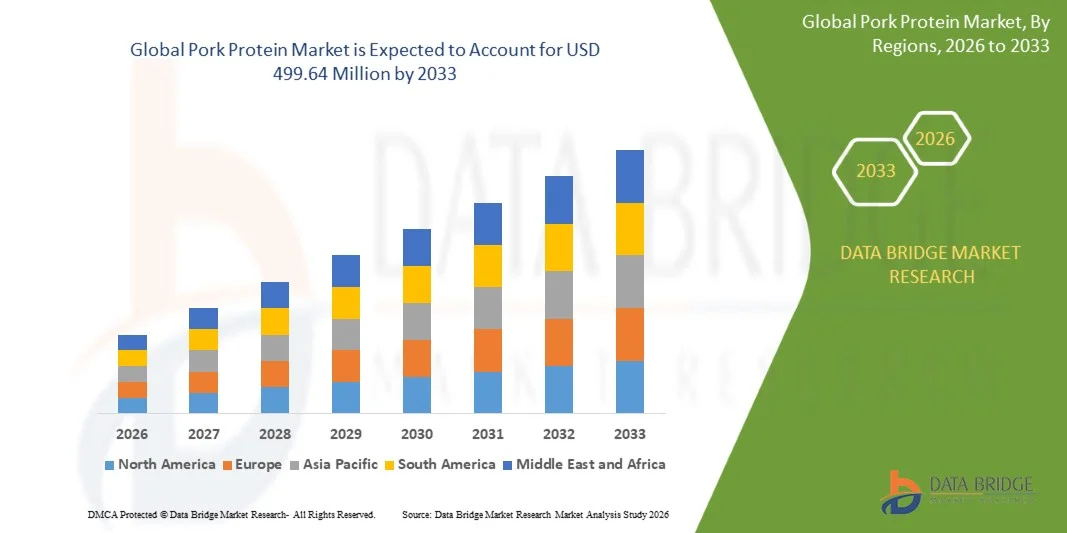
- As per Data Bridge Market Research analysis the pork protein market was valued at USD 325.57 million in 2025 and is projected to reach USD 499.64 million by 2033, growing at a CAGR of 5.50% from 2026 to 2033.
- The market is experiencing steady growth driven by increasing global consumption of pork products, rising demand for high-protein diets, and expanding applications of pork protein across processed meat products, food manufacturing, and nutritional supplements.
- The growing preference for convenient protein-rich foods, continuous advancements in meat processing technologies, and increasing investments in sustainable livestock production are encouraging food manufacturers and meat processors to expand pork protein production, supporting long-term market growth.
Market Size & Forecast
- Market Value (2025): USD 325.57 Million
- Expected Market Value (2033): USD 499.64 Million
- Forecast CAGR (2026–2033): 5.50%
- Leading Region in 2025: North America
- Fastest Growing Region: Asia-Pacific
What are the Major Takeaways of the Pork Protein Market?
- North America dominated the pork protein market with the largest revenue share in 2025, supported by strong pork consumption, an advanced meat processing industry, and well-established cold chain infrastructure.
- Asia-Pacific pork protein market is expected to witness the fastest growth rate from 2026 to 2033, supported by rapid urbanization, rising disposable incomes, expanding food processing industries, and increasing consumption of animal protein across countries such as China, Japan, South Korea, and Vietnam.
- The sausages segment dominated the market in 2025 driven by its widespread consumption, long shelf life, and extensive use across retail, foodservice, and processed meat industries. Sausages are preferred due to their convenience, affordability, and growing popularity among consumers seeking ready-to-cook and ready-to-eat protein products.
- The nuggets segment is projected to register the fastest growth at a CAGR from 2026 to 2033, driven by increasing consumer demand for convenient protein-rich snacks, expanding quick-service restaurant chains, and rising popularity of frozen and ready-to-cook meat products. Continuous product innovation and premium offerings are accelerating segment expansion.
- The powder segment dominated the market in 2025 driven by its superior stability, ease of storage, longer shelf life, and broad application across food processing, nutritional supplements, and functional food products. Powdered pork protein is widely preferred for its versatility and ease of incorporation into various formulations.
- The liquid segment is projected to register the fastest growth at a CAGR from 2026 to 2033, driven by increasing demand for liquid protein ingredients in beverage formulations, clinical nutrition products, and specialized food applications. Advancements in processing technologies and expanding product innovation are supporting segment growth.
Report Scope and Pork Protein Market Segmentation
|
Attributes |
Pork Protein Key Market Insights |
|
Segments Covered |
|
|
Countries Covered |
North America
Europe
Asia-Pacific
Middle East and Africa
South America
|
|
Key Market Players |
|
|
Market Opportunities |
|
|
Value Added Data Infosets |
In addition to the insights on market scenarios such as market value, growth rate, segmentation, geographical coverage, and major players, the market reports curated by the Data Bridge Market Research also include in-depth expert analysis, pricing analysis, brand share analysis, consumer survey, demography analysis, supply chain analysis, value chain analysis, raw material/consumables overview, vendor selection criteria, PESTLE Analysis, Porter Analysis, and regulatory framework. |
What is the Key Trend in the Pork Protein Market?
- Food manufacturers are increasingly focusing on value-added pork protein products with improved nutritional profiles, clean-label formulations, and convenient ready-to-cook and ready-to-eat offerings to meet evolving consumer preferences.
- For instance, in May 2025, Danish Crown announced a strategic collaboration with Hilton Foods to establish a new joint venture for packaged meat products in Europe, strengthening its value-added pork product portfolio and expanding production capabilities.
- Advancements in meat processing, packaging technologies, and cold chain logistics are enabling manufacturers to improve product freshness, shelf life, and distribution efficiency while reducing food waste.
- For instance, in February 2025, JBS USA announced the expansion of its prepared foods business through the acquisition of Sunnyvalley Smoked Meats, strengthening its portfolio of value-added protein products and supporting growing consumer demand for convenient meat solutions.
- As consumers increasingly seek convenient, protein-rich, and premium-quality meat products, manufacturers are expected to continue investing in product innovation and processing technologies, reinforcing value-added pork protein as a major industry trend.
What are the Key Drivers of the Pork Protein Market?
- Rising global demand for animal protein, population growth, and increasing consumption of processed and convenience meat products are significantly driving demand for pork protein across retail and foodservice sectors.
- For instance, the Food and Agriculture Organization (FAO) projects that global meat consumption will continue increasing over the coming decades, supported by population growth, urbanization, and rising incomes, reinforcing long-term demand for pork and other animal proteins.
- Leading meat processors are expanding production capacity, strengthening supply chains, and investing in processing facilities to meet growing domestic and international demand for high-quality pork products.
- For instance, in September 2024, WH Group Limited reported continued investment in production efficiency and value-added packaged meats through its annual results and corporate updates, supporting long-term growth in pork protein production.
- With growing consumer demand for high-protein diets, expanding food processing industries, and continued investment in efficient livestock production, pork protein is expected to remain a key component of the global protein market.
Which Factors are Challenging the Growth of the Pork Protein Market?
- The pork protein industry faces significant challenges from disease outbreaks, volatile feed prices, and increasingly stringent environmental and animal welfare regulations affecting livestock production.
- Rising production costs and biosecurity requirements continue to pressure producers while creating pricing challenges across global pork supply chains.
- For instance, the World Organisation for Animal Health (WOAH) continues to report outbreaks of African Swine Fever (ASF) across multiple regions, highlighting the ongoing impact of the disease on global pig populations and pork trade.
- Disease-related production losses, trade restrictions, fluctuating feed costs, and sustainability requirements continue to affect production efficiency and profitability, limiting market expansion in several regions despite steady consumer demand for pork protein.
How is the Pork Protein Market Segmented?
The market is segmented on the basis of application, form, and end-use.
- By Application
On the basis of application, the pork protein market is segmented into nuggets, burgers, meatballs, sausages, hot dogs, and others. The sausages segment dominated the market in 2025 driven by its widespread consumption, long shelf life, and extensive use across retail, foodservice, and processed meat industries. Sausages are preferred due to their convenience, affordability, and growing popularity among consumers seeking ready-to-cook and ready-to-eat protein products.
The nuggets segment is projected to register the fastest growth at a CAGR from 2026 to 2033, driven by increasing consumer demand for convenient protein-rich snacks, expanding quick-service restaurant chains, and rising popularity of frozen and ready-to-cook meat products. Continuous product innovation and premium offerings are accelerating segment expansion.
- By Form
On the basis of form, the pork protein market is segmented into tablets, powder, and liquid. The powder segment dominated the market in 2025 driven by its superior stability, ease of storage, longer shelf life, and broad application across food processing, nutritional supplements, and functional food products. Powdered pork protein is widely preferred for its versatility and ease of incorporation into various formulations.
The liquid segment is projected to register the fastest growth at a CAGR from 2026 to 2033, driven by increasing demand for liquid protein ingredients in beverage formulations, clinical nutrition products, and specialized food applications. Advancements in processing technologies and expanding product innovation are supporting segment growth.
- By End-Use
On the basis of end-use, the pork protein market is segmented into food and beverages, pharmaceutical, nutraceutical, and personal care. The food and beverages segment dominated the market in 2025 driven by increasing consumption of processed meat products, functional foods, and high-protein food formulations. Growing demand for convenient, protein-enriched food products continues to strengthen the segment's position.
The nutraceutical segment is projected to register the fastest growth at a CAGR from 2026 to 2033, driven by increasing consumer awareness of protein supplementation, rising health and wellness trends, and growing demand for high-quality animal-based protein ingredients in dietary supplements and sports nutrition products. Continuous innovation in protein-based formulations is further supporting segment growth.
Which Region Holds the Largest Share of the Pork Protein Market?
- North America dominated the pork protein market with the largest revenue share in 2025, supported by strong pork consumption, an advanced meat processing industry, and well-established cold chain infrastructure.
- Consumers across the region increasingly prefer high-protein, convenient, and value-added meat products, including processed pork, ready-to-cook meals, and frozen foods. The presence of major meat processors, stringent food safety standards, and continuous investment in processing technologies further strengthen the region's market position.
U.S. Pork Protein Market Insight
The U.S. pork protein market captured the largest revenue share in 2025 within North America, fueled by high domestic pork consumption and strong demand for processed and packaged meat products. Consumers are increasingly seeking convenient, protein-rich food options, while food manufacturers continue expanding value-added pork offerings. The country's advanced livestock production systems, efficient supply chain, and strong export capabilities are significantly contributing to market growth.
Europe Pork Protein Market Insight
Europe pork protein market is expected to witness the fastest growth rate from 2026 to 2033, primarily driven by increasing demand for premium meat products, technological advancements in meat processing, and growing consumption of protein-rich foods. Rising investments in sustainable livestock production, together with strict food quality and animal welfare standards, are encouraging innovation across the pork protein industry. The region continues to experience steady demand from both retail and foodservice sectors.
U.K. Pork Protein Market Insight
U.K. pork protein market is expected to witness the fastest growth rate from 2026 to 2033, driven by increasing consumer demand for convenient meat products, ready-to-cook meals, and protein-enriched diets. Growing retail availability of processed pork products, combined with advancements in food processing and packaging technologies, continues to support market expansion. Increasing focus on product quality and food safety is also contributing to industry growth.
Germany Pork Protein Market Insight
Germany pork protein market is expected to witness the fastest growth rate from 2026 to 2033, fueled by its well-established meat processing industry and strong demand for processed pork products. The country's advanced food manufacturing capabilities, emphasis on product quality, and continuous investment in sustainable production practices are supporting market development. Rising demand for premium and value-added pork products is further strengthening industry growth.
Asia-Pacific Pork Protein Market Insight
The Asia-Pacific pork protein market is expected to witness the fastest growth rate from 2026 to 2033, supported by rapid urbanization, rising disposable incomes, expanding food processing industries, and increasing consumption of animal protein across countries such as China, Japan, South Korea, and Vietnam. Growing investments in modern livestock production, cold chain infrastructure, and retail distribution networks are driving the adoption of processed pork protein products throughout the region.
Japan Pork Protein Market Insight
Japan pork protein market is expected to witness the fastest growth rate from 2026 to 2033 due to increasing demand for convenient, premium-quality meat products and protein-rich diets. The country's preference for high-quality processed foods, coupled with advancements in food processing and packaging technologies, is supporting market growth. Rising consumption of ready-to-eat meals and frozen meat products is further contributing to industry expansion.
China Pork Protein Market Insight
The China pork protein market accounted for the largest market revenue share in Asia-Pacific in 2025, attributed to the country's large pork-consuming population, expanding middle class, and well-developed pork production industry. Growing demand for processed meat products, continuous modernization of livestock farming, and increasing investment in meat processing facilities are driving market growth. In addition, rising urbanization and expanding retail distribution channels continue to strengthen the pork protein market in China.
Which are the Top Companies in Pork Protein Market?
The pork protein industry is primarily led by well-established companies, including:
- Cargill, Incorporated (U.S.)
- Darling Ingredients Inc. (U.S.)
- Smithfield Foods, Inc. (U.S.)
- Kerry Group plc (Ireland)
- GELITA AG (Germany)
- Essentia Protein Solutions, Inc. (U.S.)
- Proliant Meat Ingredients (U.S.)
- Sonac B.V. (Netherlands)
- BHJ A/S (Denmark)
- SARIA SE & Co. KG (Germany)
- Lauridsen Group, Inc. (U.S.)
- Scanflavour A/S (Denmark)
- Bioiberica S.A.U. (Spain)
- Symrise AG (Germany)
- A. Costantino & C. S.p.A. (Italy)
What are Latest Developments in Pork Protein Market?
- In July 2025, Mission Barns, regulatory approval, received USDA clearance for its cultivated pork fat ingredient, enabling the company to introduce products containing cultivated pork fat into the U.S. market. The approval covers its pilot facility and product labeling and follows FDA clearance earlier in 2025. The development will support the commercialization of cultivated pork fat for applications such as bacon and meatballs, while expanding the availability of innovative pork-derived protein ingredients and encouraging further innovation in alternative protein products.
- In May 2024, Clemens Food Group, acquisition, acquired Kunzler & Company, adding three processing facilities and expanding its value-added pork product portfolio. The acquisition allows Clemens to strengthen its pork-processing capabilities while retaining the Kunzler brand and expanding its product offerings across bacon, ham, smoked meats, and other processed pork applications. The deal is expected to enhance production capacity and supply-chain capabilities, supporting continued growth in processed pork and protein ingredient applications.

- Interactive Data Analysis Dashboard
- Company Analysis Dashboard for high growth potential opportunities
- Research Analyst Access for customization & queries
- Competitor Analysis with Interactive dashboard
- Latest News, Updates & Trend analysis
- Harness the Power of Benchmark Analysis for Comprehensive Competitor Tracking
Global Pork Protein Market, Supply Chain Analysis and Ecosystem Framework
To support market growth and help clients navigate the impact of geopolitical shifts, DBMR has integrated in-depth supply chain analysis into its Global Pork Protein Market research reports. This addition empowers clients to respond effectively to global changes affecting their industries. The supply chain analysis section includes detailed insights such as Global Pork Protein Market consumption and production by country, price trend analysis, the impact of tariffs and geopolitical developments, and import and export trends by country and HSN code. It also highlights major suppliers with data on production capacity and company profiles, as well as key importers and exporters. In addition to research, DBMR offers specialized supply chain consulting services backed by over a decade of experience, providing solutions like supplier discovery, supplier risk assessment, price trend analysis, impact evaluation of inflation and trade route changes, and comprehensive market trend analysis.
Data collection and base year analysis are done using data collection modules with large sample sizes. The stage includes obtaining market information or related data through various sources and strategies. It includes examining and planning all the data acquired from the past in advance. It likewise envelops the examination of information inconsistencies seen across different information sources. The market data is analysed and estimated using market statistical and coherent models. Also, market share analysis and key trend analysis are the major success factors in the market report. To know more, please request an analyst call or drop down your inquiry.
The key research methodology used by DBMR research team is data triangulation which involves data mining, analysis of the impact of data variables on the market and primary (industry expert) validation. Data models include Vendor Positioning Grid, Market Time Line Analysis, Market Overview and Guide, Company Positioning Grid, Patent Analysis, Pricing Analysis, Company Market Share Analysis, Standards of Measurement, Global versus Regional and Vendor Share Analysis. To know more about the research methodology, drop in an inquiry to speak to our industry experts.
Data Bridge Market Research is a leader in advanced formative research. We take pride in servicing our existing and new customers with data and analysis that match and suits their goal. The report can be customized to include price trend analysis of target brands understanding the market for additional countries (ask for the list of countries), clinical trial results data, literature review, refurbished market and product base analysis. Market analysis of target competitors can be analyzed from technology-based analysis to market portfolio strategies. We can add as many competitors that you require data about in the format and data style you are looking for. Our team of analysts can also provide you data in crude raw excel files pivot tables (Fact book) or can assist you in creating presentations from the data sets available in the report.













