


North America Bioplastic Multi-Layer Films Market for Compostable Food Service Packaging, By Material (Starch Blends, Polybutylene Adipate TerephthalatePolylactic Acid, PBS, and Others), End-Use Packaging (Pouches & Sachets, Clamshell, Cups, Trays, and Others), End-User (Chain Restaurants, Non-Chain Restaurants, Chain Café, Non-Chain Café, Delivery Catering, Independent Sellers & Kiosks, and Others) – Industry Trends and Forecast to 2030.
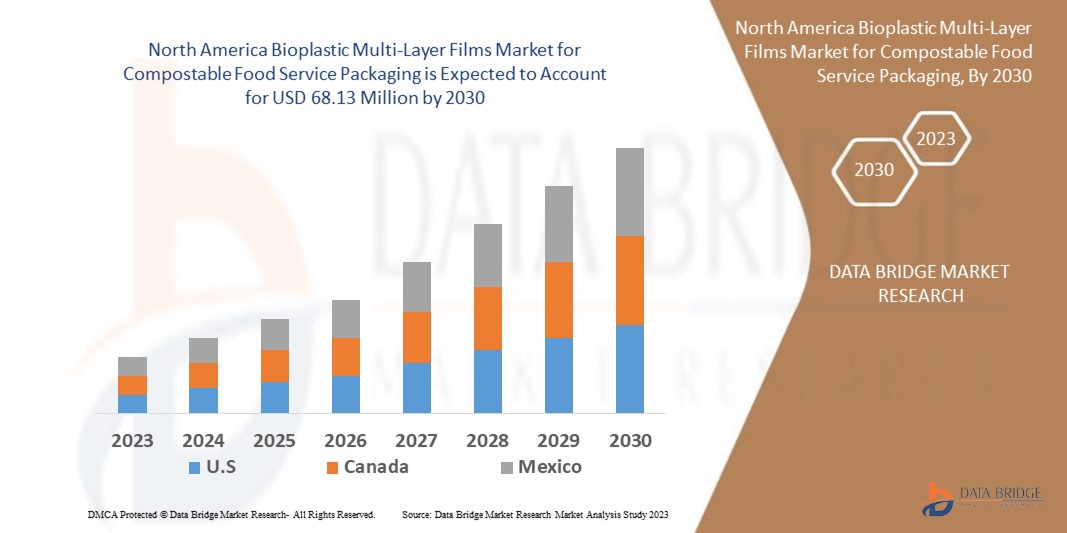
North America Bioplastic Multi-Layer Films Market for Compostable Food Service Packaging Analysis and Size
Multi-layer films can be used in packaging fresh products and dry foods to extend shelf life cost-effectively. Bioplastics are sturdy materials that can replace conventional petroleum-based plastics for sustainable food packaging. Materials derived from renewable resources and biodegradable polymers are bioplastics, such as PLA, PHA, PBAT, and starch.
Data Bridge Market Research analyses that the North America bioplastic multi-layer films market for compostable food service packaging which was USD 38.49 million in 2022, would rocket up to USD 68.13 million by 2030, and is expected to undergo a CAGR of 7.4% during the forecast period of 2023 to 2030. " “Starch blends” dominates material segment in the North America bioplastic multi-layer films market for compostable food service packaging.
In addition to the insights on market scenarios such as market value, growth rate, segmentation, geographical coverage, and major players, the market reports curated by the Data Bridge Market Research also include in-depth expert analysis, geographically represented company-wise production and capacity, network layouts of distributors and partners, detailed and updated price trend analysis and deficit analysis of supply chain and demand.
North America Bioplastic Multi-Layer Films Market for Compostable Food Service Packaging Scope and Segmentation
|
Report Metric |
Details |
|
Forecast Period |
2023 to 2030 |
|
Base Year |
2022 |
|
Historic Years |
2021 (Customizable to 2015-2020) |
|
Quantitative Units |
Revenue in USD Thousand, Volume in Tons, Pricing in USD |
|
Segments Covered |
By Material (Starch Blends, Polybutylene Adipate Terephthalate, Polylactic Acid, PBS, and Others), End-Use Packaging (Pouches & Sachets, Clamshell, Cups, Trays, and Others), End-User (Chain Restaurants, Non-Chain Restaurants, Chain Café, Non-Chain Café, Delivery Catering, Independent Sellers & Kiosks, and Others) |
|
Countries Covered |
U.S., Canada, and Mexico |
|
Market Players Covered |
BASF SE (Germany), TIPA LTD (Israel), Biome Bioplastics (A subsidiary of Biome Technologies plc) (U.K.), BioBag International AS. (Norway), and Transcontinental Inc. (Canada), among others |
|
Market Opportunities |
|
Market Definition
Bioplastics originate from a renewable resource, are biodegradable, or are both. Materials derived from renewable resources and biodegradable polymers are bioplastics, such as starch blends, polybutylene adipate terephthalate, polylactic acid, and PBS. In multi-layer film technology, two or more materials with specific and complementary properties are combined, thus improving the overall performance of the bioplastic. The materials offer competitive performance in terms of flexible and rigid packaging while minimizing the negative impact of conventional petroleum-based plastics.
In food service packaging, compostable multi-layer films offer excellent protection for fresh and dry foods. The end-use packaging products from this material can be easily printed using traditional and digital printing technologies. The compostable multi-layer films allow food service providers to move away from conventional packaging and be at the forefront of the drive to create a circular economy.
North America Bioplastic Multi-Layer Films Market for Compostable Food Service Packaging Dynamics
Drivers
- Inclination towards the consumption of convenience food
Convenience food items include pre-washed, cooked, mostly packaged, ready-to-eat foods. Western culture strongly influences consumers due to tight schedules. Moreover, fast-paced lifestyle changes have increased interest in health and wellness, and changing consumer needs have increased the demand for cooked meals. People want to reduce the number of times they visit grocery shops which influences them to buy frozen food products and different beverages in bulk and store them in flexible packaging to maintain the shelf life of the food and beverage products. Furthermore, convenience food requires the perfect temperature to protect the food from biological contamination and physical damage. As a result, this raises the demand for bioplastic multi-layer film packaging products.
- Rising popularity of flexible packaging solutions
The packaging industry is adopting smart and sustainable solutions to make product packaging more consumer-, brand-, and environmentally friendly, allowing the packaging industry to develop smart packaging involving the internet of packaging, active packaging, and nanotechnology. Flexible packaging products made of bio-plastic films are lightweight, convenient, and cost-effective, allowing hassle-free movement. The materials used to manufacture flexible packaging enable packing products of any shape, design & color scheme, size, and volume. Compostable flexible packaging is comprised of cellulose or other plant-derived materials. These bio-based plastics, or bioplastics, are plant-based materials that replace traditional petroleum-based plastics.
- Shifting consumer preference toward the hygienic food packaging products
Food packaging serves multiple purposes as it protects food from getting contaminated or spoilt, making the package look attractive, and enables the transportation of goods. Packaging retains the freshness of the product and prevents it from exposure to chemical or biological contamination. Food packaging uses various materials such as bioplastic, films, and aluminum, which protect food from different types of exposure, including sunlight, gases, and moisture. A packaging material made of bio-plastic films protects food from pathogens and chemicals. Biological packaging materials include plastic and cushioning materials, which prevent food from dislodging and getting crushed during packing, transport, and shelving.
- Growing trend toward the elimination of the single-use plastic
The increasing amount of non-recyclable plastics has created huge landfills worldwide. This kind of waste has been polluting the earth's natural resources to the extent that the aquatic ecosystems face its adverse impact, apart from the other palpable ill effects of the chemicals in it. Multi-layer bioplastic materials are widely used in packaging food products so that the products can be taken from one place to another. Multi-layer bioplastic materials are used for flexible packaging, including plastics and polymers from which different types of flexible packaging are made, such as bags, envelopes, pouches, cellulose, and aluminum foils. The increasing population in regions and the ban on single-use plastic products result in an increasing demand for the packaging of bioplastic materials.
Opportunities
- Growing demand from the e-commerce sector
Various factors, such as internet penetration, the rise in smartphone users, social media influence, and government initiatives, have boosted the e-commerce sector. The growing adoption of e-commerce platforms highlights the importance of online retail sales to the modern economy. Shipping boxes from major online retailers and other retailers symbolize e-commerce. They also represent one of the most important sources of demand growth for bioplastic multi-layer film packaging. There is also an increasing trend toward making bioplastic multi-layer film packaging attractive and enjoyable for enhancing the consumer experience on e-commerce platforms.
- Surge in innovative packaging solutions with new design
Innovative packaging solutions such as digitally printed packaging offer considerable potential savings over other printing processes and low setup costs. Manufacturers can dispense with bulk orders with large print runs and stock holding. The advanced packaging solution gives packagers more freedom in personalization and customization than mechanical processes like typesetting. Many top product brands have explored personalized packaging and found a significant return on this innovative marketing investment. Thus, adopting new and advanced printing technologies is on the rise to offer consumers personalized packaging solutions. This has helped businesses to increase their brand value in the market and enhance customer engagement with the product packaging.
Restraints/Challenges
- High costs associated with biodegradable films
Manufacturing bio-plastic film-based products depends on the number of raw materials used for production since environmentally friendly raw materials are costlier than conventional materials. Also, factors such as size and product features of the packaging products influence the price of the products used in the food packaging sector. Due to the limited amount of good biodegradable packaging worldwide, any biodegradable packaging product will be a bit more expensive than standard packaging products. Bio-plastic bags are more expensive than traditional plastic because raw materials are more expensive, less readily available, and manufacturing processes cost more with smaller batches.
- Availability of substitute products
Conventional plastics are the third most commonly-used petroleum derivative that can be used instead of bio-plastic materials and are known as fossil fuel plastics. Due to its relatively low cost, ease of manufacture, versatility, and imperviousness to water, it is used in many products. It has been a good replacement for wood, leather, and paper. On the other hand, bioplastic products are materials produced from renewable biomass sources, such as vegetable fats and oils, corn starch, straw, woodchips, and recycled food waste, which are more expensive than conventional products. In addition, at low temperatures, the production of bioplastics can be affected by using different hard chemicals, which disturbs the products' flexibility.
- Issues related to biodegradable films
Bioplastics have increased use to create packaging products that perform better than traditional plastics in many applications. Bioplastics often end up in landfills, and due to the absence of oxygen, they release methane, a greenhouse gas. Whenever bioplastics are not discarded properly, they contaminate recycled plastic batches and harm the recycling framework. Different biopolymers used for packaging products have disadvantages such as high-water vapor permeability, oxygen permeability, fragility, low thermal resistance, low mechanical properties, vulnerability to degradation, and low processability. These, in turn, decrease the demand for bioplastic film-based packaging products. Furthermore, bioplastic films have low barrier properties to air, water, and oxygen and low resistance to heat compared to conventional plastic films.
- Uncertainties in production processes and end-of-life options for bioplastics
Manufacturing units of bioplastic film packaging products are characterized by short product lifecycles with greater product variations and quick response times to customer demands. This requires effective planning and scheduling of various production activities, and hence a rigid plan is no longer valid to meet all the constraints and changes in the manufacturing process. Moreover, the lack of technological development and reduced capital investment for manufacturing bio-plastic film packaging products further decrease the demand for these products in developing countries.
This Bioplastic Multi-Layer Films Market for Compostable Food Service Packaging report provides details of new recent developments, trade regulations, import-export analysis, production analysis, value chain optimization, market share, impact of domestic and localized market players, analyses opportunities in terms of emerging revenue pockets, changes in market regulations, strategic market growth analysis, market size, category market growths, application niches and dominance, product approvals, product launches, geographic expansions, technological innovations in the market. To gain more info on the Bioplastic Multi-Layer Films Market for Compostable Food Service Packaging contact Data Bridge Market Research for an Analyst Brief, our team will help you take an informed market decision to achieve market growth.
Recent Developments
-
In June 2022, BASF SE and Confoil (an Australian food packaging manufacturer) collaborated to develop a certified compostable and dual oven-able paper tray for preparing ready-to-eat meals. The trays extend the end-of-life options for paper-based packaging by being organically recyclable. They can be commercially composted with the organic waste collected in bins. This helped the company to get recognition in the Australian market.
-
In November 2021, Transcontinental Inc. acquired H.S. Crocker Co., Inc., a leading die-cut lids manufacturer for the food industry and labels for the pharmaceutical industry in North America. This acquisition will strengthen the packaging solutions portfolio, especially in the dairy, and coffee lids as well as shelf stable and chilled desserts markets, and provide significant cross-selling opportunities.
North America Bioplastic Multi-Layer Films Market for Compostable Food Service Packaging Scope
The bioplastic multi-layer films market for compostable food service packaging are segmented based on the material, end-use packaging, and end-user. The growth amongst these segments will help you analyse meagre growth segments in the industries and provide the users with a valuable market overview and market insights to help them make strategic decisions for identifying core market applications.
MATERIAL
- Starch Blends
- Polybutylene Adipate Terephthalate
- Polylactic Acid
- PBS
- Others
END-USE PACKAGING
- Pouches & Sachets
- Clamshell
- Cups
- Trays
- Others
END-USER
- Chain Restaurants
- Non-Chain Restaurants
- Chain Café
- Non-Chain Café
- Delivery Catering
- Independent Sellers & Kiosks
- Others
Bioplastic Multi-Layer Films Market for Compostable Food Service Packaging Regional Analysis/Insights
The bioplastic multi-layer films market for compostable food service packaging is analysed and market size insights and trends are provided by country, material, end-use packaging, and end-user, as referenced above.
The countries covered in the bioplastic multi-layer films market for compostable food service packaging report are U.S., Canada, and Mexico.
The U.S. dominates the bioplastic multi-layer films market for compostable food service packaging due to its increasing consumer base and rising government initiatives which drive the market growth.
The country section of the report also provides individual market impacting factors and domestic regulation changes that impact the current and future trends of the market. Data points like down-stream and upstream value chain analysis, technical trends and porter's five forces analysis, case studies are some of the pointers used to forecast the market scenario for individual countries. Also, the presence and availability of the global brands and their challenges faced due to large or scarce competition from local and domestic brands, impact of domestic tariffs and trade routes are considered while providing forecast analysis of the country data.
Competitive Landscape and Bioplastic Multi-Layer Films Market for Compostable Food Service Packaging Share Analysis
The bioplastic multi-layer films market for compostable food service packaging competitive landscape provides details by competitor. Details included are company overview, company financials, revenue generated, market potential, investment in research and development, new market initiatives, global presence, production sites and facilities, production capacities, company strengths and weaknesses, product launch, product width and breadth, application dominance. The above data points provided are only related to the companies' focus on the market.
Some of the major players operating in the Bioplastic Multi-Layer Films Market for Compostable Food Service Packaging are:
- BASF SE (Germany)
- TIPA LTD (Israel)
- Biome Bioplastics (A subsidiary of Biome Technologies plc) (U.K.)
- BioBag International AS. (Norway)
- Transcontinental Inc. (Canada)
SKU-
Obtenha acesso online ao relatório sobre a primeira nuvem de inteligência de mercado do mundo

- Painel interativo de análise de dados
- Painel de análise da empresa para oportunidades de elevado potencial de crescimento
- Acesso de analista de pesquisa para personalização e customização. consultas
- Análise da concorrência com painel interativo
- Últimas notícias, atualizações e atualizações Análise de tendências
- Aproveite o poder da análise de benchmark para um rastreio abrangente da concorrência
Metodologia de Investigação
A recolha de dados e a análise do ano base são feitas através de módulos de recolha de dados com amostras grandes. A etapa inclui a obtenção de informações de mercado ou dados relacionados através de diversas fontes e estratégias. Inclui examinar e planear antecipadamente todos os dados adquiridos no passado. Da mesma forma, envolve o exame de inconsistências de informação observadas em diferentes fontes de informação. Os dados de mercado são analisados e estimados utilizando modelos estatísticos e coerentes de mercado. Além disso, a análise da quota de mercado e a análise das principais tendências são os principais fatores de sucesso no relatório de mercado. Para saber mais, solicite uma chamada de analista ou abra a sua consulta.
A principal metodologia de investigação utilizada pela equipa de investigação do DBMR é a triangulação de dados que envolve a mineração de dados, a análise do impacto das variáveis de dados no mercado e a validação primária (especialista do setor). Os modelos de dados incluem grelha de posicionamento de fornecedores, análise da linha de tempo do mercado, visão geral e guia de mercado, grelha de posicionamento da empresa, análise de patentes, análise de preços, análise da quota de mercado da empresa, normas de medição, análise global versus regional e de participação dos fornecedores. Para saber mais sobre a metodologia de investigação, faça uma consulta para falar com os nossos especialistas do setor.
Personalização disponível
A Data Bridge Market Research é líder em investigação formativa avançada. Orgulhamo-nos de servir os nossos clientes novos e existentes com dados e análises que correspondem e atendem aos seus objetivos. O relatório pode ser personalizado para incluir análise de tendências de preços de marcas-alvo, compreensão do mercado para países adicionais (solicite a lista de países), dados de resultados de ensaios clínicos, revisão de literatura, mercado remodelado e análise de base de produtos . A análise de mercado dos concorrentes-alvo pode ser analisada desde análises baseadas em tecnologia até estratégias de carteira de mercado. Podemos adicionar quantos concorrentes necessitar de dados no formato e estilo de dados que procura. A nossa equipa de analistas também pode fornecer dados em tabelas dinâmicas de ficheiros Excel em bruto (livro de factos) ou pode ajudá-lo a criar apresentações a partir dos conjuntos de dados disponíveis no relatório.











