




Asia Pacific Ai In Bioinformatics Market
Market Size in USD Billion
CAGR :
% 
 USD
1.31 Billion
USD
16.93 Billion
2025
2033
USD
1.31 Billion
USD
16.93 Billion
2025
2033
 Forecast Period Forecast Period |
2026 - 2033 |
 Market Size (Base Year) Market Size (Base Year) |
USD 1.31 Billion |
 Market Size (Forecast Year) Market Size (Forecast Year) |
USD 16.93 Billion |
 CAGR CAGR |
% |
| Major Markets Players |
|
Asia-Pacific AI in Bioinformatics Market Overview
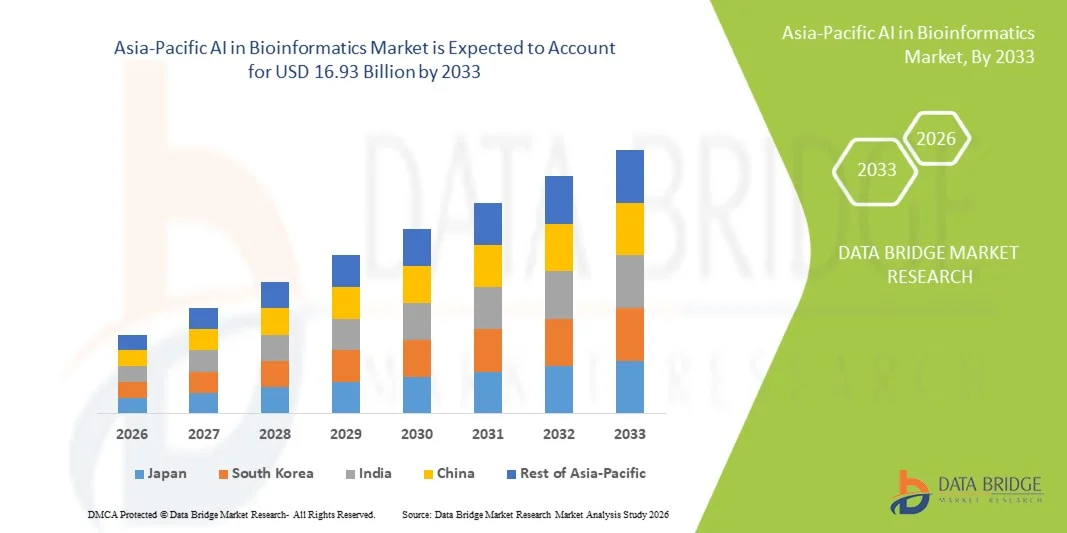
The Asia-Pacific AI in bioinformatics market was valued at USD 1.31 billion in 2025 and is projected to reach USD 16.93 billion by 2033, growing at a CAGR of 37.7% from 2026 to 2033. The market is witnessing robust growth driven by increasing adoption of artificial intelligence in genomics and proteomics research, expanding investments in precision medicine, and rising demand for advanced data analytics across pharmaceutical, biotechnology, and healthcare sectors.
The growing volume of biological and genomic data generated through next-generation sequencing technologies, coupled with government initiatives supporting digital healthcare and life sciences research, is encouraging research institutes, healthcare organizations, and biopharmaceutical companies to integrate AI-powered bioinformatics solutions. Machine learning, deep learning, and predictive analytics platforms are increasingly being utilized for drug discovery, biomarker identification, disease diagnosis, and personalized treatment development, enabling faster and more accurate interpretation of complex biological datasets while improving research efficiency and clinical outcomes across the region.
Key Market Trends & Insights
- China dominated the Asia-Pacific AI in Bioinformatics market with the largest revenue share of 34.76% in 2025, supported by large-scale genomics initiatives, substantial government funding for AI research, and rapid expansion of biotechnology and precision medicine programs.
- The Software segment led the market with a 61.84% share in 2025, driven by to the increasing deployment of AI-powered bioinformatics platforms for genomic analysis, drug discovery, biomarker identification, and precision medicine research
- India is expected to be the fastest-growing country in the market, registering a CAGR of 15.2% from 2026 to 2033, fueled by rising investments in life sciences research, expanding bioinformatics capabilities, and growing adoption of AI-based healthcare solutions.
- Services are the fastest-growing offering type, projected to register a CAGR of 15.6%, reflecting the surge in demand for bioinformatics consulting, data management, algorithm development, and outsourced analytical services.
- The Machine Learning segment dominated the type category with a 47.28% revenue share in 2025, led by extensive application in predictive modeling, disease classification, biomarker discovery, and genomic data interpretation.
- Bioinformatics Platforms accounted for 45.67% of the market, preferred by their critical role in integrating, storing, analyzing, and visualizing biological data.
- The Chemoinformatics & Drug Design segment is the fastest-growing application category, with a CAGR of 17.1%, driven by increasing adoption of AI-powered drug discovery platforms, rising demand for accelerated compound screening and molecular modeling, growing investments in precision therapeutics and biologics development.
Market Size & Forecast
- Global Market Value (2025): USD 1.31 Billion
- Expected Market Value (2033): USD 16.93 Billion
- Forecast CAGR (2026–2033): 37.7%
- Leading Country in 2025: China
- Fastest Growing Country: India
Report Scope and Asia-Pacific AI in Bioinformatics Market Segmentation
|
Attributes |
Asia-Pacific AI in Bioinformatics Key Market Insights |
|
Segments Covered |
|
|
Countries Covered |
Asia-Pacific · China · Japan · India · South Korea · Singapore · Malaysia · Australia · Thailand · Indonesia · Philippines · Rest of Asia-Pacific |
|
Key Market Players |
· BenevolentAI (Luxembourg) · SOPHiA GENETICS SA (Switzerland) · Oxford Nanopore Technologies plc (U.K.) · BioLizard NV (Belgium) · SeqOne (France) · Biomax Informatics AG (Germany) · Molecular Health GmbH (Germany) · Genomenon, Inc. (U.S.) · QIAGEN (Netherlands) · Evotec SE (Germany) · e-therapeutics plc (U.K.) · PrecisionLife Ltd (U.K.) · LIfT BioSciences Ltd (U.K.) · Congenica Ltd (U.K.) · Lindus Health Limited (U.K.) · Huma Therapeutics Limited (U.K.) · Owkin, Inc. (France) · MultiplAI Health Ltd (U.K.) · Genomics England Limited (U.K.) · Enveda Biosciences, Inc. (U.K.) |
|
Market Opportunities |
· Expansion of precision medicine programs · Increasing adoption of AI in drug discovery · Growth of cross-border genomic data sharing initiatives |
|
Value Added Data Infosets |
In addition to the insights on market scenarios such as market value, growth rate, segmentation, geographical coverage, and major players, the market reports curated by the Data Bridge Market Research also include in-depth expert analysis, patient epidemiology, pipeline analysis, pricing analysis, and regulatory framework. |
Asia-Pacific AI in Bioinformatics Market Trends
Trend: Rising Adoption of AI-Powered Multi-Omics Analysis
Research institutions, pharmaceutical companies, and biotechnology firms across Asia-Pacific are increasingly adopting AI-powered bioinformatics platforms to analyze genomics, transcriptomics, proteomics, and metabolomics datasets within unified research environments. The integration of machine learning and deep learning technologies enables faster identification of disease biomarkers, drug targets, and genetic variations while reducing the complexity of large-scale biological data interpretation. Precision medicine initiatives and expanding sequencing programs are further accelerating demand for advanced analytical platforms that can generate actionable insights from complex biological information.
For instance, in March 2025, researchers at RIKEN announced the expanded use of AI-driven multi-omics analytics to accelerate genomic research and disease pathway identification, highlighting the growing role of artificial intelligence in advanced bioinformatics workflows across Asia-Pacific.
Asia-Pacific AI in Bioinformatics Market Dynamics
Key Market Driver: Growing Use of AI in Drug Discovery and Precision Medicine
The rapid expansion of precision medicine programs and AI-assisted drug discovery initiatives has created substantial demand for advanced bioinformatics platforms capable of processing large biological datasets and identifying novel therapeutic targets. Pharmaceutical companies, biotechnology organizations, and research institutes are deploying AI-based solutions to accelerate candidate screening, predict molecular interactions, and optimize clinical development workflows. These capabilities help reduce research timelines, improve success rates, and support the development of personalized treatment strategies for complex diseases.
For instance, in January 2024, Insilico Medicine expanded its AI-driven drug discovery collaborations in Asia, demonstrating how artificial intelligence is becoming a critical component of bioinformatics-enabled pharmaceutical research and precision healthcare development.
Key Restraint/Challenge: Limited Availability of High-Quality Biological Data
A significant restraint in the Asia-Pacific AI in bioinformatics market is the limited availability of standardized, high-quality biological and clinical datasets required for effective AI model development. Data fragmentation across healthcare systems, inconsistent annotation practices, and regulatory restrictions related to patient information sharing create challenges for model training and validation. The complexity of integrating genomic, clinical, and molecular datasets further increases operational costs and can slow the adoption of AI-driven bioinformatics solutions among research organizations and healthcare providers.
For instance, in 2024, multiple genomics research programs across Asia reported challenges associated with cross-border biological data sharing and interoperability requirements, reflecting the broader difficulty of developing robust AI bioinformatics models using diverse and fragmented datasets.
Key Market Opportunity: Expansion of Cloud-Based Bioinformatics and Genomic Research Platforms
The expansion of cloud-based bioinformatics infrastructure presents a significant market opportunity. Cloud-enabled platforms provide scalable computing resources, collaborative research environments, and access to advanced AI algorithms for genomic analysis, biomarker discovery, and drug development. The increasing availability of high-performance computing services and national genomics initiatives is further supporting adoption among academic institutions, biotechnology companies, and healthcare organizations, creating new growth opportunities across emerging and developed Asia-Pacific markets.
For instance, in May 2024, Alibaba Cloud strengthened its life sciences and AI computing capabilities to support large-scale genomics and biomedical research projects, demonstrating the growing opportunity for cloud-based bioinformatics platforms throughout the region.
Asia-Pacific AI in Bioinformatics Market Scope
The Asia-Pacific AI in bioinformatics market is segmented on the basis of offering, type, products and services, application, and sector.
- By Offering
On the basis of offering, the Asia-Pacific AI in Bioinformatics market is segmented into software, services, and others. The Software segment dominated the market with a 61.84% share in 2025, owing to the increasing deployment of AI-powered bioinformatics platforms for genomic analysis, drug discovery, biomarker identification, and precision medicine research. Software solutions enable automated processing of vast biological datasets while improving analytical accuracy and reducing research timelines. Pharmaceutical companies and research institutions increasingly rely on advanced algorithms and machine learning models to derive actionable insights from complex omics data. The segment also benefits from continuous advancements in cloud computing and high-performance analytics platforms. Growing investments in digital biology and computational genomics further support adoption. The scalability and efficiency of software solutions continue to strengthen their market leadership.
The Services segment is projected to register the fastest growth at a CAGR of 15.6% from 2026 to 2033, driven by rising demand for bioinformatics consulting, data management, algorithm development, and outsourced analytical services. Many organizations lack in-house expertise to manage large-scale biological datasets and AI workflows. Service providers offer customized solutions that help accelerate research outcomes while reducing operational complexity. Increasing collaborations between biotechnology companies and bioinformatics specialists are further boosting demand. The growing adoption of AI across emerging research institutions is creating additional opportunities for service providers. Expanding precision medicine initiatives across Asia-Pacific are expected to further accelerate segment growth.
- By Type
On the basis of type, the Asia-Pacific AI in Bioinformatics market is segmented into machine learning, deep learning, and others. The Machine Learning segment dominated the market with a 47.28% share in 2025 due to its extensive application in predictive modeling, disease classification, biomarker discovery, and genomic data interpretation. Machine learning algorithms can efficiently process structured and semi-structured biological datasets while delivering accurate analytical outcomes. These technologies are widely adopted across pharmaceutical research, diagnostics, and healthcare applications. Their ability to improve decision-making and automate repetitive analytical tasks supports widespread implementation. Continuous improvements in algorithm performance and data availability are strengthening market penetration. The technology remains the foundation for most AI-enabled bioinformatics platforms.
The Deep Learning segment is anticipated to witness the fastest growth at a CAGR of 16.2% from 2026 to 2033, driven by its superior capability to analyze highly complex and unstructured biological datasets. Deep learning models are increasingly being used for protein structure prediction, drug-target interaction analysis, image-based diagnostics, and genomic sequencing applications. Advances in neural network architectures are significantly improving predictive accuracy and research efficiency. Growing availability of high-performance computing infrastructure is supporting adoption. Pharmaceutical and biotechnology companies are increasingly investing in deep learning-driven research programs. The technology's ability to uncover hidden biological patterns is expected to drive substantial growth.
- By Products and Services
On the basis of products and services, the Asia-Pacific AI in Bioinformatics market is segmented into knowledge management tools, bioinformatics platforms, and bioinformatics services. The Bioinformatics Platforms segment dominated the market with a 45.67% share in 2025 owing to their critical role in integrating, storing, analyzing, and visualizing biological data. These platforms support a wide range of applications including genomics, proteomics, transcriptomics, and drug discovery research. Researchers increasingly prefer integrated platforms that combine AI capabilities with scalable computational resources. Continuous innovation in cloud-based and AI-powered analytical systems is further enhancing platform capabilities. The growing volume of biological data generated by sequencing technologies is accelerating demand. Their comprehensive functionality makes them indispensable across research and clinical settings.
The Bioinformatics Services segment is expected to be the fastest-growing segment at a CAGR of 15.8% from 2026 to 2033. Organizations increasingly seek external expertise to manage complex bioinformatics workflows, data interpretation, and AI model development. Service providers help reduce infrastructure costs while enabling access to specialized analytical capabilities. Growing outsourcing trends within pharmaceutical and biotechnology industries are supporting market expansion. Increasing research collaborations and contract-based bioinformatics projects are creating significant growth opportunities. Demand is particularly strong among smaller research organizations lacking dedicated computational resources. The segment is expected to benefit from the continued expansion of precision medicine initiatives.
- By Application
On the basis of application, the Asia-Pacific AI in Bioinformatics market is segmented into genomics, microarrays, system biology, text mining, chemoinformatics & drug design, proteomics, transcriptomics, DNA sequencing, metabolomics, and others. The Genomics segment accounted for the largest market share of 28.94% in 2025, driven by the rapid expansion of genome sequencing programs and personalized medicine initiatives across the region. AI technologies are extensively used to analyze genetic variations, identify disease markers, and support clinical decision-making. Increasing investments in population genomics projects are further fueling demand. Pharmaceutical companies rely heavily on genomic analysis for target identification and therapeutic development. Continuous reductions in sequencing costs are increasing accessibility. The growing importance of precision healthcare continues to reinforce segment dominance.
The Chemoinformatics & Drug Design segment is projected to register the fastest growth at a CAGR of 17.1% from 2026 to 2033. AI-powered chemoinformatics solutions are transforming drug discovery by accelerating compound screening, molecular modeling, and target identification processes. These technologies significantly reduce research timelines and development costs compared to conventional approaches. Pharmaceutical companies are increasingly adopting AI-driven platforms to improve drug candidate success rates. Growing investments in innovative therapeutics and biologics are supporting demand. The increasing prevalence of complex diseases is encouraging the development of advanced drug discovery tools. As a result, the segment is expected to experience rapid expansion.
- By Sector
On the basis of sector, the Asia-Pacific AI in Bioinformatics market is segmented into medical biotechnology, animal biotechnology, plant biotechnology, environmental biotechnology, forensic biotechnology, and others. The Medical Biotechnology segment dominated the market with a 51.36% share in 2025 due to extensive utilization of AI-driven bioinformatics solutions in diagnostics, therapeutics development, precision medicine, and clinical research. The growing burden of chronic diseases and increasing demand for personalized healthcare are driving adoption. Healthcare providers and pharmaceutical companies are heavily investing in genomic and molecular research initiatives. AI technologies improve the speed and accuracy of biological data analysis, supporting better clinical outcomes. Expanding government support for biotechnology innovation further strengthens market growth. The segment continues to represent the largest area of application for AI bioinformatics technologies.
The Plant Biotechnology segment is expected to witness the fastest growth at a CAGR of 15.4% from 2026 to 2033, driven by increasing focus on food security, crop improvement, and sustainable agricultural practices. AI-enabled bioinformatics tools are helping researchers identify beneficial genetic traits and accelerate breeding programs. Rising demand for climate-resilient and high-yield crop varieties is encouraging investment in agricultural biotechnology. Governments and research institutions across Asia-Pacific are supporting genomic research aimed at improving agricultural productivity. Advances in sequencing technologies are enabling more efficient plant genome analysis. These factors are expected to contribute significantly to the rapid growth of the segment.
Asia-Pacific AI in Bioinformatics Market Regional Analysis
China dominated the Asia-Pacific AI in Bioinformatics market with the largest revenue share of 34.76% in 2025, supported by large-scale genomics initiatives, substantial government funding for AI research, and rapid expansion of biotechnology and precision medicine programs. The country also benefits from large-scale genome sequencing initiatives, strong adoption of AI-driven bioinformatics platforms, and increasing utilization of advanced analytics across drug discovery, precision medicine, and clinical research applications. Rising investments in computational biology, growing healthcare digitalization, and continued expansion of biomedical research capabilities continue to strengthen China’s leadership position in the Asia-Pacific market.
The China AI in Bioinformatics Market Insight
The China AI in bioinformatics market is growing rapidly, driven by expanding genomics programs, increasing biotechnology investments, and rising government focus on artificial intelligence and healthcare innovation. Growing adoption of AI-enabled bioinformatics platforms across pharmaceutical, clinical, and academic sectors is significantly boosting market demand. In addition, rising investments in drug discovery research, increasing availability of large-scale biological datasets, and rapid technological advancements are positioning China as one of the largest and fastest-growing markets for AI in bioinformatics in Asia-Pacific.
India AI in Bioinformatics Market Insight
The India AI in bioinformatics market is witnessing robust growth due to increasing investments in biotechnology research, expanding genomic sequencing initiatives, and growing adoption of AI-driven healthcare solutions. Pharmaceutical companies, contract research organizations, and academic institutions are increasingly utilizing AI-powered bioinformatics tools for drug discovery, disease prediction, and precision medicine applications. Furthermore, strong government support for digital healthcare and bioeconomy development is accelerating the deployment of advanced bioinformatics technologies across the country.
Japan AI in Bioinformatics Market Insight
The Japan AI in bioinformatics market is witnessing consistent growth due to rising investments in genomic research, biotechnology innovation, and precision healthcare initiatives. Pharmaceutical companies, healthcare organizations, and research institutes are increasingly adopting AI-powered bioinformatics platforms for disease analysis, biomarker discovery, and drug development purposes. Moreover, increasing integration of machine learning technologies and the country’s focus on advanced healthcare solutions are further contributing to market growth.
South Korea AI in Bioinformatics Market Insight
The South Korea AI in bioinformatics market is expanding steadily owing to strong government support for artificial intelligence, growing investments in biotechnology innovation, and increasing adoption of precision medicine programs. Research organizations and life sciences companies are leveraging AI-based bioinformatics platforms to improve genomic analysis, therapeutic development, and clinical research outcomes. Continuous advancements in digital healthcare infrastructure and computational biology capabilities are further strengthening market expansion across the country.
Asia-Pacific AI in Bioinformatics Market Share
The Asia-Pacific AI in Bioinformatics industry is primarily led by well-established companies, including:
- BenevolentAI (Luxembourg)
- SOPHiA GENETICS SA (Switzerland)
- Oxford Nanopore Technologies plc (U.K.)
- BioLizard NV (Belgium)
- SeqOne (France)
- Biomax Informatics AG (Germany)
- Molecular Health GmbH (Germany)
- Genomenon, Inc. (U.S.)
- QIAGEN (Netherlands)
- Evotec SE (Germany)
- e-therapeutics plc (U.K.)
- PrecisionLife Ltd (U.K.)
- LIfT BioSciences Ltd (U.K.)
- Congenica Ltd (U.K.)
- Lindus Health Limited (U.K.)
- Huma Therapeutics Limited (U.K.)
- Owkin, Inc. (France)
- MultiplAI Health Ltd (U.K.)
- Genomics England Limited (U.K.)
- Enveda Biosciences, Inc. (U.K.)
Latest Developments in Asia-Pacific AI in Bioinformatics Market
- In May 2024, Certara announced a distributor agreement with Cloudscientific to expand access to its D360 scientific informatics platform and Certara.AI solutions in China. The collaboration aims to accelerate AI-driven drug discovery and bioinformatics research by providing biopharmaceutical companies with advanced data analytics, scientific intelligence, and generative AI capabilities. This development strengthens the adoption of AI-powered bioinformatics tools within China's rapidly growing pharmaceutical R&D ecosystem
- In December 2023, Synplogen announced plans with Ginkgo Bioworks to accelerate DNA manufacturing and gene therapy platform services in Japan. The collaboration focuses on expanding synthetic biology and advanced genomic engineering capabilities, creating new opportunities for AI-driven bioinformatics workflows in genetic research, therapeutic development, and biotechnology innovation across the Asia-Pacific region
- In October 2023, Fujitsu and RIKEN announced the development of a generative AI-based drug discovery technology capable of predicting protein structural changes from large-scale electron microscopy images. The technology significantly reduces drug discovery time and costs while improving the accuracy of protein structure analysis. Fujitsu also integrated the capability into its AI platform, enabling broader application in bioinformatics and pharmaceutical research
- In May 2023, Kyoto University, Chordia Therapeutics, and Fujitsu launched a joint proof-of-concept project utilizing AI-based causal discovery technology to identify biomarkers for cancer drug development. The initiative applies AI to genomic datasets generated through next-generation sequencing, helping researchers improve clinical trial success rates and accelerate precision medicine development. The project highlights the growing integration of AI and bioinformatics in oncology research across Asia-Pacific
- In March 2023, National Cancer Center Japan and The University of Tokyo reported results from the world's largest gastric cancer genomic study involving 1,457 genome samples. The research identified new therapeutic targets and biomarkers that can support AI-enabled genomic analysis and personalized cancer treatment strategies. The study strengthened the region's position in large-scale genomic data generation and bioinformatics innovation
SKU-
Get online access to the report on the World's First Market Intelligence Cloud

- Interactive Data Analysis Dashboard
- Company Analysis Dashboard for high growth potential opportunities
- Research Analyst Access for customization & queries
- Competitor Analysis with Interactive dashboard
- Latest News, Updates & Trend analysis
- Harness the Power of Benchmark Analysis for Comprehensive Competitor Tracking
Research Methodology
Data collection and base year analysis are done using data collection modules with large sample sizes. The stage includes obtaining market information or related data through various sources and strategies. It includes examining and planning all the data acquired from the past in advance. It likewise envelops the examination of information inconsistencies seen across different information sources. The market data is analysed and estimated using market statistical and coherent models. Also, market share analysis and key trend analysis are the major success factors in the market report. To know more, please request an analyst call or drop down your inquiry.
The key research methodology used by DBMR research team is data triangulation which involves data mining, analysis of the impact of data variables on the market and primary (industry expert) validation. Data models include Vendor Positioning Grid, Market Time Line Analysis, Market Overview and Guide, Company Positioning Grid, Patent Analysis, Pricing Analysis, Company Market Share Analysis, Standards of Measurement, Global versus Regional and Vendor Share Analysis. To know more about the research methodology, drop in an inquiry to speak to our industry experts.
Customization Available
Data Bridge Market Research is a leader in advanced formative research. We take pride in servicing our existing and new customers with data and analysis that match and suits their goal. The report can be customized to include price trend analysis of target brands understanding the market for additional countries (ask for the list of countries), clinical trial results data, literature review, refurbished market and product base analysis. Market analysis of target competitors can be analyzed from technology-based analysis to market portfolio strategies. We can add as many competitors that you require data about in the format and data style you are looking for. Our team of analysts can also provide you data in crude raw excel files pivot tables (Fact book) or can assist you in creating presentations from the data sets available in the report.












