


Asia Pacific Circulating Tumor Cells Ctc Liquid Biopsy Market
Market Size in USD Million
CAGR :
% 
 USD
139.25 Million
USD
1,035.19 Million
2025
2033
USD
139.25 Million
USD
1,035.19 Million
2025
2033
 Forecast Period Forecast Period |
2026 –2033 |
 Market Size (Base Year) Market Size (Base Year) |
USD 139.25 Million |
 Market Size (Forecast Year) Market Size (Forecast Year) |
USD 1,035.19 Million |
 CAGR CAGR |
% |
| Major Markets Players |
|
Asia-Pacific Circulating Tumor Cells (CTC) Liquid Biopsy Market Size
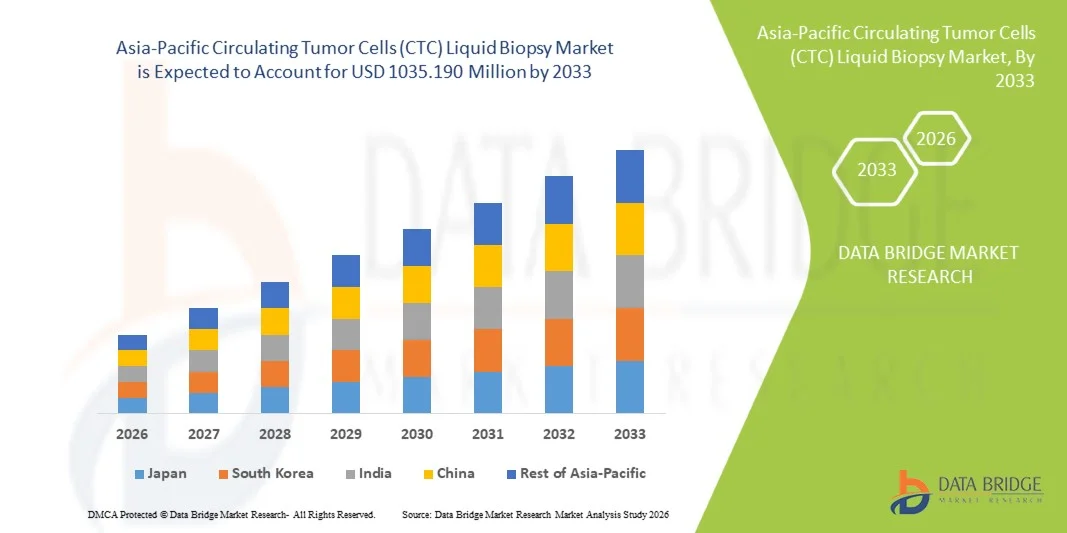
- The Asia-Pacific Circulating Tumor Cells (CTC) liquid biopsy market size was valued at USD 139.25 million in 2025and is expected to reach USD 1035.190 billion by 2033, at a CAGR of 28.4% during the forecast period
- The market growth is largely fueled by the increasing adoption of advanced cancer diagnostics and the rapid technological progress in non-invasive liquid biopsy techniques, leading to improved early cancer detection and precision oncology across both developed and emerging healthcare systems in the region
- Furthermore, rising clinical demand for accurate, real-time, and minimally invasive cancer monitoring solutions, along with expanding healthcare infrastructure and growing awareness of personalized medicine, is establishing CTC-based liquid biopsy as a key tool in modern oncology diagnostics. These converging factors are accelerating the uptake of CTC liquid biopsy solutions, thereby significantly boosting the industry's growth
Asia-Pacific Circulating Tumor Cells (CTC) Liquid Biopsy Market Analysis
- Circulating tumor cells (CTC) liquid biopsy, a minimally invasive cancer diagnostic approach that isolates and analyzes tumor cells from blood samples, is increasingly becoming an essential tool in oncology across the Asia-Pacific region due to its ability to support early cancer detection, prognosis assessment, and real-time monitoring of treatment response in both clinical and research settings
- The escalating demand for CTC liquid biopsy in Asia-Pacific is primarily driven by the rising cancer burden, increasing shift toward non-invasive diagnostic technologies, and growing adoption of precision oncology approaches, supported by rapid advancements in microfluidics, cell capture, and molecular profiling technologies that are improving detection accuracy and clinical utility
- China dominated the Asia-Pacific CTC liquid biopsy market with the largest revenue share of 38.6% in 2025, supported by a high prevalence of cancer, strong government funding for oncology research, and widespread integration of advanced diagnostic platforms in leading hospitals
- India is expected to be the fastest growing region in the Asia-Pacific CTC liquid biopsy market during the forecast period due to improving diagnostic infrastructure, increasing awareness of early cancer screening, expanding private laboratory networks, and rising affordability of advanced molecular diagnostic tests across urban healthcare centers
- The CTC detection methods segment dominated the Asia-Pacific market with a market share of 47.3% in 2025, driven by strong clinical adoption of immunoaffinity-based and microfluidic techniques, high accuracy in isolating rare tumor cells, and increasing use in cancer prognosis, metastasis monitoring, and personalized treatment decision-making applications
Report Scope and Asia-Pacific Circulating Tumor Cells (CTC) Liquid Biopsy Market Segmentation
|
Attributes |
Asia-Pacific Circulating Tumor Cells (CTC) Liquid Biopsy Key Market Insights |
|
Segments Covered |
|
|
Countries Covered |
Asia-Pacific · China · Japan · India · South Korea · Singapore · Malaysia · Australia · Thailand · Indonesia · Philippines · Rest of Asia-Pacific |
|
Key Market Players |
|
|
Market Opportunities |
· Expansion of CTC liquid biopsy applications in early cancer screening programs · Integration of CTC analysis with multi-omics platforms and AI-driven diagnostics |
|
Value Added Data Infosets |
In addition to the insights on market scenarios such as market value, growth rate, segmentation, geographical coverage, and major players, the market reports curated by the Data Bridge Market Research also include in-depth expert analysis, patient epidemiology, pipeline analysis, pricing analysis, and regulatory framework |
Asia-Pacific Circulating Tumor Cells (CTC) Liquid Biopsy Market Trends
“Advancement in Precision Oncology Through AI and Multi-Omics Integration”
- A significant and accelerating trend in the Asia-Pacific circulating tumor cells (CTC) liquid biopsy market is the integration of artificial intelligence (AI) with next-generation sequencing (NGS) and multi-omics platforms, enabling more accurate detection, classification, and interpretation of rare tumor cells in blood samples for precision oncology applications
- For instance, platforms such as Bio-Rad’s CTC analysis systems are increasingly being used with AI-driven imaging analytics in research institutions to improve cell detection accuracy and streamline workflow efficiency in oncology diagnostics
- AI integration in CTC analysis enables advanced capabilities such as automated cell identification, pattern recognition in metastatic progression, and predictive modeling for treatment response, while improving sensitivity in detecting low-abundance circulating tumor cells in early-stage cancers
- The integration of CTC liquid biopsy with genomic profiling and digital pathology platforms allows centralized cancer monitoring, enabling clinicians to track tumor evolution, detect resistance mutations, and personalize therapy strategies through a unified diagnostic ecosystem
- This shift toward intelligent, high-resolution, and data-driven cancer diagnostics is reshaping oncology practices in Asia-Pacific, with companies and research institutes increasingly focusing on AI-enabled microfluidic and imaging-based CTC detection technologies
- The demand for advanced CTC liquid biopsy solutions is growing rapidly across both clinical and research sectors, as healthcare systems increasingly prioritize non-invasive, real-time cancer monitoring and precision medicine adoption
- Furthermore, rising investments in cancer biomarker discovery programs are expanding the application scope of CTC liquid biopsy beyond prognosis into drug development and clinical trial stratification
Asia-Pacific Circulating Tumor Cells (CTC) Liquid Biopsy Market Dynamics
Driver
“Rising Cancer Burden and Expanding Adoption of Precision Diagnostics”
- The increasing prevalence of cancer across Asia-Pacific, coupled with rapid adoption of precision oncology and non-invasive diagnostic technologies, is a significant driver for the growing demand for circulating tumor cells (CTC) liquid biopsy solutions in clinical and research settings
- For instance, in April 2025, several leading oncology research centers in China expanded the use of CTC-based liquid biopsy platforms to support early detection and treatment monitoring of lung and breast cancer patients in large-scale clinical programs
- As healthcare providers increasingly focus on early cancer detection and real-time disease monitoring, CTC liquid biopsy offers critical advantages such as minimal invasiveness, repeatability, and dynamic tracking of tumor progression, improving clinical decision-making outcomes
- Furthermore, growing investments in cancer genomics research and rising adoption of personalized medicine approaches are strengthening the integration of CTC analysis into routine oncology workflows across hospitals and diagnostic laboratories
- The expanding availability of advanced molecular diagnostic tools and increasing awareness of early cancer screening in emerging economies are further accelerating adoption across both public and private healthcare sectors
- The trend toward precision medicine and biomarker-driven treatment strategies is significantly propelling the uptake of CTC liquid biopsy solutions in Asia-Pacific oncology practice
- In addition, increasing government-led cancer screening initiatives across India and Southeast Asia are further supporting the early adoption of liquid biopsy-based diagnostic solutions
- Moreover, expanding insurance coverage for advanced oncology diagnostics in developed Asia-Pacific countries is improving patient accessibility to CTC testing services
Restraint/Challenge
“High Technical Complexity and Standardization Limitations”
- Concerns regarding technical complexity and lack of standardized protocols for circulating tumor cells (CTC) isolation and analysis pose a significant challenge to wider clinical adoption of liquid biopsy technologies in the Asia-Pacific region
- For instance, variability in CTC detection efficiency across different platforms such as immunoaffinity-based and microfluidic systems has raised concerns among clinicians regarding reproducibility and cross-laboratory consistency in diagnostic results
- The absence of universally accepted clinical guidelines for CTC enumeration and interpretation limits its routine use in large-scale oncology screening and creates uncertainty in clinical decision-making processes
- In addition, the high cost of advanced CTC detection instruments and the requirement for skilled technical expertise in sample processing and analysis restrict adoption, particularly in resource-limited healthcare settings across developing economies
- While research institutions and companies such as Menarini Silicon Biosystems and other oncology diagnostics firms are working on improving standardization, regulatory harmonization across the region remains limited
- Overcoming these challenges through standardized clinical protocols, cost reduction strategies, and improved automation in CTC analysis workflows will be essential for sustained market expansion in Asia-Pacific
- Furthermore, limited reimbursement frameworks for advanced liquid biopsy tests in several Asia-Pacific countries continue to restrict large-scale clinical adoption
- In addition, sample preservation and handling variability during transportation remain key operational challenges affecting test accuracy and reliability across distributed diagnostic networks
Asia-Pacific Circulating Tumor Cells (CTC) Liquid Biopsy Market Scope
The market is segmented on the basis of technology, application, and end user.
- By Technology
On the basis of technology, the Asia-Pacific CTC liquid biopsy market is segmented into CTC detection methods, CTC enrichment methods, ex vivo positive selection, molecular (RNA)-based technologies, functional in vitro cell invasion assay, xenotransplantation models, microchips, single spiral microchannel, and negative selection & immunocytochemical technologies. The CTC detection methods segment dominated the market with the largest revenue share of 47.3% in 2025, driven by its strong clinical validation and widespread use in routine oncology diagnostics across hospitals and research centers. This segment is widely preferred due to its ability to accurately identify and enumerate rare circulating tumor cells with high sensitivity and reproducibility. Immunoaffinity-based and microfluidic detection systems are most commonly used for epithelial and mesenchymal CTC capture in clinical workflow. Strong integration with imaging platforms and AI-based cell recognition tools is improving diagnostic accuracy and efficiency. Increasing application in lung, breast, and colorectal cancer monitoring is reinforcing its clinical importance. Growing use in prognosis assessment and treatment response evaluation is expanding its adoption in oncology practice.
The microchips segment is expected to witness the fastest growth rate of 22.1% from 2026 to 2033, driven by rapid advancements in lab-on-a-chip and single-cell analysis technologies. Microchip-based platforms enable high-precision isolation and analysis of circulating tumor cells using minimal sample volumes. Increasing adoption in research institutions is supporting scalable and high-throughput cancer cell analysis. Integration with AI and automation is enhancing real-time detection and classification efficiency. Rising demand for portable and point-of-care diagnostic systems is boosting market expansion. Continuous innovation in microfluidic engineering is improving capture efficiency and reducing processing time. Expanding applications in personalized cancer profiling are accelerating adoption across Asia-Pacific.
- By Application
On the basis of application, the Asia-Pacific CTC liquid biopsy market is segmented into cancer stem cell research, multiple chromosome abnormalities, and others. The cancer stem cell research segment dominated the market with the largest revenue share of 51.6% in 2025, driven by strong focus on tumor progression, metastasis, and treatment resistance studies. This segment is extensively used to understand cancer initiation and recurrence mechanisms at the cellular level. CTC-derived stem cell analysis provides critical insights into tumor heterogeneity and aggressiveness. Strong adoption in academic and oncology research institutes across China, Japan, and South Korea supports dominance. Increasing funding for cancer biology and translational research programs is boosting segment growth. Integration with genomic and proteomic tools enhances accuracy in cancer stem cell characterization. Growing use in drug discovery and targeted therapy development is further strengthening this segment.
The multiple chromosome abnormalities segment is expected to witness the fastest growth rate of 23.4% from 2026 to 2033, driven by rising adoption of cytogenetic and genomic profiling techniques in cancer diagnostics. This segment enables detection of chromosomal instability and genetic alterations in circulating tumor cells. Increasing use of next-generation sequencing is improving identification of complex chromosomal variations. Growing emphasis on precision oncology is driving demand for detailed genetic tumor profiling. Expanding clinical use in monitoring metastasis and disease progression is supporting adoption. Integration with bioinformatics platforms is enhancing interpretation of genomic abnormalities. Rising collaborations between diagnostic companies and research institutes are accelerating technological advancement.
- By End User
On the basis of end user, the Asia-Pacific CTC liquid biopsy market is segmented into research & academic institutes, reference laboratories, and hospitals & physician laboratories. The research & academic institutes segment dominated the market with the largest revenue share of 49.8% in 2025, driven by extensive use of CTC technologies in oncology research and biomarker discovery programs. These institutes are the primary users of CTC platforms for studying tumor biology and cancer progression mechanisms. Strong government and private funding for cancer research is supporting high adoption rates. Collaboration with biotechnology firms is accelerating innovation in liquid biopsy technologies. Increasing use in clinical trials is improving understanding of treatment response and resistance. Advanced laboratory infrastructure enables large-scale experimental and translational research activities. Growing scientific publications and oncology research output further reinforce segment dominance.
The reference laboratories segment is expected to witness the fastest growth rate of 21.9% from 2026 to 2033, driven by rising demand for centralized, high-accuracy oncology diagnostic services. These laboratories provide specialized and standardized CTC testing services with high throughput capabilities. Increasing outsourcing of complex cancer diagnostics is driving demand for reference lab services. Expansion of private diagnostic networks in India and Southeast Asia is accelerating growth. Adoption of automated and AI-powered diagnostic systems is improving efficiency and turnaround time. Growing need for standardized cancer testing protocols is supporting centralized testing models. Rising physician preference for advanced molecular diagnostics is further fueling segment expansion.
Asia-Pacific Circulating Tumor Cells (CTC) Liquid Biopsy Market Regional Analysis
- China dominated the Asia-Pacific CTC liquid biopsy market with the largest revenue share of 38.6% in 2025, supported by a high prevalence of cancer, strong government funding for oncology research, and widespread integration of advanced diagnostic platforms in leading hospitals
- The country is witnessing increasing adoption of non-invasive liquid biopsy technologies such as CTC analysis due to their ability to support early cancer detection, real-time disease monitoring, and personalized treatment planning in clinical oncology practice
- This dominance is further supported by significant investments in cancer genomics research, growing collaboration between biotechnology companies and academic institutions, and the rapid development of advanced molecular diagnostic platforms
U.S. Circulating Tumor Cells (CTC) Liquid Biopsy Market Insight
China dominated the Asia-Pacific CTC liquid biopsy market with the largest revenue share of 38.6% in 2025, driven by a high cancer burden, strong government support for precision medicine, and rapid expansion of advanced oncology diagnostic infrastructure. The country is witnessing widespread adoption of CTC-based liquid biopsy for early cancer detection and real-time treatment monitoring in major hospitals and cancer centers. Significant investments in cancer genomics research and biotechnology innovation are further strengthening market development. In addition, the availability of advanced sequencing platforms and AI-enabled diagnostic tools is improving clinical efficiency. Integration of liquid biopsy into routine oncology care for lung and breast cancer is further supporting market dominance.
Japan Circulating Tumor Cells (CTC) Liquid Biopsy Market Insight
The Japan CTC liquid biopsy market is steadily expanding due to its advanced healthcare infrastructure, strong focus on early cancer detection, and high adoption of precision medicine technologies. The country places strong emphasis on minimally invasive diagnostic approaches, driving the use of CTC technologies in oncology practice. Increasing integration of liquid biopsy with genomic sequencing and digital pathology systems is enhancing diagnostic accuracy and clinical decision-making. Japan’s aging population is also increasing demand for frequent and non-invasive cancer monitoring solutions. Strong collaboration between academic institutions and biotechnology companies is further accelerating innovation and clinical adoption.
India Circulating Tumor Cells (CTC) Liquid Biopsy Market Insight
The India CTC liquid biopsy market accounted for the largest revenue share in Asia-Pacific in 2025, driven by rapid urbanization, expanding healthcare infrastructure, and increasing awareness of early cancer screening. The rising burden of cancer and growing demand for cost-effective advanced diagnostic solutions are supporting widespread adoption across hospitals and diagnostic laboratories. Government-led healthcare initiatives and digital health expansion are further boosting market growth. In addition, the rise of private diagnostic chains and improving access to molecular testing are accelerating clinical usage. Increasing investments in oncology research and precision medicine are further strengthening India’s market position.
South Korea Circulating Tumor Cells (CTC) Liquid Biopsy Market Insight
The South Korea CTC liquid biopsy market is growing at a strong pace due to its highly developed healthcare system, advanced biotechnology ecosystem, and strong emphasis on precision oncology. The country is witnessing increasing adoption of CTC-based liquid biopsy in cancer research and clinical diagnostics, particularly for lung, gastric, and colorectal cancers. Strong government support for genomics research and cancer innovation is accelerating technological advancements in liquid biopsy platforms. In addition, widespread integration of AI, digital pathology, and next-generation sequencing is improving diagnostic accuracy and efficiency. Collaboration between leading hospitals, biotech firms, and research institutes is further driving clinical adoption and market expansion.
Asia-Pacific Circulating Tumor Cells (CTC) Liquid Biopsy Market Share
The Asia-Pacific Circulating Tumor Cells (CTC) Liquid Biopsy industry is primarily led by well-established companies, including:
- Menarini Silicon Biosystems SpA (Italy)
- Thermo Fisher Scientific Inc. (U.S.)
- F. Hoffmann-La Roche Ltd (Switzerland)
- QIAGEN Germany)
- Illumina, Inc. (U.S.)
- Bio-Rad Laboratories, Inc. (U.S.)
- Exact Sciences Corporation (U.S.)
- Myriad Genetics, Inc. (U.S.)
- Guardant Health, Inc. (U.S.)
- Bio-Techne Corporation (U.S.)
- Sysmex Corporation (Japan)
- NeoGenomics Laboratories, Inc. (U.S.)
- ANGLE plc (U.K.)
- Miltenyi Biotec B.V. & Co. KG (Germany)
- RareCyte, Inc. (U.S.)
- Fluxion Biosciences, Inc. (U.S.)
- Biocept, Inc. (U.S.)
- Biolidics Limited (Singapore)
- Vortex Biosciences, Inc. (U.S.)
- Lucence Health Inc. (Singapore)
What are the Recent Developments in Asia-Pacific Circulating Tumor Cells (CTC) Liquid Biopsy Market?
- In March 2025, advanced AI-driven deep learning systems were introduced to enhance circulating tumor cell (CTC) detection and classification accuracy in liquid biopsy workflows, significantly improving the ability to identify rare tumor cells in complex blood samples. These systems are reducing manual intervention and increasing diagnostic consistency in oncology laboratories across Asia-Pacific research institutions. The innovation leverages high-resolution imaging and pattern recognition models to differentiate tumor cells from normal hematologic cells with greater precision
- In October 2024, automated AI-enabled pipelines for circulating tumor cell detection were developed and deployed in oncology research workflows, enabling high-throughput screening of blood samples with improved accuracy and efficiency. The system integrates segmentation and classification algorithms to identify CTCs from millions of background cells in a fully automated manner. This significantly reduces diagnostic workload while improving sensitivity in metastatic cancer monitoring
- In June 2024, researchers in Asia-Pacific reported major progress in improving early cancer recurrence detection using circulating tumor cells (CTCs) and multi-analyte liquid biopsy approaches, highlighting their ability to identify relapse significantly earlier than conventional imaging methods. This advancement is strengthening the clinical value of CTC-based diagnostics in precision oncology and supporting broader adoption across cancer care centers in the region. The study emphasized improved sensitivity in detecting minimal residual disease and metastatic progression using advanced molecular profiling techniques. It also demonstrated the growing role of blood-based non-invasive diagnostics in routine oncology monitoring
- In September 2023, advancements in microfluidic-based circulating tumor cell capture technologies were introduced, improving isolation efficiency and purity of rare tumor cells from blood samples in liquid biopsy applications. These platforms enhance cell sorting precision while reducing sample processing time, making them highly suitable for clinical oncology use. The innovation supports improved detection of heterogeneous tumor populations, including epithelial and mesenchymal CTCs
- In May 2021, circulating tumor cell research in Asia-Pacific expanded significantly with increased focus on clinical validation of liquid biopsy platforms for cancer detection and monitoring. Studies demonstrated improved potential of CTC analysis in early-stage cancer diagnosis and treatment response evaluation. Research institutions across the region increasingly adopted immunoaffinity-based and microfluidic systems for experimental and clinical applications. The period marked rising collaboration between academic centers and biotechnology companies in oncology diagnostics
SKU-
Get online access to the report on the World's First Market Intelligence Cloud

- Interactive Data Analysis Dashboard
- Company Analysis Dashboard for high growth potential opportunities
- Research Analyst Access for customization & queries
- Competitor Analysis with Interactive dashboard
- Latest News, Updates & Trend analysis
- Harness the Power of Benchmark Analysis for Comprehensive Competitor Tracking
Research Methodology
Data collection and base year analysis are done using data collection modules with large sample sizes. The stage includes obtaining market information or related data through various sources and strategies. It includes examining and planning all the data acquired from the past in advance. It likewise envelops the examination of information inconsistencies seen across different information sources. The market data is analysed and estimated using market statistical and coherent models. Also, market share analysis and key trend analysis are the major success factors in the market report. To know more, please request an analyst call or drop down your inquiry.
The key research methodology used by DBMR research team is data triangulation which involves data mining, analysis of the impact of data variables on the market and primary (industry expert) validation. Data models include Vendor Positioning Grid, Market Time Line Analysis, Market Overview and Guide, Company Positioning Grid, Patent Analysis, Pricing Analysis, Company Market Share Analysis, Standards of Measurement, Global versus Regional and Vendor Share Analysis. To know more about the research methodology, drop in an inquiry to speak to our industry experts.
Customization Available
Data Bridge Market Research is a leader in advanced formative research. We take pride in servicing our existing and new customers with data and analysis that match and suits their goal. The report can be customized to include price trend analysis of target brands understanding the market for additional countries (ask for the list of countries), clinical trial results data, literature review, refurbished market and product base analysis. Market analysis of target competitors can be analyzed from technology-based analysis to market portfolio strategies. We can add as many competitors that you require data about in the format and data style you are looking for. Our team of analysts can also provide you data in crude raw excel files pivot tables (Fact book) or can assist you in creating presentations from the data sets available in the report.












