




Asia Pacific Identity Verification Market
Market Size in USD Billion
CAGR :
% 
 USD
2.74 Billion
USD
7.87 Billion
2025
2033
USD
2.74 Billion
USD
7.87 Billion
2025
2033
 Forecast Period Forecast Period |
2026 –2033 |
 Market Size (Base Year) Market Size (Base Year) |
USD 2.74 Billion |
 Market Size (Forecast Year) Market Size (Forecast Year) |
USD 7.87 Billion |
 CAGR CAGR |
% |
| Major Markets Players |
|
What is the Asia-Pacific Identity Verification Market Size and Growth Rate?
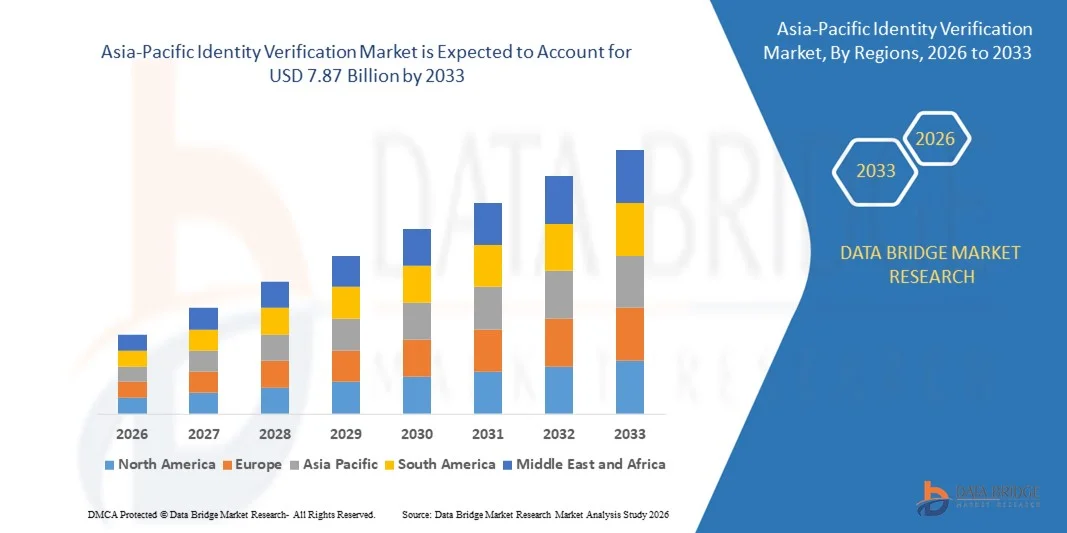
- The Asia-Pacific Identity Verification market size was valued at USD 2.74 billion in 2025 and is expected to reach USD 7.87 billion by 2033, at a CAGR of 14.10% during the forecast period
- The market growth is largely fuelled by the increasing adoption of digital identity solutions across banking, financial services, healthcare, and e-commerce sectors due to rising instances of identity fraud and the need for regulatory compliance
- The rise in remote onboarding and digital transformation across industries is accelerating the demand for identity verification solutions, as businesses seek secure and seamless ways to authenticate users without physical interaction
What are the Major Takeaways of Identity Verification Market?
- The identity verification market is seeing rapid growth due to increased digitization and the need for secure authentication across sectors such as banking, healthcare, and e-commerce
- Companies are investing in advanced biometric and AI-driven technologies to improve verification speed, accuracy, and user experience
- China dominated the Asia-Pacific identity verification market with the largest revenue share of 10.58% in 2024, driven by rapid digitalization, large-scale adoption of e-government services, and widespread use of digital payment platforms, fintech apps, and super-app ecosystems
- The Japan identity verification market is expected to growth at a fastest CAGR of 9.54%, supported by rising demand for secure digital transactions, aging population-driven digital services, and strong adoption across banking, insurance, healthcare, and government platforms
- The credit card fraud segment accounted for the largest market revenue share in 2024, driven by increasing online transactions and the rise in card-not-present frauds
Report Scope and Identity Verification Market Segmentation
|
Attributes |
Identity Verification Key Market Insights |
|
Segments Covered |
|
|
Countries Covered |
Asia-Pacific
|
|
Key Market Players |
|
|
Market Opportunities |
|
|
Value Added Data Infosets |
In addition to the insights on market scenarios such as market value, growth rate, segmentation, geographical coverage, and major players, the market reports curated by the Data Bridge Market Research also include in-depth expert analysis, pricing analysis, brand share analysis, consumer survey, demography analysis, supply chain analysis, value chain analysis, raw material/consumables overview, vendor selection criteria, PESTLE Analysis, Porter Analysis, and regulatory framework. |
What is the Key Trend in the Identity Verification Market?
Adoption of AI-Powered Biometric Verification Solutions
- AI enhances biometric accuracy by learning from interactions, continuously improving verification outcomes and minimizing false positives. For instance, Mastercard's AI-driven biometric authentication enhances transaction security in digital banking
- Facial recognition and iris scanning help reduce manual errors and human intervention in identity checks, ensuring faster and more reliable verification processes
- Financial institutions are leveraging AI for KYC compliance, streamlining onboarding and fraud detection. For instance, HSBC uses facial recognition in its mobile app to verify customer identity securely
- Healthcare providers utilize biometric tools to secure patient data access, ensuring only authorized personnel can access sensitive information and improving regulatory compliance
- Biometric verification enables fast, contactless onboarding, which is especially valuable for remote services such as digital wallets, online banking, and telehealth platforms
What are the Key Drivers of Identity Verification Market?
- Rising cyberattacks and online fraud drive demand for secure identity verification, as digital platforms become more vulnerable to data breaches and identity theft
- Businesses are investing in advanced authentication solutions to ensure secure, efficient user verification and reduce the risk of unauthorized access
- Global regulations such as KYC, AML, and GDPR mandate identity verification, compelling organizations, especially in finance and healthcare, to implement stringent compliance measures
- The European Union’s eIDAS regulation fosters trusted digital identities, promoting secure online interactions and public trust in digital services
- Identity verification platforms help build consumer trust and ensure compliance, offering reliable tools to safeguard sensitive information and prevent misuse
Which Factor is Challenging the Growth of the Identity Verification Market?
- High implementation costs hinder adoption of identity verification technologies, especially among small and medium-sized enterprises (SMEs) with limited budgets
- Advanced systems such as AI-driven facial recognition and biometric verification require major investments, along with costs for software updates, integration, and employee training
- Privacy concerns surrounding the handling of biometric and personal data are rising, as consumers and regulators demand stronger protections for sensitive information
- Legal risks from data breaches are increasing, with instances such as class action lawsuits in the U.S. against firms mishandling biometric data underscoring the potential liabilities
- To enable broader adoption, organizations must focus on transparent data governance and cost-effective solutions, ensuring both compliance and consumer trust across sectors
How is the Identity Verification Market Segmented?
The market is segmented on the basis of application, component, type, deployment mode, organization size, and vertical.
- By Application
On the basis of application, the identity verification market is segmented into credit card fraud, bank fraud, phone or utility fraud, and employment or tax-related fraud. The credit card fraud segment accounted for the largest market revenue share in 2024, driven by increasing online transactions and the rise in card-not-present frauds. Financial institutions are increasingly adopting multi-layered verification technologies to curb fraudulent card activities and improve customer trust.
The employment or tax-related fraud segment is expected to witness the fastest growth rate from 2025 to 2032, fueled by the increasing incidence of identity theft for unlawful employment and tax return claims. Governments and enterprises are now investing in robust KYC procedures to mitigate risks.
- By Component
On the basis of component, the identity verification market is segmented into solution and services. The solution segment held the largest market share in 2024 due to the widespread deployment of digital ID verification tools such as document verification, facial recognition, and database validation. These tools offer real-time authentication, scalability, and integration with legacy systems.
The services segment is expected to witness the fastest growth rate from 2025 to 2032, as organizations seek specialized support in deployment, consulting, and training services to optimize verification workflows and stay compliant with data protection regulations.
- By Type
On the basis of type, the identity verification market is segmented into non-biometrics and biometrics. The biometrics segment dominated the market in 2024 due to the rising adoption of fingerprint scanning, facial recognition, and voice analysis across sectors such as BFSI and government. Biometrics provide enhanced accuracy and user convenience, making them ideal for high-security environments.
The non-biometrics segment is expected to witness the fastest growth rate from 2025 to 2032, particularly in low-risk applications and regions with strict privacy laws, where document and database-based verification remain prevalent.
- By Deployment Mode
On the basis of deployment mode, the identity verification market is categorized into on-premise and cloud. The cloud segment held the dominant share in 2024, supported by its flexibility, scalability, and reduced infrastructure costs. Cloud-based identity verification enables real-time data processing, system updates, and remote accessibility, making it highly preferred by SMEs.
The on-premise segment is expected to witness the fastest growth rate from 2025 to 2032, due to its use in sectors such as defense and government, where data security and local control are prioritized.
- By Organization Size
The identity verification market is segmented by organization size into large enterprises and SMEs. Large enterprises captured the largest market share in 2024 owing to their extensive customer bases, regulatory compliance requirements, and substantial IT budgets to invest in sophisticated ID verification solutions.
The SME segment is expected to witness the fastest growth rate from 2025 to 2032, driven by the increasing digitization of operations and the need to combat cyber threats while ensuring smooth customer onboarding.
- By Vertical
On the basis of vertical, the market is segmented into BFSI, government & defense, energy & utilities, retail & ecommerce, IT & telecom, healthcare, gaming, and others. The BFSI segment held the largest revenue share in 2024, driven by stringent KYC norms and growing incidences of financial frauds. Banks and financial institutions are adopting AI-powered ID verification to secure transactions and build customer trust.
The gaming segment is expected to witness the fastest growth rate from 2025 to 2032, as the industry increasingly requires robust age and identity verification systems to ensure regulatory compliance and prevent underage access and fraud in online gaming environments.
Which Region Holds the Largest Share of the Identity Verification Market?
- China dominated the Asia-Pacific identity verification market with the largest revenue share of 10.58% in 2024, driven by rapid digitalization, large-scale adoption of e-government services, and widespread use of digital payment platforms, fintech apps, and super-app ecosystems. The country’s massive online user base, expanding e-commerce sector, and strong focus on fraud prevention and cybersecurity are accelerating demand for advanced identity verification solution
- Extensive deployment of biometric authentication, facial recognition, AI-based KYC, and real-time ID validation across banking, fintech, telecom, transportation, and public services is strengthening market growth. Increasing use of identity verification in smart cities, surveillance systems, and digital public infrastructure further supports large-scale adoption
- Strong government backing, strict regulatory compliance requirements, and robust domestic AI and software ecosystems position China as the leading innovation and deployment hub for identity verification technologies in the Asia-Pacific market
Japan Identity Verification Market Insight
The Japan identity verification market is expected to growth at a fastest CAGR of 9.54%, supported by rising demand for secure digital transactions, aging population-driven digital services, and strong adoption across banking, insurance, healthcare, and government platforms. Japanese companies emphasize high-accuracy biometric systems, privacy-centric authentication, and advanced fraud detection. Continuous R&D investment, strong data protection frameworks, and collaboration between technology providers and enterprises reinforce Japan’s role as a technology-driven contributor to the Asia-Pacific Identity Verification market.
South Korea Identity Verification Market Insight
The South Korea identity verification market is expanding steadily, driven by high smartphone penetration, advanced digital infrastructure, and widespread use of online financial services. Growing adoption of biometric authentication, mobile ID systems, and AI-powered fraud prevention across fintech, telecom, and e-commerce sectors is supporting market growth. Strong government initiatives for digital identity, combined with innovation in facial recognition and behavioral biometrics, position South Korea as a key innovation center in the Asia-Pacific Identity Verification market.
Which are the Top Companies in Identity Verification Market?
The Identity Verification industry is primarily led by well-established companies, including:
- Experian (Ireland),
- G.B. Group plc (‘GBG’) (U.K.),
- Equifax, Inc. (U.S.),
- Mitek Systems, Inc. (U.S.),
- Thales (France)
- LexisNexis Risk Solutions (U.S.)
- Onfido (U.K.)
- Trulioo (Canada)
- Acuant, Inc. (U.S.)
- IDEMIA (France)
- Jumio (U.S.)
- TransUnion LLC (U.S.)
- AU10TIX (Israel)
- IDology (U.S.)
- Innovatrics (Slovakia)
- Applied Recognition (Canada)
- Signicat (Norway)
- SecureKey Technologies Inc. (Canada)
- Baldor Technologies Pvt Ltd (India)
What are the Recent Developments in Global Identity Verification Market?
- In February 2024, AU10TIX introduced a new Know Your Business (KYB) solution aimed at enhancing partner verification and risk mitigation. By integrating KYB with Know Your Customer (KYC) processes, this solution offers comprehensive identity verification capabilities, supporting secure business engagements and boosting trust in financial transactions
- In January 2024, Onfido launched an all-in-one identity verification solution designed to help enterprises streamline customer onboarding. The platform enables businesses to comply with local regulatory standards, facilitating smooth expansion into new markets and improving user acquisition
- In December 2023, HireRight, LLC released “Global ID,” a digital identity verification tool featuring biometric face matching and digital liveness detection. This innovation strengthens the hiring process by ensuring candidate authenticity, thus improving compliance and reducing the risk of identity fraud
- In October 2023, Veriff unveiled two fraud prevention tools to expand its identity verification suite. Leveraging machine learning, behavioral analysis, and biometric verification, these tools help businesses detect and block fraudulent activities, enhancing overall security
- In October 2023, IDology, a GBG company, expanded its identity solutions for the gaming industry, focusing on player acquisition, retention, and fraud prevention. This development enhances regulatory compliance and operational efficiency, offering gaming operators a more secure and user-friendly experience
SKU-
Get online access to the report on the World's First Market Intelligence Cloud

- Interactive Data Analysis Dashboard
- Company Analysis Dashboard for high growth potential opportunities
- Research Analyst Access for customization & queries
- Competitor Analysis with Interactive dashboard
- Latest News, Updates & Trend analysis
- Harness the Power of Benchmark Analysis for Comprehensive Competitor Tracking
Research Methodology
Data collection and base year analysis are done using data collection modules with large sample sizes. The stage includes obtaining market information or related data through various sources and strategies. It includes examining and planning all the data acquired from the past in advance. It likewise envelops the examination of information inconsistencies seen across different information sources. The market data is analysed and estimated using market statistical and coherent models. Also, market share analysis and key trend analysis are the major success factors in the market report. To know more, please request an analyst call or drop down your inquiry.
The key research methodology used by DBMR research team is data triangulation which involves data mining, analysis of the impact of data variables on the market and primary (industry expert) validation. Data models include Vendor Positioning Grid, Market Time Line Analysis, Market Overview and Guide, Company Positioning Grid, Patent Analysis, Pricing Analysis, Company Market Share Analysis, Standards of Measurement, Global versus Regional and Vendor Share Analysis. To know more about the research methodology, drop in an inquiry to speak to our industry experts.
Customization Available
Data Bridge Market Research is a leader in advanced formative research. We take pride in servicing our existing and new customers with data and analysis that match and suits their goal. The report can be customized to include price trend analysis of target brands understanding the market for additional countries (ask for the list of countries), clinical trial results data, literature review, refurbished market and product base analysis. Market analysis of target competitors can be analyzed from technology-based analysis to market portfolio strategies. We can add as many competitors that you require data about in the format and data style you are looking for. Our team of analysts can also provide you data in crude raw excel files pivot tables (Fact book) or can assist you in creating presentations from the data sets available in the report.












