Asia Pacific Intrauterine Contraceptive Devices Market
Market Size in USD Million
CAGR :
% 
 USD
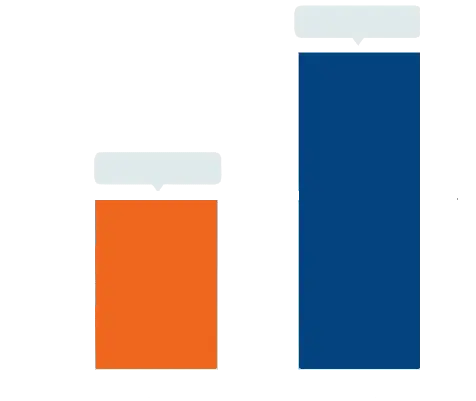
730.30 Million
USD
1,629.18 Million
2025
2033
USD
730.30 Million
USD
1,629.18 Million
2025
2033
 Forecast Period Forecast Period |
2026 –2033 |
 Market Size (Base Year) Market Size (Base Year) |
USD 730.30 Million |
 Market Size (Forecast Year) Market Size (Forecast Year) |
USD 1,629.18 Million |
 CAGR CAGR |
% |
| Major Markets Players |
|
Asia-Pacific Intrauterine Contraceptive Devices Market Size
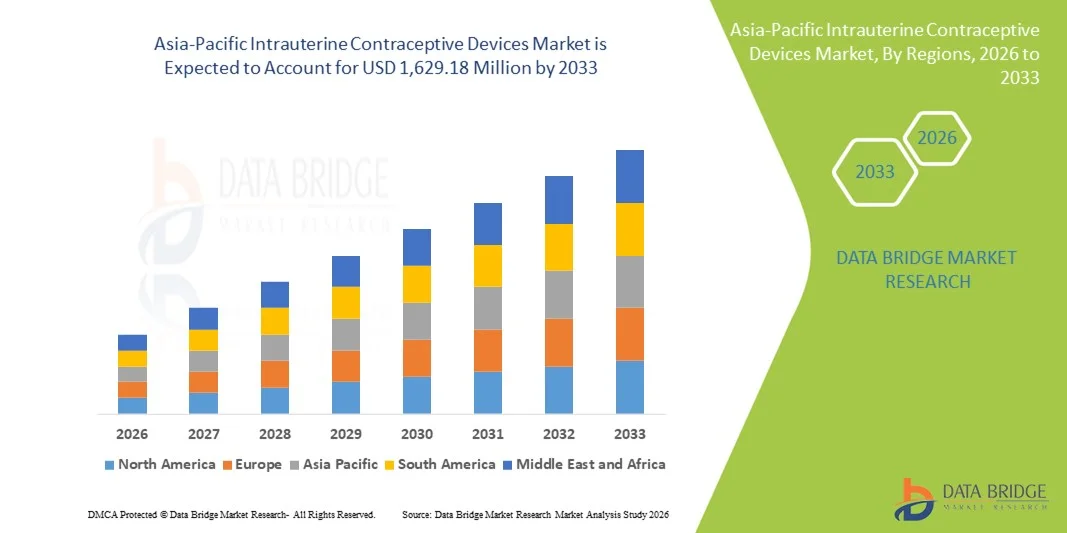
- The Asia-Pacific intrauterine contraceptive devices market size was valued at USD 730.30 million in 2025 and is expected to reach USD 1,629.18 million by 2033, at a CAGR of 10.55% during the forecast period
- The market growth is largely fueled by increasing population growth, rising awareness of modern contraceptive methods, expanding healthcare infrastructure, and supportive government family planning initiatives across key Asia‑Pacific countries, which are enhancing access and adoption of long‑acting reversible contraceptives in both urban and rural settings
- Furthermore, growing demand for effective, long‑term contraception and increasing focus on women’s reproductive health are driving the uptake of intrauterine contraceptive solutions. Continued efforts to educate women about contraceptive options and strong family planning programs are establishing IUDs as a preferred method of birth control across the region, thereby significantly boosting industry growth
Asia-Pacific Intrauterine Contraceptive Devices Market Analysis
- Asia-Pacific intrauterine contraceptive devices, offering long-acting, reversible contraception, are increasingly vital components of family planning programs and women’s reproductive healthcare across the region due to their effectiveness, ease of use, and minimal maintenance requirements
- The escalating demand for Asia-Pacific intrauterine contraceptive devices is primarily fueled by increasing awareness of modern contraceptive methods, growing government initiatives for family planning, and a rising preference among women for long-term, reliable contraception solutions
- India dominated the Asia-Pacific intrauterine contraceptive devices market with a revenue share of 22.3% in 2025, characterized by large reproductive-age populations, expanding healthcare infrastructure, and strong government family planning programs, with urban areas experiencing substantial growth in IUD adoption due to improved access, awareness campaigns, and healthcare provider initiatives
- Indonesia is anticipated to be the fastest-growing country in the Asia-Pacific intrauterine contraceptive devices market due to increasing government efforts in family planning programs, rising awareness of modern contraceptives, and improving healthcare infrastructure across urban and semi-urban areas
- Copper IUD segment dominated the Asia-Pacific intrauterine contraceptive devices market with a market share of 45.6% in 2025, driven by its established reputation for effectiveness, affordability, and long-term use without the need for hormonal intervention
Report Scope and Asia-Pacific Intrauterine Contraceptive Devices Market Segmentation
|
Attributes |
Asia-Pacific Intrauterine Contraceptive Devices Key Market Insights |
|
Segments Covered |
|
|
Countries Covered |
Asia-Pacific
|
|
Key Market Players |
|
|
Market Opportunities |
|
|
Value Added Data Infosets |
In addition to the insights on market scenarios such as market value, growth rate, segmentation, geographical coverage, and major players, the market reports curated by the Data Bridge Market Research also include in-depth expert analysis, patient epidemiology, pipeline analysis, pricing analysis, and regulatory framework |
Asia-Pacific Intrauterine Contraceptive Devices Market Trends
Rising Adoption of Long-Acting Reversible Contraception (LARC)
- A significant and accelerating trend in the Asia-Pacific intrauterine contraceptive devices market is the growing preference for long-acting reversible contraception (LARC), including both copper and hormonal IUDs, due to their effectiveness, convenience, and low maintenance
- For instance, the TCu380A copper IUD is widely adopted in India and China, offering women a hormone-free, long-term birth control solution that can last up to 10 years with minimal follow-up requirements
- The integration of modern IUDs with improved biocompatible materials and smaller insertion sizes is enhancing user comfort and reducing procedural complications, making the devices more appealing to women and healthcare providers
- Healthcare providers are increasingly educating women through clinics and digital platforms about the benefits of IUDs, contributing to higher awareness and acceptance across urban and semi-urban populations
- This trend towards highly effective, low-maintenance contraception is reshaping expectations for family planning solutions, with companies such as Bayer and Pregna offering advanced IUDs with improved design, easier insertion, and fewer side effects
- The demand for convenient, long-lasting, and minimally invasive contraceptive devices is growing rapidly across both public and private healthcare sectors as women increasingly prioritize reproductive autonomy and choice
- Rising focus on personalized reproductive healthcare and tailored contraceptive solutions is driving innovation in IUD design, including hormone-release modulation and smaller, user-friendly devices
Asia-Pacific Intrauterine Contraceptive Devices Market Dynamics
Driver
Increasing Government Initiatives and Awareness Programs
- The expansion of government-led family planning programs and awareness campaigns across Asia-Pacific is a significant driver for the rising adoption of intrauterine contraceptive devices
- For instance, in 2025, Indonesia launched nationwide initiatives to provide affordable IUDs in public health centers, aiming to reduce unintended pregnancies and improve maternal health outcomes
- Rising awareness among women regarding safe and effective contraceptive methods encourages uptake, particularly in urban areas with better access to healthcare services
- Healthcare providers and NGOs are conducting outreach programs, workshops, and counseling to promote the benefits of IUDs, thereby facilitating informed contraceptive choices
- The convenience of long-acting, reversible contraception that does not require daily attention or repeated visits for resupply is a key factor driving adoption across both urban and rural populations
- Growing partnerships between private manufacturers and public health agencies are expanding distribution networks and making IUDs more widely available at lower costs
- Increasing investments in reproductive health infrastructure and training of skilled healthcare providers are ensuring safer and more efficient IUD insertions, encouraging adoption
- Rising social media and mobile health campaigns are helping normalize contraceptive use among younger women, increasing acceptance of IUDs as a primary contraception method
Restraint/Challenge
Limited Awareness and Cultural Acceptance Barriers
- A key challenge in the Asia-Pacific intrauterine contraceptive devices market is the lack of awareness and cultural resistance toward modern contraceptive methods in certain regions
- For instance, in rural parts of India and Southeast Asia, misconceptions about IUDs causing infertility or severe side effects have slowed adoption despite government initiatives
- Healthcare providers must address these concerns through counseling, education campaigns, and community engagement to build trust and acceptance among women and families
- The relative cost of premium IUD options and limited access to trained insertion specialists in some rural or low-income areas can further hinder market penetration
- Overcoming these challenges through targeted awareness programs, affordable device options, and improving provider training is essential for sustaining market growth and achieving higher adoption rates
- Limited regulatory approvals and varying healthcare policies across countries in Asia-Pacific can delay the introduction of newer IUD products, restricting market expansion
- Social stigma and gender norms in certain regions discourage open discussions about contraception, reducing uptake and creating barriers to education and awareness campaigns
- Supply chain disruptions and inconsistent availability of IUDs in remote or rural areas remain a challenge, limiting consistent adoption despite growing awareness and demand
Asia-Pacific Intrauterine Contraceptive Devices Market Scope
The market is segmented on the basis of type of product and end use.
- Type of Product
On the basis of type of product, the Asia-Pacific intrauterine contraceptive devices market is segmented into hormonal IUD, intrauterine contraceptive device (IUCD), and copper IUCD. The copper IUCD segment dominated the market with the largest revenue share of 45.6% in 2025, driven by its well-established reputation for long-term contraception, affordability, and hormone-free nature. Copper IUCDs are widely preferred in public healthcare programs and urban clinics across India, China, and Southeast Asia, as they require minimal follow-up and offer reliable contraception for up to 10 years. The ease of insertion, biocompatibility of modern copper designs, and strong recommendations by healthcare providers further contribute to the segment’s dominance. Copper IUCDs also see high adoption in government-sponsored family planning initiatives, which provide them at subsidized rates, increasing their penetration across rural and semi-urban areas. In addition, awareness campaigns by NGOs and hospitals regarding the efficacy of copper IUCDs have reinforced their market presence among reproductive-age women.
The hormonal IUD segment is expected to witness the fastest growth from 2026 to 2033, fueled by increasing preference for hormone-based contraception that reduces menstrual bleeding and provides additional gynecological benefits. Hormonal IUDs offer targeted release of levonorgestrel, improving comfort and user experience compared to traditional copper devices. Rising awareness about personalized reproductive health and increasing availability of hormonal IUDs through private clinics and telemedicine services are driving adoption. In urban regions, women increasingly choose hormonal IUDs for their dual benefits of contraception and symptom management, particularly for heavy menstrual bleeding or endometriosis. The aesthetic appeal, reduced side effects, and endorsement by gynecologists are also contributing factors. Moreover, hormonal IUD manufacturers are focusing on smaller, easier-to-insert designs, which further supports market growth in both private and public healthcare segments.
- By End Use
On the basis of end use, the Asia-Pacific intrauterine contraceptive devices market is segmented into hospitals, gynecology clinics, community healthcare centers, and others. The hospitals segment dominated the market with the largest revenue share of 48.3% in 2025, owing to the high patient footfall and advanced medical infrastructure in tertiary and multi-specialty hospitals. Hospitals are preferred for IUD insertions due to the availability of trained gynecologists, sterilized equipment, and follow-up care, ensuring higher safety and lower complication rates. Public and private hospitals also form the backbone of government family planning programs, providing copper and hormonal IUDs at subsidized or free-of-cost rates. Hospitals often conduct awareness campaigns, workshops, and counseling sessions for women, which further boosts IUD adoption. The integration of digital health systems in hospitals also enables better patient tracking and post-insertion monitoring, strengthening their dominant position. Urban hospitals are particularly influential in shaping contraceptive choices among educated women, contributing significantly to the segment’s market share.
The gynecology clinics segment is expected to witness the fastest growth from 2026 to 2033, driven by increasing demand for personalized reproductive healthcare services and convenient access for women. Clinics offer shorter wait times, privacy, and specialized counseling for women, making them an attractive choice for hormonal IUD insertion and follow-up. The growth of private gynecology clinics in urban and semi-urban areas, along with the rise of telemedicine consultations and home health services, is further supporting market expansion. Clinics also actively promote newer and innovative IUD types, providing flexible insertion options tailored to individual patient needs. Rising awareness among younger, working women seeking discreet and efficient family planning methods is accelerating adoption in this segment. In addition, clinics’ ability to combine contraception services with broader reproductive health management enhances their appeal and drives revenue growth.
Asia-Pacific Intrauterine Contraceptive Devices Market Regional Analysis
- India dominated the Asia-Pacific intrauterine contraceptive devices market with a revenue share of 22.3% in 2025, characterized by large reproductive-age populations, expanding healthcare infrastructure, and strong government family planning programs, with urban areas experiencing substantial growth in IUD adoption due to improved access, awareness campaigns, and healthcare provider initiatives
- Consumers and women in the region increasingly value the convenience, long-term effectiveness, and minimal maintenance of IUDs, along with access to trained healthcare providers for safe insertion and follow-up care
- This widespread adoption is further supported by expanding healthcare infrastructure, growing awareness campaigns on reproductive health, and increasing availability of IUDs in public hospitals and clinics, establishing IUDs as a preferred contraceptive solution for both urban and rural populations
The India Intrauterine Contraceptive Devices Market Insight
The India intrauterine contraceptive devices market accounted for the largest revenue share in Asia-Pacific in 2025, attributed to the country’s large reproductive-age population, growing awareness of family planning, and robust government initiatives providing free or subsidized IUDs. Urbanization, rising disposable incomes, and expanding healthcare infrastructure are enabling wider access to both copper and hormonal IUDs. Public hospitals and gynecology clinics play a pivotal role in educating women about the safety, effectiveness, and convenience of IUDs. In addition, increasing adoption of private healthcare services, coupled with digital health platforms for consultation and follow-up, is boosting IUD penetration. The preference for long-acting reversible contraception and low-maintenance solutions is further driving growth in both urban and semi-urban regions.
China Intrauterine Contraceptive Devices Market Insight
The China intrauterine contraceptive devices market is witnessing strong growth due to rising awareness of modern contraceptive methods, increasing government support for reproductive health, and expanding healthcare facilities. Women increasingly prefer long-acting reversible contraception, such as copper and hormonal IUDs, for their effectiveness and minimal maintenance. Urban hospitals and gynecology clinics are key distribution channels, providing training, counseling, and safe insertion procedures. Moreover, government family planning programs ensure wide availability of IUDs, particularly copper devices, at subsidized rates. The growing acceptance of IUDs among working women and young couples, combined with increasing digital health campaigns, is accelerating adoption throughout the country.
Indonesia Intrauterine Contraceptive Devices Market Insight
The Indonesia intrauterine contraceptive devices market is expected to be the fastest-growing country in the Asia-Pacific region during the forecast period, driven by rising government initiatives, awareness campaigns, and improving healthcare access in rural and semi-urban areas. Public health centers are expanding their outreach to provide both copper and hormonal IUDs at affordable costs. Women are increasingly seeking long-term, effective contraception options, supported by counseling programs in clinics and community health centers. The adoption of digital platforms for reproductive health education, alongside growing private healthcare services, is further boosting market growth. Increasing awareness about the benefits of IUDs and the convenience of long-acting reversible contraception is creating substantial opportunities for market expansion across Indonesia.
Japan Intrauterine Contraceptive Devices Market Insight
The Japan intrauterine contraceptive devices market is growing steadily due to high awareness of women’s reproductive health, advanced healthcare infrastructure, and increasing urbanization. Women are increasingly adopting both copper and hormonal IUDs for long-term contraception and gynecological benefits. Hospitals and specialized gynecology clinics offer safe and convenient insertion services, while awareness campaigns and consultations through digital platforms help drive informed decision-making. In addition, the aging population and preference for minimally invasive, low-maintenance contraception solutions contribute to steady adoption in both residential and private healthcare segments. Rising government focus on reproductive health programs further supports growth in this market.
Asia-Pacific Intrauterine Contraceptive Devices Market Share
The Asia-Pacific Intrauterine Contraceptive Devices industry is primarily led by well-established companies, including:
- Bayer AG (Germany)
- The Cooper Companies, Inc. (U.S.)
- Teva Pharmaceuticals Inc. (U.S.)
- Pregna International Ltd. (India)
- SMB Corporation of India (India)
- OCON Therapeutics, Inc. (U.S.)
- HLL Lifecare Limited (India)
- Meril Life Sciences Pvt. Ltd. (India)
- Medicines360 (U.S.)
- Mona Lisa N.V. (Belgium)
- EUROGINE S.L. (Spain)
- Prosan International B.V. (Netherlands)
- DKT International (U.S.)
- Melbea AG (Switzerland)
- Egemen International (Turkey)
- Medisafe Distribution Inc. (Canada)
- Krishco Medical Products Pvt. Ltd. (India)
- Zhejiang Daji Medical Instruments Co., Ltd. (China)
- Medical Engineering Corporation S.A. (Argentina)
- Trimedic Supply Network Ltd. (U.S.)
What are the Recent Developments in Asia-Pacific Intrauterine Contraceptive Devices Market?
- In December 2025, Greenlandic women involved in a decades‑long legal fight over forced IUD insertions by Danish doctors were confirmed to be eligible for compensation from a reconciliation fund marking a historic step toward justice for victims of non‑consensual contraception practices
- In October 2025, health facilities across Nepal reported critically low supplies of intrauterine devices and other birth control methods, with only 350 IUDs available in inventory, highlighting ongoing access and supply challenges for modern contraceptives in rural Asia‑Pacific health system
- In September 2025, Denmark announced plans to establish a reconciliation fund offering financial compensation to Greenlandic women who were fitted with intrauterine contraceptive devices without consent as part of a coercive program, highlighting global scrutiny on reproductive rights practices
- In June 2025, a major advocacy article highlighted that sexual and reproductive health and rights, including access to contraception such as IUDs, remain limited for many women in the Asia‑Pacific region due to education, health system gaps, and restrictive laws, underscoring ongoing challenges in contraceptive access
- In May 2025, Australia saw significant public health discourse revealing that IUD usage among reproductive‑age women remains low due to lack of awareness and education, even though IUDs are among the most effective forms of contraception; experts called for stronger provider training and public information
SKU-
Get online access to the report on the World's First Market Intelligence Cloud

- Interactive Data Analysis Dashboard
- Company Analysis Dashboard for high growth potential opportunities
- Research Analyst Access for customization & queries
- Competitor Analysis with Interactive dashboard
- Latest News, Updates & Trend analysis
- Harness the Power of Benchmark Analysis for Comprehensive Competitor Tracking
Research Methodology
Data collection and base year analysis are done using data collection modules with large sample sizes. The stage includes obtaining market information or related data through various sources and strategies. It includes examining and planning all the data acquired from the past in advance. It likewise envelops the examination of information inconsistencies seen across different information sources. The market data is analysed and estimated using market statistical and coherent models. Also, market share analysis and key trend analysis are the major success factors in the market report. To know more, please request an analyst call or drop down your inquiry.
The key research methodology used by DBMR research team is data triangulation which involves data mining, analysis of the impact of data variables on the market and primary (industry expert) validation. Data models include Vendor Positioning Grid, Market Time Line Analysis, Market Overview and Guide, Company Positioning Grid, Patent Analysis, Pricing Analysis, Company Market Share Analysis, Standards of Measurement, Global versus Regional and Vendor Share Analysis. To know more about the research methodology, drop in an inquiry to speak to our industry experts.
Customization Available
Data Bridge Market Research is a leader in advanced formative research. We take pride in servicing our existing and new customers with data and analysis that match and suits their goal. The report can be customized to include price trend analysis of target brands understanding the market for additional countries (ask for the list of countries), clinical trial results data, literature review, refurbished market and product base analysis. Market analysis of target competitors can be analyzed from technology-based analysis to market portfolio strategies. We can add as many competitors that you require data about in the format and data style you are looking for. Our team of analysts can also provide you data in crude raw excel files pivot tables (Fact book) or can assist you in creating presentations from the data sets available in the report.