


Asia-Pacific Medical Device Testing Market Overview
The Asia-Pacific medical device testing market was valued at USD 820.73 million in 2025 and is projected to reach USD 1,988.95 million by 2033, growing at a CAGR of 11.70% from 2026 to 2033. The market is witnessing steady growth driven by the expanding medical device manufacturing sector, increasing regulatory compliance requirements, and rising demand for quality assurance and product safety validation across healthcare systems.
The growing prevalence of chronic diseases, increasing adoption of advanced medical technologies, and strengthening regulatory frameworks across countries such as China, Japan, India, South Korea, and Australia are encouraging manufacturers to invest in comprehensive testing services. Biocompatibility testing, microbiological testing, chemical characterization, electrical safety testing, and performance validation have become essential for regulatory approvals and market entry. In addition, the rapid development of implantable devices, diagnostic equipment, and digital health technologies is accelerating demand for specialized testing solutions, enabling manufacturers to ensure product reliability, patient safety, and compliance with international quality standards.
Key Market Trends & Insights
- China dominated the Asia-Pacific medical device testing market with the largest revenue share of 38.46% in 2025, supported by its extensive medical device manufacturing base, growing exports, and increasingly stringent regulatory requirements.
- The Testing Services segment led the market with a 52.84% share in 2025, driven by increasing regulatory requirements for product safety, performance validation, and quality assurance across medical devices
- India is expected to be the fastest-growing country at a CAGR of 8.1% from 2026 to 2033, fueled by expanding domestic medical device manufacturing, government initiatives promoting local production, and increasing investments in healthcare infrastructure.
- Certification Services are the fastest-growing service type, projected to register a CAGR of 8.5%, reflecting the surge in exports of medical devices from Asia-Pacific to global markets.
- The Chemical/Biological Testing segment dominated the testing type category with a 31.76% revenue share in 2025, led by widespread need for biocompatibility assessments and material safety evaluations.
- Preclinical accounted for 63.42% of the market, preferred by the mandatory requirement for safety and performance validation before human use.
- The Clinical segment is the fastest-growing phase category, with a CAGR of 8.3%, driven by the increasing development of advanced medical devices requiring human performance validation.
Market Size & Forecast
- Global Market Value (2025): USD 820.73 Million
- Expected Market Value (2033): USD 1,988.95 Million
- Forecast CAGR (2026–2033): 11.70%
- Leading Country in 2025: China
- Fastest Growing Country: India
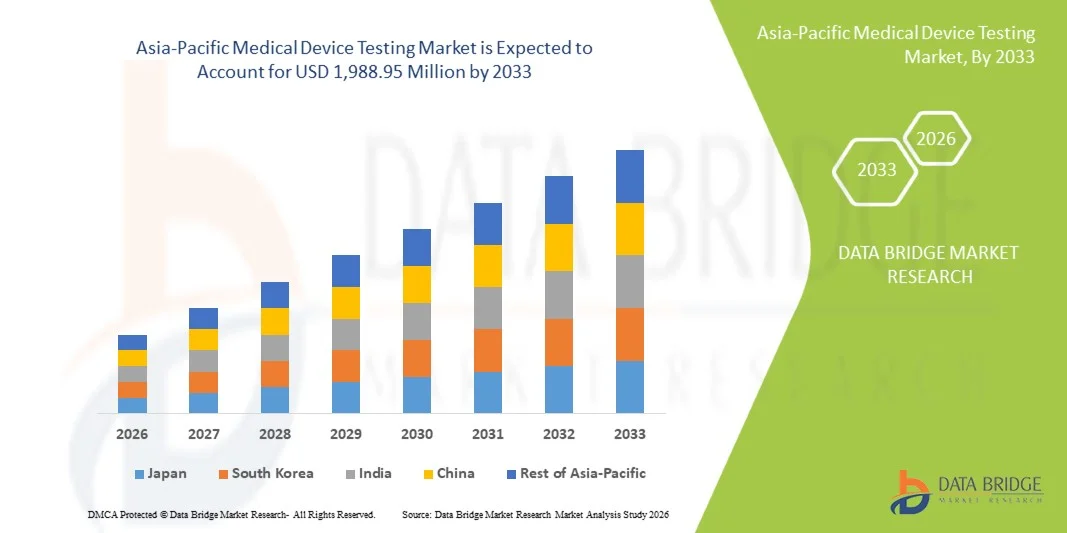
Report Scope and Asia-Pacific Medical Device Testing Market Segmentation
|
Attributes |
Asia-Pacific Medical Device Testing Key Market Insights |
|
Segments Covered |
|
|
Countries Covered |
Asia-Pacific · China · Japan · India · South Korea · Singapore · Malaysia · Australia · Thailand · Indonesia · Philippines · Rest of Asia-Pacific |
|
Key Market Players |
· Intertek Group plc (U.K.) · SGS SA (Switzerland) · Eurofins Scientific SE (Luxembourg) · TÜV SÜD AG (Germany) · TÜV Rheinland AG (Germany) · UL LLC (U.S.) · Bureau Veritas (France) · DEKRA SE (Germany) · Element Materials Technology Group Limited (U.K.) · NAMSA (U.S.) · WuXi AppTec Co., Ltd. (China) · Labcorp (U.S.) · Charles (U.S.) · QIMA Ltd. (Hong Kong) · BSI Group (U.K.) · NELSON LABORATORIES, LLC (U.S.) · Sterigenics U.S., LLC (U.S.) · Medical Engineering Technologies Ltd (U.K.) · Pacific BioLabs, Inc. (U.S.) · AsureQuality Limited (New Zealand) |
|
Market Opportunities |
· Expansion of domestic medical device manufacturing · Growing adoption of connected medical devices, wearable health technologies, and software-enabled diagnostics · The increasing development of high-value implantable devices and minimally invasive surgical products |
|
Value Added Data Infosets |
In addition to the insights on market scenarios such as market value, growth rate, segmentation, geographical coverage, and major players, the market reports curated by the Data Bridge Market Research also include in-depth expert analysis, patient epidemiology, pipeline analysis, pricing analysis, and regulatory framework. |
Asia-Pacific Medical Device Testing Market Trends
Trend: Rising Demand for Testing of Connected and Digital Medical Devices
Healthcare providers and manufacturers across Asia-Pacific are increasingly adopting connected medical devices, wearable health monitors, software-based diagnostics, and remote patient monitoring solutions. This shift is driving demand for specialized testing services that assess electrical safety, software validation, cybersecurity, interoperability, and regulatory compliance. Testing laboratories are expanding capabilities to support digital health technologies, while evolving regional regulations are encouraging manufacturers to validate device performance and safety before commercialization. For instance, in September 2024, the Therapeutic Goods Administration strengthened guidance for software-based medical devices, reinforcing the importance of comprehensive testing and validation requirements.
Asia-Pacific Medical Device Testing Market Dynamics
Key Market Driver: Expanding Medical Device Manufacturing and Regulatory Compliance Requirements
The rapid expansion of medical device manufacturing across China, India, Japan, South Korea, and Southeast Asia has significantly increased demand for testing services that ensure product quality, safety, and regulatory compliance. Manufacturers are required to conduct biocompatibility, microbiological, chemical, and performance testing before obtaining approvals and entering domestic and international markets. As export-oriented production grows, compliance with global standards is becoming a critical component of commercialization strategies. For instance, the National Medical Products Administration continues to strengthen medical device regulatory oversight, driving greater demand for accredited testing and certification services.
Key Restraint/Challenge: High Cost and Complexity of Advanced Testing Procedures
A significant restraint in the Asia-Pacific medical device testing market is the high cost associated with advanced testing procedures and regulatory validation programs. Comprehensive evaluations often require sophisticated laboratory infrastructure, specialized equipment, highly trained personnel, and adherence to multiple regional and international standards. The overall testing process can increase development timelines and operational expenses, particularly for small and medium-sized manufacturers seeking market approvals across multiple jurisdictions. For instance, extensive biocompatibility and performance validation requirements for implantable medical devices frequently increase compliance costs and create barriers for emerging manufacturers.
Key Market Opportunity: Growth of Outsourced Testing and International Certification Services
The increasing preference for outsourced testing services presents a significant market opportunity across the Asia-Pacific region. Medical device manufacturers are partnering with specialized testing organizations to reduce capital expenditure, accelerate regulatory approvals, and access advanced technical expertise. Growing exports to North America and Europe are further increasing demand for internationally recognized testing and certification services that support compliance with global regulatory frameworks. For instance, leading testing organizations are expanding laboratory networks across Asia-Pacific to help manufacturers achieve faster access to international healthcare markets.
Asia-Pacific Medical Device Testing Market Scope
The Asia-Pacific medical device testing market is segmented on the basis of service type, testing type, phase, sourcing type, device class, and product.
- By Service Type
On the basis of service type, the Asia-Pacific medical device testing market is segmented into testing services, inspection service, and certification services. The Testing Services segment dominated the market with a 52.84% share in 2025, owing to increasing regulatory requirements for product safety, performance validation, and quality assurance across medical devices. Manufacturers rely extensively on testing services to obtain regulatory approvals and ensure compliance with national and international standards. The segment benefits from growing demand for biocompatibility, microbiological, chemical, and electrical safety testing. Rising production of advanced diagnostic and therapeutic devices is further driving service demand. Testing services are also essential for supporting product innovation and market entry strategies. Their critical role throughout the device lifecycle continues to strengthen segment leadership.
The Certification Services segment is projected to register the fastest growth at a CAGR of 8.5% from 2026 to 2033, driven by increasing exports of medical devices from Asia-Pacific to global markets. Manufacturers are seeking internationally recognized certifications to comply with regulatory frameworks in North America and Europe. Growing emphasis on product quality and patient safety is accelerating certification requirements. Regulatory harmonization initiatives across several countries are also supporting market growth. Third-party certification providers are expanding their regional presence to meet rising demand. Increasing adoption of complex medical technologies is expected to further boost certification activities throughout the forecast period.
- By Testing Type
On the basis of testing type, the Asia-Pacific medical device testing market is segmented into physical testing, chemical/biological testing, cybersecurity testing, microbiology and sterility testing, and others. The Chemical/Biological Testing segment dominated the market with a 31.76% share in 2025 due to the widespread need for biocompatibility assessments and material safety evaluations. Medical device manufacturers must ensure that products do not cause adverse biological reactions in patients. The segment plays a critical role in the approval of implantable, orthopedic, cardiovascular, and dental devices. Increasing use of advanced biomaterials is creating additional testing requirements. Regulatory agencies continue to strengthen biological safety standards for medical devices. The growing volume of high-risk devices entering the market further supports segment dominance.
The Cybersecurity Testing segment is anticipated to witness the fastest growth at a CAGR of 9.1% from 2026 to 2033, driven by the increasing adoption of connected medical devices and digital health technologies. Healthcare providers are becoming more concerned about data security and cyber threats targeting medical systems. Regulatory authorities are introducing stricter cybersecurity requirements for network-connected devices. Manufacturers are investing heavily in security validation throughout product development. Rising deployment of remote monitoring and telehealth solutions is creating new testing opportunities. The expansion of software-enabled medical devices is expected to accelerate demand for cybersecurity assessments.
- By Phase
On the basis of phase, the Asia-Pacific medical device testing market is segmented into preclinical and clinical. The Preclinical segment dominated the market with a 63.42% share in 2025, supported by the mandatory requirement for safety and performance validation before human use. Manufacturers conduct extensive laboratory evaluations to assess device functionality, durability, and biological compatibility. The segment benefits from increasing innovation in implantable and diagnostic technologies. Preclinical testing helps reduce development risks and improves regulatory approval success rates. Regulatory agencies require comprehensive preclinical data before progressing to clinical studies. Its essential role in product development ensures continued market leadership.
The Clinical segment is expected to register the fastest growth at a CAGR of 8.3% from 2026 to 2033, driven by increasing development of advanced medical devices requiring human performance validation. Growing regulatory scrutiny regarding device safety and effectiveness is supporting demand for clinical evaluations. Manufacturers are investing more resources into evidence-based product development strategies. Expansion of clinical research infrastructure across Asia-Pacific is also contributing to growth. Increasing adoption of innovative therapeutic and diagnostic devices is generating additional clinical testing requirements. Rising international collaborations in medical device development further support segment expansion.
- By Sourcing Type
On the basis of sourcing type, the Asia-Pacific medical device testing market is segmented into in-house and outsourced. The Outsourced segment dominated the market with a 57.63% share in 2025 owing to the availability of specialized expertise, advanced laboratory infrastructure, and regulatory support services. Outsourcing enables manufacturers to reduce operational costs while accelerating product development timelines. Third-party laboratories provide access to accredited testing capabilities that may not be available internally. The segment is benefiting from increasing complexity in regulatory compliance requirements. Small and medium-sized manufacturers particularly prefer outsourcing to optimize resources. Growing demand for rapid market access continues to strengthen segment dominance.
The Outsourced segment is also expected to witness the fastest growth at a CAGR of 8.7% from 2026 to 2033 due to increasing reliance on independent testing organizations across the region. Manufacturers are focusing on core competencies while leveraging external expertise for compliance activities. Rising regulatory complexity is encouraging partnerships with specialized testing providers. Globalization of medical device supply chains is further supporting outsourced testing demand. Expansion of accredited laboratory networks across Asia-Pacific is improving service accessibility. The need for cost-efficient and scalable testing solutions continues to drive segment growth.
- By Device Class
On the basis of device class, the Asia-Pacific medical device testing market is segmented into Class I, Class II, and Class III. The Class II segment dominated the market with a 42.17% share in 2025, driven by the large volume of medium-risk medical devices requiring regulatory testing and validation. Products such as infusion pumps, monitoring systems, diagnostic equipment, and surgical instruments fall within this category. Manufacturers must conduct extensive performance and safety evaluations before commercialization. The segment benefits from growing healthcare infrastructure investments across the region. Increasing demand for technologically advanced medical devices is further supporting growth. Its broad application base makes it the leading device class segment.
The Class III segment is projected to register the fastest growth at a CAGR of 8.9% from 2026 to 2033, supported by increasing demand for high-risk implantable and life-supporting medical devices. These products require comprehensive testing procedures and rigorous regulatory reviews. Growth in cardiovascular, orthopedic, and neurology device markets is accelerating demand. Manufacturers are investing heavily in advanced testing to demonstrate long-term safety and effectiveness. Rising prevalence of chronic diseases is increasing adoption of complex therapeutic devices. Continuous innovation in implantable technologies is expected to fuel segment expansion.
- By Product
On the basis of product, the Asia-Pacific medical device testing market is segmented into active implant medical device, active medical device, non-active medical device, in-vitro diagnostics medical device, ophthalmic medical device, orthopedic and dental medical device, vascular medical device, and others. The Active Medical Device segment dominated the market with a 28.94% share in 2025, owing to the increasing adoption of diagnostic imaging systems, patient monitoring devices, infusion pumps, and other electronically powered healthcare technologies. These products require extensive testing for electrical safety, performance, and regulatory compliance. Rising healthcare digitization is supporting widespread deployment of active devices. Manufacturers are continuously introducing technologically advanced products with enhanced functionality. Growing investments in healthcare infrastructure are further strengthening demand. The segment's broad application across hospitals and clinics supports its dominant position.
The Active Implant Medical Device segment is anticipated to witness the fastest growth at a CAGR of 9.2% from 2026 to 2033, driven by increasing demand for pacemakers, neurostimulators, implantable cardiac devices, and other advanced therapeutic technologies. These products require highly specialized testing to ensure safety, reliability, and long-term performance. Growing prevalence of cardiovascular and neurological disorders is supporting market expansion. Continuous advancements in implant technology are increasing product development activities. Regulatory authorities require rigorous validation procedures for implantable devices, creating strong testing demand. Rising healthcare expenditure and improved patient access to advanced treatments are expected to accelerate segment growth.
Asia-Pacific Medical Device Testing Market Regional Analysis
China dominated the Asia-Pacific medical device testing market with the largest revenue share of 38.46% in 2025, supported by its extensive medical device manufacturing base, growing exports, and increasingly stringent regulatory requirements. The country also benefits from strong domestic production capabilities, rising exports of medical devices, and the presence of accredited testing laboratories and certification organizations. Increasing demand for biocompatibility, microbiological, performance, and electrical safety testing services across a broad range of medical devices continues to drive market growth. Expanding innovation in diagnostic, implantable, and connected medical technologies, along with ongoing regulatory modernization initiatives, continues to strengthen China's leadership position in the Asia-Pacific market.
The China Medical Device Testing Market Insight
The China medical device testing market is witnessing strong growth due to increasing domestic medical device manufacturing, rising healthcare expenditures, and strengthening regulatory compliance requirements. The country’s extensive production base, growing exports of medical technologies, and continuous investments in quality assurance infrastructure are driving demand for testing services across multiple device categories. In addition, increasing adoption of advanced diagnostic, implantable, and connected medical devices is accelerating the need for biocompatibility, microbiological, performance, and electrical safety testing throughout the country.
India Medical Device Testing Market Insight
The India medical device testing market is experiencing steady growth, supported by expanding domestic manufacturing capabilities, government initiatives promoting local production, and increasing demand for regulatory compliance services. Rising investments in healthcare infrastructure and growing production of diagnostic, therapeutic, and implantable devices are contributing to market expansion. Furthermore, increasing adoption of international quality standards and growing reliance on outsourced testing organizations are improving testing accessibility and supporting industry development throughout the country.
Japan Medical Device Testing Market Insight
The Japan medical device testing market is witnessing consistent growth due to rising investments in medical technology innovation, stringent quality requirements, and increasing adoption of advanced healthcare devices. Medical device manufacturers are increasingly utilizing specialized testing services to ensure compliance with domestic and international regulatory standards. Moreover, growing development of high-value diagnostic and therapeutic technologies, combined with the country’s emphasis on patient safety and product reliability, is further contributing to market growth.
South Korea Medical Device Testing Market Insight
The South Korea medical device testing market is expanding steadily due to the country’s advanced healthcare industry, strong medical technology sector, and increasing focus on product quality assurance. Manufacturers are investing in testing and validation services to support commercialization of innovative medical devices and improve global competitiveness. Continuous advancements in digital health technologies, connected medical devices, and diagnostic equipment, along with favorable government support for healthcare innovation, are further driving market growth in South Korea.
Asia-Pacific Medical Device Testing Market Share
The Asia-Pacific medical device testing industry is primarily led by well-established companies, including:
- Intertek Group plc (U.K.)
- SGS SA (Switzerland)
- Eurofins Scientific SE (Luxembourg)
- TÜV SÜD AG (Germany)
- TÜV Rheinland AG (Germany)
- UL LLC (U.S.)
- Bureau Veritas (France)
- DEKRA SE (Germany)
- Element Materials Technology Group Limited (U.K.)
- NAMSA (U.S.)
- WuXi AppTec Co., Ltd. (China)
- Labcorp (U.S.)
- Charles (U.S.)
- QIMA Ltd. (Hong Kong)
- BSI Group (U.K.)
- NELSON LABORATORIES, LLC (U.S.)
- Sterigenics U.S., LLC (U.S.)
- Medical Engineering Technologies Ltd (U.K.)
- Pacific BioLabs, Inc. (U.S.)
- AsureQuality Limited (New Zealand)
Latest Developments in Asia-Pacific Medical Device Testing Market
- In January 2025, the Yamuna Expressway Industrial Development Authority (YEIDA) announced the establishment of 13 advanced laboratories, including a gamma radiation facility, within India's Medical Device Park. The laboratories will support biomaterials testing, product validation, prototyping, regulatory compliance, and other critical testing functions for medical device manufacturers. This initiative is expected to strengthen domestic testing infrastructure and accelerate innovation within the medical device ecosystem
- In August 2024, the National Institute of Pharmaceutical Education and Research (NIPER Guwahati) announced a new postgraduate diploma program in Medical Devices beginning in the 2025–26 academic year. The curriculum includes hands-on training in pre-clinical studies, calibration, regulatory compliance, and medical device testing, helping address the growing demand for skilled professionals supporting testing and validation activities across the Asia-Pacific medical device sector
- In April 2024, Nord Pacific Medical launched regulatory and market access services across East Asia, with offices in Japan, South Korea, Taiwan, and Hong Kong. The expansion provides medical device manufacturers with regulatory support, device registration, post-market surveillance, and compliance services, helping companies navigate increasingly complex testing and certification requirements across Asian markets.
- In December 2023, Impelsys launched an advanced medical device testing facility in Mangalore, India, aimed at supporting medical device manufacturers with comprehensive quality engineering and validation services. The facility was established to improve diagnostics and patient safety through advanced testing capabilities and automated quality assurance solutions. The launch reflects the growing investment in specialized testing infrastructure across the Asia-Pacific region
- In February 2024, Stryker announced the expansion of its prototype and testing facility in India, significantly enhancing its medical device testing capabilities. The new 55,600-square-foot facility includes advanced infrastructure for lifecycle testing, microbiological testing, product validation, and quality assurance across Stryker’s medical technology portfolio. This development strengthens the company’s R&D footprint in Asia-Pacific and supports compliance with stringent global regulatory standards

- Interactive Data Analysis Dashboard
- Company Analysis Dashboard for high growth potential opportunities
- Research Analyst Access for customization & queries
- Competitor Analysis with Interactive dashboard
- Latest News, Updates & Trend analysis
- Harness the Power of Benchmark Analysis for Comprehensive Competitor Tracking
Data collection and base year analysis are done using data collection modules with large sample sizes. The stage includes obtaining market information or related data through various sources and strategies. It includes examining and planning all the data acquired from the past in advance. It likewise envelops the examination of information inconsistencies seen across different information sources. The market data is analysed and estimated using market statistical and coherent models. Also, market share analysis and key trend analysis are the major success factors in the market report. To know more, please request an analyst call or drop down your inquiry.
The key research methodology used by DBMR research team is data triangulation which involves data mining, analysis of the impact of data variables on the market and primary (industry expert) validation. Data models include Vendor Positioning Grid, Market Time Line Analysis, Market Overview and Guide, Company Positioning Grid, Patent Analysis, Pricing Analysis, Company Market Share Analysis, Standards of Measurement, Global versus Regional and Vendor Share Analysis. To know more about the research methodology, drop in an inquiry to speak to our industry experts.
Data Bridge Market Research is a leader in advanced formative research. We take pride in servicing our existing and new customers with data and analysis that match and suits their goal. The report can be customized to include price trend analysis of target brands understanding the market for additional countries (ask for the list of countries), clinical trial results data, literature review, refurbished market and product base analysis. Market analysis of target competitors can be analyzed from technology-based analysis to market portfolio strategies. We can add as many competitors that you require data about in the format and data style you are looking for. Our team of analysts can also provide you data in crude raw excel files pivot tables (Fact book) or can assist you in creating presentations from the data sets available in the report.













