


What is the Asia-Pacific Pharmacogenetics Testing in Psychiatry/Depression Market Size and Overview?
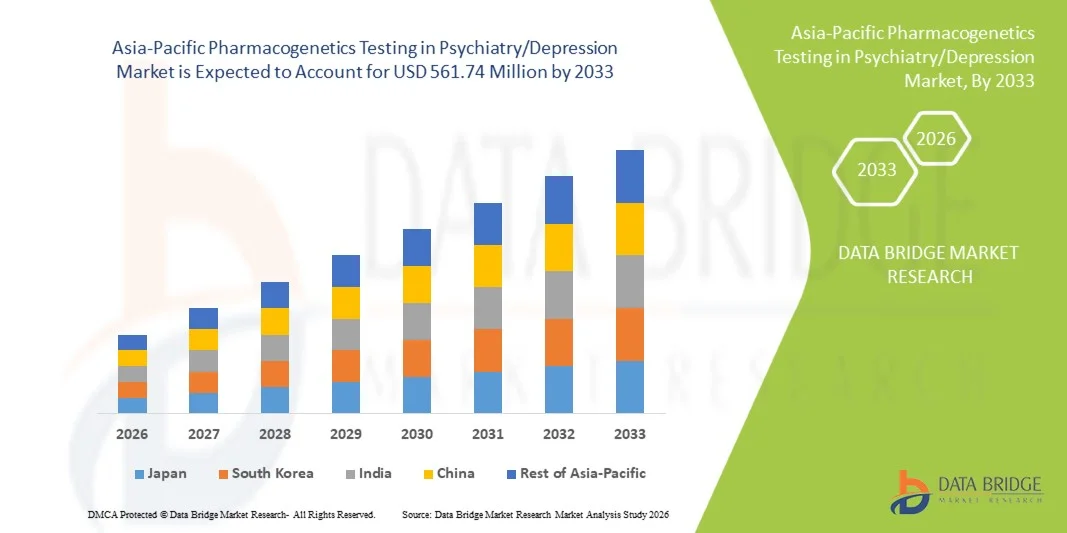
As per Data Bridge Market Research Analysis the Asia-Pacific pharmacogenetics testing in psychiatry/depression market was valued at USD 250.90 million in 2025 and is projected to reach USD 561.74 million by 2033, growing at a CAGR of 10.6% from 2026 to 2033. The market is witnessing steady growth driven by increasing awareness of personalized mental healthcare, rising prevalence of depression and psychiatric disorders, and expanding adoption of genetic testing technologies across healthcare systems.
The growing burden of treatment-resistant depression, coupled with the need to improve medication efficacy and minimize adverse drug reactions, is encouraging healthcare providers and psychiatric specialists to incorporate pharmacogenetic testing into clinical decision-making. Advances in genomic sequencing technologies, declining testing costs, and supportive investments in precision medicine initiatives are accelerating market adoption across hospitals, diagnostic laboratories, and specialized mental health centers. Pharmacogenetics-based testing is increasingly being utilized to guide antidepressant and psychotropic drug selection, offering personalized, evidence-based treatment strategies and improving patient outcomes throughout the region.
Key Market Trends & Insights
- China dominated the Asia-Pacific pharmacogenetics testing in psychiatry/depression market with the largest revenue share of 36.42% in 2025, supported by its large patient population, expanding genomic research capabilities, and increasing investments in precision medicine initiatives.
- The Depression segment led the market with a 38.64% share in 2025, driven by the rising prevalence of major depressive disorder and increasing adoption of pharmacogenetic-guided antidepressant prescribing.
- India is expected to be the fastest-growing country at a CAGR of 10.1% from 2026 to 2033, fueled by rising mental health awareness, improving access to genetic testing services, and ongoing healthcare infrastructure development.
- Chromosomal Array-Based Tests are the fastest-growing test type, projected to register a CAGR of 11.2%, reflecting the surge in demand for cost-effective genomic screening and the growing use of array technologies in identifying clinically relevant genetic variations associated with psychiatric disorders.
- The Adult segment dominated the patient type category with a 58.91% revenue share in 2025, led by high prevalence of depression, anxiety, and other psychiatric disorders among working-age populations.
- Consumables accounted for 46.82% of the market, preferred by the recurring demand for reagents, assay kits, sample preparation materials, and testing cartridges.
- The Software & Services segment is the fastest-growing products category, with a CAGR of 11.4%, driven by the rising demand for genomic data interpretation and clinical decision-support solutions.
Market Size & Forecast
- Global Market Value (2025): USD 250.90 Million
- Expected Market Value (2033): USD 561.74 Million
- Forecast CAGR (2026–2033): 10.6%
- Leading Country in 2025: China
- Fastest Growing Country: India
Report Scope and Asia-Pacific Pharmacogenetics Testing in Psychiatry/Depression Market Segmentation
|
Attributes |
Asia-Pacific Pharmacogenetics Testing in Psychiatry/Depression Key Market Insights |
|
Segments Covered |
|
|
Countries Covered |
Asia-Pacific
|
|
Key Market Players |
|
|
Market Opportunities |
|
|
Value Added Data Infosets |
In addition to the insights on market scenarios such as market value, growth rate, segmentation, geographical coverage, and major players, the market reports curated by the Data Bridge Market Research also include in-depth expert analysis, patient epidemiology, pipeline analysis, pricing analysis, and regulatory framework. |
What is the Key Trend in the Asia-Pacific Pharmacogenetics Testing in Psychiatry/Depression Market ?
Trend: Growing Adoption of Precision Psychiatry and Personalized Antidepressant Therapy
Psychiatrists and mental healthcare providers are increasingly adopting pharmacogenetics testing to optimize antidepressant selection, improve treatment outcomes, and reduce adverse drug reactions associated with trial-and-error prescribing. The integration of genomic insights enables clinicians to identify genetic variations affecting drug metabolism and therapeutic response with greater precision. Hospitals, specialty clinics, and diagnostic laboratories are similarly incorporating pharmacogenetic testing into routine psychiatric care pathways, while advances in sequencing technologies and digital health platforms support broader accessibility and clinical implementation across diverse patient populations.
Asia-Pacific Pharmacogenetics Testing in Psychiatry/Depression Market Dynamics
Key Market Driver: Rising Prevalence of Depression and Demand for Personalized Treatment Approaches
The increasing burden of depression, anxiety disorders, and other psychiatric conditions has created substantial demand for pharmacogenetics testing that can guide medication selection, optimize dosing strategies, and improve patient outcomes through personalized treatment planning. Healthcare providers, psychiatric specialists, and diagnostic laboratories are utilizing genetic insights as a core component of clinical decision-making, reducing ineffective medication use, accelerating therapeutic response, and enhancing long-term treatment adherence. The growing recognition of genetic factors influencing antidepressant efficacy is further supporting adoption across healthcare systems.
For instance, in March 2024, researchers and healthcare institutions across Asia expanded clinical studies evaluating CYP2D6 and CYP2C19-guided antidepressant prescribing, highlighting the increasing role of pharmacogenetic testing in personalized psychiatric care.
Key Restraint/Challenge: Limited Clinical Awareness and Reimbursement Coverage Across Emerging Markets
A significant restraint in the Asia-Pacific pharmacogenetics testing in psychiatry/depression market is the limited awareness among healthcare professionals regarding pharmacogenomic applications in psychiatric treatment. Many healthcare systems continue to face challenges related to reimbursement policies, clinical guideline standardization, and access to specialized genetic counseling services. The total implementation burden extends to physician education, laboratory infrastructure development, and integration of genetic data into clinical workflows, making widespread adoption difficult across resource-constrained healthcare settings and emerging economies.
For instance, several Asia-Pacific countries continue to classify pharmacogenetic testing as an out-of-pocket diagnostic service, limiting routine utilization despite growing evidence supporting its clinical value in depression management.
Key Market Opportunity: Expansion of Pharmacogenomics-Based Clinical Decision Support Platforms
The integration of pharmacogenomics into clinical decision support systems presents a significant market opportunity. AI-enabled platforms can interpret complex genetic profiles, provide medication-specific prescribing recommendations, and support personalized treatment planning for psychiatric disorders. The development of cloud-based genomic analytics solutions and digital healthcare ecosystems is further improving accessibility to precision psychiatry services, opening growth opportunities across developing healthcare markets in Asia-Pacific and expanding the adoption of evidence-based mental health treatment approaches. For instance, in 2024, multiple healthcare technology providers introduced pharmacogenomic decision-support solutions designed to assist psychiatrists in selecting antidepressant therapies based on patient-specific genetic profiles, supporting broader adoption of precision mental healthcare across the region.
How is the Asia-Pacific Pharmacogenetics Testing in Psychiatry/Depression Market Segmented?
The Asia-Pacific pharmacogenetics testing in psychiatry/depression market is segmented on the basis of type, test type, patient type, gene type, products, end user, and distribution channel.
- By Type
On the basis of type, the Asia-Pacific pharmacogenetics testing in psychiatry/depression market is segmented into anxiety, mood disorders, depression, bipolar disorders, psychotic disorders, and eating disorders. The Depression segment dominated the market with an estimated share of 38.64% in 2025, owing to the rising prevalence of major depressive disorder and increasing adoption of pharmacogenetic-guided antidepressant prescribing. Healthcare providers are increasingly utilizing genetic testing to identify variations affecting drug metabolism and treatment response. The segment benefits from growing awareness regarding personalized psychiatry and precision medicine approaches. Clinical evidence supporting improved treatment outcomes through genotype-guided therapy is further strengthening adoption. Increasing healthcare expenditure and mental health screening programs are also supporting market growth. The high burden of depression across Asia-Pacific continues to sustain the segment’s leadership position.
The Bipolar Disorders segment is projected to register the fastest growth at a CAGR of 10.3% from 2026 to 2033, driven by increasing recognition of genetic factors influencing treatment efficacy and adverse drug reactions. Pharmacogenetic testing is gaining importance in optimizing mood stabilizer and antipsychotic therapy selection. Growing diagnosis rates and improved access to mental healthcare services are accelerating demand. Healthcare providers are increasingly seeking personalized treatment strategies to reduce relapse risks and improve long-term outcomes. Expanding research on psychiatric genomics is further supporting adoption. Rising investments in precision mental healthcare are expected to contribute significantly to future segment growth.
- By Test Type
On the basis of test type, the market is segmented into whole genome sequencing and chromosomal array-based tests. The Whole Genome Sequencing segment dominated the market with an estimated share of 67.28% in 2025, driven by its ability to provide comprehensive genetic information relevant to psychiatric treatment decisions. The technology enables the identification of multiple pharmacogenomic markers in a single assessment. Increasing affordability of sequencing technologies is supporting broader clinical adoption. Healthcare institutions are utilizing genome sequencing to improve treatment personalization and medication optimization. Continuous advancements in sequencing platforms are enhancing testing accuracy and efficiency. Its extensive clinical utility continues to reinforce market dominance.
The Chromosomal Array-Based Tests segment is projected to register the fastest growth at a CAGR of 11.2% from 2026 to 2033, driven by increasing demand for cost-effective genomic screening and the growing use of array technologies in identifying clinically relevant genetic variations associated with psychiatric disorders. These tests offer faster turnaround times and lower operational costs compared to comprehensive sequencing approaches. Expanding adoption in diagnostic laboratories and research institutions is supporting market growth. Technological improvements in microarray platforms are enhancing analytical performance and clinical utility. Rising awareness regarding early genetic risk assessment and personalized treatment planning is further accelerating adoption. Their accessibility and scalability are expected to drive strong growth throughout the forecast period.
- By Patient Type
On the basis of patient type, the market is segmented into child, adult, and geriatric. The Adult segment led the market with a 58.91% share in 2025, driven by the high prevalence of depression, anxiety, and other psychiatric disorders among working-age populations. Adults account for the majority of antidepressant and psychotropic medication prescriptions across the region. Increasing awareness of pharmacogenetic testing benefits is supporting adoption among clinicians and patients. The segment also benefits from greater healthcare accessibility and mental health screening initiatives. Rising workplace stress and lifestyle-related mental health concerns are contributing to growing demand. Strong patient volumes continue to maintain segment leadership.
The Geriatric segment is anticipated to grow at the fastest CAGR of 10.5% from 2026 to 2033, supported by increasing prevalence of depression and polypharmacy among aging populations. Pharmacogenetic testing helps optimize medication regimens and reduce adverse drug interactions in elderly patients. Growing life expectancy and expanding elderly populations across Asia-Pacific are fueling demand. Healthcare providers are increasingly adopting precision medicine approaches to improve treatment safety. The need for individualized psychiatric care is becoming more prominent in geriatric healthcare settings. This trend is expected to drive substantial future growth.
- By Gene Type
On the basis of gene type, the market is segmented into CYP2C19, CYP2C9, VKORC1, CYP2D6, HLA-B, HTR2A/C, HLA-A, CYP3A4, SLC6A4, MTHFR, COMT, and others. The CYP2D6 segment dominated the market with a 24.73% share in 2025, owing to its critical role in the metabolism of numerous antidepressants and antipsychotic medications. Genetic variations in CYP2D6 significantly influence drug efficacy and safety profiles. Clinicians frequently rely on CYP2D6 testing to guide medication selection and dosage adjustments. Growing inclusion of CYP2D6 biomarkers in clinical guidelines is supporting adoption. Expanding pharmacogenomic research is strengthening its clinical relevance. The gene remains a cornerstone of psychiatric pharmacogenetic testing.
The CYP2C19 segment is projected to register the fastest growth at a CAGR of 11.1% from 2026 to 2033, driven by increasing utilization in antidepressant response prediction and medication optimization. CYP2C19 testing is becoming a standard component of pharmacogenomic panels used in psychiatry. Rising awareness among healthcare providers regarding genotype-guided prescribing is accelerating demand. Growing clinical evidence supporting improved treatment outcomes is encouraging broader adoption. Technological advancements are making testing more accessible and cost-effective. These factors are expected to sustain rapid growth throughout the forecast period.
- By Products
On the basis of products, the market is segmented into instruments, consumables, and software & services. The Consumables segment dominated the market with a 46.82% share in 2025, driven by recurring demand for reagents, assay kits, sample preparation materials, and testing cartridges. Every pharmacogenetic test requires consumable products, creating consistent revenue generation opportunities. Increasing testing volumes across hospitals and laboratories are supporting segment expansion. Product innovation is improving testing accuracy and operational efficiency. Growing adoption of genomic diagnostics is further boosting demand. The recurring nature of consumable purchases strengthens market leadership.
The Software & Services segment is expected to witness the fastest growth at a CAGR of 11.4% from 2026 to 2033, owing to rising demand for genomic data interpretation and clinical decision-support solutions. Advanced software platforms help clinicians translate genetic findings into actionable treatment recommendations. Integration with electronic health records is improving workflow efficiency. AI-powered analytics are enhancing pharmacogenomic reporting capabilities. Growing complexity of genomic datasets is increasing dependence on specialized services. The expansion of digital healthcare ecosystems is expected to accelerate adoption.
- By End User
On the basis of end user, the market is segmented into hospitals and clinics, diagnostic laboratories, academic and research institutes, and others. The Hospitals and Clinics segment accounted for the largest market share of 48.63% in 2025, driven by increasing integration of pharmacogenetic testing into routine psychiatric treatment pathways. These facilities serve as primary points of diagnosis and treatment for depression and other mental health disorders. Growing awareness among psychiatrists regarding precision medicine benefits is supporting utilization. Hospitals are increasingly investing in genomic testing infrastructure and personalized care programs. Strong patient inflow and clinical adoption continue to support segment dominance. The availability of multidisciplinary care teams further enhances implementation.
The Diagnostic Laboratories segment is projected to grow at the fastest CAGR of 10.9% from 2026 to 2033, supported by expanding genetic testing capabilities and increasing outsourcing of specialized diagnostic services. Laboratories offer advanced testing technologies and scalable processing capacity. Rising demand for high-throughput pharmacogenomic testing is strengthening growth prospects. Continuous investments in automation and sequencing technologies are improving operational efficiency. Healthcare providers increasingly rely on specialized laboratories for accurate genetic analysis. These factors are expected to drive robust segment expansion.
- By Distribution Channel
On the basis of distribution channel, the market is segmented into direct tender, third party distribution, hospital pharmacy, and others. The Direct Tender segment dominated the market with a 43.57% share in 2025, owing to widespread procurement by hospitals, government healthcare institutions, and large diagnostic laboratory networks. Direct procurement agreements enable cost optimization and reliable supply chain management. Large-scale healthcare organizations prefer direct purchasing arrangements for genomic testing products and consumables. The segment benefits from long-term supplier contracts and centralized procurement strategies. Increasing public healthcare investments are supporting growth. These advantages continue to strengthen market leadership.
The Third Party Distribution segment is anticipated to register the fastest growth at a CAGR of 10.2% from 2026 to 2033, driven by expanding market penetration into emerging healthcare facilities and underserved regions. Distribution partners help manufacturers reach a broader customer base efficiently. Growing demand for pharmacogenetic testing products across smaller clinics and laboratories is accelerating channel adoption. Third-party distributors provide logistical support, local expertise, and inventory management capabilities. Increasing regional expansion strategies by testing companies are further supporting growth. The channel is expected to play a critical role in improving market accessibility across Asia-Pacific.
Which Region Holds the Largest Share of the Asia-Pacific Pharmacogenetics Testing in Psychiatry/Depression Market ?
China dominated the Asia-Pacific pharmacogenetics testing in psychiatry/depression market with the largest revenue share of 36.42% in 2025, supported by its large patient population, expanding genomic research capabilities, and increasing investments in precision medicine initiatives. The country also benefits from increasing awareness of personalized mental healthcare, growing adoption of pharmacogenomic testing in psychiatric treatment, and the presence of advanced diagnostic laboratories and academic research institutions. Rising prevalence of depression and other psychiatric disorders, coupled with supportive government programs promoting genomic medicine, continues to drive market growth. Increasing integration of genetic testing into clinical decision-making and antidepressant prescribing practices further strengthens China's leadership position in the Asia-Pacific market.
China Pharmacogenetics Testing in Psychiatry/Depression Market Insight
The China pharmacogenetics testing in psychiatry/depression market is witnessing strong growth due to rising investments in precision medicine programs, expanding genomic research initiatives, and increasing adoption of personalized mental healthcare approaches. The country’s large patient population, advanced diagnostic infrastructure, and growing integration of pharmacogenomic testing into psychiatric practice are driving demand across hospitals, laboratories, and research institutions. In addition, increasing awareness of treatment-resistant depression and the need to improve antidepressant treatment outcomes is accelerating the adoption of pharmacogenetic testing across clinical settings.
India Pharmacogenetics Testing in Psychiatry/Depression Market Insight
The India pharmacogenetics testing in psychiatry/depression market is experiencing steady growth, supported by rising awareness of mental health disorders, increasing adoption of genomic testing technologies, and expanding access to precision healthcare services. Growing investments in diagnostic infrastructure and increasing demand for personalized treatment approaches are contributing to market growth. Furthermore, integration of pharmacogenomic analytics, digital healthcare platforms, and advanced laboratory technologies is improving testing accessibility and clinical utility, positioning India as one of the fastest-growing markets in the region.
Japan Pharmacogenetics Testing in Psychiatry/Depression Market Insight
The Japan pharmacogenetics testing in psychiatry/depression market is expanding steadily due to the country’s advanced healthcare infrastructure, strong research capabilities, and increasing adoption of personalized medicine technologies. Hospitals, psychiatric centers, and research institutes are increasingly utilizing pharmacogenetic testing for medication selection, treatment optimization, and clinical research activities. Continuous advancements in genomic diagnostics, bioinformatics platforms, and precision healthcare initiatives, along with strong government support for innovation, are further driving market growth in Japan.
South Korea Pharmacogenetics Testing in Psychiatry/Depression Market Insight
The South Korea pharmacogenetics testing in psychiatry/depression market is witnessing consistent growth due to rising investments in genomic technologies, personalized healthcare solutions, and mental health management programs. Healthcare providers, research institutions, and diagnostic laboratories are increasingly adopting pharmacogenetic testing for treatment optimization, adverse drug reaction reduction, and precision medicine applications. Moreover, increasing integration of artificial intelligence, bioinformatics technologies, and digital health platforms is further contributing to market growth.
Which are the Top Companies in Asia-Pacific Pharmacogenetics Testing in Psychiatry/Depression Market ?
The Asia-Pacific pharmacogenetics testing in psychiatry/depression industry is primarily led by well-established companies, including:
- Myriad Genetics, Inc. (U.S.)
- Genomind, Inc. (U.S.)
- OneOme, LLC (U.S.)
- Quest Diagnostics Incorporated (U.S.)
- Hoffmann-La Roche Ltd (Switzerland)
- QIAGEN (Netherlands)
- Illumina, Inc. (U.S.)
- Thermo Fisher Scientific Inc. (U.S.)
- Agilent Technologies, Inc. (U.S.)
- BGI Genomics Co., Ltd. (China)
- NalaGenetics Pte. Ltd. (Singapore)
- SOPHiA GENETICS SA (Switzerland)
- GenXys Health Care Systems Inc. (Canada)
- ADmera Health LLC (U.S.)
- Labcorp (U.S.)
- Eurofins Scientific SE (Luxembourg)
- Exact Sciences Corporation (U.S.)
- Bio-Rad Laboratories, Inc. (U.S.)
- Pacific Edge Ltd (New Zealand)
- Fulgent Genetics, Inc. (U.S.)
What are Latest Developments in Asia-Pacific Pharmacogenetics Testing in Psychiatry/Depression Market ?
- In September 2025, Quest Diagnostics launched an advanced Pharmacogenomics (PGx) laboratory testing service designed to help clinicians personalize medication selection and dosing across multiple specialties, including psychiatry. The new offering analyzes 17 genes and 4 HLA alleles associated with drug response and adverse reactions. The service aims to reduce trial-and-error prescribing and improve treatment outcomes for patients receiving antidepressants and other psychiatric medications. This launch reflects the growing commercialization of pharmacogenetic testing solutions for precision mental healthcare
- In April 2025, Myriad Genetics announced new clinical study results showing that patients with major depressive disorder experienced fewer psychiatric hospitalizations following use of its GeneSight® Psychotropic Test. The pharmacogenetic testing platform helps clinicians optimize antidepressant and psychotropic medication selection based on a patient’s genetic profile. The findings further strengthened the clinical evidence supporting pharmacogenomics-guided treatment in depression management and precision psychiatry
- In March 2025, atai Life Sciences announced the first patient dosing in its Phase 2 Elumina clinical trial evaluating VLS-01 for treatment-resistant depression. While focused on therapeutic development, the program incorporates precision-medicine principles and contributes to the broader movement toward personalized psychiatric treatment. The study represents continued innovation in advanced depression management and highlights the increasing role of individualized approaches in mental healthcare development
- In December 2024, Singapore's psychiatric and pharmacogenomics experts released the first comprehensive Asian-focused practice recommendations for pharmacogenomic testing in psychiatry through the Annals of the Academy of Medicine, Singapore. The initiative provided a structured framework for implementing CYP2D6 and CYP2C19 testing in antidepressant prescribing and psychiatric care. The development marked an important milestone in advancing precision psychiatry across Asia-Pacific healthcare systems and establishing region-specific clinical guidance
- In July 2024, Singapore-based NalaGenetics reported progress from its Implementation of Pre-emptive Pharmacogenomics Testing in Outpatient Clinics in Asia (IMPT) study utilizing the Nala RxReady™ pharmacogenomics panel. The program evaluated real-world deployment of multi-gene pharmacogenetic testing across outpatient clinics in Singapore. The initiative demonstrated the feasibility of integrating pharmacogenomics into routine clinical workflows and supported broader adoption of personalized prescribing practices, including psychiatric medication management

- Interactive Data Analysis Dashboard
- Company Analysis Dashboard for high growth potential opportunities
- Research Analyst Access for customization & queries
- Competitor Analysis with Interactive dashboard
- Latest News, Updates & Trend analysis
- Harness the Power of Benchmark Analysis for Comprehensive Competitor Tracking
Data collection and base year analysis are done using data collection modules with large sample sizes. The stage includes obtaining market information or related data through various sources and strategies. It includes examining and planning all the data acquired from the past in advance. It likewise envelops the examination of information inconsistencies seen across different information sources. The market data is analysed and estimated using market statistical and coherent models. Also, market share analysis and key trend analysis are the major success factors in the market report. To know more, please request an analyst call or drop down your inquiry.
The key research methodology used by DBMR research team is data triangulation which involves data mining, analysis of the impact of data variables on the market and primary (industry expert) validation. Data models include Vendor Positioning Grid, Market Time Line Analysis, Market Overview and Guide, Company Positioning Grid, Patent Analysis, Pricing Analysis, Company Market Share Analysis, Standards of Measurement, Global versus Regional and Vendor Share Analysis. To know more about the research methodology, drop in an inquiry to speak to our industry experts.
Data Bridge Market Research is a leader in advanced formative research. We take pride in servicing our existing and new customers with data and analysis that match and suits their goal. The report can be customized to include price trend analysis of target brands understanding the market for additional countries (ask for the list of countries), clinical trial results data, literature review, refurbished market and product base analysis. Market analysis of target competitors can be analyzed from technology-based analysis to market portfolio strategies. We can add as many competitors that you require data about in the format and data style you are looking for. Our team of analysts can also provide you data in crude raw excel files pivot tables (Fact book) or can assist you in creating presentations from the data sets available in the report.













