




Europe Artificial Intelligence Ai In Drug Discovery Market
Market Size in USD Million
CAGR :
% 
 USD
916.45 Million
USD
26,113.04 Million
2025
2033
USD
916.45 Million
USD
26,113.04 Million
2025
2033
 Forecast Period Forecast Period |
2026 - 2033 |
 Market Size (Base Year) Market Size (Base Year) |
USD 916.45 Million |
 Market Size (Forecast Year) Market Size (Forecast Year) |
USD 26,113.04 Million |
 CAGR CAGR |
% |
| Major Markets Players |
|
Europe Artificial Intelligence (AI) in Drug Discovery Market Overview
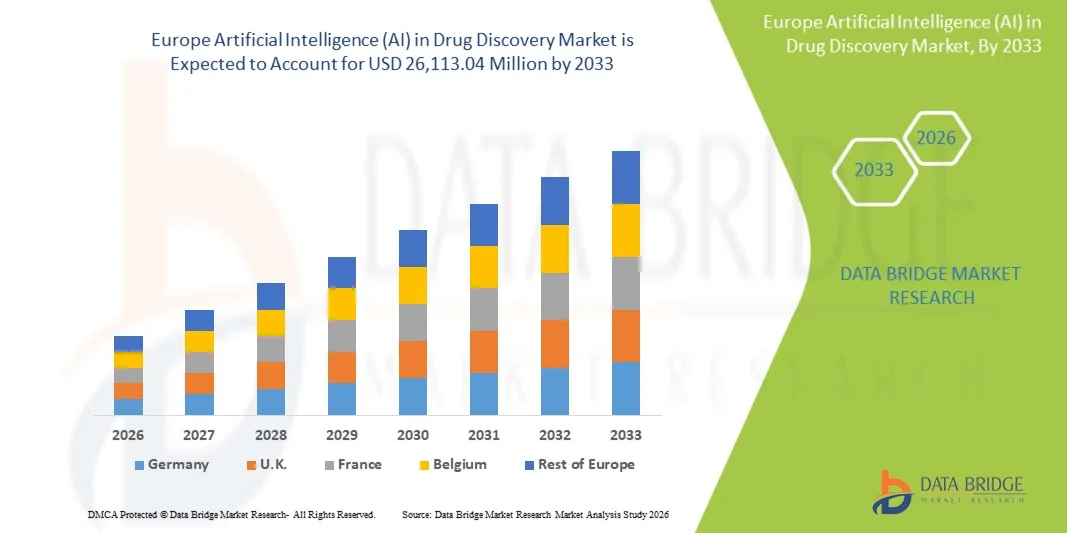
The Europe Artificial Intelligence (AI) in drug discovery market was valued at USD 916.45 million in 2025 and is projected to reach USD 26,113.04 million by 2033, growing at a CAGR of 52.0% from 2026 to 2033. The market is witnessing robust growth driven by increasing adoption of AI-powered platforms in pharmaceutical research, rising investments in biotechnology innovation, and growing demand for faster and more cost-efficient drug development processes.
The rising burden of chronic diseases, cancer, and rare disorders across Europe, coupled with the need to reduce drug discovery timelines and clinical development costs, is encouraging pharmaceutical companies, biotechnology firms, and research institutions to integrate advanced AI technologies into their R&D workflows. Machine learning, deep learning, and generative AI solutions are increasingly being utilized for target identification, molecule design, lead optimization, and predictive analytics, enabling researchers to improve success rates and accelerate the development of novel therapeutics.
Key Market Trends & Insights
- Germany dominated the Europe Artificial Intelligence (AI) in drug discovery market with the largest revenue share of 27.30% in 2025, supported by its strong pharmaceutical sector, extensive AI research ecosystem, and significant investments in biotechnology innovation.
- The Drug Optimization and Repurposing segment led the market with a 24.28% share in 2025, driven by the increasing need to extend the lifecycle of existing drugs and reduce R&D costs.
- United Kingdom is expected to be the fastest-growing country, projected to register a CAGR of 28.1% from 2026 to 2033, fueled by expanding AI-focused life sciences investments, strong academic-industry collaborations, and supportive government initiatives for healthcare innovation.
- De Novo Drug Design are the fastest-growing application type, projected to register a CAGR of 30.3%, reflecting the surge in advancements in generative AI and deep learning models capable of designing entirely new molecular structures.
- The Machine Learning segment dominated the technology category with a 45.48% revenue share in 2025, led by widespread use in predictive analytics, target identification, and compound screening.
- Small Molecule accounted for 60.65% of the market, preferred by its widespread applicability, lower manufacturing complexity, and extensive use in oral drug formulations
- The Large Molecule segment is the fastest-growing drug type category, with a CAGR of 29.2%, driven by rising interest in biologics, monoclonal antibodies, and protein-based therapies.
Market Size & Forecast
- Global Market Value (2025): USD 916.45 Million
- Expected Market Value (2033): USD 26,113.04 Million
- Forecast CAGR (2026–2033): 52.0%
- Leading Country in 2025: Germany
- Fastest Growing Country: United Kingdom
Report Scope and Europe Artificial Intelligence (AI) in Drug Discovery Market Segmentation
|
Attributes |
Europe Artificial Intelligence (AI) in Drug Discovery Key Market Insights |
|
Segments Covered |
|
|
Countries Covered |
Europe · Germany · France · U.K. · Netherlands · Switzerland · Belgium · Russia · Italy · Spain · Turkey · Rest of Europe |
|
Key Market Players |
· Exscientia (U.K.) · BenevolentAI (U.K.) · Isomorphic Labs (U.K.) · Evotec SE (Germany) · BioNTech SE (Germany) · Merck KGaA (Germany) · Bayer AG (Germany) · AstraZeneca (U.K.) · GSK plc (U.K.) · Sanofi (France) · Servier (France) · Owkin (France) · Ginkgo Bioworks (U.S.) · Recursion Pharmaceuticals (U.S.) · Schrödinger Inc. (U.S.) · Novartis AG (Switzerland) · Roche Holding AG (Switzerland) · Johnson & Johnson Services, Inc. (U.S.) · Pfizer Inc. (U.S.) · Insilico Medicine (Hong Kong) |
|
Market Opportunities |
· Growing adoption of generative AI for de novo molecule design · Increasing availability of large-scale genomic, clinical, and real-world healthcare datasets · Rising regulatory support for AI-enabled drug development and faster approval pathways |
|
Value Added Data Infosets |
In addition to the insights on market scenarios such as market value, growth rate, segmentation, geographical coverage, and major players, the market reports curated by the Data Bridge Market Research also include in-depth expert analysis, patient epidemiology, pipeline analysis, pricing analysis, and regulatory framework. |
Europe Artificial Intelligence (AI) in Drug Discovery Market Trends
Trend: Rapid Expansion of Generative AI in Molecular Design
Pharmaceutical and biotechnology companies across Europe are increasingly adopting generative AI platforms to design novel drug-like molecules, optimize chemical structures, and accelerate early-stage discovery workflows. These systems enable virtual screening of billions of compounds, significantly reducing reliance on traditional lab-based experimentation while improving hit identification rates. Integration with cloud computing and high-performance computing clusters is further enhancing scalability and predictive accuracy in drug design processes. For instance, Insilico Medicine’s AI-driven pipeline has been widely applied in Europe-based collaborations for de novo drug candidate generation and optimization.
Europe Artificial Intelligence (AI) in Drug Discovery Market Dynamics
Key Market Driver: Rising Demand for Faster and Cost-Efficient Drug Development
The increasing pressure on pharmaceutical companies to reduce drug development timelines and R&D costs is driving strong adoption of AI-based drug discovery platforms across Europe. AI enables faster target identification, improved compound screening, and predictive modeling of drug efficacy and toxicity, thereby reducing late-stage clinical failure rates. This is particularly critical in oncology and rare disease research, where traditional discovery processes are time-intensive and expensive. For instance, AstraZeneca has partnered with BenevolentAI to leverage AI for accelerating target discovery and improving drug repurposing outcomes.
Key Restraint/Challenge: Data Fragmentation and Regulatory Complexity
A major challenge in the European AI in drug discovery market is the fragmentation of healthcare and biomedical data across institutions, along with strict regulatory requirements governing data privacy and cross-border data sharing. This limits seamless integration of datasets required for training high-accuracy AI models and slows down large-scale deployment of AI-driven discovery systems. In addition, compliance with GDPR and varying national-level healthcare regulations increases operational complexity and development timelines for AI solution providers. For instance, multi-country clinical data integration projects often face delays due to inconsistent data standards and approval processes across European healthcare systems.
Key Market Opportunity: Expansion of AI-Driven Precision Medicine and Drug Repurposing
The growing focus on precision medicine and drug repurposing in Europe presents significant opportunities for AI-enabled platforms capable of analyzing genomic, proteomic, and clinical datasets to identify patient-specific treatment pathways. AI models can uncover new therapeutic indications for existing drugs, reducing development costs and accelerating time-to-market. Increasing collaboration between academic research institutions, biotech firms, and pharmaceutical companies is further supporting innovation in this area. For instance, Exscientia has demonstrated AI-based drug repurposing approaches that identify new treatment candidates for oncology and inflammatory diseases.
Europe Artificial Intelligence (AI) in Drug Discovery Market Scope
The Europe Artificial Intelligence (AI) in drug discovery market is segmented on the basis of application, technology, drug type, offering, indication, and end use.
- By Application
On the basis of application, the Europe AI in drug discovery market is segmented into novel drug candidates, drug optimization and repurposing, preclinical testing and approval, drug monitoring, finding new disease-associated targets and pathways, understanding disease mechanisms, aggregating and synthesizing information, formation & qualification of hypotheses, de novo drug design, finding drug targets of an old drug, and others. The Drug Optimization and Repurposing segment dominated the market with an estimated 24.28% share in 2025, driven by the increasing need to extend the lifecycle of existing drugs and reduce R&D costs. Pharmaceutical companies across Europe are actively leveraging AI to identify new indications for approved molecules and improve compound efficacy. This segment benefits from large availability of historical clinical data and well-established drug libraries. Rising pressure to accelerate time-to-market is further strengthening adoption. AI-driven predictive modeling and molecular simulation are widely used in this segment. Continuous collaboration between pharma firms and AI startups is further reinforcing market dominance.
The De Novo Drug Design segment is expected to be the fastest-growing, with a CAGR of 30.3% from 2026 to 2033, driven by advancements in generative AI and deep learning models capable of designing entirely new molecular structures. These technologies significantly reduce reliance on traditional chemical screening processes. Increasing computational power and cloud-based platforms are enabling large-scale molecule generation. Pharmaceutical companies are adopting this approach to discover first-in-class therapies for complex diseases such as cancer and neurodegenerative disorders. Growing investment in AI-driven biotech startups is further accelerating growth. Expanding use in precision medicine research is also contributing to rapid adoption.
- By Technology
On the basis of technology, the market is segmented into machine learning, deep learning, natural language processing, and others. The Machine Learning segment dominated the market with an estimated 45.48% share in 2025, owing to its widespread use in predictive analytics, target identification, and compound screening. Machine learning algorithms are extensively used to analyze large biomedical datasets and identify potential drug candidates. The segment benefits from strong integration with pharmaceutical R&D workflows. Its ability to improve decision-making efficiency in early-stage discovery makes it highly valuable. Continuous improvements in algorithm accuracy and data availability are further strengthening adoption. Machine learning remains the backbone of most AI-driven drug discovery platforms in Europe.
The Deep Learning segment is projected to be the fastest-growing, with a CAGR of 31.4%, driven by its superior capability in pattern recognition and molecular structure prediction. Deep learning models enable highly accurate simulations of biological interactions and protein folding processes. Increasing adoption in generative chemistry and biomarker discovery is boosting demand. Pharmaceutical companies are using deep learning to reduce experimental failures and improve success rates. Expanding use of GPU-based and cloud computing infrastructure is further accelerating performance. Strong research activity in Europe’s biotech ecosystem is supporting rapid growth.
- By Drug Type
On the basis of drug type, the market is segmented into small molecule and large molecule drugs. The Small Molecule segment dominated the market with an estimated 60.65% share in 2025, driven by its widespread applicability, lower manufacturing complexity, and extensive use in oral drug formulations. AI technologies are heavily used to optimize small molecule structures and improve binding affinity predictions. Pharmaceutical companies prefer this segment due to faster development cycles and cost efficiency. Large datasets available for small molecules further enhance AI model accuracy. Continuous innovation in oncology and cardiovascular therapies is strengthening demand. This segment remains central to most AI-driven drug discovery pipelines.
The Large Molecule segment is expected to be the fastest-growing, with a CAGR of 29.2%, driven by rising interest in biologics, monoclonal antibodies, and protein-based therapies. AI is increasingly used to analyze complex biological interactions and optimize protein structures. Growing focus on immunotherapy and precision medicine is supporting expansion. High success rates in targeted therapies are encouraging investment in this segment. Advances in structural biology and computational modeling are further enabling adoption. Pharmaceutical companies are increasingly integrating AI to improve biologic drug design efficiency.
- By Offering
On the basis of offering, the market is segmented into software and services. The Software segment dominated the market with an estimated 68.72% share in 2025, driven by widespread deployment of AI platforms for drug discovery, data analytics, and molecular modeling. Pharmaceutical companies prefer software solutions due to scalability and integration capabilities with existing R&D systems. Cloud-based AI platforms are increasingly used for collaborative research. Continuous updates and algorithm improvements enhance usability and performance. High demand for predictive modeling tools further strengthens this segment. Software remains the core enabler of AI-driven drug discovery ecosystems in Europe.
The Services segment is expected to be the fastest-growing, with a CAGR of 30.3%, driven by increasing demand for AI consulting, model training, and managed analytics services. Many pharmaceutical firms rely on external service providers for AI integration and data management. Growing complexity of AI systems is increasing demand for specialized expertise. Contract research organizations are expanding AI-enabled service offerings. Rising adoption of end-to-end AI drug discovery solutions is further boosting growth. Continuous support requirements for AI model optimization are also contributing to expansion.
- By Indication
On the basis of indication, the Europe Artificial Intelligence (AI) in drug discovery market is segmented into immuno-oncology, neurodegenerative diseases, cardiovascular diseases, metabolic diseases, and others. The Immuno-Oncology segment dominated the market with an estimated 35.40% share in 2025, driven by the rising prevalence of cancer across Europe and the strong focus of pharmaceutical companies on developing next-generation immunotherapies. AI technologies are widely used in this segment for tumor target identification, immune system pathway mapping, and personalized cancer vaccine development. Increasing availability of genomic and clinical oncology datasets is significantly improving AI model accuracy and drug discovery efficiency. Strong investments from biotech firms and large pharmaceutical companies in cancer research are further strengthening this segment’s dominance. Collaboration between AI-native companies and oncology-focused research institutes is accelerating pipeline development. Continuous innovation in precision oncology is reinforcing the leadership of this segment in the European market.
The Neurodegenerative Diseases segment is expected to be the fastest-growing, with a CAGR of 30.3% from 2026 to 2033, driven by the rising burden of Alzheimer’s disease, Parkinson’s disease, and other cognitive disorders across Europe’s aging population. AI is increasingly being used to analyze complex brain-related datasets, identify early biomarkers, and simulate disease progression patterns. Limited availability of effective treatments in this therapeutic area is pushing strong investment into AI-enabled drug discovery. Deep learning and multimodal data integration are enhancing understanding of neurological pathways. Pharmaceutical companies are actively adopting AI to accelerate CNS drug development, which traditionally has high failure rates. Expanding research funding and public-private collaborations are further driving growth in this segment.
- By End Use
On the basis of end use, the market is segmented into contract research organizations (CROs), pharmaceutical & biotechnology companies, research centers and academic institutes, and others. The Pharmaceutical & Biotechnology Companies segment dominated the market with an estimated 55.60% share in 2025, driven by heavy investment in AI-based drug discovery platforms to improve R&D productivity. These organizations use AI for target identification, lead optimization, and clinical trial design. Strong financial capacity enables large-scale adoption of advanced technologies. Increasing focus on personalized medicine is further strengthening demand. Strategic partnerships with AI technology providers are common in this segment. This group remains the primary driver of market expansion in Europe.
The Contract Research Organizations (CROs) segment is expected to be the fastest-growing, with a CAGR of 30.2%, driven by outsourcing trends in pharmaceutical R&D. CROs are increasingly integrating AI to offer faster and more cost-efficient drug discovery services. Rising demand for flexible research models is boosting adoption. Expansion of biotech startups is further increasing reliance on CRO partnerships. AI enables CROs to handle large datasets and complex modeling tasks efficiently. Growing competition in clinical research services is accelerating technology adoption.
Europe Artificial Intelligence (AI) in Drug Discovery Market Regional Analysis
Germany dominated the Europe Artificial Intelligence (AI) in drug discovery market with the largest revenue share of 27.30% in 2025, supported by its strong pharmaceutical sector, extensive AI research ecosystem, and significant investments in biotechnology innovation. The country benefits from the presence of leading global pharma companies, world-class research institutes, and a highly skilled scientific workforce. Substantial investments in digital health, computational biology, and precision medicine are further accelerating AI integration in drug discovery workflows. Government-backed initiatives promoting Industry 4.0 and healthcare digitalization are also strengthening AI adoption across life sciences. Growing collaborations between German universities, biotech startups, and global AI technology providers are enhancing innovation in molecular modeling and target identification.
The Germany Artificial Intelligence (AI) in Drug Discovery Market Insight
The Germany AI in drug discovery market is witnessing strong growth due to its well-established pharmaceutical manufacturing base, advanced biotechnology ecosystem, and early adoption of AI-driven research technologies. Leading pharmaceutical companies and research institutes are increasingly integrating machine learning and deep learning tools for target identification, molecular modeling, and lead optimization. Strong government support for digital health transformation and life sciences innovation is further accelerating adoption. The country benefits from extensive clinical research infrastructure, enabling large-scale validation of AI-generated drug candidates. Increasing collaboration between biotech startups, academic institutions, and global pharma players is driving innovation. Germany continues to remain a core hub for AI-enabled drug discovery in Europe.
United Kingdom Artificial Intelligence (AI) in Drug Discovery Market Insight
The United Kingdom AI in drug discovery market is expanding rapidly, supported by a strong academic research base, advanced biotechnology sector, and increasing investments in AI-powered healthcare innovation. The country is a global leader in early-stage drug discovery and translational research, driving strong adoption of AI tools for predictive modeling and compound screening. Growing partnerships between universities, pharmaceutical companies, and AI startups are accelerating drug development pipelines. Government initiatives supporting life sciences innovation and digital health transformation are further strengthening market growth. Increasing use of cloud-based AI platforms is enhancing research scalability and efficiency. The U.K. remains one of the most innovative AI drug discovery hubs in Europe.
France Artificial Intelligence (AI) in Drug Discovery Market Insight
The France AI in drug discovery market is growing steadily due to strong government support for healthcare innovation and a well-developed pharmaceutical industry. Leading pharma companies and research institutions are increasingly adopting AI technologies for drug screening, biomarker discovery, and clinical trial optimization. The country benefits from expanding investments in precision medicine and digital health infrastructure. Collaboration between public research organizations and private biotech firms is accelerating AI-driven innovation. Growing focus on oncology and rare disease research is further driving adoption of advanced AI platforms. France is becoming a key contributor to Europe’s AI-enabled drug discovery ecosystem.
Switzerland Artificial Intelligence (AI) in Drug Discovery Market Insight
The Switzerland AI in drug discovery market is highly advanced, driven by the presence of global pharmaceutical leaders, strong biotech innovation clusters, and world-class research institutions. The country is a major hub for pharmaceutical R&D, leading to widespread adoption of AI tools in molecular modeling, drug screening, and clinical research optimization. High investment in precision medicine and biologics development is further supporting market growth. Collaboration between global pharma companies and AI technology providers is accelerating innovation. Switzerland’s strong regulatory environment and research funding ecosystem enhance adoption of advanced drug discovery technologies. It remains one of the most influential pharmaceutical innovation centers in Europe.
Europe Artificial Intelligence (AI) in Drug Discovery Market Share
The Europe Artificial Intelligence (AI) in drug discovery industry is primarily led by well-established companies, including:
- Exscientia (U.K.)
- BenevolentAI (U.K.)
- Isomorphic Labs (U.K.)
- Evotec SE (Germany)
- BioNTech SE (Germany)
- Merck KGaA (Germany)
- Bayer AG (Germany)
- AstraZeneca (U.K.)
- GSK plc (U.K.)
- Sanofi (France)
- Servier (France)
- Owkin (France)
- Ginkgo Bioworks (U.S.)
- Recursion Pharmaceuticals (U.S.)
- Schrödinger Inc. (U.S.)
- Novartis AG (Switzerland)
- Roche Holding AG (Switzerland)
- Johnson & Johnson Services, Inc. (U.S.)
- Pfizer Inc. (U.S.)
- Insilico Medicine (Hong Kong)
Latest Developments in Europe Artificial Intelligence (AI) in Drug Discovery Market
- In May 2026, Isomorphic Labs raised $2.1 billion to scale AI-driven drug discovery platforms, strengthening its position as a leading AI drug discovery company in Europe. The funding, led by Thrive Capital, is aimed at expanding computational infrastructure and accelerating development of foundation-model-based drug design systems. The company plans to advance multiple therapeutic programs toward clinical trials, reflecting strong investor confidence in AI-enabled pharmaceutical innovation and reinforcing Europe’s leadership in generative AI-driven drug discovery ecosystems
- In October 2024, BenevolentAI showcased explainable AI (XAI) systems for drug discovery, introducing its R2E (Retrieve-to-Explain) framework to improve transparency in AI-generated biological insights. This development helped researchers better interpret AI-driven hypotheses in drug target identification and molecular analysis, addressing a key challenge in regulatory acceptance. It strengthened trust in AI-enabled drug discovery systems and supported safer integration of machine learning tools into pharmaceutical R&D workflows across Europe
- In May 2024, Google DeepMind and Isomorphic Labs advanced AlphaFold 3 for drug discovery, significantly improving the prediction of protein structures and molecular interactions. This breakthrough enabled more accurate modeling of how proteins interact with DNA, RNA, and small molecules, thereby accelerating drug target identification and compound design. European pharmaceutical companies began integrating this technology into early-stage research workflows, strengthening computational biology capabilities across the region and enhancing AI-driven structural biology applications
- In March 2024, Isomorphic Labs entered strategic partnerships with Eli Lilly and Novartis, focusing on applying AI for drug discovery across multiple therapeutic areas. The collaboration leveraged generative AI models for protein structure prediction, disease pathway analysis, and small-molecule design, aiming to reduce drug development timelines and improve success rates. This marked a significant milestone in pharma–AI convergence and highlighted growing collaboration between European AI firms and global pharmaceutical leaders in next-generation drug discovery
- In November 2021, Alphabet officially launched Isomorphic Labs in London, marking a major step in Europe’s AI-driven drug discovery landscape. The company was created as a spin-off from DeepMind to apply advanced machine learning and protein structure prediction technologies to pharmaceutical research, with the goal of designing new drugs using AI-based computational models. This launch established London as a key hub for AI-enabled drug discovery innovation and laid the foundation for deep integration of AI in early-stage pharmaceutical R&D across Europe
SKU-
Get online access to the report on the World's First Market Intelligence Cloud

- Interactive Data Analysis Dashboard
- Company Analysis Dashboard for high growth potential opportunities
- Research Analyst Access for customization & queries
- Competitor Analysis with Interactive dashboard
- Latest News, Updates & Trend analysis
- Harness the Power of Benchmark Analysis for Comprehensive Competitor Tracking
Research Methodology
Data collection and base year analysis are done using data collection modules with large sample sizes. The stage includes obtaining market information or related data through various sources and strategies. It includes examining and planning all the data acquired from the past in advance. It likewise envelops the examination of information inconsistencies seen across different information sources. The market data is analysed and estimated using market statistical and coherent models. Also, market share analysis and key trend analysis are the major success factors in the market report. To know more, please request an analyst call or drop down your inquiry.
The key research methodology used by DBMR research team is data triangulation which involves data mining, analysis of the impact of data variables on the market and primary (industry expert) validation. Data models include Vendor Positioning Grid, Market Time Line Analysis, Market Overview and Guide, Company Positioning Grid, Patent Analysis, Pricing Analysis, Company Market Share Analysis, Standards of Measurement, Global versus Regional and Vendor Share Analysis. To know more about the research methodology, drop in an inquiry to speak to our industry experts.
Customization Available
Data Bridge Market Research is a leader in advanced formative research. We take pride in servicing our existing and new customers with data and analysis that match and suits their goal. The report can be customized to include price trend analysis of target brands understanding the market for additional countries (ask for the list of countries), clinical trial results data, literature review, refurbished market and product base analysis. Market analysis of target competitors can be analyzed from technology-based analysis to market portfolio strategies. We can add as many competitors that you require data about in the format and data style you are looking for. Our team of analysts can also provide you data in crude raw excel files pivot tables (Fact book) or can assist you in creating presentations from the data sets available in the report.












