Europe Cancer Treatment Market
Market Size in USD Billion
CAGR :
% 
 USD
115.67 Billion
USD
270.43 Billion
2025
2033
USD
115.67 Billion
USD
270.43 Billion
2025
2033
 Forecast Period Forecast Period |
2026 –2033 |
 Market Size (Base Year) Market Size (Base Year) |
USD 115.67 Billion |
 Market Size (Forecast Year) Market Size (Forecast Year) |
USD 270.43 Billion |
 CAGR CAGR |
% |
| Major Markets Players |
|
Europe Cancer Treatment Market Size
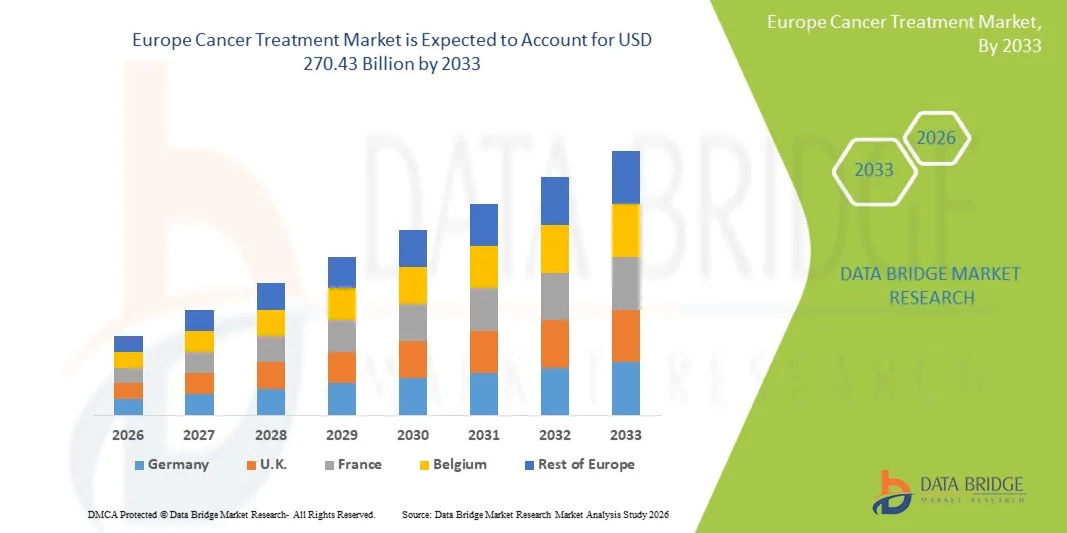
- The Europe cancer treatment market size was valued at USD 115.67 billion in 2025 and is expected to reach USD 270.43 billion by 2033, at a CAGR of 11.20% during the forecast period
- The market growth is largely driven by the rising incidence of cancer across Europe, along with continuous advancements in oncology therapies, including immunotherapy, targeted therapy, and precision medicine, leading to improved treatment outcomes
- Furthermore, increasing investments in cancer research, expanding healthcare infrastructure, and growing adoption of early diagnosis and personalized treatment approaches are strengthening the demand for advanced cancer treatment solutions, thereby significantly supporting the market’s growth
Europe Cancer Treatment Market Analysis
- Europe cancer treatment market, encompassing surgery, chemotherapy, radiation therapy, immunotherapy, targeted therapy, and precision medicine approaches, is a critical segment of the healthcare industry aimed at improving survival rates and quality of life for patients across the region due to the high and rising cancer burden
- The escalating demand for cancer treatment in Europe is primarily driven by the increasing prevalence of various cancer types, growing aging population, and continuous advancements in oncology research, along with rising adoption of personalized medicine and innovative biologics
- Germany dominated the Europe cancer treatment market with the largest revenue share 32.4% in 2025, supported by a highly advanced healthcare system, strong oncology research ecosystem, and significant adoption of immunotherapy and targeted treatment options
- Poland is expected to be the fastest growing country in the Europe cancer treatment market during the forecast period due to improving healthcare infrastructure, increasing government focus on cancer care modernization, and rising access to advanced oncology therapies
- Targeted therapy segment dominated the Europe cancer treatment market with a significant market share of 38.6% in 2025, driven by its high precision in attacking cancer cells, reduced damage to healthy tissues compared to traditional chemotherapy, and increasing adoption in personalized treatment protocols across multiple cancer types
Report Scope and Europe Cancer Treatment Market Segmentation
|
Attributes |
Europe Cancer Treatment Key Market Insights |
|
Segments Covered |
|
|
Countries Covered |
Europe
|
|
Key Market Players |
|
|
Market Opportunities |
|
|
Value Added Data Infosets |
In addition to the insights on market scenarios such as market value, growth rate, segmentation, geographical coverage, and major players, the market reports curated by the Data Bridge Market Research also include in-depth expert analysis, patient epidemiology, pipeline analysis, pricing analysis, and regulatory framework |
Europe Cancer Treatment Market Trends
“Rising Adoption of Precision Medicine and Immunotherapy”
- A significant and accelerating trend in the Europe cancer treatment market is the growing adoption of precision medicine and immunotherapy, supported by advances in genomic profiling and biomarker-driven therapies that are improving patient-specific treatment outcomes across multiple cancer types
- For instance, therapies such as pembrolizumab and nivolumab are increasingly being used across Europe for lung cancer and melanoma, reflecting a shift toward immune checkpoint inhibitors as a standard oncology treatment approach
- The integration of advanced diagnostics such as next-generation sequencing (NGS) is enabling more accurate tumor characterization, allowing oncologists to match patients with highly targeted treatment regimens and improve survival outcomes over time
- Furthermore, hospital networks and cancer centers are increasingly adopting multidisciplinary digital oncology platforms that integrate radiology, pathology, and treatment planning into a single workflow for more efficient clinical decision-making
- This trend toward highly personalized, data-driven cancer care is reshaping treatment protocols, with companies such as Roche and AstraZeneca expanding biomarker-based drug portfolios across European healthcare systems
- The demand for targeted therapies and immuno-oncology treatments is growing rapidly across Europe as healthcare providers increasingly prioritize efficacy, reduced toxicity, and long-term patient outcomes
- Furthermore, rising collaboration between pharmaceutical companies and research institutions is accelerating the development of next-generation cancer therapies, improving the overall innovation pipeline in the European oncology landscape
Europe Cancer Treatment Market Dynamics
Driver
“Rising Cancer Prevalence and Expanding Access to Advanced Oncology Care”
- The increasing incidence of cancer across Europe, coupled with aging populations and lifestyle-related risk factors, is a significant driver for the growing demand for advanced cancer treatment solutions
- For instance, in March 2025, the European Commission strengthened cross-border cancer care initiatives under Europe’s Beating Cancer Plan, aiming to improve early diagnosis and treatment accessibility across member states
- As healthcare systems face rising patient volumes, the adoption of innovative therapies such as immunotherapy, targeted therapy, and CAR-T cell therapy is increasing to improve survival rates and treatment effectiveness
- Furthermore, growing investments in oncology research and expansion of specialized cancer centers are improving access to cutting-edge treatment options across both Western and Eastern Europe
- The increasing use of combination therapies and personalized treatment protocols is also driving higher adoption of advanced oncology drugs in hospital and clinical settings
- The shift toward value-based healthcare and improved reimbursement frameworks is further accelerating the uptake of novel cancer therapies across European markets
- In addition, increasing government funding for early cancer screening programs is enhancing early detection rates, thereby boosting demand for timely and effective treatment interventions
- Furthermore, rising collaborations between public healthcare systems and private biotech firms are accelerating the commercialization and availability of innovative oncology drugs across Europe
Restraint/Challenge
“High Treatment Costs and Unequal Access to Advanced Therapies”
- Concerns surrounding the high cost of advanced cancer treatments, including immunotherapy and targeted therapy, pose a significant challenge to broader market accessibility across Europe
- For instance, therapies such as CAR-T cell treatments and next-generation biologics often involve extremely high per-patient costs, limiting their availability in lower-income and underfunded healthcare systems
- Addressing disparities in reimbursement policies and healthcare funding across different European countries is crucial for ensuring equitable access to innovative oncology treatments
- In addition, variations in regulatory approval timelines and healthcare infrastructure between Western and Eastern Europe create inconsistencies in patient access to advanced therapies
- While countries such as Germany and France provide relatively strong reimbursement support, cost barriers remain significant in several Southern and Eastern European healthcare systems
- Overcoming these challenges through improved pricing strategies, expanded insurance coverage, and broader government oncology funding will be vital for sustained market growth
- In addition, lengthy clinical trial approval processes for novel oncology drugs can delay patient access to breakthrough therapies, further slowing market penetration
- Furthermore, shortage of specialized oncology professionals in certain European countries also limits the effective delivery and adoption of advanced cancer treatment solutions
Europe Cancer Treatment Market Scope
The market is segmented on the basis of cancer type, treatment, route of administration, and end user.
- By Cancer Type
On the basis of cancer type, the Europe cancer treatment market is segmented into breast cancer, colorectal cancer with liver metastases, lung carcinoma, prostate cancer, ovarian cancer, head-and-neck cancer, pancreatic cancer, glioblastoma, renal cell carcinoma, anaplastic thyroid carcinoma, sarcoma, and others. The lung carcinoma segment dominated the market with the largest market revenue share of 28.4% in 2025, driven by its high prevalence across Europe and strong association with smoking, pollution, and aging populations. Lung cancer cases require advanced and long-term treatment strategies such as immunotherapy, targeted therapy, and chemotherapy, which significantly increases treatment demand. Countries such as Germany, France, and the U.K. report a high burden of lung carcinoma, leading to strong adoption of innovative oncology drugs. Continuous clinical research and approval of new checkpoint inhibitors further strengthen the dominance of this segment. The availability of structured screening programs and improved diagnostic rates also contributes to early detection and higher treatment uptake.
The breast cancer segment is expected to witness the fastest growth rate of 12.6% from 2026 to 2033, fueled by increasing awareness, expanding screening programs, and rising adoption of personalized medicine. Breast cancer benefits from strong research pipelines and continuous introduction of targeted therapies such as HER2 inhibitors and hormone therapies. Growing participation in early detection campaigns across Europe is improving diagnosis rates, thereby increasing treatment demand. Countries such as France, Italy, and Spain are witnessing higher investment in women’s health oncology programs. Advancements in genomic testing are enabling more precise and individualized treatment plans. In addition, strong patient advocacy and government-supported cancer initiatives are accelerating growth in this segment.
- By Treatment
On the basis of treatment, the market is segmented into medication, targeted therapies, radiotherapy, surgery, and others. The targeted therapies segment dominated the market with the largest market revenue share of 38.6% in 2025, driven by increasing adoption of precision medicine and biomarker-based treatment approaches across Europe. Targeted therapies provide higher efficacy with fewer side effects compared to traditional chemotherapy, making them a preferred option among oncologists. Strong penetration of drugs such as tyrosine kinase inhibitors and monoclonal antibodies supports segment dominance. Countries such as Germany and the U.K. have high adoption due to advanced healthcare infrastructure and reimbursement support. Continuous innovation in molecular oncology and companion diagnostics is further expanding treatment usage. Rising clinical success rates are also encouraging broader adoption in hospital oncology departments.
The immunotherapy and advanced biologics segment (included in others) is expected to witness the fastest growth rate of 14.2% from 2026 to 2033, driven by breakthroughs in immune checkpoint inhibitors and CAR-T therapies. These treatments are increasingly used for complex and late-stage cancers where traditional therapies show limited effectiveness. Expanding clinical trials across Europe are accelerating drug approvals and availability. Countries such as France, Spain, and Sweden are actively investing in immuno-oncology research. Rising combination therapies involving immunotherapy and targeted drugs are improving survival outcomes. In addition, increasing healthcare funding for innovative oncology pipelines is strengthening rapid adoption.
- By Route of Administration
On the basis of route of administration, the market is segmented into injectable, oral, and others. The injectable segment dominated the market with the largest market revenue share of 62.1% in 2025, driven by widespread use of intravenous chemotherapy, monoclonal antibodies, and immunotherapy drugs. Most advanced oncology treatments require hospital-based administration, ensuring controlled dosing and monitoring. Injectable drugs are preferred for biologics due to better bioavailability and effectiveness in systemic cancer treatment. Strong hospital infrastructure across Western Europe supports this dominance. Countries such as Germany and France have high utilization of infusion-based oncology therapies. Continuous innovation in biologics and biosimilars further strengthens injectable adoption.
The oral segment is expected to witness the fastest growth rate of 11.8% from 2026 to 2033, driven by rising demand for patient-friendly, home-based cancer treatment options. Oral targeted therapies such as kinase inhibitors are increasingly prescribed for long-term cancer management. Patients prefer oral medications due to reduced hospital visits and improved convenience. Advancements in drug formulation are improving absorption and therapeutic effectiveness. Countries such as Italy and the U.K. are witnessing higher adoption of outpatient oncology care models. Increasing focus on quality of life during cancer treatment is further boosting growth.
- By End User
On the basis of end user, the market is segmented into hospitals and specialty clinics. The hospitals segment dominated the market with the largest market revenue share of 71.5% in 2025, driven by the availability of advanced oncology departments, multidisciplinary cancer care teams, and high patient inflow for complex treatments. Hospitals serve as primary centers for chemotherapy, radiotherapy, and surgical oncology procedures. Strong government funding and public healthcare systems across Europe support hospital-based cancer treatment. Countries such as Germany, France, and the U.K. have well-established oncology hospital networks. Hospitals also play a key role in clinical trials and early access programs for new cancer therapies. Integration of advanced diagnostic and treatment technologies further strengthens their dominance.
The specialty clinics segment is expected to witness the fastest growth rate of 13.1% from 2026 to 2033, driven by increasing demand for personalized and outpatient oncology care. Specialty clinics provide faster access to targeted therapies and follow-up treatments in a more patient-centric environment. Rising preference for decentralized cancer care is supporting their expansion. Countries such as Spain and Italy are witnessing growth in private oncology clinics offering advanced treatments. Improved insurance coverage for outpatient cancer care is also boosting adoption. In addition, increasing availability of specialized oncologists outside hospital settings is accelerating segment growth.
Europe Cancer Treatment Market Regional Analysis
- Germany dominated the Europe cancer treatment market with the largest revenue share 32.4% in 2025, supported by a highly advanced healthcare system, strong oncology research ecosystem, and significant adoption of immunotherapy and targeted treatment options
- Patients and healthcare providers in the country highly value early diagnosis, access to innovative treatment protocols, and integration of precision medicine approaches that improve survival outcomes and treatment personalization
- This widespread adoption is further supported by high healthcare expenditure, strong reimbursement policies, and continuous clinical innovation, establishing Germany as a leading hub for advanced oncology treatment and clinical trials within Europe
The Germany Cancer Treatment Market Insight
The Germany cancer treatment market captured the largest revenue share in Europe in 2025, driven by a highly advanced healthcare system, strong oncology research infrastructure, and early adoption of innovative cancer therapies. Patients and healthcare providers in the country highly value access to targeted therapy, immunotherapy, and precision medicine supported by advanced clinical capabilities. This widespread adoption is further supported by strong reimbursement frameworks, high healthcare spending, and continuous innovation in cancer research, establishing Germany as a leading hub for oncology treatment and clinical trials in Europe.
France Cancer Treatment Market Insight
The France cancer treatment market is expected to grow at a considerable CAGR during the forecast period, driven by strong government initiatives for cancer prevention, early detection programs, and increasing investment in oncology research. France’s public healthcare system ensures broad access to chemotherapy, radiotherapy, and advanced biologics for cancer patients. The growing integration of precision medicine and biomarker-driven therapies is enhancing treatment effectiveness. In addition, rising adoption of immunotherapy across major cancer types is further strengthening market growth in the country.
United Kingdom Cancer Treatment Market Insight
The United Kingdom cancer treatment market is anticipated to expand at a noteworthy CAGR during the forecast period, supported by rising cancer incidence, strong NHS-led screening programs, and increasing adoption of advanced oncology treatments. Patients in the country are increasingly benefiting from immunotherapy and targeted therapy through improved reimbursement and clinical trial access. The U.K.’s strong research ecosystem and collaboration between healthcare institutions and pharmaceutical companies are accelerating the introduction of innovative cancer therapies, further driving market growth.
Poland Cancer Treatment Market Insight
The Poland cancer treatment market is expected to grow at a significant CAGR during the forecast period, driven by improving healthcare infrastructure, rising cancer awareness, and increasing access to modern oncology treatments. Patients and healthcare providers are gradually adopting advanced therapies such as chemotherapy combinations, targeted therapy, and immunotherapy supported by expanding hospital capabilities. Government initiatives aimed at strengthening cancer care services and improving early diagnosis programs are further supporting market expansion. In addition, increasing investments in healthcare modernization and growing participation in European oncology initiatives are enhancing treatment accessibility across the country.
Europe Cancer Treatment Market Share
The Europe Cancer Treatment industry is primarily led by well-established companies, including:
- Novartis AG (Switzerland)
- AstraZeneca PLC (U.K.)
- Sanofi (France)
- GSK plc (U.K.)
- Bayer AG (Germany)
- Merck KGaA (Germany)
- Boehringer Ingelheim International GmbH (Germany)
- Ipsen S.A. (France)
- Servier Laboratories (France)
- Pfizer Inc. (U.S.)
- Bristol-Myers Squibb Company (U.S.)
- Merck & Co., Inc. (U.S.)
- Eli Lilly and Company (U.S.)
- Amgen Inc. (U.S.)
- AbbVie Inc. (U.S.)
- Daiichi Sankyo Company, Limited (Japan)
- Takeda Pharmaceutical Company Limited (Japan)
- Gilead Sciences, Inc. (U.S.)
What are the Recent Developments in Europe Cancer Treatment Market?
- In March 2026, the European Medicines Agency (EMA) recommended approval of Imdylltra (tarlatamab) for the treatment of relapsed extensive-stage small cell lung cancer in Europe. The therapy is designed for patients who have progressed after platinum-based chemotherapy and represents a major advancement in immunotherapy-based cancer care
- In January 2026, the European Medicines Agency (EMA) issued a positive recommendation for Zynyz (retifanlimab) as the first immunotherapy-based treatment for advanced anal cancer in Europe. The drug provides a new option for patients with squamous cell carcinoma of the anal canal, a rare and difficult-to-treat cancer type. This approval reflects growing regulatory support for expanding immunotherapy into rare oncology indications
- In September 2025, the EMA’s CHMP recommended approval of a subcutaneous injectable formulation of Keytruda (pembrolizumab) for multiple cancer indications. This new delivery method reduces administration time from long intravenous infusions to a short injection, improving patient convenience and healthcare efficiency. The development supports broader access to immunotherapy across Europe and reflects a shift toward patient-centric oncology treatment models
- In July 2025, the European Union approved GSK’s Blenrep (belantamab mafodotin) for the treatment of relapsed or refractory multiple myeloma in combination with standard therapies. The drug is an antibody–drug conjugate designed to deliver targeted cytotoxic effects directly to cancer cells while minimizing damage to healthy tissue. This approval followed strong clinical trial evidence showing improved progression-free survival outcomes in blood cancer patients
- In March 2025, the European Medicines Agency approved tisotumab vedotin (Tivdak) for the treatment of recurrent or metastatic cervical cancer after chemotherapy failure. This antibody–drug conjugate offers a targeted approach for patients with limited treatment options and represents an important expansion of precision oncology in Europe. The approval strengthens the availability of advanced therapies for gynecological cancers and improves treatment diversity in the region
SKU-
Get online access to the report on the World's First Market Intelligence Cloud

- Interactive Data Analysis Dashboard
- Company Analysis Dashboard for high growth potential opportunities
- Research Analyst Access for customization & queries
- Competitor Analysis with Interactive dashboard
- Latest News, Updates & Trend analysis
- Harness the Power of Benchmark Analysis for Comprehensive Competitor Tracking
Research Methodology
Data collection and base year analysis are done using data collection modules with large sample sizes. The stage includes obtaining market information or related data through various sources and strategies. It includes examining and planning all the data acquired from the past in advance. It likewise envelops the examination of information inconsistencies seen across different information sources. The market data is analysed and estimated using market statistical and coherent models. Also, market share analysis and key trend analysis are the major success factors in the market report. To know more, please request an analyst call or drop down your inquiry.
The key research methodology used by DBMR research team is data triangulation which involves data mining, analysis of the impact of data variables on the market and primary (industry expert) validation. Data models include Vendor Positioning Grid, Market Time Line Analysis, Market Overview and Guide, Company Positioning Grid, Patent Analysis, Pricing Analysis, Company Market Share Analysis, Standards of Measurement, Global versus Regional and Vendor Share Analysis. To know more about the research methodology, drop in an inquiry to speak to our industry experts.
Customization Available
Data Bridge Market Research is a leader in advanced formative research. We take pride in servicing our existing and new customers with data and analysis that match and suits their goal. The report can be customized to include price trend analysis of target brands understanding the market for additional countries (ask for the list of countries), clinical trial results data, literature review, refurbished market and product base analysis. Market analysis of target competitors can be analyzed from technology-based analysis to market portfolio strategies. We can add as many competitors that you require data about in the format and data style you are looking for. Our team of analysts can also provide you data in crude raw excel files pivot tables (Fact book) or can assist you in creating presentations from the data sets available in the report.