


Europe Electric Vehicle Charging Stations Market
Market Size in USD Billion
CAGR :
% 
 USD
14.12 Billion
USD
363.74 Billion
2025
2033
USD
14.12 Billion
USD
363.74 Billion
2025
2033
 Forecast Period Forecast Period |
2026 –2033 |
 Market Size (Base Year) Market Size (Base Year) |
USD 14.12 Billion |
 Market Size (Forecast Year) Market Size (Forecast Year) |
USD 363.74 Billion |
 CAGR CAGR |
% |
| Major Markets Players |
|
Europe Electric Vehicle Charging Stations Market Size
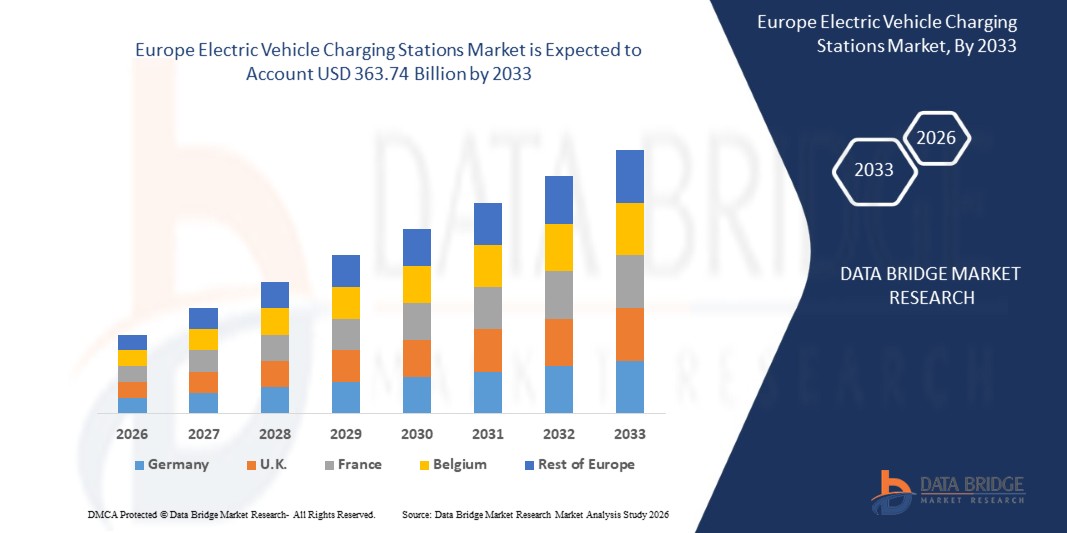
- The Europe electric vehicle charging stations market size was valued at USD 14.12 billion in 2025 and is expected to reach USD 363.74 billion by 2033, at a CAGR of 50.10% during the forecast period
- The market growth is largely fuelled by the rapid expansion of electric vehicle adoption, strong government incentives for EV infrastructure development, increasing investments from private charging network operators, and the rising need for fast-charging and ultra-fast charging solutions across urban and highway corridors
Europe Electric Vehicle Charging Stations Market Analysis
- Rapid electrification of transportation is significantly accelerating the deployment of charging infrastructure as consumers and fleets transition toward zero-emission mobility
- Continuous advancements in fast-charging and ultra-fast charging technologies are improving convenience and reducing charging time, boosting user adoption
- Germany electric vehicle charging stations market held the largest market share in 2025, driven by strong government incentives, expanding EV adoption, and a well-established public charging infrastructure network
- The U.K. electric vehicle charging stations market is expected to witness the fastest growth rate from 2026 to 2033, driven by the rapid expansion of EV adoption and strong government initiatives supporting net-zero emissions targets
- The DC Charging/Super Charging Station segment held the largest market revenue share in 2025 driven by the rising demand for fast charging infrastructure across highways, urban hubs, and commercial charging networks. DC fast chargers significantly reduce charging time and are widely deployed to support long-distance EV travel and high-utilization fleet operations, making them a preferred solution across public charging networks in Europe
Report Scope and Europe Electric Vehicle Charging Stations Market Segmentation
|
Attributes |
Europe Electric Vehicle Charging Stations Key Market Insights |
|
Segments Covered |
|
|
Countries Covered |
Europe
|
|
Key Market Players |
• ASSA ABLOY (Sweden) |
|
Market Opportunities |
• Expansion Of Ultra-Fast Charging Infrastructure |
|
Value Added Data Infosets |
In addition to the market insights such as market value, growth rate, market segments, geographical coverage, market players, and market scenario, the market report curated by the Data Bridge Market Research team includes in-depth expert analysis, import/export analysis, pricing analysis, production consumption analysis, and pestle analysis. |
Europe Electric Vehicle Charging Stations Market Trends
“Expansion of Fast and Ultra-Fast Charging Infrastructure”
• The rapid shift toward electric mobility across Europe is significantly driving the deployment of fast and ultra-fast charging stations, as governments and private players aim to reduce charging time and improve user convenience. This trend is strengthening highway corridor electrification and urban charging networks, enabling seamless long-distance EV travel and encouraging wider adoption of electric vehicles across passenger and commercial segments
• Increasing investments from energy companies, automotive OEMs, and charging network operators are accelerating the rollout of high-power charging hubs in urban centers, highways, and retail locations. These stations are being integrated with renewable energy sources and smart grid systems to improve efficiency, reduce carbon emissions, and support Europe’s broader decarbonization targets
• Growing emphasis on interoperability and roaming agreements between charging networks is improving accessibility for EV users across different countries. Standardized payment systems, app-based access, and cross-network compatibility are enhancing user experience and supporting cross-border EV mobility within the European Union
• For instance, in 2024, Ionity in Germany and Shell Recharge in the Netherlands expanded their ultra-fast charging corridors across major European highways, enabling higher charging speeds and improved coverage for long-distance EV travel. These expansions were supported by partnerships with automotive manufacturers such as BMW, Mercedes-Benz, and Volkswagen Group, strengthening network utilization and consumer adoption
• While infrastructure expansion is accelerating, long-term market growth depends on grid capacity upgrades, cost-efficient deployment, and faster permitting processes. Continued investment in renewable integration, battery storage systems, and smart charging technologies will be essential to support large-scale EV adoption
Europe Electric Vehicle Charging Stations Market Dynamics
Driver
“Strong Government Support and Rapid EV Adoption Across Europe”
• Stringent emission regulations and aggressive carbon neutrality targets across Europe are a major driver for the EV charging stations market. Governments are actively supporting infrastructure development through subsidies, tax incentives, and funding programs aimed at expanding public and private charging networks
• Rising EV adoption in countries such as Germany, France, the U.K., and the Netherlands is increasing the demand for reliable and widespread charging infrastructure. Consumers are shifting toward electric mobility due to fuel price volatility, environmental awareness, and low operating costs of EVs
• Expansion of corporate fleet electrification and public transport electrification is further boosting demand for depot and destination charging solutions. Logistics companies and ride-hailing operators are increasingly installing dedicated charging hubs to support operational efficiency and reduce emissions
• For instance, in 2023, BP Pulse in the U.K. and Enel X Way in Italy expanded their charging infrastructure by installing new fast-charging stations across urban and highway locations, supporting rising EV registrations and fleet electrification programs. These initiatives also included partnerships with retail chains and municipalities to improve charging accessibility
• Although demand is growing rapidly, sustained market expansion depends on grid modernization, faster installation approvals, and improved standardization across regions. Investment in smart charging systems and renewable-powered stations will be critical for long-term scalability
Restraint/Challenge
“High Infrastructure Costs and Grid Capacity Limitations”
• The high capital expenditure required for installing fast and ultra-fast charging stations remains a key challenge, particularly in dense urban areas where grid upgrades and construction costs are significant. Equipment costs, land acquisition, and installation expenses increase financial pressure on operators
• Limited grid capacity and unequal energy distribution across regions create bottlenecks in charging station deployment. In some areas, existing electricity infrastructure is unable to support high-power charging demand, requiring additional investment in grid reinforcement and energy storage solutions
• Complex regulatory approvals and lengthy permitting processes across different European countries also slow down infrastructure rollout. Variations in national policies and local regulations create inconsistencies in deployment timelines and operational standards
• For instance, in 2024, operators in Spain and Poland including Tesla Superchargers network and Fastned in the Netherlands faced delays in expanding high-speed charging corridors due to grid connection limitations and municipal approval processes. These challenges also led to higher project costs and slower station commissioning timelines
• Addressing these challenges will require coordinated policy frameworks, increased public-private partnerships, and accelerated investment in grid modernization. Development of modular charging systems and distributed energy solutions will also be essential to improve deployment efficiency and cost-effectiveness across the region
Europe Electric Vehicle Charging Stations Market Scope
The market is segmented on the basis of charging stations, vehicle type, installation type, technology, and charger type.
• By Charging Stations
On the basis of charging stations, the Europe electric vehicle charging stations market is segmented into AC Charging/Normal Charging Station, DC Charging/Super Charging Station, and Inductive Charging Station. The DC Charging/Super Charging Station segment held the largest market revenue share in 2025 driven by the rising demand for fast charging infrastructure across highways, urban hubs, and commercial charging networks. DC fast chargers significantly reduce charging time and are widely deployed to support long-distance EV travel and high-utilization fleet operations, making them a preferred solution across public charging networks in Europe.
The AC Charging/Normal Charging Station segment is expected to witness the fastest growth rate from 2026 to 2033, driven by its cost-effectiveness, easy installation, and suitability for residential and workplace charging. AC chargers are widely adopted in homes, apartments, and office spaces as they support overnight charging and align well with daily commuting patterns of EV users, contributing to steady market expansion.
• By Vehicle Type
On the basis of vehicle type, the Europe electric vehicle charging stations market is segmented into Battery Electric Vehicle (BEV) and Plug-In Hybrid Electric Vehicles (PHEV). The Battery Electric Vehicle (BEV) segment held the largest market revenue share in 2025 driven by strong adoption of fully electric vehicles across Europe due to stringent emission regulations and government incentives. BEVs rely entirely on external charging infrastructure, which is accelerating the demand for widespread and high-capacity charging networks across both urban and intercity locations.
The Plug-In Hybrid Electric Vehicles (PHEV) segment is expected to witness the fastest growth rate from 2026 to 2033, driven by its flexibility of combining internal combustion engines with electric power and lower dependency on charging infrastructure. PHEVs are increasingly preferred in regions with developing charging networks, supporting gradual transition toward full electrification.
• By Installation Type
On the basis of installation type, the Europe electric vehicle charging stations market is segmented into Individual Houses, Commercial, Apartments, and Others. The Commercial segment held the largest market revenue share in 2025 driven by the rapid expansion of public charging infrastructure across retail centers, highways, parking facilities, and business complexes. Commercial installations benefit from high traffic volume and government-backed infrastructure programs, making them a key contributor to network expansion across Europe.
The Apartments segment is expected to witness the fastest growth rate from 2026 to 2033, driven by increasing urbanization and rising demand for shared residential charging solutions. Multi-unit housing developments are increasingly integrating EV charging infrastructure to support growing EV ownership among urban populations, encouraging property developers to invest in dedicated charging facilities.
• By Technology
On the basis of technology, the Europe electric vehicle charging stations market is segmented into Level 1, Level 2, and Level 3. The Level 2 segment held the largest market revenue share in 2025 driven by its balanced charging speed, affordability, and widespread deployment across residential and commercial locations. Level 2 chargers are widely used for daily charging needs and offer compatibility with most electric vehicles, making them the most commonly installed charging solution across Europe.
The Level 3 segment is expected to witness the fastest growth rate from 2026 to 2033, driven by increasing demand for ultra-fast charging infrastructure along highways and urban fast-charging corridors. Level 3 chargers significantly reduce charging time and are essential for long-distance EV travel and commercial fleet operations, supporting rapid infrastructure expansion.
• By Charger Type
On the basis of charger type, the Europe electric vehicle charging stations market is segmented into Portable Charger and Fixed Charger. The Fixed Charger segment held the largest market revenue share in 2025 driven by its extensive deployment across public charging stations, residential complexes, and commercial installations. Fixed chargers provide higher efficiency, greater power output, and long-term reliability, making them the preferred choice for permanent infrastructure development.
The Portable Charger segment is expected to witness the fastest growth rate from 2026 to 2033, driven by increasing demand for flexible and emergency charging solutions. Portable chargers offer convenience for EV owners who require mobility and backup charging options, particularly in regions with developing charging infrastructure or limited access to fixed stations.
Europe Electric Vehicle Charging Stations Market Regional Analysis
- Germany electric vehicle charging stations market held the largest market share in 2025, driven by strong government incentives, expanding EV adoption, and a well-established public charging infrastructure network
- Germany’s focus on sustainability, renewable energy integration, and strict emission regulations has accelerated the deployment of fast-charging and ultra-fast charging stations across highways and urban areas
- The presence of leading automotive manufacturers, advanced grid infrastructure, and high consumer awareness regarding electric mobility further strengthens the country’s market dominance
U.K. Electric Vehicle Charging Stations Market Insight
The U.K. electric vehicle charging stations market is expected to witness the fastest growth rate from 2026 to 2033, driven by the rapid expansion of EV adoption and strong government initiatives supporting net-zero emissions targets. Increasing investments in public and residential charging infrastructure, along with rising demand for fast and convenient charging solutions, are accelerating market growth. The country’s robust digital infrastructure, favorable regulatory framework, and growing partnerships between energy providers and automotive companies are further supporting market expansion, making EV charging stations a critical component of the U.K.’s clean transportation ecosystem.
Europe Electric Vehicle Charging Stations Market Share
The Europe electric vehicle charging stations industry is primarily led by well-established companies, including:
• ASSA ABLOY (Sweden)
• dormakaba (Switzerland)
• Nuki (Austria)
• EVVA (Austria)
• SimonsVoss Technologies (Germany)
• SALTO Systems (Spain)
• DOM Security (France)
• iLOQ (Finland)
• Danalock (Denmark)
• Tedee (Poland)
• LOQED (Netherlands)
• GANTNER Electronic (Austria)
• Burg-Wächter (Germany)
• Netatmo (France)
• ISEO Ultimate Access Technologies (Italy)
SKU-
Get online access to the report on the World's First Market Intelligence Cloud

- Interactive Data Analysis Dashboard
- Company Analysis Dashboard for high growth potential opportunities
- Research Analyst Access for customization & queries
- Competitor Analysis with Interactive dashboard
- Latest News, Updates & Trend analysis
- Harness the Power of Benchmark Analysis for Comprehensive Competitor Tracking
Research Methodology
Data collection and base year analysis are done using data collection modules with large sample sizes. The stage includes obtaining market information or related data through various sources and strategies. It includes examining and planning all the data acquired from the past in advance. It likewise envelops the examination of information inconsistencies seen across different information sources. The market data is analysed and estimated using market statistical and coherent models. Also, market share analysis and key trend analysis are the major success factors in the market report. To know more, please request an analyst call or drop down your inquiry.
The key research methodology used by DBMR research team is data triangulation which involves data mining, analysis of the impact of data variables on the market and primary (industry expert) validation. Data models include Vendor Positioning Grid, Market Time Line Analysis, Market Overview and Guide, Company Positioning Grid, Patent Analysis, Pricing Analysis, Company Market Share Analysis, Standards of Measurement, Global versus Regional and Vendor Share Analysis. To know more about the research methodology, drop in an inquiry to speak to our industry experts.
Customization Available
Data Bridge Market Research is a leader in advanced formative research. We take pride in servicing our existing and new customers with data and analysis that match and suits their goal. The report can be customized to include price trend analysis of target brands understanding the market for additional countries (ask for the list of countries), clinical trial results data, literature review, refurbished market and product base analysis. Market analysis of target competitors can be analyzed from technology-based analysis to market portfolio strategies. We can add as many competitors that you require data about in the format and data style you are looking for. Our team of analysts can also provide you data in crude raw excel files pivot tables (Fact book) or can assist you in creating presentations from the data sets available in the report.












