


What is the Europe Hazelnut Market Size and Growth Rate?
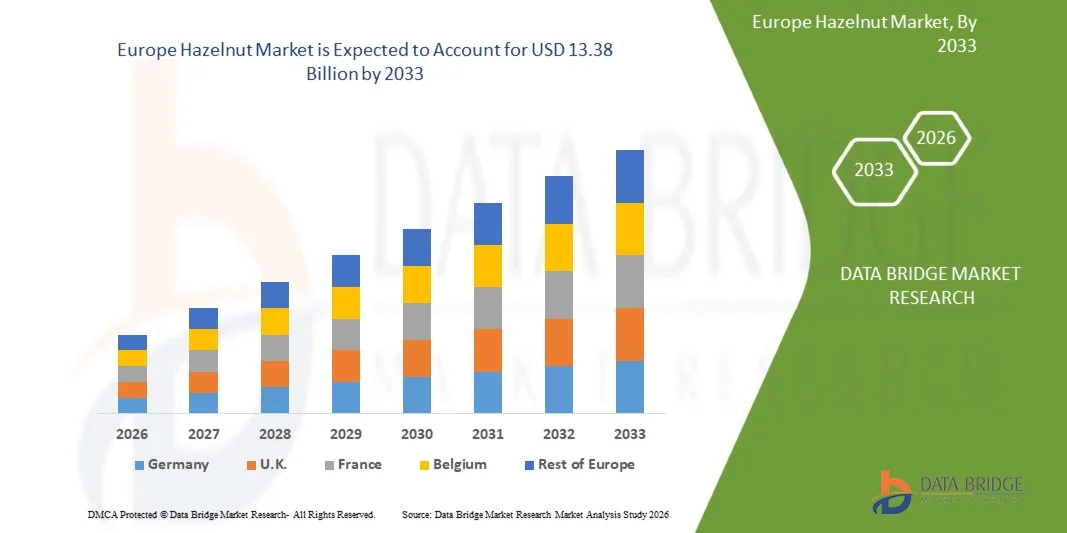
- As per Data Bridge Market Research analysis, the Europe hazelnut market was valued at USD 6.66 billion in 2025 and is projected to reach USD 13.38 billion by 2033, growing at a CAGR of 9.10% from 2026 to 2033.
- The market is being driven by a surge in demand for hazelnut-based products across confectionery, bakery, and dairy alternatives, along with a rising consumer shift toward healthy, plant-based, and clean-label ingredients.
- Hazelnuts are increasingly recognized not just as an indulgent treat but as a functional, nutrient-dense food, rich in healthy fats, antioxidants, and vitamins. This nutritional repositioning is expanding their application beyond traditional chocolates and spreads into functional snacks, plant-based milks, and protein bars.
Market Size & Forecast
- Market Value (2025): USD 6.66 Billion
- Expected Market Value (2033): USD 13.38 Billion
- Forecast CAGR (2026–2033): 9.10%
- Leading Country in 2025: Italy
- Fastest Growing Country: U.K.
What are the Major Takeaways of the Europe Hazelnut Market?
- Italy dominated the Europe hazelnut market and accounted for the largest revenue share of 28.60% in 2025, driven by its position as Europe's leading hazelnut producer and a major industrial consumer. Extensive cultivation in regions such as Piedmont, Lazio, and Campania, along with the presence of globally recognized confectionery manufacturers and government support through rural development programs, has strengthened Italy's leadership in the regional market.
- U.K. hazelnut market is expected to witness the fastest growth rate from 2026 to 2033, supported by increasing consumer preference for premium confectionery products, plant-based foods, and healthy snack alternatives. Rising demand for hazelnut spreads, dairy alternatives, bakery products, and functional food ingredients is encouraging imports and product innovation.
- The natural hazelnut segment dominated the market in 2025, owing to its extensive use across the confectionery, bakery, dairy, and snack industries. Its minimal processing, superior nutritional profile, and broad application in premium food products continue to support strong demand among manufacturers and consumers across Europe.
- The hazelnut oil segment is projected to register the fastest growth from 2026 to 2033, driven by rising demand for plant-based edible oils, natural cosmetic ingredients, and functional food products. Increasing consumer preference for healthy fats and clean-label ingredients is expected to accelerate segment growth.
- The conventional segment accounted for the largest market share in 2025, supported by its widespread availability, lower production costs, and strong utilization across food processing industries. established cultivation practices and extensive supply chains continue to reinforce the dominance of conventional hazelnuts throughout Europe.
- The organic segment is anticipated to witness the fastest CAGR from 2026 to 2033, driven by increasing consumer demand for sustainably produced, pesticide-free, and clean-label food products. Growing organic farming initiatives and premium pricing opportunities are further supporting segment expansion.
Report Scope and Europe Hazelnut Market Segmentation
|
Attributes |
Hazelnut Key Market Insights |
|
Segments Covered |
|
|
Countries Covered |
Europe
|
|
Key Market Players |
|
|
Market Opportunities |
|
|
Value Added Data Infosets |
In addition to the insights on market scenarios such as market value, growth rate, segmentation, geographical coverage, and major players, the market reports curated by the Data Bridge Market Research also include in-depth expert analysis, pricing analysis, brand share analysis, consumer survey, demography analysis, supply chain analysis, value chain analysis, raw material/consumables overview, vendor selection criteria, PESTLE Analysis, Porter Analysis, and regulatory framework. |
What is the Key Trend in the Europe Hazelnut Market?
- The growing demand for premium, clean-label, and value-added hazelnut products is emerging as a key trend in the hazelnut market, with manufacturers introducing innovative spreads, chocolates, snacks, and plant-based ingredients to meet evolving consumer preferences for healthier and minimally processed foods.
- Sustainability and supply chain traceability are becoming central to hazelnut sourcing, as leading manufacturers invest in regenerative agriculture, responsible farming practices, and farm-level traceability to comply with evolving regulations and strengthen consumer confidence in sustainably sourced ingredients.
- For instance, in May 2025, Ferrero Rocher launched Ferrero Rocher Chocolate Squares in five hazelnut-based varieties, Milk Hazelnut, Dark Hazelnut, White Hazelnut, Caramel Hazelnut, and Assorted, expanding its premium confectionery portfolio and addressing rising demand for innovative hazelnut products.
- As consumer demand for premium confectionery, plant-based foods, and sustainably sourced ingredients continues to increase, manufacturers are expected to accelerate investments in product innovation, clean-label formulations, and responsible hazelnut sourcing, reinforcing these trends as key drivers of long-term market development.
What are the Key Drivers of the Europe Hazelnut Market?
- The growing consumer demand for healthy, plant-based, and nutrient-rich foods is a major driver of the hazelnut market. Hazelnuts are widely recognized for their high content of healthy fats, protein, dietary fiber, vitamin E, and antioxidants, making them a preferred ingredient in functional foods, dairy alternatives, confectionery, bakery products, and nutritious snacks. Rising health awareness and the shift toward clean-label products are further accelerating hazelnut consumption across global markets.
- For instance, in February 2024, Chose Foods launched a better-for-you chocolate hazelnut spread made with 100% pure avocado oil, offering a clean-label product designed for consumers seeking healthier, minimally processed food options. The launch reflects the increasing demand for premium hazelnut-based products with improved nutritional profiles.
- The expanding confectionery and food processing industries are further driving demand for hazelnuts, as manufacturers continue to introduce innovative chocolate, bakery, and snack products featuring hazelnuts. Rising investments in premium product development and value-added hazelnut applications are strengthening market growth across developed and emerging economies.
- As consumer preferences continue to shift toward nutritious foods, premium confectionery, and plant-based ingredients, hazelnuts are expected to witness sustained demand across multiple food and beverage applications, reinforcing their role as a key ingredient in the global food industry.
Which Factors are Challenging the Growth of the Europe Hazelnut Market?
- Climate change, adverse weather conditions, and crop diseases remain major challenges for the hazelnut market, as hazelnut cultivation is highly concentrated in a few producing regions, particularly Türkiye and Italy. Late spring frosts, droughts, excessive rainfall, and pest outbreaks can significantly reduce yields, creating supply shortages and increasing price volatility for processors and food manufacturers.
- In July 2024, Ferrero introduced its 2024–2026 Hazelnut Charter and Action Plan, outlining new commitments to improve supply chain traceability, regenerative agriculture, biodiversity conservation, and the livelihoods of hazelnut farmers. The initiative reinforces the company's long-term investment in sustainable hazelnut sourcing across major producing regions.
- The market also faces challenges from supply chain concentration and fluctuating raw material prices, as a substantial share of the global hazelnut supply originates from a limited number of countries. Any production shortfall caused by unfavorable weather or geopolitical and logistical disruptions can quickly impact global availability, procurement costs, and profit margins for food manufacturers.
- The continued exposure of hazelnut production to climate variability, supply concentration, and price fluctuations is expected to remain a key constraint on market growth, particularly for manufacturers that rely on consistent supplies of high-quality hazelnuts for confectionery, bakery, and food processing applications.
How is the Europe Hazelnut Market Segmented?
The hazelnut market is segmented on the basis of form, category, shape, origin, packaging, application, and distribution channel.
- By Form
On the basis of form, the Europe hazelnut market is segmented into whole/in-shell hazelnut, natural hazelnut, diced hazelnut, paste hazelnut, blanched hazelnut, roasted hazelnut, sliced hazelnut, hazelnut oil, hazelnut meal, and others. The natural hazelnut segment dominated the market in 2025, owing to its extensive use across the confectionery, bakery, dairy, and snack industries. Its minimal processing, superior nutritional profile, and broad application in premium food products continue to support strong demand among manufacturers and consumers across Europe.
The hazelnut oil segment is projected to register the fastest growth from 2026 to 2033, driven by rising demand for plant-based edible oils, natural cosmetic ingredients, and functional food products. Increasing consumer preference for healthy fats and clean-label ingredients is expected to accelerate segment growth.
- By Category
On the basis of category, the Europe hazelnut market is segmented into conventional and organic. The conventional segment accounted for the largest market share in 2025, supported by its widespread availability, lower production costs, and strong utilization across food processing industries. established cultivation practices and extensive supply chains continue to reinforce the dominance of conventional hazelnuts throughout Europe.
The organic segment is anticipated to witness the fastest CAGR from 2026 to 2033, driven by increasing consumer demand for sustainably produced, pesticide-free, and clean-label food products. Growing organic farming initiatives and premium pricing opportunities are further supporting segment expansion.
- By Shape
On the basis of shape, the Europe hazelnut market is segmented into round kernels, almond kernels, pointed kernels, and others. The round kernels segment dominated the market in 2025, owing to their uniform size, high kernel yield, and extensive use in confectionery, chocolate manufacturing, and bakery applications. Their superior processing characteristics and aesthetic appeal continue to drive widespread adoption.
The pointed kernels segment is expected to witness the fastest growth from 2026 to 2033, driven by increasing demand from premium confectionery manufacturers and specialty food applications requiring distinctive kernel characteristics and high-quality raw materials.
- By Origin
On the basis of origin, the Europe hazelnut market is segmented into Akcakoca, Levant, and Giresun. The levant segment held the largest market share in 2025, supported by its high production volumes, consistent quality, and extensive exports to European food manufacturers. Levant-origin hazelnuts are widely utilized across the confectionery and processed food industries due to their reliable supply and competitive pricing.
The Giresun segment is projected to register the fastest growth from 2026 to 2033, driven by increasing demand for premium-quality hazelnuts with superior flavor, higher oil content, and excellent roasting characteristics, particularly among premium chocolate and confectionery manufacturers.
- By Packaging
On the basis of packaging, the Europe hazelnut market is segmented into vacuum & cartons box, bags, pouches, and plastic or metal drums. The bags segment dominated the market in 2025, owing to their cost-effectiveness, ease of transportation, and widespread use for bulk handling and commercial distribution. Their flexibility and compatibility with industrial supply chains continue to support market leadership.
The vacuum & cartons box segment is anticipated to witness the fastest CAGR from 2026 to 2033, driven by increasing demand for extended shelf life, premium packaging solutions, and enhanced product freshness for retail and export applications.
- By Application
On the basis of application, the Europe hazelnut market is segmented into industrial, food service industry, and household/retail. The Industrial segment accounted for the largest market share in 2025 due to extensive consumption by chocolate, confectionery, bakery, dairy, and snack manufacturers. Growing demand for hazelnut-based ingredients in value-added food products continues to strengthen the segment's dominance across Europe.
The food service industry segment is expected to register the fastest growth from 2026 to 2033, driven by rising consumption of premium desserts, specialty beverages, bakery products, and gourmet cuisine across restaurants, cafés, hotels, and quick-service establishments.
- By Distribution Channel
On the basis of distribution channel, the Europe hazelnut market is segmented into Direct and indirect. The indirect segment dominated the market in 2025, supported by the extensive presence of wholesalers, distributors, supermarkets, specialty retailers, and online platforms that provide broad market access across Europe. Well-established retail networks continue to facilitate efficient product distribution and consumer availability.
The direct segment is projected to witness the fastest growth from 2026 to 2033, driven by increasing direct sourcing agreements between growers, processors, and food manufacturers, enabling improved supply chain efficiency, product traceability, and cost optimization.
Which Country Holds the Largest Share of the Europe Hazelnut Market?
- Italy dominated the Europe hazelnut market and accounted for the largest revenue share of 28.60% in 2025, driven by its position as Europe's leading hazelnut producer and a major industrial consumer. Extensive cultivation in regions such as Piedmont, Lazio, and Campania, along with the presence of globally recognized confectionery manufacturers and government support through rural development programs, has strengthened Italy's leadership in the regional market.
- The European market benefits from a well-established confectionery and bakery industry, strong consumer demand for premium and plant-based food products, and a highly integrated hazelnut processing ecosystem. Growing adoption of hazelnut-based ingredients in chocolates, spreads, bakery products, dairy alternatives, and functional foods, together with supportive agricultural policies and increasing investments in sustainable cultivation, continues to drive market expansion across the region.
U.K. Hazelnut Market Insight
The U.K. hazelnut market is expected to witness the fastest growth rate from 2026 to 2033, supported by increasing consumer preference for premium confectionery products, plant-based foods, and healthy snack alternatives. Rising demand for hazelnut spreads, dairy alternatives, bakery products, and functional food ingredients is encouraging imports and product innovation. The expansion of organized retail channels and growing interest in clean-label and sustainably sourced ingredients are further supporting market growth in the U.K.
Which are the Top Companies in Europe Hazelnut Market?
The Hazelnut industry is primarily led by well-established companies, including:
- Ferrero International S.A. (Italy)
- Barry Callebaut AG (Switzerland)
- Kanegrade Ltd. (U.K.)
- Olam Food Ingredients B.V. (Netherlands)
- Puratos Group NV (Belgium)
- Cargill PLC (U.K.)
- Dr. Oetker GmbH (Germany)
- Zentis GmbH & Co. KG (Germany)
- Loacker S.p.A. (Italy)
- Venchi S.p.A. (Italy)
- Novi Elah Dufour S.p.A. (Italy)
- Pernigotti S.p.A. (Italy)
- Besana Group S.p.A. (Italy)
- Irca S.p.A. (Italy)
- Nigay SAS (France)
What are Latest Developments in Europe Hazelnut Market?
- In May 2025, Ferrero Rocher broadened its product lineup with the introduction of Ferrero Rocher Chocolate Squares, offering the brand's iconic hazelnut flavors and textures in a convenient, shareable format. The new range features five variants: Milk Hazelnut, Dark Hazelnut, White Hazelnut, Caramel Hazelnut, and Assorted.

- Interactive Data Analysis Dashboard
- Company Analysis Dashboard for high growth potential opportunities
- Research Analyst Access for customization & queries
- Competitor Analysis with Interactive dashboard
- Latest News, Updates & Trend analysis
- Harness the Power of Benchmark Analysis for Comprehensive Competitor Tracking
Europe Hazelnut Market, Supply Chain Analysis and Ecosystem Framework
To support market growth and help clients navigate the impact of geopolitical shifts, DBMR has integrated in-depth supply chain analysis into its Europe Hazelnut Market research reports. This addition empowers clients to respond effectively to global changes affecting their industries. The supply chain analysis section includes detailed insights such as Europe Hazelnut Market consumption and production by country, price trend analysis, the impact of tariffs and geopolitical developments, and import and export trends by country and HSN code. It also highlights major suppliers with data on production capacity and company profiles, as well as key importers and exporters. In addition to research, DBMR offers specialized supply chain consulting services backed by over a decade of experience, providing solutions like supplier discovery, supplier risk assessment, price trend analysis, impact evaluation of inflation and trade route changes, and comprehensive market trend analysis.
Data collection and base year analysis are done using data collection modules with large sample sizes. The stage includes obtaining market information or related data through various sources and strategies. It includes examining and planning all the data acquired from the past in advance. It likewise envelops the examination of information inconsistencies seen across different information sources. The market data is analysed and estimated using market statistical and coherent models. Also, market share analysis and key trend analysis are the major success factors in the market report. To know more, please request an analyst call or drop down your inquiry.
The key research methodology used by DBMR research team is data triangulation which involves data mining, analysis of the impact of data variables on the market and primary (industry expert) validation. Data models include Vendor Positioning Grid, Market Time Line Analysis, Market Overview and Guide, Company Positioning Grid, Patent Analysis, Pricing Analysis, Company Market Share Analysis, Standards of Measurement, Global versus Regional and Vendor Share Analysis. To know more about the research methodology, drop in an inquiry to speak to our industry experts.
Data Bridge Market Research is a leader in advanced formative research. We take pride in servicing our existing and new customers with data and analysis that match and suits their goal. The report can be customized to include price trend analysis of target brands understanding the market for additional countries (ask for the list of countries), clinical trial results data, literature review, refurbished market and product base analysis. Market analysis of target competitors can be analyzed from technology-based analysis to market portfolio strategies. We can add as many competitors that you require data about in the format and data style you are looking for. Our team of analysts can also provide you data in crude raw excel files pivot tables (Fact book) or can assist you in creating presentations from the data sets available in the report.













