Europe Lipid Market
Market Size in USD Billion
CAGR :
% 
 USD
2.21 Billion
USD
4.37 Billion
2025
2033
USD
2.21 Billion
USD
4.37 Billion
2025
2033
 Forecast Period Forecast Period |
2026 –2033 |
 Market Size (Base Year) Market Size (Base Year) |
USD 2.21 Billion |
 Market Size (Forecast Year) Market Size (Forecast Year) |
USD 4.37 Billion |
 CAGR CAGR |
% |
| Major Markets Players |
|
Europe Lipids Market Size
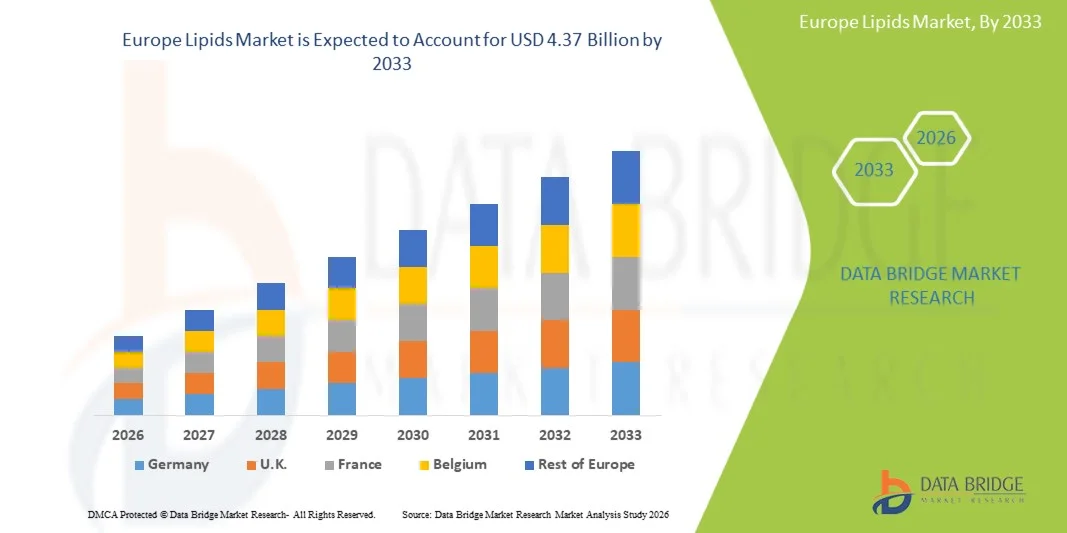
- The Europe Lipids Market size was valued at USD 2.21 billion in 2025 and is expected to reach USD 4.37 billion by 2033, at a CAGR of 8.90% during the forecast period
- The market growth is largely fueled by the increasing demand for lipid-based products across pharmaceuticals, food & beverages, and cosmetics industries, along with advancements in lipid extraction and processing technologies, leading to broader application scope and enhanced product efficacy
- Furthermore, rising adoption of lipids in drug delivery systems, growing demand for functional and fortified foods, and increasing consumer awareness regarding nutrition and health benefits are establishing lipids as a critical component across multiple industries. These converging factors are accelerating the uptake of Lipids solutions, thereby significantly boosting the industry's growth
Europe Lipids Market Analysis
- Lipids, which include fats, oils, and related compounds, are essential components in pharmaceuticals, nutrition, and cosmetics, playing a critical role in energy storage, cell structure, and advanced drug delivery systems
- The escalating demand for lipids is primarily fueled by their increasing use in functional foods, nutraceuticals, and lipid-based drug delivery technologies, along with rising consumer awareness regarding health and nutrition
- The U.K. dominated the Europe Lipids Market with the largest revenue share of approximately 32.1% in 2025, characterized by strong demand across pharmaceutical and food industries, advanced research capabilities, and presence of key industry players, with the country witnessing steady growth driven by increasing adoption of lipid-based products
- Germany is expected to be the fastest growing country in the Europe Lipids Market during the forecast period, with a projected CAGR of around 8.1%, due to rising demand for nutraceuticals, increasing investments in life sciences research, and growing awareness regarding health and wellness
- The natural lipids segment dominated the largest market revenue share of 58.6% in 2025, driven by increasing preference for biologically derived and biocompatible lipid sources in pharmaceutical and nutraceutical applications
Report Scope and Europe Lipids Market Segmentation
|
Attributes |
Lipids Key Market Insights |
|
Segments Covered |
|
|
Countries Covered |
North America
Europe
Asia-Pacific
Middle East and Africa
South America
|
|
Key Market Players |
|
|
Market Opportunities |
|
|
Value Added Data Infosets |
In addition to the insights on market scenarios such as market value, growth rate, segmentation, geographical coverage, and major players, the market reports curated by the Data Bridge Market Research also include in-depth expert analysis, patient epidemiology, pipeline analysis, pricing analysis, and regulatory framework. |
Europe Lipids Market Trends
“Advancements in Functional Lipids and Precision Nutrition Solutions”
- A significant and accelerating trend in the Europe Lipids Market is the growing focus on functional lipids and their role in precision nutrition, which is enhancing health outcomes and expanding application areas across food, pharmaceuticals, and personal care industries
- These innovations are enabling manufacturers to develop targeted lipid-based formulations that support cardiovascular health, cognitive function, and metabolic balance
- For instance, the increasing use of omega-3 fatty acids and medium-chain triglycerides (MCTs) in dietary supplements and fortified foods is gaining traction due to their proven health benefits and rising consumer awareness regarding preventive healthcare
- In addition, advancements in lipid extraction and processing technologies are improving product quality, stability, and bioavailability, making lipid-based ingredients more effective and widely applicable across industries
- The shift towards plant-based and sustainable lipid sources, such as algae-derived omega-3 and vegetable oils, is also influencing market growth, aligning with Europe’s strong focus on sustainability and clean-label products
- Furthermore, the integration of lipids in pharmaceutical drug delivery systems, particularly in enhancing the solubility and efficacy of active ingredients, is opening new avenues for innovation and market expansion
Europe Lipids Market Dynamics
Driver
“Rising Demand for Nutritional Supplements and Health-Focused Products”
- The increasing consumer focus on health and wellness, along with growing awareness of the benefits of essential fatty acids and functional lipids, is a key driver for the Europe Lipids Market. Consumers are actively seeking products that support heart health, brain function, and overall well-being, thereby boosting demand for lipid-based formulations
- For instance, the rising consumption of omega-3 enriched supplements and functional foods across European countries is significantly contributing to market growth, supported by strong clinical evidence and increasing recommendations from healthcare professionals
- In addition, the expansion of the nutraceutical and dietary supplement industry is creating substantial opportunities for lipid manufacturers to develop innovative and value-added products tailored to specific health needs
- The growing aging population in Europe is further accelerating demand for lipid-based products, particularly those aimed at managing age-related conditions such as cardiovascular diseases and cognitive decline
- Moreover, increasing investments in research and development by key players are leading to the introduction of advanced lipid ingredients with enhanced functionality, thereby strengthening market growth prospects
Restraint/Challenge
“Fluctuating Raw Material Prices and Regulatory Complexities”
- One of the major challenges in the Europe Lipids Market is the volatility in raw material prices, particularly for natural sources such as fish oil and plant-based oils, which can impact production costs and overall profitability for manufacturers
- For instance, fluctuations in fish oil supply due to environmental factors and overfishing concerns can lead to price instability, affecting the availability and affordability of omega-3-based products in the market
- In addition, stringent regulatory frameworks governing food safety, labeling, and health claims in Europe can pose challenges for companies in terms of compliance and product approvals
- Variability in quality standards and sourcing practices may also create inconsistencies in product performance, affecting consumer trust and brand reputation
- Furthermore, the increasing shift towards sustainable and ethically sourced ingredients requires significant investment in supply chain optimization and certification processes, which can act as a barrier for small and medium-sized enterprises
Europe Lipids Market Scope
The market is segmented on the basis of type, lipid system, delivery system, source, end user, and distribution channel.
• By Type
On the basis of type, the Europe Lipids Market is segmented into natural lipids and synthetic lipids. The natural lipids segment dominated the largest market revenue share of 58.6% in 2025, driven by increasing preference for biologically derived and biocompatible lipid sources in pharmaceutical and nutraceutical applications. Natural lipids are widely used due to their safety, low toxicity, and compatibility with human metabolism. Growing demand for clean-label and organic products further supports adoption. Increasing use in drug delivery and vaccine formulations boosts demand. Rising awareness regarding sustainable and eco-friendly materials strengthens market growth. Expansion of nutraceutical and functional food industries further enhances usage. Natural lipids are also preferred in cosmetic formulations due to their skin-friendly properties. Advancements in extraction and purification technologies improve quality and yield. Increasing investment in natural ingredient research supports innovation. Strong regulatory acceptance further drives adoption globally. These factors collectively ensure the dominance of the natural lipids segment.
The synthetic lipids segment is expected to witness the fastest CAGR of 9.7% from 2026 to 2033, driven by increasing demand for customized lipid structures in advanced drug delivery systems. Synthetic lipids offer higher stability and controlled functionality compared to natural counterparts. Growing use in mRNA vaccines and targeted therapies significantly boosts demand. Advancements in lipid engineering enhance performance and application scope. Rising investment in biotechnology and pharmaceutical R&D further supports growth. Synthetic lipids enable precise formulation in nanotechnology-based delivery systems. Increasing prevalence of chronic diseases drives need for advanced therapeutics. Expanding applications in gene therapy strengthen market potential. Continuous innovation in lipid synthesis technologies improves scalability. These factors position synthetic lipids as the fastest-growing segment.
• By Lipid System
On the basis of lipid system, the Europe Lipids Market is segmented into neutral lipids, bacterial lipids, fluorescent lipids, bioactive lipids, polymerizable lipids, headgroup modified lipids, and others. The bioactive lipids segment held the largest market revenue share of 34.9% in 2025, driven by their crucial role in cell signaling, inflammation regulation, and therapeutic applications. Bioactive lipids are widely used in pharmaceutical research and disease treatment. Increasing prevalence of chronic diseases supports demand for targeted therapies. Growing focus on personalized medicine enhances adoption. Expansion of biomedical research further drives usage. Advancements in lipidomics improve understanding of lipid functions. Rising healthcare expenditure supports development of novel therapeutics. Increasing collaboration between research institutes and pharma companies boosts innovation. These factors ensure dominance of the bioactive lipids segment.
The fluorescent lipids segment is expected to witness the fastest CAGR of 10.4% from 2026 to 2033, driven by increasing use in imaging, diagnostics, and cell tracking applications. Fluorescent lipids enable real-time visualization of biological processes. Growing adoption in research laboratories supports demand. Advancements in imaging technologies enhance application scope. Rising investment in life sciences research fuels growth. Increasing use in drug discovery and development further boosts adoption. Expansion of academic and research institutes supports usage. Improved sensitivity and detection capabilities enhance effectiveness. These factors position fluorescent lipids as the fastest-growing segment.
• By Delivery System
On the basis of delivery system, the Europe Lipids Market is segmented into liposomes, solid lipid nanoparticles, nanostructured lipid carriers, niosomes, transferosomes, and others. The liposomes segment dominated the largest market revenue share of 39.2% in 2025, driven by their extensive use in drug delivery systems due to high biocompatibility and ability to encapsulate both hydrophilic and lipophilic drugs. Liposomes are widely used in cancer therapy and vaccine delivery. Increasing demand for targeted drug delivery supports growth. Advancements in liposomal formulations enhance stability and efficacy. Rising prevalence of chronic diseases further drives adoption. Expansion of pharmaceutical R&D strengthens usage. Regulatory approvals for liposomal drugs boost market confidence. Increasing use in cosmetic formulations also supports demand. These factors ensure dominance of the liposomes segment.
The nanostructured lipid carriers segment is expected to witness the fastest CAGR of 11.1% from 2026 to 2033, driven by their improved drug loading capacity and stability compared to traditional systems. These carriers provide controlled drug release and enhanced bioavailability. Growing use in advanced therapeutics supports adoption. Rising demand for precision medicine boosts growth. Technological advancements improve formulation efficiency. Increasing research in nanotechnology strengthens market expansion. Expanding applications in pharmaceuticals and cosmetics further drive demand. These factors position nanostructured lipid carriers as the fastest-growing segment.
• By Source
On the basis of source, the Europe Lipids Market is segmented into egg yolk, soyabean, non-GMO soyabean, purified oils, purified fatty acids, and others. The soyabean segment held the largest market revenue share of 36.8% in 2025, driven by its cost-effectiveness and widespread availability. Soyabean-derived lipids are extensively used in pharmaceuticals and food applications. Increasing demand for plant-based ingredients supports growth. Expansion of agricultural production enhances supply stability. Growing preference for vegan and sustainable sources further boosts adoption. Advancements in extraction processes improve quality. Rising use in nutraceuticals strengthens demand. These factors ensure dominance of the soyabean segment.
The purified fatty acids segment is expected to witness the fastest CAGR of 9.9% from 2026 to 2033, driven by increasing demand for high-purity lipid components in specialized applications. These lipids are widely used in pharmaceuticals and research. Growing focus on precision formulations supports adoption. Advancements in purification technologies enhance quality and consistency. Increasing R&D activities boost demand. Expansion of biotechnology applications further strengthens growth. These factors position purified fatty acids as the fastest-growing segment.
• By End User
On the basis of end user, the Europe Lipids Market is segmented into pharmaceutical industries, biotechnology industries, academic and research institutes, cosmetic industries, and others. The pharmaceutical industries segment accounted for the largest market revenue share of 47.5% in 2025, driven by the extensive use of lipids in drug formulation, delivery systems, and vaccine development. Lipids play a crucial role in enhancing drug solubility and bioavailability, making them essential in modern therapeutics. Increasing development of lipid-based drug delivery systems, including liposomes and lipid nanoparticles, significantly supports growth. Rising prevalence of chronic diseases such as cancer and cardiovascular disorders drives demand for advanced treatment solutions. Expansion of pharmaceutical R&D activities further accelerates lipid adoption. Growing approvals of lipid-based formulations enhance market confidence and commercialization. Increasing demand for targeted and controlled drug delivery boosts segment growth. Strong presence of major pharmaceutical manufacturers supports large-scale consumption. Technological advancements in formulation science further improve efficiency. Regulatory support for innovative therapies strengthens adoption. These factors collectively ensure the dominance of the pharmaceutical industries segment.
The biotechnology industries segment is expected to witness the fastest CAGR of 10.6% from 2026 to 2033, driven by the increasing application of lipids in cutting-edge technologies such as gene therapy and mRNA-based therapeutics. Lipids are critical components in lipid nanoparticle (LNP) systems used for nucleic acid delivery. Rising investment in biotechnology research and innovation significantly boosts demand. Growing focus on personalized medicine further accelerates adoption. Expansion of biologics and biosimilar pipelines enhances lipid utilization. Increasing development of RNA-based vaccines and therapies supports growth momentum. Collaboration between biotech firms and research institutions strengthens product innovation. Advancements in nanotechnology improve delivery efficiency and targeting capabilities. Increasing funding from governments and private sectors fuels R&D expansion. Growing demand for novel therapeutic approaches drives long-term adoption. These factors position biotechnology industries as the fastest-growing end-user segment.
• By Distribution Channel
On the basis of distribution channel, the Europe Lipids Market is segmented into direct tender, retail sales, and others. The direct tender segment dominated the largest market revenue share of 52.3% in 2025, driven by large-scale procurement by pharmaceutical companies, biotechnology firms, and research organizations. Direct tendering ensures bulk purchasing at competitive pricing, making it highly cost-effective for large buyers. It enables long-term supply agreements, ensuring consistent availability of high-quality lipid materials. Increasing demand from large-scale drug manufacturing facilities supports segment growth. Strong supplier–buyer relationships enhance procurement efficiency and reliability. Growing production of lipid-based formulations further drives bulk purchasing. Regulatory compliance and quality assurance in direct procurement strengthen trust among end users. Expansion of global pharmaceutical manufacturing capacities boosts demand. Government and institutional procurement programs further support this channel. These factors collectively ensure the dominance of the direct tender segment.
The retail sales segment is expected to witness the fastest CAGR of 8.8% from 2026 to 2033, driven by increasing demand from small-scale laboratories, academic institutions, and emerging biotech startups. Retail channels provide easier and quicker access to lipid products in smaller quantities. Growing decentralization of research activities supports segment expansion. Increasing number of research institutes and universities boosts demand through retail purchasing. Expansion of specialty chemical distributors enhances accessibility. Rising awareness about lipid applications in research and diagnostics further drives adoption. Online and catalog-based sales platforms contribute to retail growth. Improved logistics and supply chain networks ensure timely delivery. Increasing innovation among small biotech firms fuels product demand. Flexible purchasing options make retail channels attractive for smaller buyers. These factors position retail sales as the fastest-growing distribution channel.
Europe Lipids Market Regional Analysis
- The Europe Lipids Market is projected to expand at a substantial CAGR throughout the forecast period, primarily driven by increasing demand for functional food ingredients and growing applications in pharmaceuticals and personal care products
- The region’s strong emphasis on health, wellness, and sustainability is encouraging the adoption of plant-based and specialty lipids
- In addition, supportive regulatory frameworks and ongoing research activities are fostering innovation and market growth across Europe.
U.K. Europe Lipids Market Insight
The U.K. dominated the Europe Lipids Market with the largest revenue share of approximately 32.1% in 2025, characterized by strong demand across pharmaceutical and food industries, advanced research capabilities, and the presence of key industry players. The country is witnessing steady growth driven by increasing adoption of lipid-based products in dietary supplements, functional foods, and drug delivery systems. Rising consumer awareness regarding health and nutrition, along with expanding applications in clinical nutrition, is further supporting market expansion in the U.K.
Germany Europe Lipids Market Insight
The Germany Europe Lipids Market is expected to be the fastest growing country during the forecast period, with a projected CAGR of around 8.1%, driven by rising demand for nutraceuticals, increasing investments in life sciences research, and growing awareness regarding health and wellness. Germany’s strong industrial base and focus on innovation are supporting the development of advanced lipid-based formulations. In addition, increasing use of lipids in pharmaceutical applications and functional food products is contributing to sustained market growth.
Europe Lipids Market Share
The Lipids industry is primarily led by well-established companies, including:
- Cargill, Incorporated (U.S.)
- Archer Daniels Midland Company (U.S.)
- BASF SE (Germany)
- Koninklijke DSM N.V. (Netherlands)
- Croda International Plc (U.K.)
- Evonik Industries AG (Germany)
- Kerry Group plc (Ireland)
- FMC Corporation (U.S.)
- Lipoid GmbH (Germany)
- Avanti Polar Lipids, Inc. (U.S.)
- Merck KGaA (Germany)
- IOI Oleo GmbH (Germany)
- Wilmar International Ltd. (Singapore)
- Omega Protein Corporation (U.S.)
- Polaris (France)
- Stepan Company (U.S.)
- Novozymes A/S (Denmark)
- DuPont de Nemours, Inc. (U.S.)
- Corbion N.V. (Netherlands)
- AAK AB (Sweden)
Latest Developments in Europe Lipids Market
- In December 2021, lipid nanoparticles gained global prominence as the primary delivery system used in mRNA COVID-19 vaccines, demonstrating large-scale commercial viability of lipid-based drug delivery technologies. This milestone significantly accelerated investment and innovation in lipid formulations across pharmaceutical pipelines
- In June 2023, industry analyses reported rapid expansion of lipid nanoparticle technologies driven by increasing applications in RNA-based therapeutics, including mRNA and siRNA delivery systems. This development reinforced the critical role of lipids in next-generation drug delivery platforms
- In January 2025, market research indicated that lipid nanoparticle CDMO (contract development and manufacturing organization) services were expanding rapidly, driven by increasing demand for scalable lipid-based drug manufacturing solutions. This reflects growing industrialization of lipid technologies in pharmaceutical production
- In August 2025, multiple industry reports highlighted advancements in lipid nanoparticle manufacturing technologies, improving scalability, formulation efficiency, and delivery precision for therapeutic applications. These innovations are enabling broader commercialization of lipid-based medicines
- In December 2025, global lipid nanoparticle market analyses projected strong future growth fueled by rising demand for targeted drug delivery, increasing prevalence of chronic diseases, and expansion of RNA-based therapies. This underscores the long-term growth trajectory of lipid technologies in healthcare
SKU-
Get online access to the report on the World's First Market Intelligence Cloud

- Interactive Data Analysis Dashboard
- Company Analysis Dashboard for high growth potential opportunities
- Research Analyst Access for customization & queries
- Competitor Analysis with Interactive dashboard
- Latest News, Updates & Trend analysis
- Harness the Power of Benchmark Analysis for Comprehensive Competitor Tracking
Research Methodology
Data collection and base year analysis are done using data collection modules with large sample sizes. The stage includes obtaining market information or related data through various sources and strategies. It includes examining and planning all the data acquired from the past in advance. It likewise envelops the examination of information inconsistencies seen across different information sources. The market data is analysed and estimated using market statistical and coherent models. Also, market share analysis and key trend analysis are the major success factors in the market report. To know more, please request an analyst call or drop down your inquiry.
The key research methodology used by DBMR research team is data triangulation which involves data mining, analysis of the impact of data variables on the market and primary (industry expert) validation. Data models include Vendor Positioning Grid, Market Time Line Analysis, Market Overview and Guide, Company Positioning Grid, Patent Analysis, Pricing Analysis, Company Market Share Analysis, Standards of Measurement, Global versus Regional and Vendor Share Analysis. To know more about the research methodology, drop in an inquiry to speak to our industry experts.
Customization Available
Data Bridge Market Research is a leader in advanced formative research. We take pride in servicing our existing and new customers with data and analysis that match and suits their goal. The report can be customized to include price trend analysis of target brands understanding the market for additional countries (ask for the list of countries), clinical trial results data, literature review, refurbished market and product base analysis. Market analysis of target competitors can be analyzed from technology-based analysis to market portfolio strategies. We can add as many competitors that you require data about in the format and data style you are looking for. Our team of analysts can also provide you data in crude raw excel files pivot tables (Fact book) or can assist you in creating presentations from the data sets available in the report.