


Europe Medical Device Testing Market Overview
The Europe medical device testing market was valued at USD 1.78 billion in 2025 and is projected to reach USD 3.76 billion by 2033, growing at a CAGR of 9.80% from 2026 to 2033. The market is witnessing steady growth driven by the increasing complexity of medical devices, stringent regulatory requirements under the European Medical Device Regulation (MDR), and rising demand for safety, performance, and biocompatibility testing services across the healthcare sector.
The growing adoption of advanced medical technologies, including implantable devices, diagnostic equipment, and connected digital health solutions, is increasing the need for comprehensive testing and certification. In addition, manufacturers are investing in independent laboratory testing and validation to ensure regulatory compliance, accelerate product approvals, and maintain patient safety standards. Expanding innovation in medical devices, coupled with greater emphasis on quality assurance and post-market surveillance, continues to support the demand for specialized testing services throughout Europe.
Key Market Trends & Insights
- Germany dominated the Europe medical device testing market with the largest revenue share of 24.68% in 2025, supported by its strong medical device manufacturing base, advanced healthcare infrastructure, and the presence of leading testing and certification organizations.
- The Testing Services segment led the market with a 48.26% share in 2025, driven by increasing regulatory requirements under MDR and IVDR and the need for comprehensive product validation before commercialization.
- Poland is expected to be the fastest-growing country, projected to register a CAGR of 8.1% from 2026 to 2033, fueled by expanding medical device manufacturing activities, increasing foreign investments, and growing outsourcing of testing and certification services.
- Certification Services are the fastest-growing service type, projected to register a CAGR of 8.4%, reflecting the surge in regulatory scrutiny and the growing number of devices requiring MDR-compliant certification.
- The Preclinical segment dominated the phase category with a 63.42% revenue share in 2025, led by extensive testing requirements before devices can enter human studies and commercialization stages
- Class II accounted for 45.63% of the market, preferred by the large number of medium-risk medical devices requiring regulatory testing and certification
- The Active Implant Medical Devices segment is the fastest-growing product category, with a CAGR of 9.0%, driven by increasing adoption of pacemakers, neurostimulators, cochlear implants, and other advanced implantable technologies.
Market Size & Forecast
- Global Market Value (2025): USD 1.78 Billion
- Expected Market Value (2033): USD 3.76 Billion
- Forecast CAGR (2026–2033): 9.80%
- Leading Country in 2025: Germany
- Fastest Growing Country: Poland
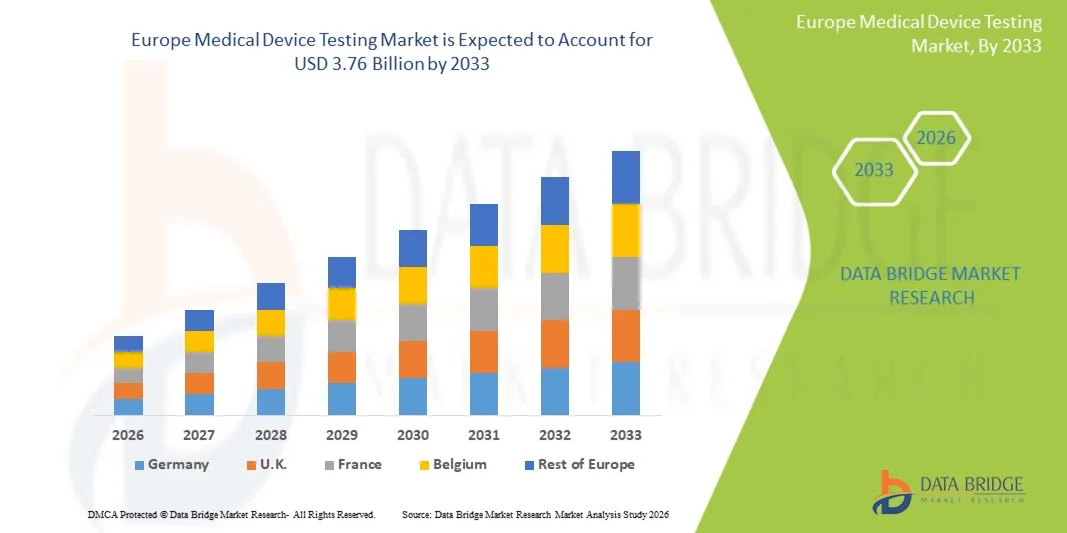
Report Scope and Europe Medical Device Testing Market Segmentation
|
Attributes |
Europe Medical Device Testing Key Market Insights |
|
Segments Covered |
|
|
Countries Covered |
Europe · Germany · France · U.K. · Netherlands · Switzerland · Belgium · Russia · Italy · Spain · Turkey · Rest of Europe |
|
Key Market Players |
· TÜV SÜD (Germany) · TÜV Rheinland (Germany) · SGS S.A. (Switzerland) · Bureau Veritas (France) · Eurofins Scientific SE (Luxembourg) · Intertek Group plc (U.K.) · DEKRA SE (Germany) · BSI Group (U.K.) · Element Materials Technology (U.K.) · Medistri SA (Switzerland) · Nelson Labs (U.S.) · STERIS plc (U.S.) · UL Solutions Inc. (U.S.) · Charles (U.S.) · Envigo (U.K.) · LGC Group (U.K.) · Smithers (U.S.) · Medpace Laboratories (U.S.) · Wickham Laboratories (U.K.) · Applus+ Laboratories (Spain) |
|
Market Opportunities |
· Expansion of domestic medical device manufacturing · Growing adoption of connected medical devices, wearable health technologies, and software-enabled diagnostics · The increasing development of high-value implantable devices and minimally invasive surgical products |
|
Value Added Data Infosets |
In addition to the insights on market scenarios such as market value, growth rate, segmentation, geographical coverage, and major players, the market reports curated by the Data Bridge Market Research also include in-depth expert analysis, patient epidemiology, pipeline analysis, pricing analysis, and regulatory framework. |
Europe Medical Device Testing Market Trends
Trend: Rising Demand for Cybersecurity and Connected Device Testing
The increasing adoption of connected medical devices, software-based healthcare platforms, and Internet of Medical Things (IoMT) technologies is driving demand for advanced cybersecurity and software validation testing services across Europe. Medical device manufacturers are focusing on ensuring data integrity, network security, and regulatory compliance throughout the product lifecycle. In addition, the growing use of cloud-enabled diagnostics, remote patient monitoring systems, and AI-powered medical devices is accelerating the need for comprehensive testing protocols that verify device reliability, interoperability, and protection against evolving cyber threats in real-world healthcare environments.
For instance, in June 2025, the European Union Agency for Cybersecurity published updated cybersecurity guidance for connected medical devices, reinforcing the importance of security testing and lifecycle risk management across the European healthcare ecosystem.
Europe Medical Device Testing Market Dynamics
Key Market Driver: Stringent European Regulatory Compliance Requirements
The implementation of the European Medical Device Regulation (MDR) and In Vitro Diagnostic Regulation (IVDR) has significantly increased the demand for comprehensive medical device testing services throughout Europe. Manufacturers must conduct extensive evaluations covering biocompatibility, electrical safety, performance validation, software verification, and clinical assessment before obtaining market approval. As regulatory authorities continue to strengthen requirements for product safety, quality, and post-market surveillance, medical device companies are increasingly relying on accredited testing organizations to accelerate compliance processes, reduce regulatory risks, and support successful commercialization across European markets.
For instance, in January 2024, TÜV SÜD expanded its medical device testing and certification capabilities in Europe to help manufacturers address evolving MDR and IVDR compliance requirements.
Key Restraint/Challenge: High Cost and Complexity of Regulatory Testing
A major challenge in the Europe medical device testing market is the substantial cost and complexity associated with regulatory compliance and product validation activities. Advanced testing procedures often require specialized laboratories, highly skilled personnel, sophisticated analytical equipment, and extensive documentation processes. Additional expenses related to clinical evaluations, technical file preparation, and ongoing post-market surveillance further increase the total compliance burden. These requirements can create significant barriers for small and medium-sized manufacturers, potentially extending product development timelines and delaying market entry across highly regulated European healthcare markets.
For instance, in 2024, multiple European medical technology industry associations highlighted continued challenges related to MDR implementation costs, testing capacity constraints, and lengthy conformity assessment procedures affecting manufacturers across the region.
Key Market Opportunity: Expansion of Digital Health and Software-Based Medical Devices
The rapid growth of digital health technologies, artificial intelligence-enabled diagnostics, and software as a medical device (SaMD) solution presents a significant opportunity for the Europe medical device testing market. Testing providers are increasingly developing specialized capabilities for software validation, cybersecurity assessment, interoperability verification, and AI algorithm performance evaluation. Growing investments in digital healthcare transformation, combined with increasing adoption of remote monitoring and connected care platforms, are expected to create sustained demand for advanced testing services and regulatory support across the European medical technology industry.
For instance, in March 2025, MedTech Europe emphasized the accelerating adoption of digital and AI-enabled medical technologies, supporting the need for expanded testing, validation, and regulatory assessment services across Europe.
Europe Medical Device Testing Market Scope
The Europe medical device testing market is segmented on the basis of service type, testing type, phase, sourcing type, device class, and product.
- By Service Type
On the basis of service type, the Europe medical device testing market is segmented into testing services, inspection services, and certification services. The Testing Services segment dominated the market with a 48.26% share in 2025, owing to increasing regulatory requirements under MDR and IVDR and the need for comprehensive product validation before commercialization. Medical device manufacturers rely heavily on testing services to assess safety, performance, functionality, and biocompatibility. The growing complexity of connected and software-driven devices is further increasing demand for specialized testing solutions. Testing services are required throughout the product development lifecycle, from design verification to post-market surveillance. The expansion of outsourced laboratory networks across Europe is also supporting segment growth. Their critical role in obtaining regulatory approval continues to drive market dominance.
The Certification Services segment is projected to register the fastest growth at a CAGR of 8.4% from 2026 to 2033, driven by increasing regulatory scrutiny and the growing number of devices requiring MDR-compliant certification. Manufacturers are seeking certification support to accelerate market entry and ensure compliance with evolving standards. The rising volume of high-risk and implantable medical devices is creating additional demand for certification assessments. Growing cross-border commercialization of medical technologies is further supporting adoption. Certification providers are expanding their service portfolios to accommodate changing regulatory requirements. Increasing emphasis on quality assurance and patient safety is expected to sustain strong growth.
- By Testing Type
On the basis of testing type, the Europe medical device testing market is segmented into physical testing, chemical/biological testing, cybersecurity testing, microbiology and sterility testing, and others. The Chemical/Biological Testing segment dominated the market with a 31.87% share in 2025 due to stringent requirements for biocompatibility, toxicological assessment, and material safety evaluation. Regulatory agencies require extensive biological testing before device approval, particularly for implantable and long-term contact devices. The increasing use of advanced biomaterials is further driving demand for specialized testing. Manufacturers must demonstrate patient safety and material compatibility throughout the product lifecycle. Rising innovation in orthopedic, cardiovascular, and dental devices is also contributing to segment expansion. The mandatory nature of these assessments ensures continued market leadership.
The Cybersecurity Testing segment is anticipated to witness the fastest growth at a CAGR of 9.1% from 2026 to 2033, supported by the increasing adoption of connected medical devices and digital health platforms. Hospitals and healthcare providers are prioritizing device security to protect sensitive patient information. Regulatory bodies are also introducing stricter cybersecurity requirements for medical technologies. The expansion of remote monitoring systems and IoMT devices is creating new testing needs. Manufacturers are investing heavily in vulnerability assessments and software validation programs. Growing concerns regarding cyber threats and data breaches are expected to accelerate segment growth significantly.
- By Phase
On the basis of phase, the Europe medical device testing market is segmented into preclinical and clinical. The Preclinical segment accounted for the largest market share of 63.42% in 2025 owing to extensive testing requirements before devices can enter human studies and commercialization stages. Preclinical assessments evaluate safety, performance, durability, and biological compatibility under controlled laboratory conditions. Manufacturers conduct these studies to identify risks and optimize product design before regulatory submissions. The increasing complexity of medical technologies is expanding the scope of preclinical validation activities. Regulatory authorities require robust preclinical evidence to support approval applications. The segment continues to benefit from growing innovation across the European medical device industry.
The Clinical segment is expected to register the fastest growth at a CAGR of 8.0% during the forecast period, due to increasing emphasis on clinical evidence generation under MDR regulations. Manufacturers are required to demonstrate real-world safety and effectiveness through rigorous clinical investigations. Growing demand for innovative implantable and high-risk devices is increasing the number of clinical studies conducted across Europe. Advances in data collection and patient monitoring technologies are improving study efficiency. Rising investment in evidence-based healthcare is further supporting market expansion. The growing focus on post-market clinical follow-up activities is also contributing to strong growth.
- By Sourcing Type
On the basis of sourcing type, the Europe medical device testing market is segmented into in-house and outsourced. The Outsourced segment dominated the market with a 61.42% share in 2025 due to the increasing preference for specialized third-party testing laboratories and certification organizations. Outsourcing enables manufacturers to access advanced expertise, accredited facilities, and regulatory support without significant capital investment. It also helps reduce operational costs and accelerate product development timelines. Growing complexity of testing requirements is encouraging companies to rely on external service providers. Many organizations prefer outsourcing to manage fluctuating testing workloads efficiently. The availability of highly specialized laboratories across Europe continues to support segment dominance.
The In-House segment is projected to experience the fastest growth at a CAGR of 7.7% from 2026 to 2033, driven by large manufacturers investing in internal testing capabilities to improve efficiency and maintain greater control over intellectual property. Companies are increasingly establishing dedicated testing facilities to accelerate innovation cycles. Internal testing reduces dependency on external providers and shortens development timelines. Growing adoption of digital testing technologies is making in-house operations more feasible. The need for rapid product iteration is further supporting investment in internal infrastructure. Expansion of R&D activities among leading medical device companies is expected to boost growth.
- By Device Class
On the basis of device class, the Europe medical device testing market is segmented into Class I, Class II, and Class III. The Class II segment dominated the market with a 45.63% share in 2025 owing to the large number of medium-risk medical devices requiring regulatory testing and certification. Products such as infusion pumps, surgical instruments, and diagnostic equipment fall within this category. These devices require extensive safety and performance evaluations before commercialization. Growing demand for technologically advanced healthcare equipment is increasing testing volumes within the segment. Regulatory compliance obligations under MDR are also driving testing demand. The broad application range of Class II devices continues to support market leadership.
The Class III segment is expected to be the fastest-growing segment at a CAGR of 8.8% from 2026 to 2033 due to increasing adoption of implantable and life-supporting medical technologies. These high-risk devices require comprehensive testing, clinical validation, and regulatory review processes. Rising prevalence of chronic diseases is boosting demand for cardiovascular, orthopedic, and neurological implants. Manufacturers are investing heavily in advanced testing to ensure product safety and effectiveness. Regulatory authorities maintain stringent approval requirements for these devices. Continuous innovation in implantable technologies is expected to drive strong growth.
- By Product
On the basis of product, the Europe medical device testing market is segmented into active implant medical devices, active medical devices, non-active medical devices, in-vitro diagnostics medical devices, ophthalmic medical devices, orthopedic and dental medical devices, vascular medical devices, and others. The In-vitro Diagnostics (IVD) Medical Devices segment dominated the market with a 27.35% share in 2025 due to rising demand for diagnostic testing, disease screening, and laboratory automation technologies. Increasing prevalence of chronic and infectious diseases is supporting the adoption of advanced diagnostic solutions. Regulatory requirements for performance and accuracy testing remain stringent across Europe. Continuous innovation in molecular diagnostics and point-of-care testing is further driving demand. Healthcare systems are increasingly emphasizing early disease detection and precision medicine. These factors collectively strengthen the segment’s leading position.
The Active Implant Medical Devices segment is projected to register the fastest growth at a CAGR of 9.0% from 2026 to 2033, driven by increasing adoption of pacemakers, neurostimulators, cochlear implants, and other advanced implantable technologies. These products require extensive testing to ensure long-term safety, reliability, and functionality. Rising aging populations and growing incidence of cardiovascular and neurological disorders are supporting market demand. Technological advancements are enabling the development of more sophisticated implantable devices. Manufacturers are increasing investments in testing and validation to meet regulatory standards. The expanding use of smart and connected implants is expected to further accelerate segment growth.
Europe Medical Device Testing Market Regional Analysis
Germany dominated the Europe medical device testing market with the largest revenue share of 24.68% in 2025, supported by its strong medical device manufacturing base, advanced healthcare infrastructure, and the presence of leading testing and certification organizations. The country benefits from a well-established R&D infrastructure, high adoption of advanced testing technologies, and strong collaboration between manufacturers, laboratories, and regulatory bodies. Increasing demand for biocompatibility, cybersecurity, and performance testing across complex medical devices further strengthens Germany’s leadership position. The rapid expansion of connected healthcare technologies, growing clinical research activities, and increasing outsourcing of specialized testing services continue to reinforce Germany’s dominance in the European market.
The Germany Medical Device Testing Market Insight
The Germany medical device testing market is witnessing strong growth due to strict MDR enforcement, a highly advanced medical device manufacturing base, and the presence of globally recognized testing and certification bodies. The country’s strong R&D ecosystem, high adoption of innovative healthcare technologies, and leadership in engineering-driven medical devices are driving demand for biocompatibility, performance, and software validation testing. Increasing focus on connected medical devices, cybersecurity compliance, and AI-enabled healthcare solutions is further accelerating testing requirements. Germany remains a central hub for both in-house and outsourced testing services across Europe.
France Medical Device Testing Market Insight
The France medical device testing market is expanding steadily due to strong government support for healthcare innovation, increasing regulatory scrutiny, and rising demand for high-quality diagnostic and therapeutic devices. The country’s well-developed hospital infrastructure and growing medical technology sector are boosting demand for safety, sterility, and clinical testing services. Increasing adoption of digital health technologies and connected medical devices is driving cybersecurity testing requirements. France continues to strengthen its position through expanding certification and compliance service networks.
United Kingdom Medical Device Testing Market Insight
The United Kingdom medical device testing market is growing due to strong clinical research capabilities, increasing adoption of advanced regulatory frameworks, and rising outsourcing of testing services. The presence of innovation-driven MedTech companies and contract testing organizations is supporting market expansion. Growing demand for software validation, cybersecurity testing, and clinical performance evaluation is accelerating adoption. The U.K. remains a key hub for early-stage testing and regulatory compliance support in Europe.
Poland Medical Device Testing Market Insight
The Poland medical device testing market is growing rapidly due to increasing medical device manufacturing activities, rising foreign investments, and expanding outsourcing of testing and certification services. The country offers cost-efficient testing solutions, making it attractive for global MedTech companies. Demand for regulatory compliance testing and certification services is increasing significantly. Poland is emerging as one of the fastest-growing testing hubs in Europe.
Europe Medical Device Testing Market Share
The Europe medical device testing industry is primarily led by well-established companies, including:
- TÜV SÜD (Germany)
- TÜV Rheinland (Germany)
- SGS S.A. (Switzerland)
- Bureau Veritas (France)
- Eurofins Scientific SE (Luxembourg)
- Intertek Group plc (U.K.)
- DEKRA SE (Germany)
- BSI Group (U.K.)
- Element Materials Technology (U.K.)
- Medistri SA (Switzerland)
- Nelson Labs (U.S.)
- STERIS plc (U.S.)
- UL Solutions Inc. (U.S.)
- Charles (U.S.)
- Envigo (U.K.)
- LGC Group (U.K.)
- Smithers (U.S.)
- Medpace Laboratories (U.S.)
- Wickham Laboratories (U.K.)
- Applus+ Laboratories (Spain)
Latest Developments in Europe Medical Device Testing Market
- In July 2025, leading European testing and certification organizations including TÜV SÜD, SGS, and Intertek expanded their medical device testing portfolios under MDR frameworks, adding stronger capabilities in cybersecurity testing, AI-based device validation, and advanced performance testing. These expansions were driven by increasing adoption of connected medical devices and software-driven healthcare solutions across Europe. Laboratories also enhanced sterilization validation and electrical safety testing services to meet evolving regulatory requirements. The development reflects the shift from traditional device testing toward digital and software-centric evaluation frameworks
- In February 2025, the European Commission’s Medical Device Coordination Group (MDCG) updated its guidance on MDR/IVDR implementation, further tightening requirements for conformity assessment, clinical evaluation, and technical documentation for medical device testing and certification across Europe. The update aimed to improve consistency among notified bodies and strengthen oversight of high-risk and software-based medical devices. It also reinforced stricter expectations for clinical evidence and post-market surveillance data submitted during approval processes. The development directly impacted testing laboratories by increasing documentation and validation workload
- In October 2024, the European Union officially activated EU Reference Laboratories (EURLs) under the IVDR framework for high-risk Class D in-vitro diagnostic devices, introducing mandatory independent performance verification and batch testing requirements across Europe. This development significantly enhanced regulatory scrutiny for diagnostic products, particularly in infectious disease and critical care testing. It also added a new layer of validation between manufacturers, notified bodies, and reference laboratories. The rollout increased demand for specialized laboratory testing capacity and advanced analytical capabilities
- In March 2024, TÜV SÜD expanded its medical device testing and MDR/IVDR conformity assessment capabilities across Europe to address growing demand and certification bottlenecks. The expansion included additional technical experts and improved laboratory capacity to support faster and more efficient regulatory approvals. This move was driven by increasing complexity in device technologies, especially AI-enabled and connected medical devices requiring advanced validation. It also aimed to reduce delays in certification timelines caused by limited notified body capacity. The development reflects rising pressure on European testing infrastructure
- In January 2024, the European Commission extended transitional provisions under the MDR and IVDR frameworks to prevent shortages of medical devices in the European market, directly impacting testing and certification timelines. The extension allowed manufacturers additional time to complete required testing, technical documentation, and conformity assessments before full compliance enforcement. It also reduced immediate pressure on notified bodies and testing laboratories facing high workloads. However, it emphasized the ongoing need for expanded regulatory and testing capacity across Europe. The decision was taken to balance patient safety with market continuity

- Interactive Data Analysis Dashboard
- Company Analysis Dashboard for high growth potential opportunities
- Research Analyst Access for customization & queries
- Competitor Analysis with Interactive dashboard
- Latest News, Updates & Trend analysis
- Harness the Power of Benchmark Analysis for Comprehensive Competitor Tracking
Data collection and base year analysis are done using data collection modules with large sample sizes. The stage includes obtaining market information or related data through various sources and strategies. It includes examining and planning all the data acquired from the past in advance. It likewise envelops the examination of information inconsistencies seen across different information sources. The market data is analysed and estimated using market statistical and coherent models. Also, market share analysis and key trend analysis are the major success factors in the market report. To know more, please request an analyst call or drop down your inquiry.
The key research methodology used by DBMR research team is data triangulation which involves data mining, analysis of the impact of data variables on the market and primary (industry expert) validation. Data models include Vendor Positioning Grid, Market Time Line Analysis, Market Overview and Guide, Company Positioning Grid, Patent Analysis, Pricing Analysis, Company Market Share Analysis, Standards of Measurement, Global versus Regional and Vendor Share Analysis. To know more about the research methodology, drop in an inquiry to speak to our industry experts.
Data Bridge Market Research is a leader in advanced formative research. We take pride in servicing our existing and new customers with data and analysis that match and suits their goal. The report can be customized to include price trend analysis of target brands understanding the market for additional countries (ask for the list of countries), clinical trial results data, literature review, refurbished market and product base analysis. Market analysis of target competitors can be analyzed from technology-based analysis to market portfolio strategies. We can add as many competitors that you require data about in the format and data style you are looking for. Our team of analysts can also provide you data in crude raw excel files pivot tables (Fact book) or can assist you in creating presentations from the data sets available in the report.













